Showing posts with label Albrecht Dürer. Show all posts

Monday, June 24, 2024

The horrible hairy homeward-hurrying hogs of Hieronymus

I keep finding more in the central cover illustration of Animalia by Graeme Base:


As discussed in "GAEL," what I noticed first was the lion, green gorilla, and elephant, arranged in a line along the left side of the picture. Then I noticed that one of the elephants in the book is apparently named Eric, and that the cover shows an elephant right next to a knight on horseback -- encoding the name of Eric Knight, the author of the novel Lassie Come-Home. Just below Eric and the Knight is a golden jackal, suggesting the golden dog on the cover of Lassie Come Home. In my post "Lassie Come Home," I recorded a hunch that Lassie has something to do with the Woman of Revelation 12, who is menaced by the Dragon and has to go into hiding. Sure enough, right above Eric and the Knight on the cover is a menacing-looking dragon in flight. The D page in Animalia is titled "Diabolical Dragons Daintily Devouring Delicious Delicacies." Revelation 12 says that the Dragon is "called the Devil" (i.e, diabolical) and that it "stood before the woman which was ready to be delivered, for to devour her child as soon as it was born."

The Knight carries a banner, the end of which points to a herd of zebra -- a juxtaposition which suggests the zebra-striped flag of Brittany:


The flag of Normandy, the other part of Armorica, is a red field with two gold lions.

Under the banner is another black-and-white animal, an ostrich. In The Satanic Verses, the image of an out-of-place ostrich running along the English beach is associated with the Norman conquest. Rosa Diamond has just been daydreaming about that history -- "Come on, you Norman ships, she begged: let's have you, Willie-the-Conk" -- when

Running along the midnight beach in the direction of the Martello tower and the holiday camp, -- running along the water's edge so that the incoming tide washed away its footprints, -- swerving and feinting, running for its life, there came a full-grown, large-as-life ostrich.

These references to travel between Britain and Armorica fit right in with "The Gospel of Luke on Lobsterback," where I even propose that the "lobsters" may actually be soldiers, like our Knight. The Knight has the face of a hog, and both hogs and lobsters are well-known as non-kosher animals. As in Peter's vision in Acts, "unclean" animals may symbolize "Gentiles" -- the Gentiles entrusted with bringing the lost sheep of Israel, and their lost Gospel of Light, safely home:

I will lift up mine hand to the Gentiles, and set up my standard to the people; and they shall bring thy sons in their arms, and thy daughters shall be carried upon their shoulders (1 Ne. 21:22).

The language is from Isaiah, of course, and for "set up my standard" many translations have something like "raise high my banner."

Confirmation that this hog Knight with his banner has to do with the Lassie Come Home story can be found on the H page of Animalia, where we learn that the hogs on horseback are "hurrying homeward":


William Wright's recent post about Ali with an I and Daniel with an L led me to look up a 2019 post of mine about Dante's claim that I and EL were the two earliest names for God. I was surprised to find that the post also included this detail from a painting by Hieronymus Bosch:


My interest at the time was in the owl, and how it proves that the creature in the basket in Bosch's painting The Conjurer is also an owl (not a monkey, as some have claimed). Looking at it now, though, what I see is an anthropomorphic hog, like our Knight, leading a golden dog on a leash -- as if bringing Lassie home. He is also dressed in dark green and carries a lute, suggesting this detail from the L page of Animalia:


Hieronymus is the Latin form of the name Jerome. I don't know how I could have posted so much about lions in a library, even referring to the library as a "study," without making the connection with Albrecht Dürer's famous copper engraving Saint Jerome in His Study:


Sleeping on the floor next to the saint's pet lion is a contented-looking dog. Lassie has come home.

One more thing to mention. In the vision described in "Étude brute?" -- which primed me to notice the Lions in a Library image in Animalia -- an indirect vision of the Holy Family -- Joseph and his wife and son, radiating light to bright for me to look at them (perhaps identical to William Wright's "Family of Light"?) -- was followed by my being led into a library or study by a "Bull of Heaven," which I described as being "something like an aurochs." Later I noted that the Bull is a traditional symbol of the House of Joseph. This symbolism comes from Deuteronomy:

[Joseph's] glory is like the firstling of his bullock, and his horns are like the horns of unicorns: with them he shall push the people together to the ends of the earth: and they are the ten thousands of Ephraim, and they are the thousands of Manasseh (Deut. 33:17).

Where the King James has unicorns, the Douay-Rheims translation favored by Catholics has -- following no less an authority than Saint Jerome himself! -- rhinoceros. Most modern translations have wild ox, meaning the aurochs. These three animals, then, may be considered interchangeable as symbols of the House of Joseph. Here they are on the cover of Animalia:


The unicorn and rhinoceros caught my eye first, but there's also a yak in the background. Does that count as a "wild ox"? We usually think of the yak as a domestic animal, but there are still wild yaks in the Himalayas. The domestic yak is Bos grunniens ("grunting ox"), while the wild yak is Bos mutus ("silent ox"). Why bring up the scientific names? Because I specifically described the animals in my vision as "silent bulls."

Thursday, April 4, 2019

The Wheel of Fortune: Miélot and Dürer (15th century)

I continue my brief overview (started here) of non-Tarot versions of the Wheel of Fortune motif. This illustration by Jean Miélot, accompanying a text by Christine de Pizan, dates from roughly the same time period as the earliest known Tarot cards, the Visconti-Sforza deck.


Here Fortuna stands apart from the wheel and apparently governs its rotation remotely by means of the authority symbolized by her crown and scepter. The wheel, then, would appear to be consciously obeying her rather than being turned by mechanical means. Miélot might have had Ezekiel's wheels in mind ("Whithersoever the spirit was to go, they went, . . . for the spirit of the living creature was in the wheels"), a connection Éliphas Lévi was to make some centuries later, or he might have moved Fortuna off to the side for purely aesthetic reasons, to make the composition less cluttered. Fortuna is portrayed winged and blindfolded, symbolizing her superhuman nature and her indifference to the merits of those on her wheel. Wise man or fool, one event happeneth to them all.

If the figure under the wheel in the Carmina Burana illustration might possibly be a corpse, his counterpart in Miélot's version leaves no room for doubt -- and he clearly died still embracing the wheel that killed him. The monarch perched atop the wheel seems oddly dressed to me, with robes that look almost like a nightgown; pink is hardly a regal color, and the bright reds elsewhere in the picture make it clear that it cannot be explained as faded paint. The two figures on the sides of the wheel are dressed in countercharged color schemes -- one with a red shirt and blue hose; the other, vice versa. In each case, the part of the body nearest the top of the wheel is clothed in red, and that nearest the bottom, in blue -- almost as if their clothes change from blue to red as they ascend and then back to blue as they descend. (For consistency, the monarch should be dressed all in red, and the corpse in blue, but perhaps pink and gray are close enough.) Fortuna is dressed in the same color scheme, wearing an outer garment of red over an inner garment of blue. If red represents the top of the wheel (success) and blue the bottom (ruin), perhaps Fortuna's costume of red-covering-blue means that she indeed appears beautiful outward but within is full of dead men's bones.

What are we to make of the dead man, holding tight to the wheel even as it rolls over him? Embracing what kills him seems the epitome of foolishness -- but on the other hand, letting go of the wheel at this point makes no sense. He's already at the bottom, so holding onto the wheel can only improve his fortunes; whereas letting go would leave him at the bottom, with no way to regain his lost position. In the long term, though, the wheel will raise him only to bring him down again, so it doesn't really matter. As I've said, the Wheel offers no desirable options -- but Miélot hints at an alternative: on the left side of the picture, behind Fortuna, is a rocky hill composed of enormous boulders. Anyone who could reach the top of that hill would be higher even than the monarch's perch, and the position would be a stable one -- but it would mean doing the hard work of climbing, not just hitching a ride on Fortuna's wheel.

*

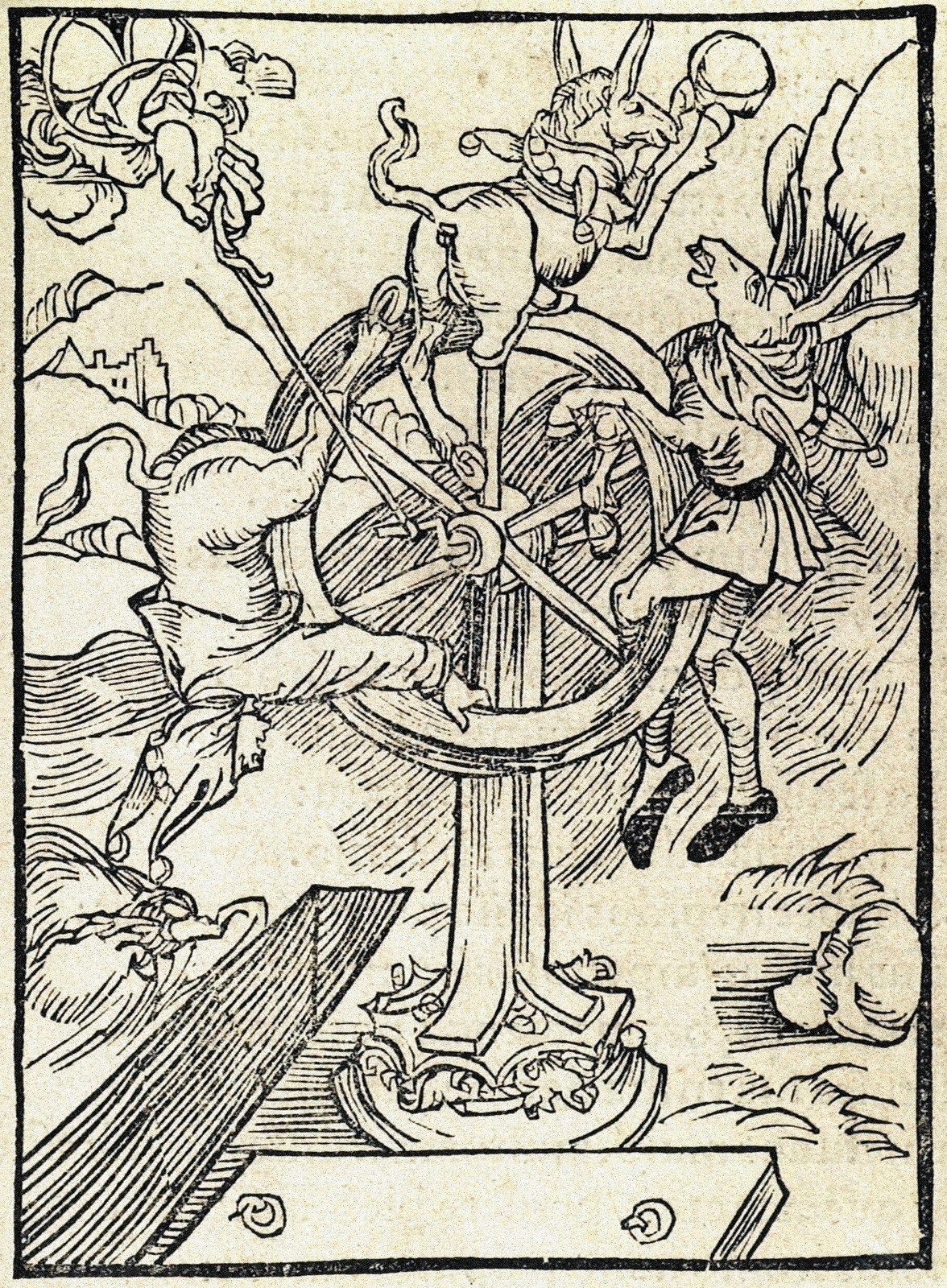
Dürer did a woodcut of the Wheel of Fortune as an illustration for Sebastian Brant's Ship of Fools, which was published a few decades after the appearance of the earliest known Tarot cards. Dürer's version is quite different from the others we have looked at. Its relevance to Tarot iconography is obvious, though the nature of the relationship is unclear. The Tarot of Marseille may well have been directly influenced by Dürer's woodcut, but of course that is not possible for the Visconti-Sforza, which predates it. It is possible, but not likely, that Dürer was influenced by the Italian cards and then in turn influenced the French ones. More probably, some lost (or at least unknown-to-me) source lies behind both the Dürer woodcut and the Tarot. But before taking this line of discussion any further, we had best take a look at the image itself.


The major innovation here is the addition of animal characteristics to the figures on the wheel -- a feature which is universal within the Tarot tradition, so that in many decks the Wheel becomes the second trump (the other is the Moon) to feature no human beings.

We have seen that in Miélot's version, the ascending and descending figures are so dressed that those parts of their bodies that are above the hub of the wheel are clothed in red, and those below, in blue -- and I have mentioned that, for consistency, the one at the top of the wheel should be dressed entirely in red. Dürer takes this idea to the next level. The ascending figure is an ass above the waist; the descending one is an ass below the waist; and at the top of the wheel, where a more conventional artist would depict a crowned king, Dürer gives us -- simply an ass. If I am making out Dürer's picture correctly, the ass is reaching out to grasp the moon -- which would of course be impossible even if it had hands.  All the figures on the wheel are dressed alike, in the garb of a fool, so that even the descending figure appears to have ass's ears because his fool's cap is so decorated. The fourth figure, the one who should be under the wheel and who, in Dürer's scheme, would be the only fully human one, has been omitted entirely -- an innovation also adopted by the Tarot de Marseille and decks influenced by it. Also all-but-omitted is Fortuna herself, who appears only as a hand reaching down from heaven to turn the wheel. (These disembodied hands-from-clouds would later be used extensively by Waite in his highly innovative Minor Arcana.)

The wheel itself is much more realistically depicted. Where more traditional depictions have a huge free-standing wheel, supported by nothing and lacking even an axle, Dürer's wheel is mounted on a stand and turned by a crank. Rather than the mystical visions of Ezekiel, it suggests an ordinary piece of manmade machinery. The placing of the wheel on a raised stand also means that it no longer crushes anyone. If the traditional fourth figure had been included, he would simply be clinging to the underside of the wheel, unharmed and still several feet above the ground.

Consider for a moment how completely Dürer's innovations change the meaning of the Wheel of Fortune. In the conventional version of the motif, both the allure of Fortune and her ultimate treachery are clear. She promises a crown and throne to those who trust her, but in the end crushes them mercilessly. Dürer's wheel, in contrast, promises only to turn you into an ass, and threatens nothing worse than an implied return to full humanity and a chance to go around again. The image conveys not so much a feeling of treachery and tragedy as one of complete and utter pointlessness.

What motivates those who cling to Dürer's wheel? Surely they are not drawn in by the promise of a pair of long ears, a tail, and four fine hoofs! No one consciously aspires to become an ass. We can only conclude that they want what the ass at the top is reaching for -- the moon! -- and that they delusionally believe the wheel will carry them high enough to reach out and grasp it. Of course each will have observed that all his predecessors have transformed into asses and failed to obtain the moon, but each thinks he himself will be different. Each believes that he has discovered the secret: to reach the top without becoming an ass and then, opposable thumbs still intact, reach out and take it! But such is the magic of the Wheel that he inevitably does become an ass -- and anyway, the hoofs aren't really what stops him from grasping the moon. A wheel mounted on a stand on the ground just isn't the sort of thing that ever could allow anyone to reach the moon. (Neither, for that matter, is the rocky hill which also appears in Dürer's picture.) Dürer's Wheel has something of the Tower of Babel about it -- the attempt to reach heaven by means of an earthbound structure, and the subsequent loss of the power of intelligible speech (transformed, in this case, into the braying of an ass). But the builders of the Tower did not fail because their speech was confounded, nor do the riders on the wheel fail because they become asses. In both cases, they fail because what they are attempting is by its nature impossible. The means are not commensurate to the ends in view.

Popular posts