
Showing posts with label The highway is for gamblers. Show all posts
Showing posts with label The highway is for gamblers. Show all posts
Saturday, July 13, 2024
Europa again
Today I was once again trying to go to archive.org, but autocomplete sent me to archive.4plebs.org/x/random/ instead. The random post it served up was this:


Friday, July 12, 2024
Hatched by a monkey
My dream about an unpublished red book titled Unhenned has been interpreted by William Wright as being about Israel -- citing Jesus' statements in the Bible and Book of Mormon about gathering Israel "as a hen gathereth her chickens" and Daymon "Doug" Smith's reference to the history of Israel as a book with "red chapters."
This morning I was in my study, and it occurred to me to scan my shelves for red books. The Eustace Diamonds . . . The Seven Sins of Memory . . . The Uninscribed . . . ah, The Circle by David Eggers! The title of the book reinforces the "egg" in his name, and an egg is the sort of thing that might be described as "unhenned" -- that is, without a hen to sit on it and incubate it.
Most of my books are in cabinets with glass doors, but two small shelves are behind opaque doors. I don't usually keep books on those shelves, but today I thought I'd better look inside just in case there were any more red books hiding there. And there, sure enough, I found a bright red three-ring binder containing selections from the Scarlet Notebook, a collection of Tychonievich juvenilia. The full Scarlet Notebook (still so called for historical reasons) is currently in a massive white binder in America somewhere, but I have PDF scans of the whole thing. As soon as I saw the red binder on my shelf, I remembered that among its contents is a little fragment called "Hatched by a Monkey," written by one of my brothers as a child. It didn't make the cut for inclusion in the small red binder in Taiwan, but I looked it up in the PDF. Here it is in its entirety:
Desnor wondered, as he often did, why he had to be the one who was hatched by a monkey! His long, flexible tail still hurt from his last entry into the chicken-house. The other roosters had nearly murdered him, but he had escaped, with the helpy of his two extra lages and usable wings.The only person who really cared about him was Henry. Tomorrow, they were going to run away. Henry was an orphan birth, trying to survive until he was old enough to get a real job, not just assistant chicken-keeper.Suddenly, all the chickens started to squawk and run around, flapping their wings and causing a general ruckus. Then Desnor saw the reason: The butcher was coming, equipped with a large axe and a miniature crossbow.Immediately, Desnor flew down, opened the gate, and flew into the top of a pine tree.Amongst all the mess of chickens, the butcher dropped his weapons and tried to get all the chickens in the pen at the same time!Desnor flew down and took the crossbow and quarrels onto the roof, where he stayed.When the butcher saw this, he yelled, "Chicken's out!" so loud that the shutters rattled.
This lines up with the dream pretty neatly. It's from an unpublished book with a red cover, and it's about a creature that apparently hatched from an "unhenned" chicken egg that was incubated by a monkey.
In the context of William Wright's interpretation -- that "unhenned" refers to the House of Israel, with the absent hen being the rejected Jesus Christ -- the idea of being "hatched by a monkey" made me think of the prophecy that "the kings of the Gentiles shall be nursing fathers unto [Israel], and their queens shall become nursing mothers" (2 Ne. 10:9) -- i.e., that the Gentiles will raise Israel in the absence of the father hen. Gentiles essentially means "barbarians," of which monkeys or apes would be a natural symbol.
Desnor is an anagram of Red Son, which came up in my 2020 post "Robin Hood."
Thursday, July 11, 2024
Why I talk about the paranormal
Bruce Charlton has an important new post up: "Belief in the supernatural/ paranormal/ occult phenomena." He begins thus:
I don't know how unusual it is; but I find that I combine a firm belief in the reality of many supernatural/ paranormal/ occult phenomena; with an almost 100% reflex dis-belief in the objective reality of nearly-all specific examples of these phenomena, by nearly everybody.So, although in principle I am convinced of the reality of - in no particular order - telepathy, ghosts, miracles, synchronicity, personal destiny, magic, purposive personal evil (demons), angels, fairies... Nonetheless, I am very sceptical of the objective truth of almost every single report of such things I have encountered.Even among people whom I respect and trust; I find I often do not believe the specific truth of what they say or write...
"I don't know how unusual it is" -- not unusual at all, I would wager. I assume that most people can easily understand and sympathize with Bruce's stance here, and that most of us probably share it at least to some degree and with respect to some phenomena. It's obviously somewhat paradoxical, though. On what grounds does one assent to a general truth -- or what does it even mean to say that one so assents -- if one rejects every one of the specifics on which the generalization is based? If there is no x such that I believe x to be a genuine instance of telepathy, for example, why would I say I have "a firm belief in the reality of" telepathy?
Bruce emphasizes his skepticism of reports of the paranormal, so one possibility is that his firm belief in various phenomena is based entirely on his own firsthand experience. I think this is unlikely to be the whole story, though, since there are so many different phenomena in which he believes. It seems highly improbable that he personally has seen ghosts and angels and fairies and miracles and so on through the whole list.
We could also note the qualifiers he uses -- "almost 100%," "nearly-all," "nearly everybody" -- and infer that for each category of phenomena on his list there exists at least one specific instance in which he firmly believes, and that -- since one well-authenticated ghost is all it takes to establish that ghosts exist -- it is on these exceptional cases that his general beliefs rest. I doubt this is the case, though. If asked, for example, "Which ghost stories do you find uniquely convincing?" I assume he wouldn't have any to point to.
Another possibility is that the firm general beliefs are logical inferences. For example, each and every one of my beliefs is, by definition, something that I believe to be true. Nevertheless, at the meta level, I recognize my own fallibility and am therefore firmly convinced that some of my beliefs -- a great many of them, in all likelihood -- are in fact false. A general belief in "miracles" can be similarly grounded: Given the fallibility of our knowledge, it is virtually certain that some phenomena we consider to be impossible are in fact possible and do occur, and these are what we call "miracles." For more specific paranormal beliefs, though, this doesn't seem to work. From what general principles could one derive the likely existence of ghosts, say, or of fairies? I don't see how such beliefs can be anything other than empirical.
It's possible, then, that stances like Bruce's are inherently unstable and that this can only be resolved by persisting in one's folly one way or the other. During my atheist years, I found myself in the opposite but equally unstable position of "officially" not believing in anything supernatural while at the same time believing in practice in certain specific instances. I would often find myself saying things like, "Of course I don't believe in omens, but this is pretty clearly an omen." In the end I came to understand this as a sign that I was not being honest with myself about my own beliefs. My attempts to rectify those discrepancies -- particularly with regard to "free will," in which I purportedly disbelieved -- precipitated my eventual reconversion to theism and a supernatural worldview.
⁂
Coming back to Bruce's post, he writes of those who claim paranormal experiences:
And indeed; to my mind, across such people, they have said and written a vast range of incompatible and often incoherent things. If I tried to base my life upon believing the specific information (facts and understandings) of even those relatively few sincere persons who I respect and trust - I would nonetheless be building my faith on a seething mass of sand, rubble, and water - not on solid rock!
I agree with this. We cannot base our beliefs or lives on anything as slippery as the paranormal. That is, we can't believe something simply because it was allegedly communicated by an angel or a miracle or a synchronicity or whatever. We have to judge content from such sources the same way we judge any other content. I discuss this in my post "Who or what is the ultimate spiritual authority? (a Mormon perspective)." As is well documented on this blog, I learned this lesson the hard way after making some extremely confident predictions about the outcome of the 2020 election based on synchronicity alone -- some really extraordinary synchronicities, I must say, most of which were objective and publicly verifiable (meaning the fact that there were such synchronicities, not the correct interpretation of the same) -- but the predictions failed.
I've been quoting John Dominic Crossan on this for decades now:
Altered states of consciousness, such as dreams and visions, are something common to our humanity, something hard-wired into our brains, something as normal as language itself. They were recognized as common possibilities in the early first century, and they are still recognized as such in the late twentieth century. And only when their human normalcy is accepted can a proper response be offered. That response should not be, We deny the fact of your vision. It should be, Tell us the content of your vision. And then we will have to judge, not whether you had it or not, but whether we should follow it or not.
The distinction Crossan makes is an important one, one which perhaps tends to be blurred by Bruce's ambiguous language about "believing in the reality of the phenomena." Questioning whether someone in fact had the experience they claim to have had is entirely different from questioning the conclusions they draw from it.
I generally suspend judgment on the correct interpretation of paranormal experiences, including my own, to a degree that sometimes annoys others. When otherwise trustworthy people report the fact of a paranormal experience, though, I mostly believe them -- "mostly" because of the danger Bruce identifies in the following quote from his post:
This is why I try to refrain from ever communicating my own such experiences; because I know that they will be unconvincing to others, that there are many alternative mundane explanations, they can be explained-away or else my own honesty and competence will be rejected - and therefore in making such communications I feel an almost irresistible temptation to persuade, exaggerate, distort - and I assume others do also.
The temptation he mentions -- to "photoshop" one's experiences a bit in order to make them more presentable -- is very real and very hard to resist. I make an effort to be strictly factual in my reports, but everyone should definitely take them all with large quantities of salt. Paranormal experiences are so slippery that articulating them at all inevitably involves distortion, and much of this will be, even with the best of conscious intentions, motivated distortion.
⁂
My policy is, obviously enough, the opposite of Bruce's. I do try to communicate my paranormal experiences, and in fact for some time now this blog has consisted almost entirely of reports of synchronicities, dreams, visions, and such, with more discursive posts like the present one increasingly few and far between.
In doing this, I am not trying to convince anyone of anything. I don't generally draw firm conclusions from my own experiences, let alone try to push those conclusions on others. My primary concern is simply to normalize the paranormal. To quote Crossan again, "only when their human normalcy is accepted can a proper response be offered" -- because paranormal experiences absolutely are a normal aspect of the human condition. Quite a few people have shared theirs with me -- but nearly always in confidence, on the understanding that I will keep my mouth shut (and I do). I've been there, and I sympathize, but at the same time, how much progress can we make in understanding such things when everyone is too embarrassed to compare notes? Embarrassment is fear, and fear is the mind-killer.
If we report our paranormal experiences, the reports will inevitably include distortion. If we systematically avoid talking about a whole area of experience, though, that's an even greater distortion. And if we coyly hint that we have had paranormal experiences without giving any specifics -- the old Mormon trope of "I know by experiences to sacred to relate" -- well, that path has its own temptations and corrupting influences. As always, "playing it safe" is not really one of our options.
⁂
To end on a synchronistic note, earlier today, as I was thinking about Bruce's post, a quote from William Blake came to mind -- from The Ghost of Abel -- and I looked it up:
To Lord Byron in the Wilderness: What doest thou here Elijah? Can a Poet doubt the Visions of Jehovah? Nature has no Outline: but Imagination has. Nature has no Tune: but Imagination has. Nature has no Supernatural & dissolves: Imagination is Eternity.
It came to mind because of the theme of "doubting visions," and also probably because I've recently been reading, thinking about, and dreaming of Lord Byron. After looking it up and reading it, though,my main impression was the emphasis on the value of imagination.
Before looking up the Blake quote, I had been reading Section 124 of the Doctrine and Covenants, which is quite long. After rereading The Ghost of Abel, I returned to Section 124 and soon encountered this passage:
And he shall be led in paths where the poisonous serpent cannot lay hold upon his heel, and he shall mount up in the imagination of his thoughts as upon eagles’ wings. . . . Therefore, let my servant William cry aloud and spare not, with joy and rejoicing, and with hosannas to him that sitteth upon the throne forever and ever, saith the Lord your God (vv. 99, 101).
Is this the only positive reference to "imagination" in all of scripture? I think it may be -- and it's in reference to "my servant William" and is closely followed by an injunction to "cry aloud and spare not" -- i.e., to speak up and not hold back.
I took this as synchronistic confirmation that, whatever path may be right for other people, I at least should continue to speak openly about these things. To me it seemed like a message from the sync fairies -- though I quite understand if you, reader, reflexively doubt that.
Sunday, July 7, 2024
Sweet Baby James
I've been reading Tolkien's The Notion Club Papers rather slowly. Today I came to Frankley's poem about Saint Brendan, with its interesting rhyme scheme:
We sailed for a year and a day and hailedno field nor coast of men;no boat nor bird saw we ever afloatfor forty days and ten.
As you can see, in the first and third lines of every quatrain, the first foot (not the second as in limericks) rhymes with the fourth. Sometimes this is done in a very clever way which would not have been possible if rhymes came only at the ends of lines:
We turned away, and we left asternthe rumbling and the gloom;then the smoking cloud asunder broke,and we saw that Tower of Doom:
What this made me think of, oddly, was the James Taylor song "Sweet Baby James." In my 2019 post "The rhyme burden of various poetic forms," I had noted the song's rhyme scheme as being slightly more challenging to write in than the ottava rima of Byron's Don Juan. (By the metric used in that post, the rhyme burden of ottava rima is 0.35, while "Sweet Baby James" is 0.357. Frankley's poem is 0.429, the same as a Spenserian sonnet.)
These thoughts led me to listen to "Sweet Baby James," and some of the lyrics hit differently than they had in the past -- "Good night, you moonlight ladies," for instance. What really got my attention was this verse, though:
There's a song that they sing when they take to the highwayA song that they sing when they take to the seaA song that they sing of their home in the skyMaybe you can believe it if it helps you to seeBut singing seems to work fine for me
In "Pushed to Zion with songs of everlasting joy," I wrote about the song the ransomed sing as they return via a "highway" which is actually the sea. And of course this "sea" may in fact be a figurative reference to outer space, hence the song "of their home in the sky." In that post, the ransomed are portrayed as singing yaks, tying in with the cattle-herding theme of "Sweet Baby James."
Lord Byron on a motorcycle
My dreams of last night ended with this brief scene: Lord Byron, dressed in the clothing of his era, with a black cape about his shoulders, was standing astride a black Yamaha crotch rocket with a long bridge ahead of him. Behind him, the late afternoon sun was shining. Before him, dark storm clouds gathered. He stood there for a few moments, gazing into the distance as if sizing up the situation. Then he started the engine, hunched forward in the seat, and sped off over the bridge and into the storm.
This afternoon, I experienced a weird sense of déjà vu when, motorcycling back home from Taichung, I came up on a long bridge and saw black clouds lowering ahead, even as the sun shone bright behind me. I had a paper bag full of books hanging from a hook in front of me and was not prepared to deal with rain, but what choice did I have? Like Byron in the dream, I went over the bridge and into the dark. The first fat drops began falling literally seconds after I arrived at my destination.
Saturday, July 6, 2024
Yaniv!
I think I've finally solved the mystery of the five playing cards on the Y page of Animalia, as discussed in "Pushed to Zion with songs of everlasting joy."


I had pretty much given up, to the point where I was trying to contact the author and ask him to reveal the answer. Graeme Base is a difficult man to contact, it turns out, but that's okay because I think I've got it. I had looked at a few lists of card games, none of which had anything beginning with Y. After checking a few more such lists, though, I found Yaniv.
Yaniv is a draw-and-discard game in which each player always has exactly five cards in his hand, and the object is to have the hand with the lowest value. Aces are low, so the hand depicted -- two aces, two deuces, and a trey -- would be a pretty good one.
In my post about the Y page, I interpreted it in terms of the return of the Lost Tribes of Israel -- particularly the House of Joseph, whose symbol is the wild ox. It is then singularly appropriate that Yaniv is not only an Israeli game but one particularly associated with Israeli backpackers -- i.e., with nominal "Israelites" who are traveling overseas.
Yaniv is named after one of the two backpackers who invented it. Yaniv is a modern Hebrew name (not biblical) and means "he will bear fruit, yield, produce." According to Wikipedia, the game is also known as Yusuf -- i.e., Joseph ("he will add") -- which also begins with a Y. The other co-inventor of the game was named Asaf, which means "collector, gatherer."
Tuesday, July 2, 2024
Pushed to Zion with songs of everlasting joy
The bovine symbolism associated with the House of Joseph comes from this verse in Deuteronomy:


[Joseph's] glory is like the firstling of his bullock, and his horns are like the horns of unicorns: with them he shall push the people together to the ends of the earth: and they are the ten thousands of Ephraim, and they are the thousands of Manasseh (Deut. 33:17).
As I have noted before, the unicorns of the King James Version is a rhinoceros in the Vulgate and a wild ox in most modern English translations. The classic wild ox, the aurochs, is now extinct, but one of its closest relatives, the wild yak (Bos mutus) still lives in the wild. As noted in "The horrible hairy homeward-hurrying hogs of Hieronymus," these three animals -- the unicorn, the rhinoceros, and the yak -- appear together on the cover of Animalia.

Note that in Deuteronomy, Joseph uses his figurative "horns" to "push the people together to the ends of the earth." This is curious phrasing -- how can they be "together" at "the ends of the earth"? -- and has been variously interpreted. The most common reading seems to be that Joseph will "push" (i.e., gore) all the nations, including even those at the ends of the earth, and that he will attack them all at once, or "together."
Today, in my regular daily scripture study, I read an allusion to this imagery in one of the revelations of Joseph Smith:
Keep these sayings, for they are true and faithful; and thou shalt magnify thine office, and push many people to Zion with songs of everlasting joy upon their heads (D&C 66:11).
Here, pushing people together means driving them together and causing them to gather in a group, as a sheepdog would do. That the "pushing" is not a violent attack is evident in the "songs of everlasting joy" upon the heads of those pushed. If the first part of the verse alludes to Deuteronomy, the second part borrows a turn of phrase from Isaiah:
Then shall the lame man leap as an hart, and the tongue of the dumb sing: for in the wilderness shall waters break out, and streams in the desert.And the parched ground shall become a pool, and the thirsty land springs of water: in the habitation of dragons, where each lay, shall be grass with reeds and rushes.And an highway shall be there, and a way, and it shall be called The way of holiness; the unclean shall not pass over it; but it shall be for those: the wayfaring men, though fools, shall not err therein.No lion shall be there, nor any ravenous beast shall go up thereon, it shall not be found there; but the redeemed shall walk there:And the ransomed of the Lord shall return, and come to Zion with songs and everlasting joy upon their heads: they shall obtain joy and gladness, and sorrow and sighing shall flee away (Isa. 35:6-10).
The tongue of the dumb shall sing. The wild yak, as mentioned above, is Bos mutus ("mute ox"), in contrast to its domestic cousin Bos grunniens ("grunting ox"). Repeated references to water -- "waters break out," "a pool," "springs of water" -- suggest that the "highway" by which the pushed-together ransomed will return is the one the Vikings called the "whale-road."
Which brings us by a commodius vicus of recirculation back to Animalia:

According to Etymonline, yodel is "from German jodeln, from dialectal German jo, an exclamation of joy." Songs of everlasting joy.
The sails of the yaks' yachts are decorated with various things beginning with Y: a Yeoman Warder in a yin-yang symbol, a yeti, an egg with a yolk, a yoke, and even another little yacht. There's also a poker hand -- Two of Hearts, Three of Diamonds, Two of Clubs, Ace of Clubs, Ace of Hearts -- whose connection to the letter Y is a mystery to me. I've looked through glossaries of poker terms and lists of card games but can't find anything beginning with that letter.
Notice that if you go straight down from the egg, you will find a yo-yo. In "Leo, Egbert, Peter," I posted this photo of the shoe shelves at my school.

I was focused on the three names in the post title, but a commenter (whose name happens to be extremely close to Leo Egbert) asked about the lower shelf. Only one name is visible there but isn't very legible in the photo. He thought it might be Sarah, but in fact it's Ivan. The name directly below Egbert is obscured by a pair of slippers, but it's this:

Quite a few kids in Taiwan use Yoyo as their "English" name; I blame that cellist. In the William Wright post that led to my posting photos of shoe shelves in the first place, he interpreted Egbert as meaning "famous egg" and connected it with Humpty Dumpty -- famous as a broken egg that can't be put back together. On the Y page, we have a broken egg above a yo-yo. I suppose the yoke between them even suggests the heel ends of a pair of slippers.

Besides the poker hand, one other element in the picture puzzled me because of its lack of any obvious connection to the letter Y:

This is a reference back to "The Gospel of Luke on lobsterback," keeping in mind that the Gospel of Luke is symbolized by the ox or bull (or yak, same difference). The Beefeater on the sail, dressed in red, is a link to the other meaning of lobsterback, a red-coated British soldier.
Monday, July 1, 2024
Valhalla, I am coming!
In "Zinc Zeppelin," I connected the Z page from Graeme Base's Animalia with Led Zeppelin's "Immigrant Song." The song is about Vikings, and one of the lines is, "Valhalla, I am coming!"
The V page in Animalia depicts the Valhalla Variety Venue, with a picture of a Viking visible near the top of the picture:

This page was actually one of the main reasons I bought Animalia in the first place. My May 1 post "Armored vultures and Cherubim" discusses a cartoon character called Victor the Vulture and connects him with the Cherubim.
Up in the corner, next to the vicar and the Viking, we have the five black stripes in the form of a vent:

Victor wears a badge with a picture of a yellow Volkswagen Beetle, on a sky-blue background as if it is flying through the air:

This is a link to "Hinbad the Hailer traveled far / By riding in a yellow car." In "Just how far did Hinbad and Rinbad travel?" I connect this yellow car with Elijah's chariot of fire, in which he traveled all the way to Heaven -- or, translated into Viking terms, to Valhalla.
The Beetle is located just below Victor's blue butterfly-shaped bow tie. This same juxtaposition appears on the B page:

No more a roving
On June 25, I did a Tarot read in which I asked about the roles various people have to play, and I drew this card with reference to myself:

There is a pretty obvious sense in which this is "my" card. My surname means "son of Tychon," a name which ultimately derives from Tyche, the Greek counterpart to the Roman goddess Fortuna, making me "Will of Fortune." When I drew it on June 25, I was struck by the central brass-colored disc covered with engravings, and by the four Cherubic creatures in the corners, each with its book. This ties in very neatly with the Round Book of Brass Plates and with the book called the Cherubim from the vision recounted in "Étude brute?" Thinking about it today, after posting about the zebra-striped flag of Brittany in "Dreaming in black and white," I noticed the zebra-striped headdress worn by the sphinx at the top of the wheel.
It was then that I realized a possible link between "Étude brute?" and the Brittany theme. I had previously taken it as a reference to the Ides of March, my birthday, but Caesar's assassin was not the only Brutus. According to a very old legend, the name Britain derives from that of the island's first king, Brutus of Troy. Since Brittany derives from the same root as Britain, it would also thus be named after this Brutus.
As I was thinking about this and making these connections, my attention was suddenly drawn to one of the books in my study, a 1000-plus-page compilation of the major works of Byron, with the edge of a bookmark sticking out above the pages. I had a very strong impression that I should take the book down and see which page was bookmarked.
The bookmark was between pages 314 and 315. Page 314 is the last page of Manfred, which I last read in 2014. Since then, the only works I've read from that book have been short poems which didn't require moving the bookmark around, so there it still was.
Page 315 -- the page corresponding to the Ides of March, my birthday -- has this short and fairly well-known poem:
So, we'll go no more a roving
So late into the night,
Though the heart be still as loving,
And the moon be still as bright.For the sword outwears its sheath,
And the soul wears out the breast,
And the heart must pause to breathe,
And love itself have rest.Though the night was made for loving,
And the day returns too soon,
Yet we'll go no more a roving
By the light of the moon.
Note the immediate context: I had just been thinking about "Étude brute?" as, among other things, an Ides of March reference, and about the Wheel of Fortune Tarot card in connection with myself. Do you know how the word "wheel" is written on old French cards? ROVE.

"The sword outwears its sheath" also fits the Tarot card, on which a sphinx holds an unsheathed sword. It's also a link to "Makmahod in France?" and "This sword will never be sheathed again." In the Rider-Waite version of the card, where the wheel is a Brass Plate, it stands to reason that the unsheathed sword would be that of Laban.
Then there are those moonlight references. I looked up a French translation, and sure enough:
Ainsi, nous n'irons plus vagabonder
Si tard dans la nuit,
Même si nos coeurs restent accordés
et que la lune toujours luit.Car telle l'épée usant son fourreau,
l'âme use la poitrine à respirer.
Le coeur doit pouvoir ėtre au repos
et même l'amour se délasser.Bien que la nuit soit faite pour s'aimer
et que l'aube ne soit qu'infortune,
Pourtant, nous n'irons plus vagabonder
La nuit, au clair de lune.
When I was searching for a French translation, autocomplete thought I might be looking for Leonard Cohen's rendition of the poem. I didn't know he had done one:
The album cover art -- a black-and-white portrait of a young woman -- caught my eye, and I wondered if there was a story behind it. Searching for that led me to this thread. Early on, one person mentions that the woman's expression reminds him of Joan Crawford in Johnny Guitar, and everyone picks this up and runs with it. "Joan" -- with no surname except in the first reference -- is mentioned a whopping 36 times in the thread.
After I'd played Cohen's take on Byron, YouTube queued up the next song automatically: "New Slang (When You Notice The Stripes)" by the Chins. I posted "When you notice the stripes" on May 9, connecting that line from the song with the idea of using the stars and stripes on the US flag to create a constellation. The syncs in this present post began with my noticing the stripes on the Wheel of Fortune card and connecting them with stripes on a flag.
What is being communicated by drawing my attention to that Byron poem? Is this Claire/Joan saying goodbye, or at least announcing a hiatus? Time will tell.
Leo, Egbert, Peter
On May 29, William Wright published a post with the title “Leon Eggbert, Pharazon, and Sun-Moon Time.” In that post he mentioned his idea of “Peter being the same Being that had played the role of Pharazon.”

Today I was cleaning out the photos folder on my phone.
At my school, students have to change into slippers before going upstairs to the classroom. At the foot of the stairs is a “shoe room” with shelves for their shoes and slippers, and each shelf is labeled with a student’s name. (They use English names when studying English.) These labels have to be updated as old students leave and new students enroll.
On June 25, I noticed that the staff had neglected to do this, that there was a shelf still labeled with the name of a student who had left some months ago. I took a photo of the offending label and sent it to the staff group, with a reminder to keep the labels up to date.
Today I was about to delete that photo when I noticed something:

Three labels are visible on the central shelf in the photo: from left to right, Leo, Egbert, Peter. Keeping in mind that Pharazon and Peter are considered by William to be the same person, these are the same three names, in the same order, as in the title of his post.
I had no role in this. I didn’t give any of these students his English name, and my staff applied the labels and decided which shelf to give to which student.
Quite a coincidence, I thought, especially considering what an unusual name Egbert is.
Sunday, June 30, 2024
Dreaming in black and white
On Friday night (June 28) I dreamed all night about the flag of Brittany -- mostly the modern Gwenn ha Du (Sable four bars argent, a canton ermine) but sometimes also the older Kroaz Du (Argent a cross throughout sable).


That was all there was to the dream: no plot, no characters, no role for myself, just one shot after another of these black-and-white Breton flags.
On Saturday (June 29), I started using a new textbook with a student of mine. The first page of the first unit included this illustration:

It's a black-and-white picture of the Greek flag -- literally black and white, even though the Greek flag is blue and white, and the other pictures I've included in the photo show that the illustrations use shades of gray, and that even coffee is portrayed as gray rather than black.
This version of the Greek flag obviously closely resembles the Breton flags I had been dreaming about: five black stripes, four white stripes, and a canton which is the Kroaz Du with the colors swapped.
This morning (June 30), I checked my email and found that a correspondent had sent me a photo of a moth with striking black-and-white markings:

The central black marking resembles both a cross and a heraldic ermine spot, suggesting both of the Breton flags.
Later today, I spotted this on the wall of a restaurant:

In both parts of the design, there are five black stripes, just as on the Gwenn ha Du.
Update: After lunch, I went to a used bookstore and found a book about Ireland (a Celtic nation, like Brittany) shelved next to one with a zebra on the cover.

Update 2: Forgot to include this photo, taken on the street the same day. Of course it had to be five black noodles hanging from the chopstick-flagpole:

Saturday, June 29, 2024
Zinc Zeppelin
Zinc Zeppelin? Okay, I guess, but I prefer a heavier sound.


That's the zodiac -- the 12 signs depicted together in the form of a disc-shaped diagram engraved on zinc (of which brass is an alloy), and right next to it two zebu bulls. In the vision, I first saw the two Bulls inside an egg-shaped cavern, and then one of them led me into a second cavern where the Cherubim book was. On the Zeppelin, the two zebu bulls are in an oval frame, and one of them is facing the second frame which has the zodiac.

In "The horrible hairy homeward-hurrying hogs of Hieronymus," zebras are juxtaposed with the Hog Knight and his banner, and I therefore connected them with the zebra-striped flag of Brittany. Conceptually, the Hog -- associated by way of pun with the biblical Ham -- was bearing the black and white banner of Brittany.
Although the pun has the tribe of Ham being bred and mustered in Arabia -- thus accounting for the sandwiches there -- the more conventional understanding is, as Debbie has repeatedly pointed out, that the descendants of Ham are the Black peoples of Africa. In the Z picture, the Zeppelins are labeled with the names of African countries -- Zanzibar, Zambia, Zaire, and Zimbabwe -- and one of them bears a man whose distinctive Nguni shield marks him as a Zulu warrior from southern Africa. So here, too, we have the tribe of Ham bearing aloft the colors of Brittany.
We can see a total of six airships, each with a zebra -- corresponding to the Nautical Newts, six of which are in a boat.The Newts are from Northman Land -- i.e., from the land of the ice and snow, from the midnight sun where the hot springs flow. With the zebras we perhaps have yet another representation of this immigration -- only in metal zeppelins this time:
In other representations, the immigrants from Northman Land have brought sacred writings -- represented as the book Lassie Come Home and the newspaper The Northern Star. Elsewhere, a future scripture has been represented as a "round book" engraved on a metal disc, possibly brass. In the vision recounted in "Étude brute?" there is a holy book called the Cherubim, guarded by two Bulls. In "Lassie Come Home," I discussed how the Cherubim represent the 12 Tribes of Israel and the 12 signs of the zodiac, so the Cherubim (the book) would represent the combined scriptures of the 12 tribes. Near the prow of the Zanzibar zeppelin is this:

Friday, June 28, 2024
Gryphon + Mock Turtle = Cherubim

Mock turtle soup is traditionally made with a calf's head, and so the Mock Turtle in Alice is portrayed as a turtle with the head, tail, and back hooves of a calf. Its companion, the Gryphon, is of course part lion and part eagle.
This comes very close to matching the four component creatures of the Cherubim. According to Ezekiel, the Cherubim had the faces of a man, a lion, an ox and an eagle. In John’s adaptation of this imagery in Revelation, the ox actually becomes a calf. In the Gryphon and the Mock Turtle, we have these same four -- except that the man is replaced with a turtle.This substitution is astrologically justified. The four creatures of the Cherubim represent the fixed signs of the zodiac -- Aquarius, Leo, Taurus, and Scorpio -- but the scorpion is replaced by the nearby constellation of Aquila, the Eagle. The man stands for Aquarius, and in Chinese astrology Aquarius belongs to the Black Tortoise. Thus, the turtle can stand in for Aquarius.
According to Ezekiel, the Cherubim had feet like "a calf's foot" and "the hands of a man." This maps perfectly to the Mock Turtle, whose "feet" are calf's hooves and whose "hands" are the flippers of a turtle (corresponding to Aquarius and thus to the man).
In Ezekiel, each Cherub looks the same, and each is a combination of all four creatures. In Revelation, there are four different Cherubim, each corresponding to only one of the four creatures. Lewis Carroll is intermediate between the two, having two different Cherubim, each combining two of the four creatures.
The World card of the Tarot follow's John's schema, with four distinct Cherubim, but notice how perfectly it corresponds to the illustration from Alice above: On the left, Aquarius and Taurus (the Mock Turtle); on the right, Scorpio and Leo (the Gryphon); in the center, a human female with her body turned toward the Gryphon but her face turned toward the Mock Turtle.

Just as the Eagle is above the Lion on the World card, the eagle parts of the Gryphon are above the lion parts. The Mock Turtle has calf parts at both the top and the bottom, with the turtle parts in the middle, so it doesn't map quite so perfectly.
Thursday, June 27, 2024
Nautical Newts
At this rate I'm going to go through the whole freaking alphabet.

A newt is a kind of salamander. Although the picture is captioned "Nine Nautical Newts Navigating Near Norway," there are only six newts in the boat. The remaining three are in the water and are only partially visible. This immediately made me think of the Knight of Wands, recently discussed in "More on Joan and Claire." The Knight's outer garment is printed with salamanders -- six full salamanders plus a few partially visible ones.

The newts are navigating the open sea, while the Knight and his salamanders are traveling through the deserts of Egypt. That's a pretty big discrepancy, but as it happens, I just mentioned in a comment on "The horrible hairy homeward-hurrying hogs of Hieronymus" that "Egypt was also underwater when it was discovered" according to the Book of Abraham. This was following a train of thought started by the fact that the Hog Knight on the cover of Animalia is accompanied by an ostrich, which had made me think of a passage from The Satanic Verses related to the Norman Conquest. The Nautical Newts are also accompanied by an ostrich.
Actually, the Hog Knight has a lot in common with the Knight of Wands:

Both are wearing armor and riding in the same direction. The helmet of the Knight of Wands even appears to have one of those hounskull-style visors which, when closed, would give the Knight a "pig-faced" appearance. The Hog Knight holds a flagpole with a banner; the Knight of Wands holds a staff which, in my post, I connected with a flagpole as well. The Knight of Wands is in Egypt; the Hog Knight's banner, as seen inside the book, is decorated with what appear to be Egyptian hieroglyphics:
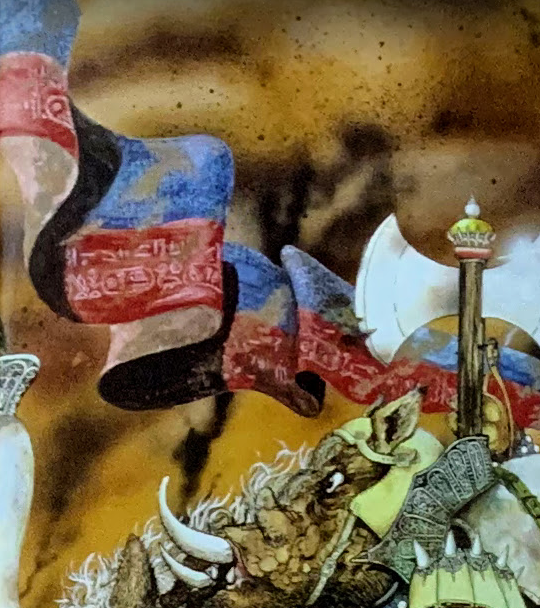
In the comment, I quote the statement that the discoverer of this underwater Egypt was "the daughter of Ham" and that she "afterward settled her sons in it," and I suggest that "hogs could be a punning reference to 'Ham.'" That Ham pun in its classic form, the one famously referenced by Bloom in Ulysses, includes a desert reference:
Why should no man starve on the deserts of Arabia?Because of the sand which is there.How came the sandwiches there?The tribe of Ham was bred there and mustered.
Ham, bread, and mustard -- a very respectable pun. "Mustering" is something that military men do, which fits with the warlike portrayal of the tribe of ham in Animalia. Mustard is also interesting in connection with the Nautical Newts. It is the scholarly consensus that "eye of newt," the famous witches'-brew ingredient, originally referred to mustard seed. The Synoptic Gospels have Jesus compare the Kingdom to a grain of mustard seed, and Joseph Smith adapted the parable to apply to the Book of Mormon:
Let us take the Book of Mormon, which a man took and hid in his field, securing it by his faith, to spring up in the last days, or in due time; let us behold it coming forth out of the ground, which is indeed accounted the least of all seeds, but behold it branching forth, yea, even towering, with lofty branches, and God-like majesty, until it, like the mustard seed, becomes the greatest of all herbs. And it is truth, and it has sprouted and come forth out of the earth, and righteousness begins to look down from heaven, and God is sending down His powers, gifts and angels, to lodge in the branches thereof.
The mustard seed is planted and grows in a field, but the mustard seed is also mentioned in Luke in connection with the idea that a tree could be planted in the sea by those with sufficient faith:
And the Lord said, If ye had faith as a grain of mustard seed, ye might say unto this sycamine tree, Be thou plucked up by the root, and be thou planted in the sea; and it should obey you (Luke 17:6).
Joseph Smith connected the mustard seed with a book of scripture buried in the earth. The Nautical Newts appear to have their own seaborne scripture -- a Nautical New T., or New Testament. Keeping in mind that the word translated as gospel in the Bible literally means "good news," the symbolism is pretty clear:

The name of the newspaper is The Northern Star, which makes me think that this "gospel" is the writings of the Lost Tribes, as mentioned in 2 Nephi 29, since those tribes are traditionally thought of as being "in the North." We typically speak of the Ten Lost Tribes, but they could also be reckoned as nine, if (as is often the case in the Bible) Joseph is counted as a single tribe rather than being divided into the half-tribes of Ephraim and Manasseh. The Book of Mormon never gives them a number, though we know that there were 12 tribes in all and that three (Judah, Benjamin, and Levi) were not "lost."
Touching the newspaper is a snail shell. Well, I suppose it's actually a nautilus shell, given the alphabet theme, but it certainly looks like a snail shell. In "The Gospel of Luke on lobsterback," I specifically brought in snails as a symbol of a Gospel being transported across the sea. The snail in that analysis (from Lewis Carroll) was paired with the whiting, and here the snail shell is white. In Carroll, the idea of whiting having their tails in their mouths is emphasized; we see the same pose in the salamanders on the Knight of Wands.
To the right of the snail shell, we can see the ghostly image of what I suppose is meant to be a nurse, but her hat -- a rectangular shape marked with a cross -- is symbolic shorthand for "Bible," confirming our interpretation of the newspaper.
The Newts are navigating "Near Norway." Norway is, etymologically, "the northern way," which fits in with the Lost Tribes theme. The Old English name for Norway was Norðmanna land -- "Northman Land" -- which is also the etymological meaning of Normandy. Since Armorica (comprising Normandy and Brittany) has been so prominent in the sync-stream of late, we could think of "Near Norway" as referring to the Northman Land nearer to Britain -- i.e., Normandy as opposed to Norway in Scandinavia.
Finally, coming back to Ham for a moment, note that he is also implicitly present in the Nautical Newts picture, as one of the eight passengers on Noah's Ark:

By the way, I wasn't kidding about going through almost the whole alphabet. Stay tuned next time for the esoteric significance of Zany Zebras Zigzagging in Zinc Zeppelins.
Monday, June 24, 2024
The horrible hairy homeward-hurrying hogs of Hieronymus
I keep finding more in the central cover illustration of Animalia by Graeme Base:


As discussed in "GAEL," what I noticed first was the lion, green gorilla, and elephant, arranged in a line along the left side of the picture. Then I noticed that one of the elephants in the book is apparently named Eric, and that the cover shows an elephant right next to a knight on horseback -- encoding the name of Eric Knight, the author of the novel Lassie Come-Home. Just below Eric and the Knight is a golden jackal, suggesting the golden dog on the cover of Lassie Come Home. In my post "Lassie Come Home," I recorded a hunch that Lassie has something to do with the Woman of Revelation 12, who is menaced by the Dragon and has to go into hiding. Sure enough, right above Eric and the Knight on the cover is a menacing-looking dragon in flight. The D page in Animalia is titled "Diabolical Dragons Daintily Devouring Delicious Delicacies." Revelation 12 says that the Dragon is "called the Devil" (i.e, diabolical) and that it "stood before the woman which was ready to be delivered, for to devour her child as soon as it was born."
The Knight carries a banner, the end of which points to a herd of zebra -- a juxtaposition which suggests the zebra-striped flag of Brittany:

The flag of Normandy, the other part of Armorica, is a red field with two gold lions.
Under the banner is another black-and-white animal, an ostrich. In The Satanic Verses, the image of an out-of-place ostrich running along the English beach is associated with the Norman conquest. Rosa Diamond has just been daydreaming about that history -- "Come on, you Norman ships, she begged: let's have you, Willie-the-Conk" -- when
Running along the midnight beach in the direction of the Martello tower and the holiday camp, -- running along the water's edge so that the incoming tide washed away its footprints, -- swerving and feinting, running for its life, there came a full-grown, large-as-life ostrich.
These references to travel between Britain and Armorica fit right in with "The Gospel of Luke on Lobsterback," where I even propose that the "lobsters" may actually be soldiers, like our Knight. The Knight has the face of a hog, and both hogs and lobsters are well-known as non-kosher animals. As in Peter's vision in Acts, "unclean" animals may symbolize "Gentiles" -- the Gentiles entrusted with bringing the lost sheep of Israel, and their lost Gospel of Light, safely home:
I will lift up mine hand to the Gentiles, and set up my standard to the people; and they shall bring thy sons in their arms, and thy daughters shall be carried upon their shoulders (1 Ne. 21:22).
The language is from Isaiah, of course, and for "set up my standard" many translations have something like "raise high my banner."
Confirmation that this hog Knight with his banner has to do with the Lassie Come Home story can be found on the H page of Animalia, where we learn that the hogs on horseback are "hurrying homeward":

William Wright's recent post about Ali with an I and Daniel with an L led me to look up a 2019 post of mine about Dante's claim that I and EL were the two earliest names for God. I was surprised to find that the post also included this detail from a painting by Hieronymus Bosch:

My interest at the time was in the owl, and how it proves that the creature in the basket in Bosch's painting The Conjurer is also an owl (not a monkey, as some have claimed). Looking at it now, though, what I see is an anthropomorphic hog, like our Knight, leading a golden dog on a leash -- as if bringing Lassie home. He is also dressed in dark green and carries a lute, suggesting this detail from the L page of Animalia:

Hieronymus is the Latin form of the name Jerome. I don't know how I could have posted so much about lions in a library, even referring to the library as a "study," without making the connection with Albrecht Dürer's famous copper engraving Saint Jerome in His Study:

Sleeping on the floor next to the saint's pet lion is a contented-looking dog. Lassie has come home.
One more thing to mention. In the vision described in "Étude brute?" -- which primed me to notice the Lions in a Library image in Animalia -- an indirect vision of the Holy Family -- Joseph and his wife and son, radiating light to bright for me to look at them (perhaps identical to William Wright's "Family of Light"?) -- was followed by my being led into a library or study by a "Bull of Heaven," which I described as being "something like an aurochs." Later I noted that the Bull is a traditional symbol of the House of Joseph. This symbolism comes from Deuteronomy:
[Joseph's] glory is like the firstling of his bullock, and his horns are like the horns of unicorns: with them he shall push the people together to the ends of the earth: and they are the ten thousands of Ephraim, and they are the thousands of Manasseh (Deut. 33:17).
Where the King James has unicorns, the Douay-Rheims translation favored by Catholics has -- following no less an authority than Saint Jerome himself! -- rhinoceros. Most modern translations have wild ox, meaning the aurochs. These three animals, then, may be considered interchangeable as symbols of the House of Joseph. Here they are on the cover of Animalia:

The unicorn and rhinoceros caught my eye first, but there's also a yak in the background. Does that count as a "wild ox"? We usually think of the yak as a domestic animal, but there are still wild yaks in the Himalayas. The domestic yak is Bos grunniens ("grunting ox"), while the wild yak is Bos mutus ("silent ox"). Why bring up the scientific names? Because I specifically described the animals in my vision as "silent bulls."
Sunday, June 23, 2024
GAEL
Recent sync activity has centered around Animalia by Graeme Base, which is an alphabet book. I was thinking how funny it was to be taking an alphabet book so seriously, and then I remembered that I was well within Mormon tradition in so doing, given Joseph Smith's Grammar and Alphabet of the Egyptian Language. This is commonly referred to (by those few who do refer to it) as "the GAEL," which I guess makes the language therein described -- clearly "Egyptian" in name only -- GAELic.
"The Gael" is also the name of that tune from The Last of the Mohicans. Just in case it's not playing in your head already, here's a little help:
My interest in Animalia has been focused on the G and L pages -- two of the letters in GAEL -- both of which have some "Gaelic" themes. The L page includes a leprechaun, while the main subject of the G page is green gorillas. Green is the symbol of Ireland, and Punch cartoons used to portray the stereotypical Irishman as "Mr. G-O'Rilla." The Irish poet William Butler Yeats has recently been associated with Pharaoh's butler from Genesis, who dreamed of holding a cup and pressing grapes into it:
And Pharaoh's cup was in my hand: and I took the grapes, and pressed them into Pharaoh's cup, and I gave the cup into Pharaoh's hand (Gen. 40:11).
Here, from Animalia, is a green gorilla preparing to do just that:

I've just noticed for the first time that William Butler G-O'Rilla's grail is decorated with running greyhounds -- only they're not grey; they're gold. A golden dog running ties right in with Lassie Come Home on the L page:

Lassie is a stereotypically Scottish word, so there's another "Gaelic" link.
It occurred to me to look up gael on Eldamo. It's defined as "pale, glimmering" -- another link to Yeats, Claire, and The Song of Wandering Aengus, in which Aengus pursues a "glimmering girl." Another permutation of the same letters, laeg, is also Elvish and means, what else, "green."
The G and L pages encode the two keys. One of these, remember, is associated with gold, red, the sun, and the rose; the other, with silver, green, the moon, and the lily. Lions are associated with gold and the sun, and there is a key reference in the Lions' library in the form of a book by John Locke. Gorillas are associated with silver ("silverback"), and a gorilla is in a loose sense a "monkey" -- moon-key. The green "silverback" on the G page is complemented by the red "lobsterback" on the L page.
L and G also represent the square and compass. The square obviously resembles the letter L and appears as such in Mormon symbolism. Some forms of the capital G look like an arrow indicating circular motion, which is the function of the compass. (Transliterated into Greek, the mapping is reversed: Gamma is the square; Lambda, the compass.)
Doing an image search now to try to find a particularly arrow-like form of G, I found this, which for some reason also includes a lion named Lucas -- not the most natural choice for a page about the letter G!

But G and L are only two of the four letters in GAEL. What of the other two? Well, I don't have much to say about A at this point, but recent syncs have strongly suggested that I give the E page another gander. "Stink Gorilla More" included a photo of a little gorilla figurine my wife keeps on one of her bookshelves. The other day I was passing that shelf and noticed the gorilla's companions:

I first noticed the lion-gorilla juxtaposition, of course, but elephant is E, another component of GAEL. This trio of animals is also prominently featured on the cover of Animalia:

The E page of Animalia is kind of boring. Unlike G and L, which include dozens of different things beginning with those letters, E pretty much just has elephants and Easter eggs.

I mean, eggs are a Humpty Dumpty link, and he's been associated with the number eight (nice belt!), but that's about it.
Then I noticed that each of the eggs has a tiny name tag. The names are Emily, Elizabeth, Eric, Esmerelda (sic), Egbert, Ethel, Ernest, and what could be either Edward or Edwin. I guess these are the elephants' names. You can click the photo above to zoom in if you want to see the names for yourself.
The relevance of some of these is immediately obvious. William Wright has already written quite a bit about Elizabeth and Egbert. Eric is interesting because if you look back at the photo of the cover, an elephant (Eric?) is standing right next to a knight on horseback (a warthog knight, but still). Eric Knight is the author of Lassie Come-Home. The one that really got my attention, though, was the misspelled Esmerelda. William Wright recently posted about how the Elfstone in Tolkien's writings is a Green Stone. The name Esmeralda means "emerald" -- i.e., a green stone -- and here the spelling has been modified so as to include elda. Elda, as I suppose even the merest dabbler in things Tolkienian will be aware, means "elf."
Subscribe to:
Posts (Atom)
Popular posts
-
 Following up on the idea that the pecked are no longer alone in their bodies , reader Ben Pratt has brought to my attention these remarks by...
 -
But Men shall remember Atlantis's name Come hell or high water! Sith both of them came, It rests unforgotten, and what we now tell Skill...
-
 Mark your calendars, and in the meantime find something else to read. Note added: For those who have asked, nothing is wrong, and my decisi...
 -
 It's been a while since I clicked for a randomly selected /x/ thread . I tried it today just in the spirit of "Is this thing on?...
 -
 In a comment on " Ascending to the black star ," Bill brought up a game called The Blue Prince , and so on a random whim I searche...
 -
 My mention of a "Buddhist text" in my last post was probably misleading, making it sound like I was poring over Mahayana scriptur...
 -
Back on August 17, Bruce Charlton posted an episode from the old children's TV show Pipkins (which I had never heard of), in which Hart...
-
As I have mentioned before, I regularly have to create cloze tests for which write a brief article using a dozen or so of the vocabulary ite...
-
I had had a meeting scheduled for this afternoon, but the client called to ask if we could reschedule it to 7/22. Minutes later, I was readi...
-
 This morning, a preschooler dropped a case of alphabet stamps. These had been in alphabetical order, but when he picked them up, he paid no ...

