Showing posts with label W. B. Yeats. Show all posts

Sunday, June 23, 2024

GAEL

Recent sync activity has centered around Animalia by Graeme Base, which is an alphabet book. I was thinking how funny it was to be taking an alphabet book so seriously, and then I remembered that I was well within Mormon tradition in so doing, given Joseph Smith's Grammar and Alphabet of the Egyptian Language. This is commonly referred to (by those few who do refer to it) as "the GAEL," which I guess makes the language therein described -- clearly "Egyptian" in name only -- GAELic.

"The Gael" is also the name of that  tune from The Last of the Mohicans. Just in case it's not playing in your head already, here's a little help:

My interest in Animalia has been focused on the G and L pages -- two of the letters in GAEL -- both of which have some "Gaelic" themes. The L page includes a leprechaun, while the main subject of the G page is green gorillas. Green is the symbol of Ireland, and Punch cartoons used to portray the stereotypical Irishman as "Mr. G-O'Rilla." The Irish poet William Butler Yeats has recently been associated with Pharaoh's butler from Genesis, who dreamed of holding a cup and pressing grapes into it:

And Pharaoh's cup was in my hand: and I took the grapes, and pressed them into Pharaoh's cup, and I gave the cup into Pharaoh's hand (Gen. 40:11).

Here, from Animalia, is a green gorilla preparing to do just that:

I've just noticed for the first time that William Butler G-O'Rilla's grail is decorated with running greyhounds -- only they're not grey; they're gold. A golden dog running ties right in with Lassie Come Home on the L page:

Lassie is a stereotypically Scottish word, so there's another "Gaelic" link.

It occurred to me to look up gael on Eldamo. It's defined as "pale, glimmering" -- another link to Yeats, Claire, and The Song of Wandering Aengus, in which Aengus pursues a "glimmering girl." Another permutation of the same letters, laeg, is also Elvish and means, what else, "green."

The G and L pages encode the two keys. One of these, remember, is associated with gold, red, the sun, and the rose; the other, with silver, green, the moon, and the lily. Lions are associated with gold and the sun, and there is a key reference in the Lions' library in the form of a book by John Locke. Gorillas are associated with silver ("silverback"), and a gorilla is in a loose sense a "monkey" -- moon-key. The green "silverback" on the G page is complemented by the red "lobsterback" on the L page.

L and G also represent the square and compass. The square obviously resembles the letter L and appears as such in Mormon symbolism. Some forms of the capital G look like an arrow indicating circular motion, which is the function of the compass. (Transliterated into Greek, the mapping is reversed: Gamma is the square; Lambda, the compass.)

Doing an image search now to try to find a particularly arrow-like form of G, I found this, which for some reason also includes a lion named Lucas -- not the most natural choice for a page about the letter G!


Lucas is another form of the name Luke. William Wright has already suggested that the "Gospel of Luke" featured on the L page might have something to do with Luke Skywalker, and this "G. Lucas" would seem to confirm that reading.

But G and L are only two of the four letters in GAEL. What of the other two? Well, I don't have much to say about A at this point, but recent syncs have strongly suggested that I give the E page another gander. "Stink Gorilla More" included a photo of a little gorilla figurine my wife keeps on one of her bookshelves. The other day I was passing that shelf and noticed the gorilla's companions:

I first noticed the lion-gorilla juxtaposition, of course, but elephant is E, another component of GAEL. This trio of animals is also prominently featured on the cover of Animalia:

The E page of Animalia is kind of boring. Unlike G and L, which include dozens of different things beginning with those letters, E pretty much just has elephants and Easter eggs.

I mean, eggs are a Humpty Dumpty link, and he's been associated with the number eight (nice belt!), but that's about it.

Then I noticed that each of the eggs has a tiny name tag. The names are Emily, Elizabeth, Eric, Esmerelda (sic), Egbert, Ethel, Ernest, and what could be either Edward or Edwin. I guess these are the elephants' names. You can click the photo above to zoom in if you want to see the names for yourself.

The relevance of some of these is immediately obvious. William Wright has already written quite a bit about Elizabeth and Egbert. Eric is interesting because if you look back at the photo of the cover, an elephant (Eric?) is standing right next to a knight on horseback (a warthog knight, but still). Eric Knight is the author of Lassie Come-Home. The one that really got my attention, though, was the misspelled Esmerelda. William Wright recently posted about how the Elfstone in Tolkien's writings is a Green Stone. The name Esmeralda means "emerald" -- i.e., a green stone -- and here the spelling has been modified so as to include elda. Elda, as I suppose even the merest dabbler in things Tolkienian will be aware, means "elf."

Tuesday, June 11, 2024

Crescent waxing

The sync fairies have a way of dredging up my juvenilia -- which is somewhat embarrassing, but if you want to ride with the sync fairies, embarrassment is one of the first things you have to give up. Today I suddenly remembered these two stanzas from an unfinished poem I wrote as a student. I no longer have the manuscript, but the Olentangy River reference dates it to 2001-2002.

Went to the record store and bought
Bookends because it matched my mood
Still haven’t played it (I forgot)
Stayed out all night to pace and brood
Along the Olentangy River
Crescent waxing, just a sliver

Up in a pine tree in the park
Collected works of Yeats in hand
I sit and read till it is dark
How innocent -- just like I’d planned
Won’t someone take a photograph?
Crescent waxing, almost half

Bookends is a Simon and Garfunkel album, and that duo's recent entrance into the sync stream (see "More on Joan and Claire" and "Over troubled water") is what brought the poem to mind. William Wright also recently brought up a Five for Fighting album with a very similar name, Bookmarks, in "Running with Claire."

Then the second stanza brings in Yeats, and each stanza ends with a reference to the phase of the moon. In my first dream-encounter with Claire ("Rapunzel and the True Song of Wandering Aengus"), she quizzed me about the phases of the moon and then gave me the "true" version of a Yeats poem. I could remember only a few details of this "True Song," and googling those details led me to a book called The Witch's Tower. The poem quoted above was apparently written when I was living in Morrill Tower, on the banks of the Olentangy in Columbus, Ohio. After Peter Jackson's The Two Towers came out, many students started calling the building -- which is one of the university's Two Towers -- Minas Morrill. This was of course a reference to Tolkien's Minas Morgul, literally "Tower of Sorcery." (If that seems like a creepy thing to call your dorm, it was an improvement over its old nickname: the Jeffrey Dahmer Building.)

Of course, there's also the obligatory dark reference.

Were all those syncs pre-arranged, lying dormant in a forgotten poem for twenty-some years until I was ready to notice them? I guess the vision that was planted in my brain all those years ago still remains. Or, as Yeats is quoted as saying in The Witch's Tower, "The world is full of magic things, patiently waiting for our senses to grow sharper."

Thursday, June 6, 2024

What's the connection between Joan and Claire?

In his May 30 post "'Naming' Joan (and 'Beware this one!')," William Wright proposes that the beings I know as Joan of Arc and Claire Delune are actually one and the same, and also the same as one of the beings he has been in contact with, one of "a group of laughing women" whom he thinks of as the Daughters of Asenath. It is strongly implied that this being may not actually have anything to do with the historical Joan of Arc even though "that is how she has allowed herself to be thought of for a few reasons." In his June 4 post "The French Connection" he refers to "Joan-Claire" as if the identity has been established.

As the person who has actually interacted with these two women, I'm still not quite sold on the idea, though I haven't ruled it out.

Basically, Joan and Claire just feel like very different presences. My first two encounters with Joan, on January 1, 2021 (see "Can you just choose a patron saint?") were absolutely overwhelming. The sense of goodness and purity was so intense that it left me trembling and in tears. I felt very much as if I'd literally been in the presence of a goddess. A year later ("Softly now"), she manifested again in a way that I wrote was "a good deal subtler" but "still unmistakably her." If William's theory is right, then I suppose that 2022 manifestation is the missing link between Joan in her glory and the much more approachable Claire.

Unlike Joan, Claire first appeared in a dream and only later in waking life. In her first appearance, on January 5, 2024 ("Rapunzel and the True Song of Wandering Aengus"), she didn't actually appear in visual form, but my impression was "of a blonde woman who looked as if she might burst into laughter at any moment." In that dream, although I understood that she wanted to be called Claire Delune, I knew that was not her real name, and she spoke English. Then on January 21 ("The Green Door finally closes"), I "heard" a mental voice that sounded like Claire's saying in French that the Rosary was "one of the keys." I guess this is a potential link to Joan, as she was speaking French and delivering a "Catholic" message. (I'm not sure whether the historical Joan would have known a form of the Rosary or not; the history there is a bit murky.) I didn't assume the voice was Joan, though; I assumed it was Claire. If the 2022 manifestation was "unmistakably her," the 2024 one was not. Of course, the 2022 manifestation came on the anniversary of the original two, and I was actively anticipating a repeat visit; the lack of that context in 2024 may have led to my misidentifying the voice. I don't think so, though. They're just different. With Claire, the dominant impression is exuberant playfulness, which is quite distinct from Joan's affect, and they're also just different in a directly experienced way, the way two different people have different faces and voices.

After I read William Wright's May 30 post, Claire reappeared (for the first time since January) and has done so almost every day since then. Usually this is just an intense feeling of presence with her particular "flavor" to it, but there have been a couple of verbal messages. As soon as I had read the sentence proposing that Claire was Joan, she chimed in with a French pun: "C'est clair : c'est Claire!" -- "This much is clear: It's Claire!" Then, on June 2, she said in English, "Consider the lilies." That's a line from the Sermon on the Mount, of course, but also a link to Joan, who bore a banner "whose field was sown with lilies" -- and also, more surprisingly, to Tim. Tim didn't appear under that name until November 2023 ("Well, that didn't take long"), but I quickly reached the conclusion that the anonymous man who visited Whitley Strieber in Toronto on June 6, 1998, was this same Tim ("'Tim' and The Key"). And what do you know, here I am posting this on June 6! In my 2022 post about Joan, I actually quoted this person I would later identify as Tim: "The most important thing that Christ said was 'be as the lilies of the field.' It is a message for the next millennium."

This, together with the recent sync in which Claire is Tim's assistant ("Tim, Claire, Diego"), makes me wonder if we need to reconsider William Wright's conclusion that Tim is basically the devil.

On May 30, as recounted in "Yeats, Joan, and Claire," I ended up, through a combination of hunch and serendipity, buying a secondhand Rider-Waite Tarot deck, something I would ordinarily never dream of doing. (I spent a couple of hours reconsecrating the whole deck, one card at a time, which seems to have worked. So far, no discernible influence from whoever the previous owner may have been.) In that post, the question of Yeats's possible influence on that deck came up, and I said he may have had a hand in the inclusion of roses and lilies on two of the cards: the Magician and the Ace of Pentacles. I posted a photo showing those two cards, plus the Ace of Swords, which resembles Joan's coat of arms:


As should be clear in that post, I was under the impression that those were the only two Rider-Waite cards to feature roses and lilies. That turns out to be incorrect.

This morning, since Claire seems to have had a hand in my acquiring this deck of cards, I decided to see what it had to say about her. Asking "What is Claire's role?" I drew the Hierophant. This is Waite's version of the Pope card, which he for some reason renamed while keeping the image essentially unchanged and even adding more papal symbolism!


At first this threw me for a loop. The Hierophant typically represents established authorities, formal education, codified religious doctrine, and so on -- quite out of keeping with the spirit of Claire. Then I noticed the crossed keys. This is a papal symbol, obviously, but one that does not appear on traditional Pope cards; Waite added it. It has also come up repeatedly here and on William's blog in various contexts. It definitely relates to Claire: In my first waking encounter with her, she said of the Rosary, "Yes, this is one of the keys" -- implying that there is a second key. In my May 30 post, I tentatively concluded that this very deck of cards was the second key.

Then I noticed the roses and lilies, on the vestments of the two monks in the foreground. Somehow I had never noticed that detail before. This, then, would be another card that potentially has Yeats's fingerprints on it.

Remarkably, in my February 7 post "What's the second key?" my thoughts on the two keys led me to the symbolism of roses and lilies:

I tried to think what attributes the other cross-key might have. One should be gold and the other silver, I guess, but that's not very helpful. Which is the Rosary, anyway, gold or silver? Maybe try a different tack. A rosary is literally a garland of roses, and lilies complement roses as silver complements gold. 

So I first thought the two keys might have something to do with roses and lilies, and then that one of the keys might be the Rider-Waite deck. Not until today did I discover that the Rider-Waite deck actually shows crossed keys juxtaposed with roses and lilies!

I still haven't worked all this out to my satisfaction, but for now my tentative conclusions are that Joan is literally Joan of Arc, that Claire is a different but allied being, and that Tim may end up being one of the good guys after all.

Sunday, June 2, 2024

Fourth Down

I’m not actually all that clear on what a “fourth down” is in football terms (don’t tell my Cousin Lou!), but it’s the name of one of my uncle’s songs, which I quoted recently because it name-drops William Butler Yeats:

I sent my Butler to the Land of Ire
To bring me back some Yeast
Because I needed to bake some bread
For my wedding feast.
He came back empty-handed,
And I thought my heart would break
When he told me he’d been robbed
By a bandit named Billy Blake.
That postponed my wedding,
And I had to shed a tear,
Then locked myself in the bathroom
So I could shake my spear.

And then the chorus:

Drown my head in water.
Lay it on the chopping block.
You can turn that oil up hotter
Cause I’m singing, but I ain’t gonna talk.

I had quoted the first lines earlier in connection with The Tarot by Richard Cavendish, which has a portrait of Yeats in it. Today I started reading it. On p. 15, Cavendish mentions that some packs of cards, both Tarot and ordinary playing cards, have portrayed the court cards as historical figures. The first he mentions is Shakespeare (Jack of Diamonds in an 1879 German pack), and another is “La Hire . . . a supporter of Joan of Arc,” whose name is used by the French to this day as a nickname for the Jack of Hearts.

I looked up La Hire. His nom de guerre is believed to have come from the English word ire, with reference to the wrath of God. (Note that as far back as 2016 I had connected the name Claire with the divine ire.)

“Fourth Down” references both Shakespeare (apparently as a euphemism for masturbation!) and the Land of Ire. The chorus is about how torture will make him sing but not talk. I recently quoted Rimbaud saying, just after a Joan of Arc reference, “I am of the race that sang under torture.”

Friday, May 31, 2024

Yeats, Joan, and Claire

Yesterday, May 30, I enjoyed "good luck" all day. Everything just went unusually smoothly, with lots of little good things just happening to happen. Therefore, when I had a few free hours in the afternoon and had a sudden hunch that I should go to a particular used bookstore, even though it meant a 40-minute drive to another city, I figured it was a good day for pursuing hunches.

When I arrived, I realized that I had brought very little cash with me and wouldn't be able to buy much, but I thought I'd look around anyway. I was immediately drawn to a small table with several Tarot decks, including two different editions of the Rider-Waite. I'd been to this store countless times, and they'd never sold Tarot cards before. I know it's basic common sense that you do not buy magical items secondhand, especially if you don't know who the previous owner was, but I'd been without a physical Rider-Waite deck for some years now, and I felt impressed to buy one. "It's okay," put in the helpful excuse-maker on my shoulder (right or left?). "You can just reconsecrate them."

I picked up one of the decks, but the price tag slightly exceeded what I had in my pocket. When I checked the second one, though, I saw that I had exactly the right amount of cash to buy it. That seemed like a sign, and I decided to get it.

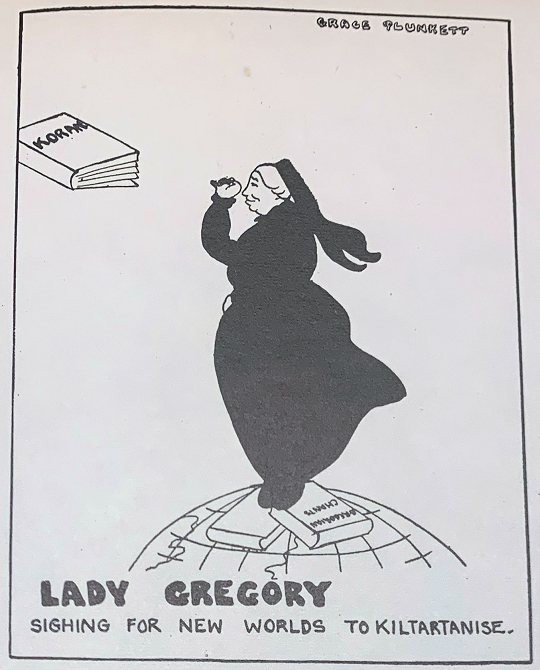
Even though that decision left me with exactly zero dollars to spend on anything else, I took a brief look at the books anyway. One I would definitely have bought was W. B. Yeats and His World by Micheál Mac Liammóir and Eaven Boland, which had lots of illustrations. Because of my sword vision earlier that day, my first thought was to wonder whether it included a photo of the poet's magical sword (yes, he owned one), so I flipped through the book to check. No sword pics, alas, but this cartoon caught my eye:


It shows a woman dressed in black, standing atop the globe with two books under her feet, one of which is labeled "Gregorian Chants," and looking out into space at a giant flying Koran. A female Gregory was the main thing that got my attention, as a possible link to Odessa Grigorievna. I also happened to briefly start reading the Quran just a few weeks after the Grigorievna dream. I was vaguely aware that a Lady Gregory had been one of Yeats's associates but knew essentially nothing else about her and couldn't understand what the cartoon was trying to say. Today I went to Wikipedia for a quick rundown, where I read that she had been born on March 15, 1852 -- the Ides of March. This was shortly after reading William Wright's post "'Naming' Joan (and 'Beware this one!')" -- on which much more below -- in which he interprets two things said by a female voice as referring to me: "Beware this one!" and "When I dream, I dream about books!" I was born on the Ides of March (as in "Beware the Ides of March!") and have had many dreams about books. Lady Gregory, it turns out, shares my birthday, and the cartoon looks as if it might depict her dreaming about the Quran.

Anyway, I didn't buy the Yeats book. I took the Tarot deck to the counter to pay -- and discovered to my surprise that I was eligible for a special discount! Instead of spending every bit of my cash, as I had expected, I received $99 (about three US dollars) back -- so I went right back to the bookshelves to browse some more. I found Richard Cavendish's 1975 book The Tarot -- a large hardback full of color photos and certainly far too expensive to buy with my remaining cash. When I picked it up, though, I saw the price sticker: exactly $99. That seemed like another sign, and I bought it.

Flipping through Cavendish's book later, I was surprised to discover a full-page portrait of Yeats!


The use of his full name, William Butler Yeats, is another indirect link to Odessa Grigorievna, as my post "Hey birds, here are cookies!" links her with the biblical story of the Pharaoh's butler and baker. My uncle's song "Fourth Down" directly links Yeats with butling and baking: "I sent my Butler to the Land of Ire / To bring me back some Yeast / Because I needed to bake some bread / For my wedding feast."


Does Yeats really deserve a full-page portrait in a history of the Tarot? He moved in magicians' circles, yes, and knew MacGregor (MacGregor!) Mathers and Waite and Crowley, but what contribution to the Tarot iconography or interpretation did he himself make? The only possible fingerprints of his I've been able to find are on the Rider-Waite Magician and Ace of Pentacles, where his poem "The Travail of Passion" may -- this is my own personal hypothesis -- have influenced Waite to include red roses and white lilies in the imagery. (See my 2018 post "The Rider-Waite Magician.")

This made me think of my February 2 post "What's the second key?" -- the first key being the Rosary. I had written:

One [key] should be gold and the other silver, I guess, but that's not very helpful. Which is the Rosary, anyway, gold or silver? Maybe try a different tack. A rosary is literally a garland of roses, and lilies complement roses as silver complements gold.

Where did this idea come from, of there being two keys, one of which is the Rosary? See my January 23 post "The Green Door finally closes":

I thought to myself [of the Rosary], "It's magic!" and was immediately answered by a mental voice in my head, a woman speaking French: Oui, c'est l'une des clés. "Yes, this is one of the keys."

The voice reminded me of the woman in the dream recounted in "Rapunzel and the True Song of Wandering Aengus." That woman had spoken English, but I had understood that she wanted me to think of her as Claire Delune, and l'une des clés (the final s's are silent) sounds almost like clair de lune in reverse. That dream had prominently featured the Yeats lines "The silver apples of the moon, / The golden apples of the sun," and that combined with "one of the keys" made me think of the gold and silver keys that were recently in the sync-stream. If the Rosary is one of the two keys, what's the other?

In William Wright's post, on which I said I would have more to say, he proposes that the beings I think of as Joan of Arc and Claire Delune are one and the same. He actually ends the post -- which was written on St. Joan's Day (i.e., May 30, the anniversary of her death) -- with "Happy Feast Day, Claire." I had forgotten that in my first encounter with Claire she had quizzed me about the "true" form of a Yeats poem, and specifically a poem about the Irish god Aengus. One of the things I learned today from skimming the Wikipedia article for Lady Gregory is that she used to publish under the pseudonym Angus Grey.

In that post, I also mention that the only keys mentioned in the Book of Mormon are those of Laban's treasury. One of Laban's greatest treasures was the sword Makmahod -- recently connected with Joan and thus perhaps also with Claire.

Now look back at the photo of the full-page portrait of Yeats. Up in the corner is the name of the chapter in which it is found: "The Universal Key."

Does that settle it? Is the Tarot -- particularly in its Yeats-adjacent Rider-Waite form -- the long-sought second key? I wasn't sure until I opened up my new cards and saw what was printed on the backs:


A rose argent. I'd already connected the two keys with the duality of red and white flowers. Symbolically, a white rose is interchangeable with a lily. I thought at first it was the Rose of York, but that should be barbed and seeded proper (i.e., with green leaves and a yellow center). This one is all white, even the leaves, suggesting that it is the blossom of an all-white tree -- with obvious implications from a Mormon or Tolkienian point of view.

Are Joan and Claire the same being, as William Wright suggests? The possibility had never crossed my mind, but my immediate inclination is to think that it may well be true. Serendipitously running into all this Claire-related content on Joan's Day  is obviously a data point in favor of the hypothesis. Another data point is the poem I published yesterday for St. Joan's Day. An earlier draft had ended with the line "And act -- however high the stakes," but then I felt something nudging me to change it to "Clear-eyed -- however high the stakes" -- even though being clear-eyed had no obvious connection with the overall theme of the poem. The French word for "clear" is clair -- or, in the feminine, claire.

Coincidence? Here's another. Last Joan's Day I wrote, but did not publish, a translation of a French poem by St. Thérèse de Lisieux. (This year, by "coincidence," I did another translation from Thérèse just five days before Joan's Day.) I was tolerably happy with it as a translation but felt that its take on Joan was not my own, and thus I never ended up posting it. It's still in my Drafts folder, dated May 30, 2023, so I looked it up. Here's the original:

A Jeanne d'Arc

Quand le Dieu des armées te donnant la victoire
Tu chassas l'étranger et fis sacrer le roi
Jeanne, ton nom devint célèbre dans l'histoire
Nos plus grands conquérants pâlirent devant toi.

Mais ce n'était encor qu'une gloire éphémère
Il fallait à ton nom l'auréole des Saints
Aussi le Bien-Aimé t'offrit sa coupe amère
Et tu fus comme Lui rejetée des humains.

Au fond d'un noir cachot, chargée de lourdes chaînes
Le cruel étranger t'abreuva de douleurs
Pas un de tes amis ne prit part à tes peines
Pas un ne s'avança pour essuyer tes pleurs.

Jeanne tu m'apparais plus brillante et plus belle
Qu'au sacre de ton roi, dans ta sombre prison.
Ce céleste reflet de la gloire éternelle
Qui donc te l'apporta ? Ce fut la trahison.

Ah ! si le Dieu d'amour en la vallée des larmes
N'était venu chercher la trahison, la mort
La souffrance pour nous aurait été sans charmes
Maintenant nous l'aimons, elle est notre trésor.

And my version:

To Joan

The God of Hosts gave thee the field --
The king was crown'd, the foe did yield --
And all the conq'rors France had known
Did pale before the name of Joan.

Yet thy name, too, had paled and died
If not by suff'ring sanctified.
The cup which caus'd our Lord to shrink,
He offer'd thee -- thou, too, didst drink.

Thou wast, like Him, rejected, left
Alone, of all thy friends bereft.
Not one did come to kiss thy chains,
To still thy tears, to share thy pains.

When Charles the Seventh took the throne,
How brightly then thy glory shone!
But brighter still that glory ray'd
In dungeons dark -- alone, betray'd.

Our Lord did, too, to this sad vale
Come down to seek out death, betray'l.
Through Him we see with clearer eyes:
Now suff'ring is our greatest prize.

A note after the poem offers this as "a more literal translation of the final stanza":

Ah! If the God of love had not come to this vale of tears
To seek betrayal and death,
Suffering would have had no appeal for us.
Now we love it; it is our treasure.

So I took some liberties with that final stanza, the chief effect of which was -- to add a reference to clearer eyes that was not in the original!

Thursday, March 28, 2024

Annunciation rescheduled to coincide with eclipse

I just saw this on Ann Barnhardt's blog:

March 25th is the fixed date of the great Feast of the Annunciation… BUT since March 25th falls inside Holy Week this year, Holy Mother Church defers the Great Feast to the first day outside of Eastertide, which is Monday, April 8th this year.

I'm not quite sure how the math works -- I was under the impression that Eastertide lasted from Easter Sunday to Pentecost and would end on May 19 this year -- but I'm sure Ann Barnhardt knows the Catholic calendar better than some random Mormon does. Interesting to see so many things lining up on that date.

In anticipation, here's some Yeats:

The threefold terror of love; a fallen flare
Through the hollow of an ear;
Wings beating about the room;
The terror of all terrors that I bore
The Heavens in my womb.
Had I not found content among the shows
Every common woman knows,
Chimney corner, garden walk,
Or rocky cistern where we tread the clothes
And gather all the talk?
What is this flesh I purchased with my pains,
This fallen star my milk sustains,
This love that makes my heart's blood stop
Or strikes a Sudden chill into my bones
And bids my hair stand up?

Friday, January 5, 2024

Rapunzel and the True Song of Wandering Aengus

I took a brief nap after lunch today, which is not something I ordinarily do, and I had a verbal dream. My unseen interlocutor (there was no visual aspect to this dream) was a woman who wanted me to think of her as Claire, but I understood that this was definitely not her real name; she was using Claire Delune as a sort of jokey nom de guerre, chosen precisely because it was ridiculous. She never actually told me this, and I never actually addressed her as Claire; it was just understood. Although I could not see Claire, my mental image of her (for even in dreams there is a distinction between what we "see" and what we picture) was of a blonde woman who looked as if she might burst into laughter at any moment.

Claire and I were having what I understood to be a ritualized dialogue, with each of us reciting lines from a memorized script. I thought of the whole thing as being "Masonic" in nature:

Claire: Do you know what a week is?

William: I do.

Claire: Will you tell me?

William: I will.

From none to half, or half to all,
Or all to half, or half to none
Takes seven days, and this we call
A week, and now my tale is done.

Claire: That is well said. Do you know the True Song of Wandering Aengus?

William: I do not.

Claire: I will give it you.

Claire then recited the "true" version of the Yeats poem "The Song of Wandering Aengus." Unfortunately, my memory of this disintegrated almost immediately upon waking. I can only remember a few details: It was told from the point of view of the Glimmering Girl rather than from that of Aengus, and there were only two long stanzas. The second stanza ended with the well-known lines "The silver apples of the moon, / The golden apples of the sun," and the first stanza ended with the same two lines in reverse: "The golden apples of the sun, / The silver apples of the moon." Aside from that, the only specific wording I can remember is the phrase "viper dragon," which appeared in both stanzas. (The second stanza mirrored the first in many ways, after the manner of "The Two Trees.")

After I awoke, the first thing I did was look up "The Song of Wandering Aengus" and refresh my memory. No viper dragons. Then I ran a search for "yeats" "viper dragon" just in case anything should turn up. This yielded what Google humorously terms "about 0 results" -- but not exactly zero:


The Witch's Tower! That caught my eye because William Wright's two latest posts -- "Disney's 'Tangled', Galadriel's Hair, and linking the Anor and Ithil Stones" and "New Moons Shining and Karma Chameleons" -- have dealt with the story of Rapunzel, specifically as told in a Disney movie I had never heard of, in which Rapunzel's animal sidekick is a chameleon. I had read these shortly before my nap, and the reference to the Anor ("sun") and Ithil ("moon") Stones may have occasioned my dreaming of Wandering Aengus. I had also watched a clip from Tangled that William had posted, in which I learned for the first time that the traditional name of Rapunzel's witch captor is Gothel.

"Viper dragon" has no obvious connection to Rapunzel, though, so imagine my surprise when I clicked on the third image above and enlarged it. (Only a low-resolution image is available, sorry.)


I'm pretty jaded when it comes to seemingly impossible coincidences, but this is really a seemingly impossible coincidence! Just after learning for the first time that Rapunzel was held captive by a witch called Gothel, I have a dream in which the phrase "viper dragon" appears in a Yeats poem. I then search for "viper dragon" "yeats" -- and the only results are from a Rapunzel story, including the page in which Gothel introduces herself!

The Witch's Tower was published in 2019 by Tamara Grantham and is the first book in a series called Twisted Ever After. (Disney's Tangled was released in 2010, with a 2012 sequel called Tangled Ever After.) The sample available on Amazon shows that it begins with an epigraph from Yeats:


A Google Books search shows that the string "viper, dragon" appears only once, in a list of potion ingredients:


Both excerpts above include references to drops of Gothel's blood, which I suppose is an additional coincidence.

Sunday, February 19, 2023

Lear, the Byrds, and 242

In "242, and crabs," I noted that, just as there are a total of eight cardinal and intercardinal directions (compass points) on a two-dimensional map, there would be 242 such directions in a five-dimensional space.

Thinking about a five-dimensional space led me to the Wikipedia disambiguation page for "Fifth Dimension," which took me to the Byrds album of that name. Side one begins with "5D (Fifth Dimension)" and ends with "I Come and Stand at Every Door." Side two begins with "Eight Miles High" and ends with "2-4-2 Fox Trot (The Lear Jet Song)."

"I Come and Stand at Every Door" begins thus:

I come and stand at every door
But no one hears my silent tread
I knock and yet remain unseen
For I am dead, for I am dead

Today, searching my own blog for the word dove, I reread "Syncs courtesy of Laura Wood (and 4chan)" (September 2022). Laura Wood and a 4chan anon had both quoted Revelation 3:20. Mrs. Wood's post was titled "The Knock at Every Door." A short time after that, I checked Bruce Charlton's blog and found that the latest post was called "Contact with the (so-called) dead - past and present."

Revelation has the S:E:G: value 121. Two references to Revelation makes for two 121s, which is 242.

"Eight Miles High" includes the line "Rain gray town, known for its sound." London is famously gray and foggy. Earlier today, I posted "Britain as another planet," ending with a reference to the classic 4chan greentext that began the tradition of referring to Britain as Bongland.

At least on 4chan, then, the rain-gray town is indeed "known for its sound" -- the sound being BONG!

In the greentext, no one has a watch, no one knows what time means -- but the time is "seven bong." The Byrds song "I Come and Stand at Every Door" continues:

I'm only seven although I died
In Hiroshima long ago
I'm seven now as I was then
When children die they do not grow

For the ghost-child, as for the inhabitants of Bongland, there is no time, but also the time is seven. My reference to the bong story was in connection with the Muse music video "Sing for Absolution," which ends with a view of a London as thoroughly destroyed as Hiroshima, but with Big Ben still standing.

In the comments, "for the benefit of any readers from planet n00b," I posted a link to a Reddit thread about the bong greentext. One of the comments was this:

And now we finally get around to the Lear connection: the juxtaposition of "trees" (r/trees is a pothead forum) and "bongs." In "The Owl and the Pussy-Cat" by Edward Lear, the two titular animals "sailed away, for a year and a day / to the land where the bong-tree grows." This tree also appears in Lear's "The Dong with the Luminous Nose": "A light on the bong-tree stem it throws / And those who watch at that midnight hour . . . ."

"2-4-2 Fox Trot (The Lear Jet Song)" has no lyrics other than "Go 'n ride the Lear Jet, baby" repeated again and again. According to Wikipedia, "The song was inspired by the band's friendship with John Lear, son of jet manufacturer Bill Lear, and the title is a reference to the registration number of Lear's own personal jet, which was N242FT."

Shortly after learning that, I checked The Secret Sun, where the newest post was "I Didn't Meme to Turn You On." One of the memes posted there was this one:

There's "fox trot" as in the Byrds' Lear Jet song, and midnight is the hour when people watch the Dong with the Luminous Nose throw light on the bong-tree stem. The Dong is perhaps a cousin to the Sleepy Manchurian Candidate with the Luminous Eyes.

In "Lear's i' the town" (January 21 -- that's 121), I posted, among other things, a comment someone had left alluding (with reference to my having eaten at two 666 restaurants) to the closing lines of the Yeats poem "The Second Coming," and my uncle William John Tychonievich's own such allusion at the end of his poem "Closing the Hemisphere":

And what rough beast,
Its hour come round last,
Pilots a Lear jet to oblivion?

Yeats's original rough beat slouches towards Bethlehem at the end of a stanza that begins:

Surely some revelation is at hand;
Surely the Second Coming is at hand.

As already noted, revelation is 121 in S:E:G:. So is second coming. Two 121s makes 242.

The post was called "Lear's i' the town" in reference to an earlier post, "'No coincidences' implies a single-author creation" (November 2021). In that post, I tried to use the fact that that line from King Lear includes the word Israel spelt backwards as an example of a true coincidence.

Another example I used was the chance occurrence of the acronym SMILE in the Book of Mormon ("to be spiritually minded is life eternal") and in a random BBC story ("lethal microbes that killed so many in London's East End in the mid-Victorian period"). Edward Lear was born in London and lived  during the Victorian period.

I recently posted ("No B in Harley-Davidson" and "The seal of Melchizedek," February 9 and 18) about seeing "Keep smiling" juxtaposed with 666 twice: once in a barber shop, and once in one of the 666 restaurants that prompted my commenter to adapt Yeats.

Friday, September 9, 2022

Life Is Romantic, The Travail of Passion, and the Sorrowful Mysteries

While on the road this afternoon, I fell to thinking about the term Romantic Christian -- designating the approach to Christianity advocated by Bruce Charlton, William Wildblood, Francis Berger, and myself -- and about how it is somewhat suboptimal because it is not a single word and because it cannot be abbreviated without confusion (since RC, in a religious context, normally means Roman Catholic). While my mind was thus occupied, I saw this printed on the back of the T-shirt of the motorcyclist in front of me:


I took this as synchronistic confirmation that Romantic is after all the best term to be using. The T-shirts equation of Romanticism with life also struck me as appropriate, since a big part of the Romantic Christian approach is a focus on Heaven as eternal life (rather than eternal rest, absorption into God, etc.) and on God as the living God, existing in time. An emphasis on life is also typical of the Gospel and First Epistle of John.

Later in the day, as is my habit on Fridays, I prayed the Sorrowful Mysteries of the Rosary, which are (translating): the Prayer in the Garden, the Scourging, the Crowning with Thorns, the Carrying of the Cross, and the Crucifixion and Death of Our Lord Jesus Christ. My meditations on the Rosary are highly visual in nature, the verbal part of my brain being preoccupied with the prayers themselves, and my mental image of the Prayer in the Garden is heavily influenced by the Yeats poem The Travail of Passion (which alludes to all five of the Sorrowful Mysteries).

When the flaming lute-thronged angelic door is wide;
When an immortal passion breathes in mortal clay;
Our hearts endure the scourge, the plaited thorns, the way
Crowded with bitter faces, the wounds in palm and side,
The hyssop-heavy sponge, the flowers by Kidron stream:
We will bend down and loosen our hair over you,
That it may drop faint perfume, and be heavy with dew,
Lilies of death-pale hope, roses of passionate dream.

Today my meditations were also colored by the T-shirt synchronicity: "Life is Romantic: Romantic Crown." Jesus' crown, plaited of thorny plants, was a crown of life, in contrast to the inorganic gold and jewels worn by worldly kings. "Why do ye adorn yourselves with that which hath no life?" (Morm. 8:39).

While imagining Jesus praying among "the flowers by Kidron stream . . . Lilies of death-pale hope, roses of passionate dream," I suddenly realized the relationship of roses and lilies to one of the strange features of the T-shirt inscription: the use of an upside-down W in place of an M. My recent experience with a red dove had led me back to my 2018 post "The Rider-Waite Magician." In that post, I connect the red dove flying upward on the Magician card with the white dove flying downward on the Ace of Cups -- and I note that the Ace of Cups is marked with a W which is actually an upside-down M, confirming that it is an inversion of the Magician. I see now that the birds themselves have the form of a stylized W and M.

As detailed in the 2018 post, the red dove represents the Pillar of Severity and prayers ascending to heaven, and the white dove represents the Pillar of Mercy and blessings descending to earth. The red dove flying to heaven made me think of the Mosaic rite for cleansing lepers (Leviticus 14), which involves killing a bird in a clay vessel over running water (cf. the white dove over a vessel with running water on the Ace of Cups), dipping a living bird in its blood, and then releasing this bloody bird in an open field (cf. the Magician's red dove, surrounded by what Waite calls flos campi et lilium convallium, "flowers of the field and lilies of the valley").

Blood crying to heaven is a familiar biblical expression, and Jesus bled (or sweat as if her were bleeding) as he prayed in the garden. By "coincidence," just before seeing the "Life Is Romantic" T-shirt, I had read this in Ã‰liphas Lévi's Histoire de la magie:

Paracelsus knew the mysteries of blood; he knew why the priests of Baal made incisions with knives in their flesh, and then brought down fire from heaven; . . . he knew how spilt blood cries for vengeance or mercy and fills the air with angels or demons.

He goes on to relate an anecdote from Jean-Baptiste Tavernier about certain Asian magicians who caused a small piece of wood to grow up into a flowering mango tree in the space of half an hour, by cutting themselves and rubbing the wood with their blood.

The Magician card alludes to Gethsemane via the red dove of prayer flying upward, surrounded by garden flowers. The Ace of Cups shows the content of Jesus' prayer in the garden -- "if thou be willing, remove this cup from me" -- and the white dove descending alludes to Heaven's response: "and there appeared an angel unto him from heaven, strengthening him."

The Yeats poem begins with an open door: "When the flaming lute-thronged angelic door is wide." This reminds me of a recent dream:

I was exploring an old abandoned building and found in it a very large wooden rosary. Each bead was the size of a golf ball and had a single word engraved on it. I believe the words were those of the Lord’s Prayer. I found that the cross on the rosary was also a key which fit the lock of one of the doors in the old building. I left the rosary hanging from the keyhole, but an old priest came and told me not to, saying a key has no purpose if you just leave it in the keyhole.

After the dream, I counted the words in the Latin Pater Noster and found that there are exactly 50, corresponding perfectly to the five decades of the Rosary.

And to the angel of the church in Philadelphia write; These things saith he that is holy, he that is true, he that hath the key of David, he that openeth, and no man shutteth; and shutteth, and no man openeth; I know thy works: behold, I have set before thee an open door, and no man can shut it: for thou hast a little strength, and hast kept my word, and hast not denied my name (Rev. 3:7-8).

Incidentally, Abraham von Franckenberg's illustration of Guillaume Postel's interpretation of the "key of David" would later influence Lévi significantly, particularly in his idea of writing the word ROTA/TARO around the rim of a wheel.

Tuesday, December 31, 2019

Chinese (and 100 other languages) whispers

I suppose everyone has heard the apocryphal story about the early days of machine translation. Having developed software to translate between English and Russian, the programmers tested it by giving it the English sentence "The spirit is willing, but the flesh is weak" and having it translate it into Russian. They then fed the result back into the program to translate back into English, and the result was: "The wine was good, but the meat was rotten."

Have you ever wondered what would happen if you had Google Translate translate an English text into all 103 of the other languages it supports, one after another? The result would be distorted, sure, but how distorted? Well, once such a question has been asked, I must, as they say, obey the inscrutable exhortations of my soul.

I put the 103 languages in random order, and started with a short poem by Yeats. I translated it into the first language, then back into English; translated the result into the second languages, then back into English, and so on. Below are the results, showing every tenth translation so that you can follow the progressive degradation of the text. (I've added line breaks and capitalization to imitate the poetic form of the original; everything else is reproduced verbatim from Google Translate.)


Original

Toil and grow rich,
What’s that but to lie
With a foul witch
And after, drained dry,
To be brought
To the chamber where
Lies one long sought
With despair?

10 languages

Lying to a false magician
Who enriched the bathroom
And was taken to a room
Where people were exhausted
After drying up?

20 languages

The wise man came
And told him he was lying.
He found the toilet counter
And took them to the bedroom.
Is it because people are tired?

30 languages

The doctor said he was lying.
He found the bathroom
And took her to the bathroom.
Are you tired?

40 languages

The doctor who said he was lying.
He found the bathroom
And went to the bathroom.
Did you get Alicia?

50 languages

Dr. Drew.
When he was washing,
He came to the bathroom.
Are you fine?

60 languages

Picture.
Take a bath
In the bath
While bathing.
You are good

70 languages

Form.
Wash in the bathroom well.

80 languages

Beauty, beauty.
Wash well.

90 languages

Meat.
Take a shower.

103 languages

Size: poultry


That surprise ending gets me every time!

Popular posts