I’m not actually all that clear on what a “fourth down” is in football terms (don’t tell my Cousin Lou!), but it’s the name of one of my uncle’s songs, which I quoted recently because it name-drops William Butler Yeats:
I sent my Butler to the Land of Ire
To bring me back some Yeast
Because I needed to bake some bread
For my wedding feast.
He came back empty-handed,
And I thought my heart would break
When he told me he’d been robbed
By a bandit named Billy Blake.
That postponed my wedding,
And I had to shed a tear,
Then locked myself in the bathroom
So I could shake my spear.
And then the chorus:
Drown my head in water.
Lay it on the chopping block.
You can turn that oil up hotter
Cause I’m singing, but I ain’t gonna talk.
I had quoted the first lines earlier in connection with The Tarot by Richard Cavendish, which has a portrait of Yeats in it. Today I started reading it. On p. 15, Cavendish mentions that some packs of cards, both Tarot and ordinary playing cards, have portrayed the court cards as historical figures. The first he mentions is Shakespeare (Jack of Diamonds in an 1879 German pack), and another is “La Hire . . . a supporter of Joan of Arc,” whose name is used by the French to this day as a nickname for the Jack of Hearts.
I looked up La Hire. His nom de guerre is believed to have come from the English word ire, with reference to the wrath of God. (Note that as far back as 2016 I had connected the name Claire with the divine ire.)
“Fourth Down” references both Shakespeare (apparently as a euphemism for masturbation!) and the Land of Ire. The chorus is about how torture will make him sing but not talk. I recently quoted Rimbaud saying, just after a Joan of Arc reference, “I am of the race that sang under torture.”
Yesterday, May 30, I enjoyed "good luck" all day. Everything just went unusually smoothly, with lots of little good things just happening to happen. Therefore, when I had a few free hours in the afternoon and had a sudden hunch that I should go to a particular used bookstore, even though it meant a 40-minute drive to another city, I figured it was a good day for pursuing hunches.
When I arrived, I realized that I had brought very little cash with me and wouldn't be able to buy much, but I thought I'd look around anyway. I was immediately drawn to a small table with several Tarot decks, including two different editions of the Rider-Waite. I'd been to this store countless times, and they'd never sold Tarot cards before. I know it's basic common sense that you do not buy magical items secondhand, especially if you don't know who the previous owner was, but I'd been without a physical Rider-Waite deck for some years now, and I felt impressed to buy one. "It's okay," put in the helpful excuse-maker on my shoulder (right or left?). "You can just reconsecrate them."
I picked up one of the decks, but the price tag slightly exceeded what I had in my pocket. When I checked the second one, though, I saw that I had exactly the right amount of cash to buy it. That seemed like a sign, and I decided to get it.
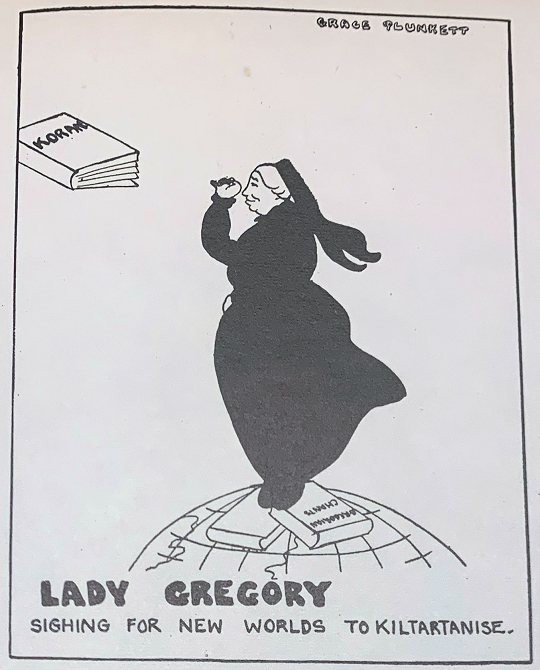
Even though that decision left me with exactly zero dollars to spend on anything else, I took a brief look at the books anyway. One I would definitely have bought was W. B. Yeats and His World by Micheál Mac Liammóir and Eaven Boland, which had lots of illustrations. Because of my sword vision earlier that day, my first thought was to wonder whether it included a photo of the poet's magical sword (yes, he owned one), so I flipped through the book to check. No sword pics, alas, but this cartoon caught my eye:
It shows a woman dressed in black, standing atop the globe with two books under her feet, one of which is labeled "Gregorian Chants," and looking out into space at a giant flying Koran. A female Gregory was the main thing that got my attention, as a possible link to Odessa Grigorievna. I also happened to briefly start reading the Quran just a few weeks after the Grigorievna dream. I was vaguely aware that a Lady Gregory had been one of Yeats's associates but knew essentially nothing else about her and couldn't understand what the cartoon was trying to say. Today I went to Wikipedia for a quick rundown, where I read that she had been born on March 15, 1852 -- the Ides of March. This was shortly after reading William Wright's post "'Naming' Joan (and 'Beware this one!')" -- on which much more below -- in which he interprets two things said by a female voice as referring to me: "Beware this one!" and "When I dream, I dream about books!" I was born on the Ides of March (as in "Beware the Ides of March!") and have had many dreams about books. Lady Gregory, it turns out, shares my birthday, and the cartoon looks as if it might depict her dreaming about the Quran.
Anyway, I didn't buy the Yeats book. I took the Tarot deck to the counter to pay -- and discovered to my surprise that I was eligible for a special discount! Instead of spending every bit of my cash, as I had expected, I received $99 (about three US dollars) back -- so I went right back to the bookshelves to browse some more. I found Richard Cavendish's 1975 book The Tarot -- a large hardback full of color photos and certainly far too expensive to buy with my remaining cash. When I picked it up, though, I saw the price sticker: exactly $99. That seemed like another sign, and I bought it.
Flipping through Cavendish's book later, I was surprised to discover a full-page portrait of Yeats!
The use of his full name, William Butler Yeats, is another indirect link to Odessa Grigorievna, as my post "Hey birds, here are cookies!" links her with the biblical story of the Pharaoh's butler and baker. My uncle's song "Fourth Down" directly links Yeats with butling and baking: "I sent my Butler to the Land of Ire / To bring me back some Yeast / Because I needed to bake some bread / For my wedding feast."
Does Yeats really deserve a full-page portrait in a history of the Tarot? He moved in magicians' circles, yes, and knew MacGregor (MacGregor!) Mathers and Waite and Crowley, but what contribution to the Tarot iconography or interpretation did he himself make? The only possible fingerprints of his I've been able to find are on the Rider-Waite Magician and Ace of Pentacles, where his poem "The Travail of Passion" may -- this is my own personal hypothesis -- have influenced Waite to include red roses and white lilies in the imagery. (See my 2018 post "The Rider-Waite Magician.")
This made me think of my February 2 post "What's the second key?" -- the first key being the Rosary. I had written:
One [key] should be gold and the other silver, I guess, but that's not very helpful. Which is the Rosary, anyway, gold or silver? Maybe try a different tack. A rosary is literally a garland of roses, and lilies complement roses as silver complements gold.
Where did this idea come from, of there being two keys, one of which is the Rosary? See my January 23 post "The Green Door finally closes":
I thought to myself [of the Rosary], "It's magic!" and was immediately answered by a mental voice in my head, a woman speaking French: Oui, c'est l'une des clés. "Yes, this is one of the keys."
The voice reminded me of the woman in the dream recounted in "Rapunzel and the True Song of Wandering Aengus." That woman had spoken English, but I had understood that she wanted me to think of her as Claire Delune, and l'une des clés (the final s's are silent) sounds almost like clair de lune in reverse. That dream had prominently featured the Yeats lines "The silver apples of the moon, / The golden apples of the sun," and that combined with "one of the keys" made me think of the gold and silver keys that were recently in the sync-stream. If the Rosary is one of the two keys, what's the other?
In William Wright's post, on which I said I would have more to say, he proposes that the beings I think of as Joan of Arc and Claire Delune are one and the same. He actually ends the post -- which was written on St. Joan's Day (i.e., May 30, the anniversary of her death) -- with "Happy Feast Day, Claire." I had forgotten that in my first encounter with Claire she had quizzed me about the "true" form of a Yeats poem, and specifically a poem about the Irish god Aengus. One of the things I learned today from skimming the Wikipedia article for Lady Gregory is that she used to publish under the pseudonym Angus Grey.
In that post, I also mention that the only keys mentioned in the Book of Mormon are those of Laban's treasury. One of Laban's greatest treasures was the sword Makmahod -- recently connected with Joan and thus perhaps also with Claire.
Now look back at the photo of the full-page portrait of Yeats. Up in the corner is the name of the chapter in which it is found: "The Universal Key."
Does that settle it? Is the Tarot -- particularly in its Yeats-adjacent Rider-Waite form -- the long-sought second key? I wasn't sure until I opened up my new cards and saw what was printed on the backs:
A rose argent. I'd already connected the two keys with the duality of red and white flowers. Symbolically, a white rose is interchangeable with a lily. I thought at first it was the Rose of York, but that should be barbed and seeded proper (i.e., with green leaves and a yellow center). This one is all white, even the leaves, suggesting that it is the blossom of an all-white tree -- with obvious implications from a Mormon or Tolkienian point of view.
Are Joan and Claire the same being, as William Wright suggests? The possibility had never crossed my mind, but my immediate inclination is to think that it may well be true. Serendipitously running into all this Claire-related content on Joan's Day is obviously a data point in favor of the hypothesis. Another data point is the poem I published yesterday for St. Joan's Day. An earlier draft had ended with the line "And act -- however high the stakes," but then I felt something nudging me to change it to "Clear-eyed -- however high the stakes" -- even though being clear-eyed had no obvious connection with the overall theme of the poem. The French word for "clear" is clair -- or, in the feminine, claire.
Coincidence? Here's another. Last Joan's Day I wrote, but did not publish, a translation of a French poem by St. Thérèse de Lisieux. (This year, by "coincidence," I did another translation from Thérèse just five days before Joan's Day.) I was tolerably happy with it as a translation but felt that its take on Joan was not my own, and thus I never ended up posting it. It's still in my Drafts folder, dated May 30, 2023, so I looked it up. Here's the original:
A Jeanne d'Arc
Quand le Dieu des armées te donnant la victoire
Tu chassas l'étranger et fis sacrer le roi
Jeanne, ton nom devint célèbre dans l'histoire
Nos plus grands conquérants pâlirent devant toi.
Mais ce n'était encor qu'une gloire éphémère
Il fallait à ton nom l'auréole des Saints
Aussi le Bien-Aimé t'offrit sa coupe amère
Et tu fus comme Lui rejetée des humains.
Au fond d'un noir cachot, chargée de lourdes chaînes
Le cruel étranger t'abreuva de douleurs
Pas un de tes amis ne prit part à tes peines
Pas un ne s'avança pour essuyer tes pleurs.
Jeanne tu m'apparais plus brillante et plus belle
Qu'au sacre de ton roi, dans ta sombre prison.
Ce céleste reflet de la gloire éternelle
Qui donc te l'apporta ? Ce fut la trahison.
Ah ! si le Dieu d'amour en la vallée des larmes
N'était venu chercher la trahison, la mort
La souffrance pour nous aurait été sans charmes
Maintenant nous l'aimons, elle est notre trésor.
And my version:
To Joan
The God of Hosts gave thee the field --
The king was crown'd, the foe did yield --
And all the conq'rors France had known
Did pale before the name of Joan.
Yet thy name, too, had paled and died
If not by suff'ring sanctified.
The cup which caus'd our Lord to shrink,
He offer'd thee -- thou, too, didst drink.
Thou wast, like Him, rejected, left
Alone, of all thy friends bereft.
Not one did come to kiss thy chains,
To still thy tears, to share thy pains.
When Charles the Seventh took the throne,
How brightly then thy glory shone!
But brighter still that glory ray'd
In dungeons dark -- alone, betray'd.
Our Lord did, too, to this sad vale
Come down to seek out death, betray'l.
Through Him we see with clearer eyes:
Now suff'ring is our greatest prize.
A note after the poem offers this as "a more literal translation of the final stanza":
Ah! If the God of love had not come to this vale of tears
To seek betrayal and death,
Suffering would have had no appeal for us.
Now we love it; it is our treasure.
So I took some liberties with that final stanza, the chief effect of which was -- to add a reference to clearer eyes that was not in the original!
My January 30 post "Hearts of gold, new shoes, dirty paws, and walking on air" included a video montage of scenes from The Secret Life of Walter Mitty set to the song "Dirty Paws." At one point, the video shows someone holding a black-and-white photo of a thumb:
In today's post "Wolves, swans, mirrored cities, and Kubla Khan," Alph came up, as both the name of the sacred river in Kubla Khan and the word for "swan" in one of Tolkien's Elvish languages. This made me think of Tintin and Alph-Art, the unfinished 24th Tintin book -- Hergé's "swan song"? -- which I had heard of but never read. I checked the summary on Wikipedia, which ends with this sentence:
Akass declares his intention to kill Tintin by having him covered in liquid polyester and sold as a work of art by César Baldaccini.
I'd never heard of that particular artist, so I clicked through to his Wikipedia article. One of his famous works is called Le Pouce ("The Thumb"):
Note added: In the song "This Country's Going to War" from the Marx Brothers movie Duck Soup, there's a bit where they sing, "They got guns / We got guns / All God's children got guns" -- but, due to the poor audio quality, as a child I always thought that what they were saying everyone had got was thumbs. This was reinforced by the body language as they sing that part, holding out their hands with thumbs extended:
Yes, I know thumbs doesn't make any sense in that context, but come on, was I supposed to be surprised at the Marx Brothers saying something that doesn't make sense?
I think I've mentioned before on this blog my uncle's half-serious opinion that Groucho Marx was the incarnation of the Greek god Zeus. When I asked him where that idea had come from, he said the thing that originally suggested it to him had been Groucho's duck-like walk, which made him think of Zeus taking the form of a swan when he seduced Leda, fathering Helen of Troy and Pollux. (Castor was a twin half-brother, fathered by Tyndareus, as was Helen's twin half-sister Clytemnestra.)
In William Wright's post yesterday "Michael Jackson and the Stone," he relates a dream in which he saw a big baby carriage inside a Mormon church and believed that the Sawtooth Stone (a supernatural stone which is the main focus of his blog) was hidden inside it.
So, Michael (Jackson) in possession of a shrouded, newly-born Stone entering church a little late, and having to take a seat in the back, but likely with some things to say. Who knows, maybe he entered a Fast and Testimony meeting and can find a chance to head on up to the pulpit (for those not familiar, this is a meeting where there is essentially an open microphone and anybody can go up to speak).
So the Stone is a baby, and there may be a chance to testify. This put a song in my head that I haven't heard or thought of in a good long time: "Rock and Roll Religion" by Billy Tyger. (That's my uncle, William John Tychonievich, who quite literally believes in a rock-'n'-roll religion.)
"Rock, baby, testify / Rock till you get that heavenly high . . . ."
I converted this from audiocassette to YouTube just for you, by the way. You will be the first Internet People ever to hear it.
I downloaded a collection of H. G. Wells short stories so that I could read "The Door in the Wall," but since I've got it and all, I figured I might as well read the rest of them. Today I read "The Flowering of the Strange Orchid," which is about -- spoiler warning! -- a flower that kills people, one of its weapons being the heady scent that renders its victims unconscious. It reminded me of a sonnet by my uncle, William John Tychonievich, called "O Poison Rose of Poetry," so I looked it up and reread it for the first time in well over a decade.
O poison Rose of Poetry, we drink
Your deadly nectar deep with each inhale
Of life's sweet atmosphere. Our breath does stink
Of your humid, earthy vapors. O Grail
Of Thorns and bright red-colored Seduction,
Your Goddess-sent scent both lures and entraps
Butterfly bards pulled by your soft suction
Into this matrix of sharp spiny paps.
Within your lattice prison we flutter
And strive, suffocating on your perfume
Until we fall and our corpses clutter
Your attar-petaled bed, our womb and tomb.
And here we lay, amid robust young shoots,
Our rotting essence feeding hungry roots.
I had forgotten there was a Grail reference in there! Earlier today I read and posted about an /x/ post called "Quantum Spacetime is the Holy Grail."
The main character in the Wells story is named Winter Wedderburn. Winter is a rather unusual given name, and for some reason what it made me think of was the 1992 Tori Amos song of that name, even though it's probably been 20 years or more since I've listened to anything by that singer, whose persona and most of whose music I've come to find actively repellent. (I was a big fan in my college days. Things change, my dear.) "Winter" is good, though, so I found it on YouTube and played it. I had never seen the video before.
Most of the video is pretty straightforward -- Tori walking around, singing, playing the piano, etc. -- but at one point it switches to a black screen with a big silver cup -- a trophy perhaps (it goes with the lyrics "you say I wanted you to be proud"), but also suggestive of the Grail.
A hand from offscreen pulls the cup away, and then some flowers float in and arrange themselves into this circular configuration. Then it's back to your regularly scheduled walking, singing, and piano playing.
The circle of flowers is a weird sync, since earlier today I saw this on /x/, posted with no comment but "what did they mean by this?":
Has Charles not been crowned yet? Kind of taking their time, aren't they? It's just some innocent graphic design, incorporating the floral emblems of England, Scotland, Wales, and Ireland -- unless, that is, you're /x/ enough to see the inverted crosses hidden in the shamrocks and the inverted pentagram at the top of the crown, usurping the place of the Cross. Anyway, whatever else it may be, it's a pretty specific sync with the Tori Amos video.