Saturday, March 18, 2023
Sync: Another yellow ptero, St. Valentine's Day, Empire of the Ants
Thursday, March 16, 2023
An odd stereotype from H. G. Wells: Orientals live fast, die young
Suppose a man repeatedly dosed with such a preparation: he would live an active and record life indeed, but he would be an adult at eleven, middle-aged at twenty-five, and by thirty well on the road to senile decay. It seemed to me that so far Gibberne was only going to do for any one who took his drug exactly what Nature has done for the Jews and Orientals, who are men in their teens and aged by fifty, and quicker in thought and act than we [Europeans] are all the time.
Monday, March 13, 2023
Sync: Near the day of purification, there will be cobwebs spun back and forth in the sky
Last night I watched the latest video from LXXXVIII finis temporis, about the 1968 movie What's So Bad About Feeling Good and how it foreshadowed the birdemic. There are some pretty striking links there, and I highly recommend the video:
In the movie, the mayor of New York considers force-pecking all the citizens but thinks the people won't go for it, so they instead decide to treat everyone secretly by mixing an inhalable cure into all the gasoline, diesel, and jet fuel and releasing it into the atmosphere as air pollution.
Near the end, there's a shot of an airliner with clouds of exhaust coming out of it, with the implication that this is one of the ways the cure is being spread. This led one commenter to write "They put 'The Cure' in the chemtrails."
The commenter's handle is Batman. See my last post, "Are you not entertained?"
⁂
This morning, I started reading the H. G. Wells story "The Valley of Spiders," which I haven't finished yet. So far, we have three hombres riding through a valley when they see this:
And then he saw first one and then a second great white ball, a great shining white ball like a gigantic head of thistledown, that drove before the wind athwart the path. These balls soared high in the air, and dropped and rose again and caught for a moment, and hurried on and passed, but at the sight of them the restlessness of the horses increased.
Then presently he saw that more of these drifting globes -- and then soon very many more -- were hurrying towards him down the valley.
They became aware of a squealing. Athwart the path a huge boar rushed, turning his head but for one instant to glance at them, and then hurling on down the valley again. And at that all three stopped and sat in their saddles, staring into the thickening haze that was coming upon them.
"If it were not for this thistle-down --" began the leader.
But now a big globe came drifting past within a score of yards of them. It was really not an even sphere at all, but a vast, soft, ragged, filmy thing, a sheet gathered by the corners, an aerial jelly-fish, as it were, but rolling over and over as it advanced, and trailing long cobwebby threads and streamers that floated in its wake.
"It isn't thistle-down," said the little man.
Going from the title of the story, I'm going to assume that these objects have "long cobwebby threads" because they are cobwebs -- cobwebs flying through the air.
⁂
This evening, I glanced at /x/, and one of the threads caught my attention because it had a picture of the Maid of Orléans and said "Say something nice about Joan of Arc, /x/." I clicked in spite of myself. The first few comments were about the level I was expecting -- "she cute" -- "most based woman ever" -- so I was going to close the tab, but then this caught my eye:
Why was this posted in a thread about Joan of Arc? I don't know, probably the same reason Gay Pride Batman saying "Are you not entertained?" was posted in a thread about Yahweh. However it got there, it's a reference to chemtrails as cobwebs in the sky.
The LXXXVIII finis temporis video focuses mainly on the birdemic, but it also points out several 9/11 references in What's So Bad About Feeling Good. September 11, 2001, was just two weeks before Yom Kippur, making it "near the day of purification."
I wrote this in a comment on my own "Are you not entertained?" post -- the one featuring Gay Pride Batman:
Russell Crowe is etymologically “red crow,” not too conceptually dissimilar to a rainbow bat. Ted Hughes called the crow “a black rainbow.” Crowe has played Noah, a link to the dark arc/ark.
"A link to the dark arc/ark" is obviously also a link to Jeanne d'Arc. Joan was also the creator of the first rainbow flag.
Saturday, March 11, 2023
The candles blew and then disappeared
In "Knock, knock, Neo" (February 27), I mention reading the H. G. Wells story "The Red Room." The narrator, scoffing at ghosts, attempts to stay in the titular room, which is supposed to be haunted, but ends up getting spooked in spite of himself. He lights lots of candles, but they keep going out, one after another, faster than he can relight them, and in the end he panics. After his ordeal, he tells his hosts that the room is haunted by Fear itself:
"You believe now," said the old man with the withered hand, "that the room is haunted?" He spoke no longer as one who greets an intruder, but as one who condoles with a friend.
"Yes," said I, "the room is haunted. . . . There is neither ghost of earl nor ghost of countess in that room; there is no ghost there at all, but worse, far worse, something impalpable --”
"Well?" they said.
"The worst of all the things that haunt poor mortal men," said I; "and that is, in all its nakedness -- 'Fear!' Fear that will not have light nor sound, that will not bear with reason, that deafens and darkens and overwhelms. It followed me through the corridor, it fought against me in the room --"
I stopped abruptly. There was an interval of silence. My hand went up to my bandages. "The candles went out one after another, and I fled --"
Three or four days ago, about a week after reading "The Red Room," I was praying in my chapel at night, with several candles as my only illumination. At one point, although the door and windows were closed, the candle flames all suddenly turned horizontal and then went out one by one. No panic ensued, in part because, unlike Wells's protagonist, I had the option of just flipping on the light switch.
In a comment on my own March 10 post "Weirdly specific sync: Meerkats and piranhas," I mentioned listening to the Keep Shelly in Athens version of the Blue Öyster Cult song "(Don't Fear) the Reaper," noting the "Valentine" reference in the lyrics. Debbie replied that she didn't know the song but had looked up the lyrics and was struck by a different line: "Then the door was open, and the wind appeared." I hadn't noticed that line myself because that verse isn't included in the KSiA version. I looked up the original:
Then the door was open and the wind appeared
The candles blew and then disappeared
The curtains flew and then he appeared
Saying don't be afraid . . .
Tuesday, March 7, 2023
Fever dreams and syncs: Popol Vuh twins, Spinal Pap, stone worship, and more
I've been out of commission for a bit with a case of food poisoning, and it had the effect of turning my dreams into something more like delirium or schizophrenia than like ordinary nocturnal dreams. The visual element was not lifelike at all but consisted solely of constantly changing symbols and diagrams, and I felt that these were being expounded with great clarity and that suddenly I got it The overall feeling of the experience was similar to that attending a dream I had a few years ago which enabled me to perceive Mozart's Magic Flute as a single unified whole, an audible diagram of great complexity and symmetry -- or perhaps more like what the fellow in the John Linnell song feels when he realizes that Montana is really just a leg, with the round part just the way you would espect. I can't really remember much of the content of this supposed revelation -- likely because there is no there there -- but at the time it felt as if the mysteries of the universe were being unfolded to my view.
Central to the dream was the symbol D∞D and its variants D&D and 484 -- and a significant portion of the dream constituted a direct death threat from the synchronicity fairies if I dared to share any of what had been revealed to me. The allusions to extinct species like the dodo and the T. rex were veiled threats, you see, and one of the meanings of D&D was "Death & Death" -- referring to One Death and Seven Death, characters from the Mayan Popol Vuh. And one and seven make eight, as do four and four. (The Chinese words for "four" and "death" are near-homophones, a fact that is the basis of many East Asian superstitions.)
Back on February 23, I received an email about the Rosary from someone whose email address includes the string "1and7," which I suppose is what put my in mind of such Popol Vuh pairs as One and Seven Death and One and Seven Hunahpu.
During the dream, I felt that I had a moral duty to disregard the death threats. Upon waking, I found that I couldn't remember enough of the forbidden knowledge to share it anyway.
Today, after the fever dream, a bit of random link-following led me to the MythoAmerica article "50 truths on the hidden metaphysics of America." In the article, these two pictures are juxtaposed:
The Popol Vuh for our times pic.twitter.com/cNmaGKV1V3
— Hernan Cortes (@CyberPunkCortes) April 30, 2022
Your Goddess-sent scent both lures and entrapsButterfly bards pulled by your soft suctionInto this matrix of sharp spiny paps.
Monday, February 27, 2023
Knock, knock, Neo.
Neo : You ever have that feeling where you're not sure if you're awake or still dreaming?Choi : All the time. It's called mescaline. It's the only way to fly.
Saturday, February 25, 2023
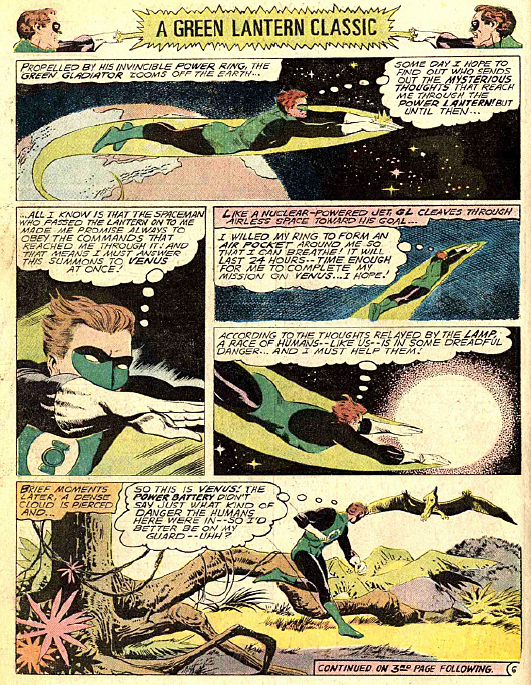
Green Lantern’s yellow pterodactyls — and my own
Wednesday, February 22, 2023
Will Power is the flame of the Green Lantern!
In "Green Door, Green Lantern," that B-list superhero came to my attention because the emblem on his chest (in the Silver-Age version) looks like 101, the S:E:G: value of the phrase green door.
Searching for green lantern time travel, I had found a page from a comic book in which Green Lantern travels back in time and sees a T. rex. Later, trying to find the full story online, I ended up browsing a lot of old comic books. I found this in Green Lantern #1.
When you've spent enough time playing around with gematria, you develop a sort of sense for it, just like some mathematicians can tell if a large number "looks prime" even before doing any calculations. As soon as I saw this page, I could just somehow see that will power and Green Lantern had the same S:E:G: value, even though I couldn't have told you what that value was. I did the math and confirmed it.
Will power = Green Lantern = 133.
Following a second hunch, I calculated the S:E:G: for the title of H. G. Wells's most famous novel.
The Time Machine = 133
The Green Lantern comic I had been looking for -- unsuccessfully -- was this one:
Green Lantern's "time-tunnel" is obviously a close cousin to Wells's machine, and sure enough:
time-tunnel = 133
S:E:G: is what drew my attention to Green Lantern in the first place -- but the number 101, not 133. In my original "Green Door 101" post, I had noted this:
Eight six = 101. Eight is the lemniscate, and six as in 666, a number which is also part of this sync stream.
Why "eight six"? Why not "six eight"? Just a lucky random choice, I guess. After discovering that The Time Machine is 133, I naturally checked the name of its author:
H. G. Wells = 86
H. G. Wells is 86; eight six is 101; 101 is the Green Lantern logo; Green Lantern is 133; and 133 is The Time Machine, which is by H. G. Wells. What is impressive is not that such a convoluted six-degrees-of-Kevin-Bacon connection exists, but that I discovered it so quickly and easily.
The "eight six" connection made me curious about the gematria values of other spelled-out numbers, which led to this mildly interesting coincidence:
one three three = 146
one four six = 146
"One three three" was the first number I tried, and it led me directly to a number that encodes its own gematria value. A decade or so ago I made an exhaustive search for such numbers, and there aren't many of them. I only found two, if memory serves:
two hundred and fifty-one = 251
two hundred and fifty-nine = 259
I had only looked at fully written-out numbers of the above type, though -- "two hundred and fifty-one," not "two five one" -- and so had not discovered 146.
Monday, February 20, 2023
Powers of three, modern dismissal of miracles, relationships with the so-called dead
Yesterday, as mentioned in "242, and crabs," seeing a reference to the eight points of the compass made me think that if there were eight directions in a two-dimensional space, the number of directions for any n-dimensional space would be the nth power of three minus one (because the center is not a direction). I calculated these in my head up to the fifth power of three.
Today I read the H. G. Wells short story "The Story of the Late Mr. Elvesham," which is about how the titular old man successfully switches bodies with a young man named Eden after making him his heir, the idea being that Elvesham's body will die, and Elvesham (in Eden's body) will inherit his own possessions and continue his life as a healthy young man.
The story is narrated by Eden. When he wakes up to find himself in Elvesham's body, he thinks it must be a dream and tries to go back to sleep. He has recourse to a curious alternative to counting sheep:
I shut my eyes, breathed regularly, and, finding myself wakeful, began to count slowly through the powers of three.
How often do people count through the powers of three? I'd say that's a pretty remarkable coincidence.
There's more, though. Yesterday I also participated in an email discussion with some of my Romantic Christian blogging associates about the advisability of speaking openly of miracles. Bruce Charlton expressed the opinion that, while telling miracle stories may have been helpful at most other times in history, it was usually net-harmful in the modern West because people assume atheistic materialism and reject miracles out of hand, so that a miracle story generally has no other effect than damaging the credibility of the person who tells it. I responded that, while assumptions are important, people do sometimes update them in response to experience, and that a materialist who never hears of any miracles is unlikely to question his axioms.
Continuing with Mr. Eden's reaction to the strange situation in which he finds himself:
Had I been a man of any other age, I might have given myself up to my fate as one enchanted. But in these sceptical days miracles do not pass current.
In the end, though, the evidence of his own experience forces him to update his assumptions:
I have been a materialist for all my thinking life, but here, suddenly, is a clear case of man's detachability from matter.
A specific instance of Bruce's opinion about sharing miracles, and how the advisability of doing so has changed over time, can be found in his post of the day before yesterday, "Contact with the (so-called) dead - past and present." In this post, he dismisses spiritualism as unlikely to be helpful but says contact with the resurrected dead is a different matter:
For some people, in some situations, contact with one or more of the resurrected dead may even be their primary spiritual task.
For a start, it can be a vital source of spiritual guidance.
He goes on to say that this sort of contact has its potential pitfalls as well, but that many of these can be avoided by maintaining a policy of secrecy, "by not disclosing to others with whom we have contact, and keeping secret their information and guidance."
The day I read that post, I had also read H. G. Wells's story "The Moth," which is about an entomologist who is haunted by a mysterious moth which he believes to be the vengeful ghost of a rival entomologist with whom he had feuded. This, combined with Bruce's post, made me think of Whitley Strieber's book The Afterlife Revolution, detailing his ongoing relationship with his late wife, who he believes often appears in the form of a moth. So confident is Strieber of the reality of this ongoing relationship and communication that he lists his wife as a co-author of the book, even though it was written entirely after her death.
Last night, I was working in my study when I suddenly heard a loud thump behind me. Turning around, I saw that one of my books had spontaneously fallen off the shelf: an English translation of Oswald Wirth's Le Tarot des imagiers du Moyen Âge. -- The Tarot of the Medieval Image-makers, badly translated as The Tarot of the Magicians. I had read the book only once, four years ago, but I decided right then that I should read it again. I was about to turn to the first chapter but had a strong impression that I should instead go back and read the preface. I did so.
The preface is all about Stanislas de Guaita, the French poet and Rosicrucian. The two men met in 1887, when Wirth was 27 and de Gauita was 26. Wirth learned the Tarot and the French language from de Guaita and created his first Tarot deck under the Frenchman's guidance two years later. De Guaita died young, in 1897, and Le Tarot des imagiers du Moyen Âge was not published until 1927, three decades after de Guaita's untimely death. Nevertheless, Wirth presents the book as having been written in collaboration with his late friend.
I am convinced that the master for whom the veil of mystery was lifted, does not abandon his colleague who is straining to discern the truth. . . . Our true initiators often do not reveal themselves to our senses, and sometimes remain as silent as the symbolic compositions of the Tarot, but they keep watch on our efforts at deciphering, and as soon as we have found the first letter, they can mysteriously prompt the second to put us on the path of the third. Guaita certainly helped me, for my thought calls to him so that between us a telepathic connection is established. The relationship between one mind and another is in the nature of things, that has nothing in common with the classic or modernized necromancy in the form of spiritism. . . .
Like Raphael and Mozart, Guaita was to die young. It was granted to me to live on, but the incomparable friend, the inspiring master, has never died for me. His thought remains as mine; and with him and through him I aspire to initiate myself into the secret things. We collaborate secretly, for he who has gone encourages me to pursue his work . . . .
I am conscious of never having ceased to be the secretary of Stanislas de Guaita . . . whose acts continue, for nothing is lost in this sphere of strength.
May the reader be grateful to Stanislas de Guaita for the ideas which I express, and indulge his pupil who sets them forth here.
I am convinced that this kind of thing is far more common than most people imagine.
Thursday, February 16, 2023
Another link between 8 and time travel
Sunday, February 12, 2023
Winter, flowers, and the Grail
O poison Rose of Poetry, we drinkYour deadly nectar deep with each inhaleOf life's sweet atmosphere. Our breath does stinkOf your humid, earthy vapors. O GrailOf Thorns and bright red-colored Seduction,Your Goddess-sent scent both lures and entrapsButterfly bards pulled by your soft suctionInto this matrix of sharp spiny paps.Within your lattice prison we flutterAnd strive, suffocating on your perfumeUntil we fall and our corpses clutterYour attar-petaled bed, our womb and tomb.And here we lay, amid robust young shoots,Our rotting essence feeding hungry roots.
What if Dot got in the Green Door?
The Grail isn't anything you might have heard it is except for perhaps the generative principle of nature itself. We are all within the grail. This is how God comes to know us. We are like fish in a great ocean, bound to our school. When the question is asked the realm is restored.
As a second example of "an error that wasn't," a reader wrote to complain that in figure 5.8 (the circuit diagram of a phase-shift oscillator) the voltage u is to the right of voltage v, but in the text I refer to the voltage u being to the left. This assertion stopped me dead in my tracks for a moment (I had confused left and right? -- my Lord, I must be dumber than an owl!), until I realized he was looking at the resistor-capacitor feedback network in the circuit, despite the fact that in the text I specifically state I am talking about the voltages on the input/output terminals of the amplifier connected to the network. (Thank the Lord, I'm not dumber than an owl! Such are the little things that give pleasure to the mind of an old mathematics writer at midnight.)
Friday, February 10, 2023
"The Door in the Wall" by H. G. Wells
As described in my January 31 post "The Door in the Wall," I recently reread Aldous Huxley's The Doors of Perception because of its possible relevance to the Green Door sync theme. Huxley several times uses the expression "Doors in the Wall," saying it is H. G. Wells's phrase, so that led me to download Wells's short story of that name. At that time, I had no idea that the story involved a door of any particular color, but less than 24 hours later, I received an email mentioning Wells's "The Door in the Wall" and that the door in it was green.
Yesterday, I finally got around to reading the story. Not only is the door green, its greenness is emphasized again and again; the phrase "green door" appears 12 times in a story of less than 7,000 words. In the story, a five-year-old boy happens upon a green door in a white wall and walks through it into a vast enchanted garden. He encounters various animals and people there -- most significantly, from the sync point of view, "very tame and friendly white doves" -- and a woman shows him a magical book in which he can see his own life. He turns the pages, seeing one episode after another up to the point where he opened the green door. When he tries to read beyond that point, he suddenly finds himself transported back into the ordinary world.
So there are two portals between the enchanted world and our own: a green door and a book. This ties in with the Mary E. Wilkins Freeman story "The Green Door," in which a girl steps through a green door and finds that she has traveled back into the past. There she eventually meets another modern who has traveled back in time. "Did you come through a little green door?" she asks. "No," he replies, "I came through a book."
Coming back to the Wells story, the child tries in vain to find the green door again, but later, throughout his life, he sees it again from time to time -- a green door in a white wall -- and knows that it will take him back to that enchanted garden. But each time he is busy or preoccupied or has something important to do, and he passes up his chance. He ends up having a very successful career in politics, but is tormented to the end with regret at having attained his success by sacrificing one opportunity after another to go back through the door.
A very unwelcome synchronicity: One of the occasions on which the green door appeared was "as I rushed to my father's bedside to bid that stern old man farewell. Then, too, the claims of life were imperative." As I read the story, my wife was out of town, having rushed to her father's bedside to bid that stern old man farewell. Today she returned.
Tuesday, January 31, 2023
The Door in the Wall
Art and religion, carnivals and saturnalia, dancing and listening to oratory -- all these have served, in H. G. Wells' phrase, as Doors in the Wall. And for private use there have always been chemical intoxicants.
Popular posts
-
Following up on the idea that the pecked are no longer alone in their bodies , reader Ben Pratt has brought to my attention these remarks by...
-
Mark your calendars, and in the meantime find something else to read. Note added: For those who have asked, nothing is wrong, and my decisi...
-
Back on August 17, Bruce Charlton posted an episode from the old children's TV show Pipkins (which I had never heard of), in which Hart...
-
It's been a while since I clicked for a randomly selected /x/ thread . I tried it today just in the spirit of "Is this thing on?...
-
But Men shall remember Atlantis's name Come hell or high water! Sith both of them came, It rests unforgotten, and what we now tell Skill...
-
Gustave Doré, The Death of Abel (1866) I struggled with some demons, they were middle-class and tame I didn't know I had permission t...
-
My mention of a "Buddhist text" in my last post was probably misleading, making it sound like I was poring over Mahayana scriptur...
-
All sins shall be forgiven unto the sons of men, and blasphemies wherewith soever they shall blaspheme. -- Mark 3:28 As strong as ca...
-
Over the past few days, I’ve been trying to puzzle out the meaning of "The plant is the three pages just starred by an asterisk," ...
-
This morning, a preschooler dropped a case of alphabet stamps. These had been in alphabetical order, but when he picked them up, he paid no ...