Showing posts with label Oswald Wirth. Show all posts

Saturday, January 27, 2024

Worm Jacob

This jumped out at me yesterday as I was reading Isaiah:

Fear not, thou worm Jacob, and ye men of Israel; I will help thee, saith the Lord, and thy redeemer, the Holy One of Israel (Isa. 41:14).

Due to current events, it was "Yemen of Israel" that first caught my eye, but my interest pretty quickly shifted to "thou worm Jacob."

From a very early age, maybe six or seven, I've used the old-fashioned abbreviation Wm for my first name. (Jas was added much later, when I started blogging.) From time to time, people jokingly pronounce it as it's written, as /wəm/, which is very close to how worm is pronounced in the non-rhotic New England accent I grew up speaking in Derry, New Hampshire. Jas is for James, of course, which derives, via French and Latin, from the name Jacob. So, in a fairly straightforward way, Worm Jacob = Wm Jas.

Thinking about this jogged loose a half-remembered factoid I'd picked up somewhere ages ago: Doesn't Isaiah use the same Hebrew word for "worm" and "crimson"? Indeed he does:

This word appears as worm in Isa. 41:14. A different form of the same word appears as crimson in one of Isaiah's most famous lines:

Come now, and let us reason together, saith the Lord: though your sins be as scarlet, they shall be as white as snow; though they be red like crimson, they shall be as wool (Isa. 1:18).

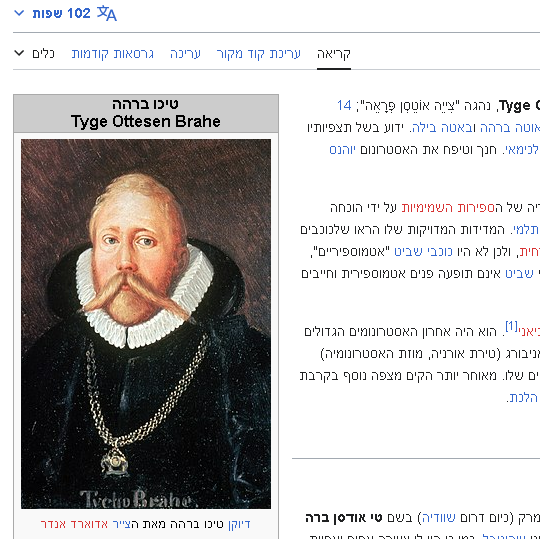
Isaiah juxtaposes crimson with wool, which got my attention because Woolly was a nickname of mine in my late teens and early twenties -- an alteration of Willy, but also inspired by my appearance at that time. As hard as it may be to believe now, there was a time when I not only had hair but had enough of it that a photo of me from back then is being used to this day as an illustration in the Hebrew Wikipedia article for "Hair." (I know this because some random Israeli dude once emailed me about it.)

The caption reads "blond hair and red beard." Of course it had to be Hebrew Wikipedia, and they chose me because I had a woolly red beard. In what I've written above, I started with something that reminded me of my name, looked up the Hebrew behind it, and was led to Isaiah talking about something red becoming like wool.

The Hebrew word in question means both "red" and "worm." This made me think of the red serpent I mentioned in my recent post "Red chameleons, manticores, and vampires":

the esotericists of the 19th and 20th centuries associated Teth with the serpent, and specifically with the red serpent. (This is why Oswald Wirth, who mapped Teth to the Hermit card, added a red serpent to his otherwise traditional version of that trump.)

(Like my past self, Wirth's Hermit seems to have gone a bit overboard with the beard.)

So Worm Jacob leads us to the red worm or serpent, which leads us to Teth, one of the two Hebrew letters transliterated as T. Is that a link not only to Wm Jas but to my surname as well? At first I thought probably not. Teth evolved into Theta, while the Greek and Latin letter T, as used in the Greek word from which my surname derives, evolved from a different Semitic letter, Tav. Hebrew Wikipedia changed my mind:

That's Tycho Brahe, another man who loved facial hair not wisely but too well. As you can see, Tycho is transliterated into Hebrew with Teth, not Tav. I can assume that Tychonievich would be similarly rendered.

Incidentally, I have one other link to Tycho besides the name and the fashion sense. Tycho famously lost part of his nose in a duel and used to wear false noses made of gold, silver, or brass. Some years ago, one of my young students asked me if I'd ever broken a bone. When I told him I'd broken my nose once, he looked at me in amazement and said, "So, that's not your real nose?"

Monday, February 20, 2023

Powers of three, modern dismissal of miracles, relationships with the so-called dead

Yesterday, as mentioned in "242, and crabs," seeing a reference to the eight points of the compass made me think that if there were eight directions in a two-dimensional space, the number of directions for any n-dimensional space would be the nth power of three minus one (because the center is not a direction). I calculated these in my head up to the fifth power of three.

Today I read the H. G. Wells short story "The Story of the Late Mr. Elvesham," which is about how the titular old man successfully switches bodies with a young man named Eden after making him his heir, the idea being that Elvesham's body will die, and Elvesham (in Eden's body) will inherit his own possessions and continue his life as a healthy young man.

The story is narrated by Eden. When he wakes up to find himself in Elvesham's body, he thinks it must be a dream and tries to go back to sleep. He has recourse to a curious alternative to counting sheep:

I shut my eyes, breathed regularly, and, finding myself wakeful, began to count slowly through the powers of three.

How often do people count through the powers of three? I'd say that's a pretty remarkable coincidence.

There's more, though. Yesterday I also participated in an email discussion with some of my Romantic Christian blogging associates about the advisability of speaking openly of miracles. Bruce Charlton expressed the opinion that, while telling miracle stories may have been helpful at most other times in history, it was usually net-harmful in the modern West because people assume atheistic materialism and reject miracles out of hand, so that a miracle story generally has no other effect than damaging the credibility of the person who tells it. I responded that, while assumptions are important, people do sometimes update them in response to experience, and that a materialist who never hears of any miracles is unlikely to question his axioms.

Continuing with Mr. Eden's reaction to the strange situation in which he finds himself:

Had I been a man of any other age, I might have given myself up to my fate as one enchanted. But in these sceptical days miracles do not pass current.

In the end, though, the evidence of his own experience forces him to update his assumptions:

I have been a materialist for all my thinking life, but here, suddenly, is a clear case of man's detachability from matter.

A specific instance of Bruce's opinion about sharing miracles, and how the advisability of doing so has changed over time, can be found in his post of the day before yesterday, "Contact with the (so-called) dead - past and present." In this post, he dismisses spiritualism as unlikely to be helpful but says contact with the resurrected dead is a different matter:

For some people, in some situations, contact with one or more of the resurrected dead may even be their primary spiritual task. 

For a start, it can be a vital source of spiritual guidance.

He goes on to say that this sort of contact has its potential pitfalls as well, but that many of these can be avoided by maintaining a policy of secrecy, "by not disclosing to others with whom we have contact, and keeping secret their information and guidance."

The day I read that post, I had also read H. G. Wells's story "The Moth," which is about an entomologist who is haunted by a mysterious moth which he believes to be the vengeful ghost of a rival entomologist with whom he had feuded. This, combined with Bruce's post, made me think of Whitley Strieber's book The Afterlife Revolution, detailing his ongoing relationship with his late wife, who he believes often appears in the form of a moth. So confident is Strieber of the reality of this ongoing relationship and communication that he lists his wife as a co-author of the book, even though it was written entirely after her death.

Last night, I was working in my study when I suddenly heard a loud thump behind me. Turning around, I saw that one of my books had spontaneously fallen off the shelf: an English translation of Oswald Wirth's Le Tarot des imagiers du Moyen Âge. -- The Tarot of the Medieval Image-makers, badly translated as The Tarot of the Magicians. I had read the book only once, four years ago, but I decided right then that I should read it again. I was about to turn to the first chapter but had a strong impression that I should instead go back and read the preface. I did so.

The preface is all about Stanislas de Guaita, the French poet and Rosicrucian. The two men met in 1887, when Wirth was 27 and de Gauita was 26. Wirth learned the Tarot and the French language from de Guaita and created his first Tarot deck under the Frenchman's guidance two years later. De Guaita died young, in 1897, and Le Tarot des imagiers du Moyen Âge was not published until 1927, three decades after de Guaita's untimely death. Nevertheless, Wirth presents the book as having been written in collaboration with his late friend.

I am convinced that the master for whom the veil of mystery was lifted, does not abandon his colleague who is straining to discern the truth. . . . Our true initiators often do not reveal themselves to our senses, and sometimes remain as silent as the symbolic compositions of the Tarot, but they keep watch on our efforts at deciphering, and as soon as we have found the first letter, they can mysteriously prompt the second to put us on the path of the third. Guaita certainly helped me, for my thought calls to him so that between us a telepathic connection is established. The relationship between one mind and another is in the nature of things, that has nothing in common with the classic or modernized necromancy in the form of spiritism. . . .

Like Raphael and Mozart, Guaita was to die young. It was granted to me to live on, but the incomparable friend, the inspiring master, has never died for me. His thought remains as mine; and with him and through him I aspire to initiate myself into the secret things. We collaborate secretly, for he who has gone encourages me to pursue his work . . . .

I am conscious of never having ceased to be the secretary of Stanislas de Guaita . . . whose acts continue, for nothing is lost in this sphere of strength.

May the reader be grateful to Stanislas de Guaita for the ideas which I express, and indulge his pupil who sets them forth here.

I am convinced that this kind of thing is far more common than most people imagine.

Wednesday, July 27, 2022

The Locust Grove crop circle

I really do have a lot of substantial philosophical and theological posts in my drafts folder, but the synchronicity fairies just won't let up with the fire hose. So my apologies to those of you who "just read it for the articles," but this blog is still in sync mode for the time being.


In "Break on through to the other side," I mentioned that I had done a one-card pull from the Rider-Waite, got the Eight of Cups, and noted its similarity to the Flammarion engraving. In my own notes on the reading, not published on the blog until later, I mentioned a mental image of

the overlapping circles of a Venn diagram (forming the vesica piscis where Christ sits enthroned in the Maiestas Domini icon), and I associated this with the strange object in the sky of the Eight of Cups (a combined crescent moon and full moon?)

My next post was "The Green Door," and Debbie left a comment all about yoni symbolism in connection with the Door, not knowing of my recent mental image of a vesica piscis (a yoni symbol) in connection with the Eight of Cups (a card I had featured in a post with a Doors lyric as its title).

The thing is, the object in the sky of the Eight of Cups doesn't really look anything like a Venn diagram or a vesica piscis. I just connected it with that at a conceptual level because it seemed to be a union of opposites (Sun and Moon, or full moon and crescent).

My posts sent Debbie looking through her old dream journals, though, and her attention was drawn to one dream in particular, called Serpent Holes. Some convoluted but inspired train of thought led her from that to Serpent Mound in Ohio and to the Locust Grove crop circle, which was discovered on August 24, 2003, less than 2,000 feet from the Mound. Here's a schematic drawing of the layout of the circle:

In "The vesica piscis and the blue moon," I noted that the "moon" on the Eight of Cups is not actually a circle divided into two parts by an arc (like the bright and dark parts of a crescent moon), but is a smaller circle overlapping a larger one. If you look at the silhouette of the entire object, it's not circular but has a convex bulge on one side. The resemblance to the Locust Grove circle is uncanny.

What the Locust Grove formation also includes -- but which is absent from the Eight of Cups -- is an explicit vesica piscis. This is mentioned in the write-up I linked (originally linked to by Debbie in her comment):

So I intuitively connected the Eight of Cups "moon" with the vesica piscis even though nothing in the image really suggests that; and Debbie, following the thread of her own dreams, stumbled upon a formation (in Ohio, which is where I usually say I'm "from"; in 2003, I lived less than 100 miles from Serpent Mound) which combines the Eight of Cups shape with a vesica piscis.

In a similar way, Ben looked at the Eight of Cups and for some reason thought of the Archangel Michael of Panormitas, even though I can't see any connection between the two at all except for the Sun and Moon on Michael's chest -- which Ben did not even notice until after he had made the link. This led me to look up other representations of Michael with a Sun and Moon, and I ended up finding one that corresponds perfectly to the Nebra sky disc -- which disc had also been brought up by Debbie in connection with her dream journal. This is an unusually collaborative sync-stream that's emerging; Ben, Debbie, and I all seem to be "in sync," so to speak.

The Archangel Michael, of course, is generally shown with his foot on the defeated serpent or dragon -- which syncs with the crop formation being so close to Serpent Mound. The file Debbie linked to about the crop circle even says that Serpent Mound probably represents the constellation Draco, identified by the Sumerians with Tiamat. In D&D, Tiamat is the evil counterpart to the good Bahamut, the Metal Worm.

If the serpent is the Metal Worm, who is Michael? He's Mr. Owl, of course. In the de Vos painting of Michael, written around his hand is the Latin motto Qui ut Deus? -- a translation of the literal meaning of the name Michael. In English, it would be Who is like God?

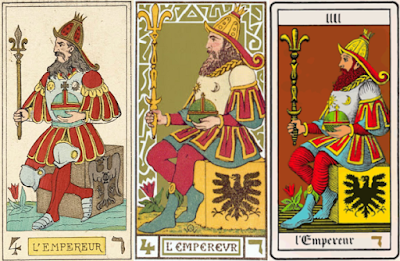
In the sky, Hercules is depicted with one foot on Draco -- in other words, he plays the role of St. Michael. In Oswald Wirth's Tarot, the Emperor is associated with Hercules, and he has a Sun and Moon on his breastplate just like the depictions of Michael we have been discussing.

Wirth also identified his Herculean Emperor with the Hebrew letter Daleth -- the Door. The Emperor is numbered 4, and his throne is a cube -- adorned with, if not actually an owl, at least a bird of prey.

In a recent discussion I was having with someone about the Owl Door, the number 64 and the word Lionclad (from a dream) came up. Lionclad clearly means Hercules, and 64 is the cube of 4. (Also, if 4 = Daleth = Door, 64 corresponds to Six Doors -- called Six Owl Door in English.)

It's also worth noting that my posts on Oswald Wirth's Emperor card are what first led Debbie to contact me.

Thursday, October 8, 2020

What's on the Magician's table?

1. The traditional Marseille layout

Tarot de Marseille decks stick very closely to the following layout for the Bateleur's table.

Based on Wilfried Houdouin's 2017 deck; color coding is my own

The details of each element below are taken from the Historical Tarots Gallery at the Tarot of Marseilles Heritage website. Upper row, from left to right: Pierre Madenié (1709), François Héri (1718), François Chosson (1736), Jean-Baptiste Madenié (1739), François Tourcaty (1745), and Rochus Schär (1750). Lower row: Claude Burdel (1751), Nicolas Conver (1760), Jacques Rochias (1782), Arnoux & Amphoux (1793), Suzanne Bernardin (1839), and Lequart (1890).

A: A cup with a round top, vertical sides, and a square bottom. There is very little variation in the shape. The main body of the cup is consistently yellow, and the mouth is most often red but sometimes other colors.


B: Another cup, with a different shape, wider at the top than at the bottom. It looks as if it may have a lid covering it. The color scheme is fairly consistent: yellow cup with a red mouth or lid.


C: It is not clear whether this object should be classified with the cups (A and B) or with the little round objects (D, E, and F). It is much smaller than the two cups but considerably larger than the little round things. While its basic shape is that of a circle divided into two parts, the concave curve of the dividing line suggests a very small, shallow cup, bowl, or dish. This object is most often the same color as the tabletop.


D: Three circular objects with the central one overlapping the one on the lower right (and sometimes the one on the left as well). So slavishly is this arrangement copied from deck to deck that when we see one with only two circles on this part of the table, it seems positively revolutionary! The objects are generally the color of the table. To me the layout suggests flat coins or discs rather than spherical objects. If they were balls, the lower right one (being in the foreground) would overlap the central one rather than vice versa. (On the other hand, the flat bottoms of cups A and B suggest an artist with little understanding of such things.) 


E: This element ranges from two circles side by side, to two overlapping circles, to a divided circle similar to C. The color is generally the same as the tabletop. The uncertainty as to whether this is one object or two suggests that the shapes were being copied blindly by cardmakers who did not know what they represented. My best guess is that the "original" form was a smaller circle in the northeast overlapping a larger one in the southwest, and that this was sometimes misunderstood as a single object due to the influence of the C object. As with the D objects, the direction of the overlap suggests flat rather than spherical objects.


F: Two more round items, vertically arranged. In most cases, they are touching so as to form a figure like an Arabic numeral 8, but in some decks there is a gap between them. Like the other round objects, they are generally the same color as the tabletop, but sometimes one of them is red.


G: A curved knife and its sheath, both generally the color of the table. The shape and orientation is consistent across decks. In one case the sheath has been transformed into a second knife. The knife has a very distinctive shape -- almost like a miniature scimitar with no cross-guard -- that makes me wonder what its purpose is. It certainly doesn't look much like a typical medieval pen knife, hunting knife, or dagger. The handle also seems much too small for the magician's hands, but perhaps that indicates nothing more than poor draftsmanship.


H: A bag, consistently light blue with a yellow mouth and strap. There are between one and three little round things at the mouth of the bag, which presumably represent some sort of latching mechanism. The bag is decorated with a tassel or something of that nature at the lower left corner. Sometimes one end of the strap appears to go behind the table rather than connecting to the bag.

2. Marseille variants, new and old

We have been looking at some of the oldest and most traditional Marseille decks, mostly from the 18th century, but in modern times the most influential Tarot de Marseille by far has been the 1930 Grimaud deck designed by Paul Marteau. Marteau claimed to be restoring the Nicolas Conver deck (the canonical Tarot de Marseille) but in fact introduced many innovations. Most of these are changes in the color scheme, but some are more substantial. Here is what Marteau's Bateleur has on his table:


If we ignore the colors, this is in line with Conver and the other decks we have examined, with one exception: The F element, realized as two circles in every historical deck we have looked at, has become a pair of dice.

A more recent "restored" Tarot de Marseille, also claiming the mantle of Nicolas Conver, features dice as well. This is the Jodorowsky-Camoin deck of 1997.


Note that Jodorowsky and Camoin have added a third die between the knife and its sheath, and also that the sheath has been given a fantastic new shape in defiance of tradition.

Whence these dice? As far as I am aware, there is only one early deck that unambiguously features dice, but it is one of the earliest: Jean Noblet's deck of c. 1650. Noblet's Tarot is generally very close to the Tarot de Marseille in its iconography, but not so close as to be considered a full member of that tradition. Here is his Bateleur's table:


Notice that Noblet's C element -- realized in the standard Tarot de Marseille as a circle divided into two parts -- appears here as a third and smaller cup. This suggests that what was originally a small cup was distorted over time, by a process of repeated copying without understanding, into the indistinct round object that later became standard.

Isn't it highly probably that some of the other round things on the table in the traditional Tarot de Marseille are also distortions of what were originally distinct objects? Isn't it more likely that indistinctly printed dice would degenerate into circles than that circles would be misinterpreted as dice? Marteau, Jodorowsky, and Camoin seem to have thought so. Noblet has three horizontally arranged dice where the standard Tarot de Marseille has two vertically arranged circles (the F element). Marteau apparently split the difference, keeping just two elements vertically arranged but changing them to dice. Jodorowsky and Camoin put two dice in the same position as Marteau's and add a third between the knife and the sheath, as in Noblet.

Note also that Noblet's D element -- three circles -- is somewhat different. Rather than overlapping, the three circles are more spread out but are connected by two lines. It is not at all clear what sort of object this is intended to represent. The E element -- either two circles or a single divided circle -- is absent.

Also dating to around 1650 is Jacques Viéville's card. The detail below is shown in mirror image in order to facilitate comparison with the TdM.


Here, A is a square cup, B is a round one, and C is apparently a shallow bowl or dish. D is a single round object rather than three, and E is a sort of lozenge divided horizontally into two triangles. Where the F element would be (two circles in TdM, dice in Noblet), we have two rectangular objects, a large one divided in thirds, and a smaller one not so divided. What objects were intended by these abstract geometric shapes is anyone's guess. Despite the early date for this card, it had apparently already been through several generations of ignorant miscopying.

The lozenge shape in Viéville is perhaps historically related to the diagonal lines connecting the circles in Noblet.


A few other not-quite-standard representatives of the greater Marseille tradition also deserve our attention. The 1780 deck of Ignaz Krebs follows Noblet in some ways.


As in Noblet, the D element appears as three non-overlapping circles, and the E element is absent. Instead of Noblet's dice, though, we have between the knife and the sheath a single rectangle with six pip-marks on it. To me this is further confirmation that the "original" design featured dice, since one could imagine dice being incorrectly copied either as circles (as in the mainstream TdM) or as the domino-like object in Krebs.

Jean-Pierre Payen's 1713 deck (a TdM "Type I" deck, as opposed to the mainstream "Type II") has a fairly standard Bateleur (or, rather, "Branchus," that being the anomalous title given to this card) but is interesting because its D element (three round objects) looks more unambiguously like coins rather than balls.

3. Magician's tables before the Tarot de Marseille

The earliest surviving Tarot cards are the Visconti-Sforza cards painted by Bonifacio Bembo. Bembo's magician has objects on his table similar to those in the TdM but not the same. There is a cup (only one), a knife (but no sheath), and two small round objects of uncertain identity.


The large white object which takes the place of the TdM Bateleur's bag has been variously interpreted, but, as I have explained elsewhere, I find Michael Pearce's case that it is a sea sponge to be completely convincing. Dr. Pearce found several pictures by Bembo depicting holy relics, among them the sponge on a stalk of hyssop which was used to give vinegar to the Crucified, and the sponge very closely resemble's the Magician's white object.

Three sponges (on hyssop stalks) by Bonifacio Bembo

This crucial discovery allows Pearce to reveal the true identity of Bembo's "magician": He is a scribe or writer. His "wand" is actually a reed pen (he holds it like a pen, and nibs are visible if you look closely), the knife is a pen knife, and the cup and other yellow objects are receptacles for ink. Sponges were used in the past for erasing and for cleaning pens; in support of this, Pearce shows an illustration from a 15th-century Decameron which depicts a writer with pen, pen knife, inkwell, and sponge.


The Cary sheet (c. 1550), a sheet of uncut Tarot cards from Milan, shows a broadly Marseille-like assortment of objects on the Magician's table, but the image is too unclear for them to be identified with any confidence. There are two long objects that may be a knife and a sheath, a total of six roundish things, and two cups on the table, with a third in the Magician's right hand. This syncs up pretty well with the Noblet card, which also has three cups, a knife and a sheath, and a total of six small objects (three dice and three round things).


While it is not a Tarot card, Hieronymus Bosch's 1502 painting The Conjurer should also be mentioned here, chiefly because of its similarity to the Cary sheet.


Bosch's Conjurer and the Cary sheet Magician wear similar headgear, and the Cary sheet may even show some sort of bag or basket dangling from the Magician's waist or wrist. In both depictions, the cups on the table are apparently inverted, narrow end up. Finally, and to me most evocatively, the roughly egg-shaped object at the northeast end of the table on the Cary sheet closely resembles the little frog at the west end of Bosch's table. (A second frog is emerging from the mouth of one of the spectators.)


See this post for more on echoes of Bosch in the Tarot.

4. Wirth and Waite

No overview of the Magician's table would be complete without mentioning the modern, post-Marseille standard, which I believe originated with Oswald Wirth. Although I find it a bit gauche and uninteresting, I feel I ought to give it a few lines.

It's a pretty obvious move to associate the Magician's objects with the four suits of the Tarot. The Magician holds a wand, and on his table are cups, a knife suggesting the suit of Swords, and round objects that might be coins. Oswald Wirth made this explicit.


All the clutter has been eliminated, and there are now only three objects on the table: a cup (not the simple cups of the TdM Bateleur, but a chalice or goblet as in the suit of Cups), a full-size sword, and a giant "coin" the size of a Frisbee (clearly a symbolic representation of the suit of Coins, not an actual piece of currency). The wand in the Magician's hand has been enlarged considerably, too, making it more like the cudgels and scepters in the suit of Bastons than like an actual magician's wand.

A. E. Waite, in his hugely influential Rider-Waite deck, takes Wirth's idea a step further. Apparently wanting to include a large "wand" suggestive of the suit, but without making his Magician look like a baton-twirling drum major, he put two wands on his card: a small one in the Magician's hand, and a large cudgel on the table. (The giant coin is now a "pentacle," that being Waite's take on this suit.)

Waite lived before subways were common.

All in all, I greatly prefer the traditional Bateleur's evocative hodgepodge of gewgaws to the cut-and-dried symbolism of Wirth and Waite.

Thursday, December 19, 2019

The Fool's Wheel

The Fool's Wheel, as discussed in an earlier post, is one of four plausible alternatives to a schema of Tarot interpretation created by Oswald Wirth and called (by me, not him) the Lover's Wheel. The idea is to arrange the 22 Major Arcana in a circle and contrast each card with those horizontally and vertically opposite it. Wirth put's the Lover card at the top of the wheel, while I put the Fool there -- hence the names.

This is what the Fool's Wheel looks like. The numbers represent the trumps in their standard Marseille order (Justice is 8, Strength is 11). The Fool is represented by the number 0 as a matter of convenience, though in fact it is unnumbered.


As the colored lines show, the Fool's Wheel organizes the cards into five groups of four (the colored rectangles) and a single pair (the central axis). Let's look at each of these groups in turn, starting from the center and working our way out.


Group 1: Strength and Weakness


These two cards both show a person interacting with a potentially dangerous animal. The Fool is being attacked by a dog (or, as some commentators would have it, a lynx), while the woman on the Strength card is holding open the jaws of a lion. While the Fool, being equipped with a stout walking stick, should be able to defend himself from a dog quite easily, it has apparently not occurred to him to do so. The woman on the Strength card, in contrast, effortlessly subdues a lion despite being entirely unarmed. The fact that she is holding its jaws open (not closed, as an alligator wrestler would do) shows that her power over the beast is more psychological than physical.

While the names Strength and La Force have become conventional in English and French, the original name of the 11th arcanum is La Fortezza -- that is, the classical virtue of Fortitude or courage. (Justice and Temperance are also among the Major Arcana; the apparent absence of the fourth virtue, Prudence, has been the subject of endless speculation among Tarot commentators.) Our Fool seems also to be displaying a courage of sorts -- or, rather, the vice-of-excess corresponding to that virtue in the Aristotelian system. He does not appear to be at all afraid of the dog, after all, but walks on with a smile on his face, as if unaware that he is being attacked.

The Fool, for his part, is called Il Matto or Le Mat -- as in the chess term échec et mat (Italian scacco matto) -- a word ultimately derived from Persian, where (despite the widespread, Arabic-influenced misconception that checkmate means "the king is dead") it means "stymied, stupefied, helpless." The Fool, then, represents the opposite of Strength, and his fearlessness is that of the dodo bird, not of the lion. "'Twas grace that taught my heart to fear, and grace my fear relieved": The woman of Strength enjoys both of these graces; the Fool, neither.


Group 2: Chance and Destiny


Looking at the vertical oppositions first, it would be hard to find one more perfect than the Hanged Man and the World. Several old French decks write the Hanged Man's number as "IIX," suggesting that the card ought to be turned upside down. Doing so transforms the Hanged Man into a dancer in almost exactly the same posture as the one featured on the World Card. The Hanged Man's gallows,with its 12 lopped branches, is a stylized representation of the zodiac, as are the wreath and Four Living Creatures on the World card.

The Magician holding his wand over his table of gewgaws (including, in some decks, two or three dice) corresponds to the sword-wielding sphinx that presides over the Wheel of Fortune -- or perhaps to Fortuna (not portrayed in the Marseille version of the image), who controls the wheel. Images suggestive of both the Magician and the Wheel of Fortune appear together in Hiernoymus Bosch's painting The Conjurer. The Magician represents control, while those on the Wheel are at the mercy of events beyond their control.

Horizontally, the Magician and the World, as the first and last numbered trumps, make a natural contrast. Both figures hold a wand in the left hand. The Magician's infinity-sign hat is echoed in the similarly shaped ribbon that binds the wreath in (many versions of) the World.

Traditional representations of the Wheel of Fortune generally put four figures on the wheel, but the Tarot de Marseille follows Albrecht Dürer in bringing that number down to three, perhaps as much to avoid a too-cluttered composition as for any other reason. We can perhaps see in the upside-down Hanged Man the missing figure at the bottom of the wheel; he certainly seems to have suffered a "reversal" of fortune!


Group 3: Last Things


Though it is called "The Judgement," the 20th trump actually depicts the resurrection of the dead. "Behold, I shew you a mystery; We shall not all sleep, but we shall all be changed, in a moment, in the twinkling of an eye, at the last trump: for the trumpet shall sound, and the dead shall be raised incorruptible, and we shall be changed. . . . then shall be brought to pass the saying that is written, Death is swallowed up in victory" (1 Corinthians 15: 51-52, 54). What trump could with greater appropriateness be placed opposite Death? But there is affinity as well as opposition. The 13th trump, too, proclaims that "we shall all be changed," and Death's character as the Grim Reaper brings to mind the line "the harvest is the end of the world; and the reapers are the angels" (Matthew 13:39).

The other vertical pair, the Priestess and the Hermit, are both solitary, mystical characters, each bearing a sign of enlightenment (a book, a lantern). A curtain behind the Priestess makes her face visible only from certain angles; likewise, the Hermit's lantern is partially concealed by his mantle.

The open book on the Priestess's lap connects her to the idea of the Last Judgment: "And I saw the dead, small and great, stand before God; and the books were opened: and another book was opened, which is the book of life: and the dead were judged out of those things which were written in the books, according to their works" (Revelation 20:12).

The 9th and 13th arcana probably share a common origin, as I have discussed in my post on "The Reaper of Marseille." The name given to the Hermit in the oldest Italian decks is usually the Old Man, the Hunchback, or simply Time, and his lantern was originally an hourglass. This is the familiar figure of Father Time, whose other main attribute (thanks to the conflation of Chronos, or Time, with the harvest god Kronos, or Saturn) is the sickle or scythe, and to whom the Grim Reaper can perhaps also trace his lineage.

Starting with the Hermit and going clockwise, we find that these four trumps lay out in order Four Last Things (not entirely the same as the Four Last Things of tradition): old age, death, resurrection, and judgment (the last being represented by the Priestess and her book, rather than by the trump that bears that name).

I consider this to be the strongest foursome in this schema.


Group 4: The Queens


The iconographic unity of three of these four cards is immediately apparent. Both the Empress and Justice depict a crowned woman seated on a throne, and the shapes of both thrones suggest the wings of the angel of Temperance. (In some decks, the Empress actually has wings.) The two ewers of Temperance echo the two pans of the scales of Justice.

The Sun, which is personified as male in most cultures, and which shines on the male twins Castor and Pollux, seems out of place in this group. However, sun goddesses are not unknown, nor is it uncommon to apply solar imagery to women ("Arise, fair sun, and kill the envious moon"). The Empress bears an eagle, a solar bird, and some post-Marseille decks portray her as the "woman clothed with the sun" of Revelation 12:1. The Sun, because it sees all and shines on all impartially, is often associated with justice; think, for example, of Utu/Shamash, or of Malachi's "sun of righteousness." The twins depicted on the Sun card also link it to the balanced duality of Temperance and Justice.


Group 5: The Kings


The Moon and the Devil make a natural pair, both emphasizing illusion, unreality, and animality. The relationship of the Emperor to the Chariot, which also features a crowned man holding a scepter in his right hand, is similarly obvious.

The horizontal pairings are perhaps less obvious. Just as the Fool's Wheel matches the Empress with the Sun, it matches the Emperor with the Moon, reversing what are the more common associations in most cultures. (Thoth is a male moon good, but the Tarot Emperor is hardly a Thothly figure!). In Whitley Strieber's Tarot book, The Path, he sees the Emperor as ruling the path the left-hand path that leads to the Moon, representing "outer life" and a reduction of freedom, but acknowledges that this is a symbolically unusual choice ("Almost universally, the left hand path has been associated with women, darkness and the moon, while the right has been connected to men, light and the sun"). In this Strieber is presumably influenced by Gurdjieff and his idea that those human "slugs" who fail to develop proper souls are destined to become "food for the moon." Notice also the moon-like spaulders of the charioteer.

In the Devil we may see a caricature of the charioteer. His two captives are harnessed to the globe on which he stands, just as the two horses are harnessed to the Chariot, and he stands over them brandishing a cat o' nine tails.


Group 6: The Transcendent


The two ewers being emptied in the Star correspond to the two people falling from the Tower; both the stars and the lightning bolt that destroys the Tower represent the ineluctable forces of the cosmos.

The Pope represents infallible authority, and the tonsured monks represent unquestioning obedience. In contrast, the Marseille version of Lover represents a free choice to be made (the Choice of Hercules) and the possibility of making the wrong choice. The Pope and Cupid represent, respectively, Roma and Amor -- each word being the reverse of the other.

The Star and the Pope both express the idea of humble submission -- whether to cosmic destiny or to papal authority.

The lightning bolt that destroys the Tower corresponds to the bolt of Cupid -- and in fact, the earliest name of the 16th trump is Sagitta -- the arrow.

All four trumps in this group represent something -- the "starry heavens above and the moral law within" (Kant), and the bolts of Zeus and Eros -- which transcends the personal and which enters our lives will we nill we and must be reckoned with.

Tuesday, December 10, 2019

The Lover's Wheel of Oswald Wirth, and four alternatives

In a previous post (qv) I have mentioned Oswald Wirth's schema in which the 22 Major Arcana of the Tarot are arranged at regular intervals around the circumference of a wheel, and each card is considered to have a special relationship with those horizontally and vertically opposite it on the wheel.

Since the oppositions being considered are rectilinear rather than diametric, which cards are opposite which depends entirely on which card is placed at 12 o'clock. Wirth puts the 6th trump, called the Lover, in that position, so I have found it convenient to dub his schema the Lover's Wheel. When the 6th trump is at 12 o'clock, the 17th (the Star) is at 6 o'clock. Obviously, rotating everything 180 degrees, so that the Star was at 12 o'clock, would yield the same set of oppositions, so putting the (n + 11)th trump at 12 o'clock is equivalent to putting the nth trump there. That means there are 11 distinct ways of arranging the trumps around the wheel, of which Wirth's Lover's Wheel is just one possibility.

In practice, though, most of those possible arrangements are too arbitrary to be worth considering. We might naturally expect the first (or perhaps the last) trump to be located at 12 o'clock (or at 6 o'clock, which is functionally equivalent). Nine o'clock (or 3 o'clock) would also be a natural place to put the first or last trump -- but because 22 is not divisible by 4, a wheel that has a trump at 12 o'clock will not have one at exactly 9 o'clock; instead, one is at (to make our clock-face terminology a bit more precise than is customary) 8:27, and another is at 9:33. All in all, I think there are three tolerably natural arrangements:
  1. first trump at 12 o'clock
  2. last trump at 12 o'clock
  3. first and last trumps at 9:33 and 8:27
Of course, any of these three arrangements can be rotated 90, 180, or 270 degrees, or mirrored, without affecting the card-to-card relationships.

Things are further complicated by uncertainty as to which trump should count as the first. Because the Fool is traditionally unnumbered (often numbered 0 in modern decks, generally treated by Wirth as if numbered 22), it can be considered either the first trump (in which case the World is the last) or the last trump (in which case the Magician is first).

Taking all this into consideration, the bottom line is that there are only five plausible candidates for the 12 o'clock position: the Lover (Wirth's choice), the Fool (my own hunch after seeing Wirth's version), the Magician, the Pope (seen in a "coʀʀecᴛed veʀsioɴ" of Wirth modified by an unknown hand), and the World. (Again, I am only saying "12 o'clock" for the sake of simplicity; 3, 6, or 9 o'clock would be functionally equivalent.)


The way to evaluate the relative merits of these five schemata is to look at the card-to-card relationships each creates and decide which seem the most meaningful. That means looking at 105 different links (21 for each wheel, with no overlap). My original plan was to discuss all 105 of these in this post, but it was starting to turn into one of those dissertation-length mega-posts that I'm not supposed to be writing anymore, so I'll stop this post here and discuss the individual wheels in detail in future posts.

Monday, December 2, 2019

Then Cometh the End

A rare allegorical picture by Kat Valentine (née Crystal Tychonievich), who usually does portraits. It depicts the Last Judgment.

Then Cometh the End

I found this a very striking composition, even though I do not yet understand the allegory itself in any detail. I was also struck by the synchronicity of her choice to include an enormous swan in a picture of the Last Judgment -- something which Oswald Wirth also does in his chapter on "Le Jugement" in Le tarot des imagiers du moyen-âge, which I read a few days before seeing the above picture for the first time. His version of that trump is quite conventional, based closely on the Tarot de Marseille, but he also includes a small picture of the same scene, but with a huge swan replacing the angel.


Wirth offers no real explanation of this picture, except to note that Cygnus is the constellation that most closely corresponds to the 20th trump ("we should picture the swan of Leda as being the Pagan equivalent of the Dove of the Holy Ghost"). He connects every one of the trumps with a constellation, though, but in no other case does he offer an alternative version of the card in which its astrological alter ego is inserted into the scene.

Besides the general similarity -- a swan at the Last Judgment -- note that Kat's swan is in an underground cavern, while Wirth's appears to be diving down into an open grave. Note also the unusual dimensions of Kat's picture, which almost make it look like a Tarot card itself.

Tuesday, November 19, 2019

A gallery of early or otherwise historically important Magician cards

This is primarily for my own future reference, but I post it here because others may find it helpful as well. These are the highest-quality images I have been able to find for each of the cards. They are in something approximating chronological order, keeping in mind that most of the dates are estimates.

I am indebted to Andy's Playing Cards for providing innumerable leads, and to Tarot of Marseilles Heritage for many of the images of cards from that tradition. If I've missed anything important, please inform me in the comments.

(Note: The image of the Oswald Wirth card I had originally posted was incorrect. I replaced it with the correct one on November 23, 2019. The "restored" Jean Dodal card was replaced with the original on November 25, 2019.)

Visconti-Sforza (Milan, 1451)
Ercole I d'Este (Ferrara, 1473)
The Cary Sheet (Milan, 1550)
Jacques Viéville (Paris, 1650)
Jean Noblet (Paris, 1650)
Tarot de Paris (Paris, 1650)
Mitelli's Tarocchini (Bologna, 1664)

Jean Dodal (Lyon, 1710)


Pierre Madenié (Dijon, 1709)
Jean-Pierre Payen (Avignon, 1713)
François Héri (Solothurn, 1718)
Minchiate Etruria (Florence, 1725)
François Chosson (Marseille, 1736)
Jean-Baptiste Madenié (Dijon, 1739)
François Tourcaty (Marseille, 1745)
Rochus Schär (Mümlisvil, 1750)
Claude Burdel (Fribourg, 1751)
Nicolas Conver (Marseille, 1760)
Ignaz Krebs (Fribourg, 1780)
Jacques Rochias (Neuchâtel, 1782)
Grand Etteilla (Paris, 1788)
Minchiate al Leone (Florence, 1790)
Arnoux & Amphoux (Marseille, 1793)
Bernardin Suzanne (Marseille, 1839)
Oswald With (Paris, 1899)
Lequart "Arnoult 1748" (Paris, 1890)
Rider-Waite (London, 1910)

Crowley's Thoth (1938-1943, pub. 1969)