Showing posts with label Crop circles. Show all posts

Thursday, January 19, 2023

Lots of old syncs resurfacing: red turtle dove, vesica piscis, crop circles

Sequence of events this morning:

1. At home on my computer, I prepare an English-to-Chinese glossary for something my students have to read. One of the words that needs to be glossed is dove. I know it, but I type the Chinese into Google Translate translate it back into English, just to be sure I've got the correct character. It's a single morpheme which means only "dove, pigeon" -- but oddly, dove is only the second suggestion from Google; the first is bird of peace.


I also notice in passing the phonetic similarity of 鴿子 (gēzi, "dove") to 哥吉拉 (Gējílā, "Godzilla")

2. I go to my school, and he's back! The red turtle dove that was following me everywhere back in August and then disappeared after I posted about him.

3. I have about half an hour before anyone else will arrive, so I pray my daily Rosary and then mess around a bit with a compass and straightedge, trying to work out a new way of constructing a regular pentagon. I try to get creative, but my first steps are still straight out of Euclid: draw a line segment, and then use it to construct a vesica piscis.

4. I have my morning tutoring session, in which I discuss magazine articles with my student. He's read an article about, of all things, why rugby balls are shaped the way they are, which apparently has to do with the fact that they used to be made from pig bladders. Of course the shape of a rugby ball approximates a vesica piscis, and the word vesica literally means "bladder."

5. Having some more free time, I look up and skim my old "red turtle dove" post. In connection with the "bird of peace" translation, I notice that the post includes this image. It's from this same student's magazine.


Since recent syncs have focused on time, and even on the word time itself (e.g. how its S:E:G: value is 44), this image from the "red turtle dove" post also seems relevant:


5. Since I've got my blog up, I idly check my stats and notice that an old post from August 28 of last year -- the time when I was being followed by the red turtle dove -- is for some reason getting a lot of visits these days, fare more than it got back when I posted it. The post is "More syncs related to the 'Glove Puppet' video and crop circles" -- just another ephemeral sync post, not the sort of thing I would expect to attract a lot of attention months later. I click on the post and see that it prominently features vesica piscis imagery.


Then I scroll down and find that it also includes this image again!


To top things off, the post ends with a reference to the O. Henry story "The Green Door" -- an old sync theme which has suddenly resurfaced in the past few days.

6. I go to YouTube to put on some music. I've been listening to the Muse album Black Holes and Revelations, and YouTube suggests the "official video" for the opening track, "Take a Bow." I didn't know there was a video, so I put it on. It soon becomes obvious that it's not the "official" video at all but something put together by a fan. It's a good song, though -- and very 2020s-relevant -- so I play it anyway.


It begins with a clip from 2001: A Space Odyssey and then footage of Nazis. Then this flashes on the screen repeatedly:


Shortly after that, we get a rapid-fire series of crop circle images.


A bit later, we see a surgeon putting on a glove, and then the Masonic square and compass flashes on the screen. (I had just been using a compass, and then looking at a post about a "glove puppet.")

Sunday, August 28, 2022

More syncs related to the "Glove Puppet" video and crop circles

It turns out (see Debbie's comment here) that my most recent reference to the Locust Grove crop circle (pdf), in "Michael the glove puppet and X the Owl," was posted on the 19th anniversary of the appearance of that formation on August 24, 2003. On the same date in 2004 a very similar formation appeared in Miamisburg, Ohio (pdf).

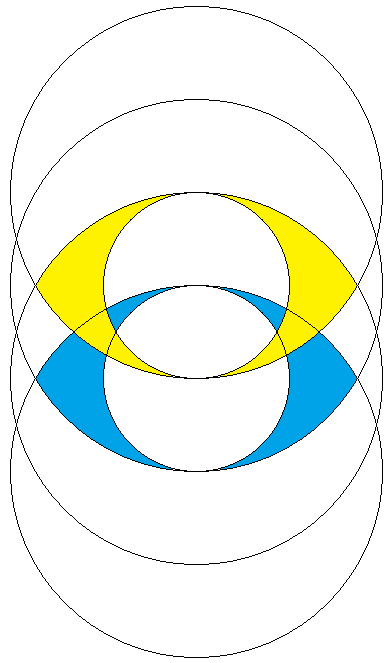
The glove puppet referenced in the title of that post is from an episode of the British TV show Pipkins. As WanderingGondola pointed out in a comment, the broadcaster's logo features a vesica piscis -- actually, two overlapping vesicae, each with a circle inscribed in it to make an eye shape (as in the Locust Grove formation), and these circles overlap to form a third vesica. The whole thing bears more than a passing resemblance to the 2004 Miamisburg crop formation.


Here's a schematic representation of the geometry of the ATV logo, which is based on four overlapping circles forming two vesicae piscium in which smaller circles are inscribed.


There's another well-known logo that approximates this same geometry pretty closely.


WanderingGondola also calls attention to two other interesting features of the Pipkins video. At the end of the glove puppet story, Johnny asks Moony to ask Michael to say the word it's, which he does. Then a series of images of clocks flashes on the screen for a few seconds, and then the word Time. Johnny then appears, completing the sentence: "[It's time] for me to make a glove puppet."


This fits with recent syncs involving such phrases as "It's time," "Now is the time," "The time is now," and "Time's up." (See "Owl time, and cold noodles." I notice now that the owl featured on that post is blue, like X and Meneer de Uil.)

Also, the credits at the end feature a name which is interesting in the context of the Mormon doctrine that Adam, the first man, is the same individual as Michael the Archangel.


WanderingGondola also notes that X the Owl get his name from the word escape, mispronounced by Daniel Striped Tiger as X-scape, and that Xscape also happens to be the name of a posthumously released Michael Jackson song and album. Check out what, according to IMDb, Michael Eve was doing just before his work on Pipkins.


Of course the series is a decade too early to have anything to do with Michael Jackson's Thriller, but the name is still quite a coincidence. It's not a just a Michael Jackson album; it's the Michael Jackson album, the only one a non-fan like myself would be able to name off the top of my head.

Michael Eve also worked on a series called Knock on Any Door in 1966. In the O. Henry story "The Green Door," the protagonist, Rudolf Steiner (no relation!) is handed a mysterious card with "The Green Door" written on it, and responds by entering a nearby apartment building, seeing a green door, and knocking on it. Only much later does he discover that all the doors in the building are green, and that he could have knocked on any one of them.

Saturday, August 6, 2022

The Wizard at the green door

In "The Locust Grove crop circle," I describe how I spontaneously visualized a vesica piscis while contemplating the Eight of Cups, and how Debbie then drew my attention to the titular crop formation, the structure of which includes both a vesica piscis and a shape like the anomalous "moon" on the Eight of Cups.


Yesterday (August 5), the homework for one of the English classes I teach happened to include this exercise:


Venn diagrams are fairly commonplace, but this one is uniquely relevant. As you can see, the two circles are for singular and plural nouns, with nouns that do not change form going in the middle section. One of the words that needs to be written there is fish -- as in vesica piscis. Also notice that what is printed on the other side of the page is faintly visible, and that right in the vesica is a picture of a baby, tying in with the vesica as a yonic image and a symbol of birth.

The vesica piscis is obviously closely related to the ichthys, or "Jesus fish," and Jesus (the baby in the picture above?) can also be thought of in terms of the Venn diagram -- the intersection of human nature and divine nature. Does that mean that Jesus had "two natures," as classical theology has it, or does it mean that there is only one nature? "One or two?" asks the Venn diagram with the baby.

Whitley Strieber used a Venn diagram on the cover of his book Jesus: A New Vision. As in the Locust Grove formation, there is a smaller circle inscribed in the vesica piscis.


I have discussed this vesica piscis sync first to get it out of the way, but it was actually the second one of August 5. Earlier that day, one of my young students (from a different class) drew this on the whiteboard during a break between classes: a vesica piscis inscribed in a circle, with the remainder of the circle colored green. I didn't get a chance to snap a photo, but this is a schematic reconstruction. It looked very close to being a mathematically precise vesica piscis, one by the square root of three.


The Locust Grove formation features a circle inscribed in a vesica piscis, with a narrower lens (too narrow to be a true mathematical vesica) inscribed in the circle.

"What's that?" asked one of the other students.

"It's a watermelon!"

"Why is it empty in the middle?"

Why indeed? It's a very strange way of drawing a watermelon, and it made me think of "Cucurbits from an alien land" and the melon or gourd as a gateway to the dream realm. As Debbie has pointed out, the "yoni" shape of the vesica piscis is closely associated with the symbolism of the door -- and in this case it's a green door -- a circular green door, like the one Gandalf knocks on.


The "watermelon" drawing also resembles a green letter O, as seen on the original cover of The Wonderful Wizard of Oz.


And how could I have forgotten that The Wizard of Oz (the 1939 film version) also has a scene in which someone knocks on a green door?


And this green door includes a smaller, circular green door.


In the book, the Guardian of the Gates, who lets Dorothy and company into the Emerald City is described as being "about the same size as the Munchkins" -- that is, very short, like a hobbit. In the movie, Dorothy and her friends first ring the doorbell, but the doorman insists that they knock instead, drawing their attention to a notice that says, "Bell out of order. Please knock."

In The Hobbit, Bilbo is first disturbed by one group of dwarves after another showing up and ringing his doorbell, and then:

[T]here came a loud knock. Not a ring, but a hard rat-tat on the hobbit's beautiful green door. Somebody was banging with a stick!

Bilbo . . . pulled open the door with a jerk, and they all fell in, one on top of the other. More dwarves, four more! And there was Gandalf behind, leaning on his staff and laughing. He had made quite a dent on the beautiful door . . . .

It is Gandalf, a Wizard, who knocks on the green door. When Dorothy knocks on the green door and is asked to state her business, she says, "We want to see the Wizard."

The Wizard is a representative of the supernatural or divine world, so this ties in with the Script line, "You can talk to God, go bangin' on his door." (Banging is the very word used by Tolkien.) Sometimes you knock on God's door, and sometimes he knocks on yours. Jesus said both, "Knock, and it shall be opened unto you" (Matt. 7:7, Luke 11:9) and "Behold, I stand at the door, and knock: if any man hear my voice, and open the door, I will come in to him" (Rev. 3:20).

When Mormon artist Greg Olsen decided to illustrate that last verse, guess what color he chose to make the door?

Greg Olsen, Let Him In (2005)


Note added: In this post, I talk about Gandalf knocking on a door just after I refer to "the melon or gourd as a gateway to the dream realm." How could I have forgotten that in The Lord of the Rings, Gandalf opens another door by uttering the word mellon?

Wednesday, July 27, 2022

The Locust Grove crop circle

I really do have a lot of substantial philosophical and theological posts in my drafts folder, but the synchronicity fairies just won't let up with the fire hose. So my apologies to those of you who "just read it for the articles," but this blog is still in sync mode for the time being.


In "Break on through to the other side," I mentioned that I had done a one-card pull from the Rider-Waite, got the Eight of Cups, and noted its similarity to the Flammarion engraving. In my own notes on the reading, not published on the blog until later, I mentioned a mental image of

the overlapping circles of a Venn diagram (forming the vesica piscis where Christ sits enthroned in the Maiestas Domini icon), and I associated this with the strange object in the sky of the Eight of Cups (a combined crescent moon and full moon?)

My next post was "The Green Door," and Debbie left a comment all about yoni symbolism in connection with the Door, not knowing of my recent mental image of a vesica piscis (a yoni symbol) in connection with the Eight of Cups (a card I had featured in a post with a Doors lyric as its title).

The thing is, the object in the sky of the Eight of Cups doesn't really look anything like a Venn diagram or a vesica piscis. I just connected it with that at a conceptual level because it seemed to be a union of opposites (Sun and Moon, or full moon and crescent).

My posts sent Debbie looking through her old dream journals, though, and her attention was drawn to one dream in particular, called Serpent Holes. Some convoluted but inspired train of thought led her from that to Serpent Mound in Ohio and to the Locust Grove crop circle, which was discovered on August 24, 2003, less than 2,000 feet from the Mound. Here's a schematic drawing of the layout of the circle:

In "The vesica piscis and the blue moon," I noted that the "moon" on the Eight of Cups is not actually a circle divided into two parts by an arc (like the bright and dark parts of a crescent moon), but is a smaller circle overlapping a larger one. If you look at the silhouette of the entire object, it's not circular but has a convex bulge on one side. The resemblance to the Locust Grove circle is uncanny.

What the Locust Grove formation also includes -- but which is absent from the Eight of Cups -- is an explicit vesica piscis. This is mentioned in the write-up I linked (originally linked to by Debbie in her comment):

So I intuitively connected the Eight of Cups "moon" with the vesica piscis even though nothing in the image really suggests that; and Debbie, following the thread of her own dreams, stumbled upon a formation (in Ohio, which is where I usually say I'm "from"; in 2003, I lived less than 100 miles from Serpent Mound) which combines the Eight of Cups shape with a vesica piscis.

In a similar way, Ben looked at the Eight of Cups and for some reason thought of the Archangel Michael of Panormitas, even though I can't see any connection between the two at all except for the Sun and Moon on Michael's chest -- which Ben did not even notice until after he had made the link. This led me to look up other representations of Michael with a Sun and Moon, and I ended up finding one that corresponds perfectly to the Nebra sky disc -- which disc had also been brought up by Debbie in connection with her dream journal. This is an unusually collaborative sync-stream that's emerging; Ben, Debbie, and I all seem to be "in sync," so to speak.

The Archangel Michael, of course, is generally shown with his foot on the defeated serpent or dragon -- which syncs with the crop formation being so close to Serpent Mound. The file Debbie linked to about the crop circle even says that Serpent Mound probably represents the constellation Draco, identified by the Sumerians with Tiamat. In D&D, Tiamat is the evil counterpart to the good Bahamut, the Metal Worm.

If the serpent is the Metal Worm, who is Michael? He's Mr. Owl, of course. In the de Vos painting of Michael, written around his hand is the Latin motto Qui ut Deus? -- a translation of the literal meaning of the name Michael. In English, it would be Who is like God?

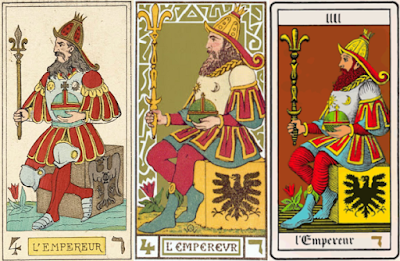
In the sky, Hercules is depicted with one foot on Draco -- in other words, he plays the role of St. Michael. In Oswald Wirth's Tarot, the Emperor is associated with Hercules, and he has a Sun and Moon on his breastplate just like the depictions of Michael we have been discussing.

Wirth also identified his Herculean Emperor with the Hebrew letter Daleth -- the Door. The Emperor is numbered 4, and his throne is a cube -- adorned with, if not actually an owl, at least a bird of prey.

In a recent discussion I was having with someone about the Owl Door, the number 64 and the word Lionclad (from a dream) came up. Lionclad clearly means Hercules, and 64 is the cube of 4. (Also, if 4 = Daleth = Door, 64 corresponds to Six Doors -- called Six Owl Door in English.)

It's also worth noting that my posts on Oswald Wirth's Emperor card are what first led Debbie to contact me.

Popular posts