the overlapping circles of a Venn diagram (forming the vesica piscis where Christ sits enthroned in the Maiestas Domini icon), and I associated this with the strange object in the sky of the Eight of Cups (a combined crescent moon and full moon?)
My next post was "The Green Door," and Debbie left a comment all about yoni symbolism in connection with the Door, not knowing of my recent mental image of a vesica piscis (a yoni symbol) in connection with the Eight of Cups (a card I had featured in a post with a Doors lyric as its title).
The thing is, the object in the sky of the Eight of Cups doesn't really look anything like a Venn diagram or a vesica piscis. I just connected it with that at a conceptual level because it seemed to be a union of opposites (Sun and Moon, or full moon and crescent).
My posts sent Debbie looking through her old dream journals, though, and her attention was drawn to one dream in particular, called Serpent Holes. Some convoluted but inspired train of thought led her from that to Serpent Mound in Ohio and to the Locust Grove crop circle, which was discovered on August 24, 2003, less than 2,000 feet from the Mound. Here's a schematic drawing of the layout of the circle:

In "The vesica piscis and the blue moon," I noted that the "moon" on the Eight of Cups is not actually a circle divided into two parts by an arc (like the bright and dark parts of a crescent moon), but is a smaller circle overlapping a larger one. If you look at the silhouette of the entire object, it's not circular but has a convex bulge on one side. The resemblance to the Locust Grove circle is uncanny.

What the Locust Grove formation also includes -- but which is absent from the Eight of Cups -- is an explicit vesica piscis. This is mentioned in the write-up I linked (originally linked to by Debbie in her comment):

So I intuitively connected the Eight of Cups "moon" with the vesica piscis even though nothing in the image really suggests that; and Debbie, following the thread of her own dreams, stumbled upon a formation (in Ohio, which is where I usually say I'm "from"; in 2003, I lived less than 100 miles from Serpent Mound) which combines the Eight of Cups shape with a vesica piscis.
In a similar way, Ben looked at the Eight of Cups and for some reason thought of the Archangel Michael of Panormitas, even though I can't see any connection between the two at all except for the Sun and Moon on Michael's chest -- which Ben did not even notice until after he had made the link. This led me to look up other representations of Michael with a Sun and Moon, and I ended up finding one that corresponds perfectly to the Nebra sky disc -- which disc had also been brought up by Debbie in connection with her dream journal. This is an unusually collaborative sync-stream that's emerging; Ben, Debbie, and I all seem to be "in sync," so to speak.
The Archangel Michael, of course, is generally shown with his foot on the defeated serpent or dragon -- which syncs with the crop formation being so close to Serpent Mound. The file Debbie linked to about the crop circle even says that Serpent Mound probably represents the constellation Draco, identified by the Sumerians with Tiamat. In D&D, Tiamat is the evil counterpart to the good Bahamut, the Metal Worm.
If the serpent is the Metal Worm, who is Michael? He's Mr. Owl, of course. In the de Vos painting of Michael, written around his hand is the Latin motto Qui ut Deus? -- a translation of the literal meaning of the name Michael. In English, it would be Who is like God?

In the sky, Hercules is depicted with one foot on Draco -- in other words, he plays the role of St. Michael. In Oswald Wirth's Tarot, the Emperor is associated with Hercules, and he has a Sun and Moon on his breastplate just like the depictions of Michael we have been discussing.
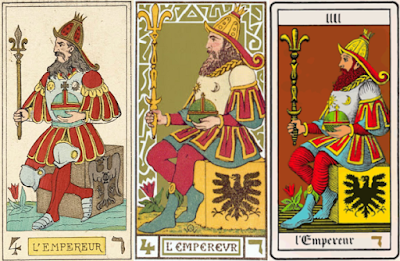
Wirth also identified his Herculean Emperor with the Hebrew letter Daleth -- the Door. The Emperor is numbered 4, and his throne is a cube -- adorned with, if not actually an owl, at least a bird of prey.
In a recent discussion I was having with someone about the Owl Door, the number 64 and the word Lionclad (from a dream) came up. Lionclad clearly means Hercules, and 64 is the cube of 4. (Also, if 4 = Daleth = Door, 64 corresponds to Six Doors -- called Six Owl Door in English.)
It's also worth noting that my posts on Oswald Wirth's Emperor card are what first led Debbie to contact me.


