Showing posts with label Adam and Eve. Show all posts

Wednesday, May 1, 2024

Armored vultures and Cherubim

In my last post, "How is an armadillo like a griffon vulture in the Crimea?" vultures are connected, by way of armadillos, with armored knights. This reminded me of two cartoon characters I used to draw as a child: Victor the Vulture and Sylvester the Snake. None of the cartoons have survived, but they were drawn in the style of Walt Kelly's Pogo. Victor wore a visored helmet like a medieval knight's, a baldric, and a scabbard; and Sylvester would ride inside the scabbard as if he were a sword, with his head sticking out where the hilt would be. There was a running gag that Sylvester liked to eat apples, which he swallowed whole, and when he and Victor were on a mission, he would always end up finding some apples and getting distracted by them.

The idea of a vulture wearing armor like a knight is a pretty unusual one, I think.

In recent syncs, the vulture (particularly the genus known as "griffon vultures") has been interchangeable with the griffin, and particularly the griffin in The Tinleys, which lives at the top of a mountain and turns out to have godlike powers. In Russian (the vultures in the syncs have been Russian/Ukrainian), the word for "vulture" also means "griffin."

I had always assumed that griffin was related to the French griffe, "claw," but apparently not. Etymonline suggests a more surprising connection:

Klein suggests a Semitic source, "through the medium of the Hittites," and cites Hebrew kerubh "a winged angel," Akkadian karibu, epithet of the bull-colossus (see cherub).

So griffin may be related to the biblical word Cherubim. Just as a griffin's role is typically to protect treasure, the biblical Cherubim protect the Tree of Life:

So he drove out the man; and he placed at the east of the garden of Eden Cherubims, and a flaming sword which turned every way, to keep the way of the tree of life (Gen. 3:24).

Victor the Vulture wears a sword belt, but instead of a sword it contains a snake that like to eat apples -- a pretty obvious link to the Garden of Eden story. The snake is even called Sylvester, meaning "forest dweller." The griffin in The Tinleys lives at the top of "the biggest, steepest, most dangerous mountain around." Ezekiel places the Cherub and the Garden of Eden on a mountaintop:

Thou hast been in Eden the garden of God . . . . Thou art the anointed cherub that covereth; and I have set thee so: thou wast upon the holy mountain of God; thou hast walked up and down in the midst of the stones of fire (Ezek. 28:13-14).

In Nephi's vision, too, the Tree of Life is seen on "an exceedingly high mountain, which I never had before seen, and upon which I never had before set my foot" (1 Ne. 11:1).

Saturday, December 3, 2022

Sync: Archaic Revival and the serpents and birds of paradise

I'm normally reading several books at once. I'm still in the middle of Valentin Tomberg's Lazarus, Come Forth! but last night I randomly decided to start reading a book I'd picked up some time ago but never opened: Terence McKenna's The Archaic Revival (1992). I only read a few pages. Between the table of contents and the foreword was this full-page illustration by the German collage artist Wilfried Sätty.


A naked couple in a jungle with a huge snake -- a pretty obvious Garden of Eden reference, presumably chosen by McKenna because of the forbidden fruit's character as a "mind-altering plant." There are also a lot of birds in the picture -- vultures or cormorants or something, but also, by virtue of the setting in which they appear, "birds of paradise."

I didn't really think much about it until today, when I picked up Lazarus, Come Forth! again and read this:

The madness in which Nietzsche's great adventure ended was not personally deserved; nor was it brought about by addiction to a personal lust for power, position, and greatness. Nietzshce was a sacrifice to the superhuman force of the collective all-human subconscious, which came to a kind of volcanic eruption in him. And what broke through there was the archaic evolutionary drive itself, belonging to the most archaic layer of humanity's subconscious. Here lies the most general and most hidden drive working in the subconscious of man: this is the impulse and promise given by the serpent in Paradise.

Here again the word archaic and the idea of revival (one of the main themes of the book, as indicated by its title) are paired with the serpent in Paradise.

My decision to start reading a book by a drug guru was probably inspired in part by the experience recounted in my recent post "Nutmeg is a drug." In that post, I mentioned that nutmeg belongs to the same class of drugs as datura, and I told how I had tried in vain to track down a novel I had read as a child in which a bird became intoxicated by eating nutmegs. I had reached the tentative conclusion that it must be one of the many English versions of The Swiss Family Robinson, but Kevin McCall has discovered that it was actually 20,000 Leagues Under the Sea. (Oddly, in the post I had mentioned dreams of the sort "where you wake up feeling as if you've been underwater.") Check out the context:

Some inoffensive serpents glided away from us. The birds of paradise fled at our approach, and truly I despaired of getting near one, when Conseil, who was walking in front, suddenly bent down, uttered a triumphant cry, and came back to me bringing a magnificent specimen.

"Ah! bravo, Conseil!"

"Master is very good."

"No, my boy; you have made an excellent stroke. Take one of these living birds, and carry it in your hand."

"If master will examine it, he will see that I have not deserved great merit."

"Why, Conseil?"

"Because this bird is as drunk as a quail."

"Drunk!"

"Yes, sir; drunk with the nutmegs that it devoured under the nutmeg-tree under which I found it. See, friend Ned, see the monstrous effects of intemperance!"

Another book I am reading at the moment is Divination in Ancient Israel by Frederick H. Cryer, a lot of which is devoted to preliminaries. (Not until p. 229 does the actual discussion of ancient Israel begin.) In a passage I read a few days ago, Cryer is commenting on the book Witchcraft, Oracles and Magic among the Azande by E. E. Evans-Pritchard and cites, of all the things to cite in this rather pedantic book, The Teachings of Don Juan.

[Evans-Pritchard's] distinction between "empirical reality" and "Zande explanations" of the same cannot ultimately be maintained. Just how meaningless the distinction in question can be may be illustrated by an event in the course of Carlos Castaneda's initiation at the hands of a Yaqui "man of power", Don Juan. Having been taught how to prepare the datura plant for a psychic excursion, Castaneda has an experience of being transformed into a bird and soaring above and away from his mentor. . . .

I've posted about this business of transforming into a bird before -- and no prizes for guessing what specific kind of bird! See my 2020 post "Whitley Strieber and the thing that turned into a bird of paradise."

I also note in passing that the Spanish don derives from Latin dominus, while Juan is the Spanish form of Iohannes. Both Latin words featured prominently in my recent post "What does 'do-re-mi' mean?" as they are the reason the scale begins with do and ends with si.

Friday, November 25, 2022

Ave Maria

As a young child, I had heard Ave Maria set to music, and I was aware that Catholics and football players prayed "Hail Mary," but for a surprisingly long time (maybe until I was 11 or 12?) I never made the connection between the two. Having been raised without any knowledge of Latin, I didn't know what ave meant, but I thought of it as likely meaning "grandmother" (because of Esperanto avo, "grandfather," which I correctly guessed was probably derived from Latin) or perhaps having something to do with birds (the class Aves). The relevance of birds was obscure, so I tended toward the former interpretation: Ave Maria probably meant something like "Grandmother Mary" -- as God's children might well address the woman called the "Mother of God." I never guessed that it simply meant "hail"!

I also noticed early on the similarity of ave to the name Eve, which struck me as a meaningful coincidence. Eve was also our "grandmother," of course, and Mary was the mother of the Second Adam, Jesus, just as Eve was symbolically the "mother" of the first Adam (who called her "the mother of all living" before they had had any children together).

Much later, when I became aware of Muhammad's apocryphal statement about the goddesses of Mecca -- "these are exalted birds, whose intercession is to be hoped for" -- that idea, too, became part of the cloud of association surrounding the phrase Ave Maria.

⁂

Today I was washing the dishes and listening to the Verve song "Bitter Sweet Symphony," with its repeated line, "it's a bittersweet symphony, that's life," and it made me think of the old debate among Mormons over whether the fruit of the tree of life was bitter or sweet. Referring to the two trees of Eden, the Book of Mormon speaks of "the forbidden fruit in opposition to the tree of life; the one being sweet and the other bitter" (2 Nephi 2:15). The problem is that the fruit of the tree of life is said elsewhere to be "sweet above all that is sweet" (Alma 32:40-42), and the forbidden fruit is said to be "delicious to the taste and very desirable" -- so which fruit was bitter? When I was a missionary, one of my colleagues attempted to solve the riddle by proposing, mostly tongue-in-cheek, that the forbidden fruit was the coffee bean -- bitter but delicious, and of course forbidden to Mormons!

The bitter fruit debate passed briefly through my mind, and my attention turned to other things. I thought of the /x/ thread I linked in my November 15 post "Mandrakes, treasure-hunting, syzygy," in which one anon had, somewhat surprisingly, listed "Spelling and Etymology" as one of the factors that might bring about paranormal experiences. This made me wonder if there were any words that I used often without knowing their etymology. Not really, not in English, but then it occurred to me: a word I am in the habit or repeating 50 times a day every single day -- ave! I know now of course that it means "hail," not "grandmother" or "exalted bird," but I realized that I hadn't the faintest idea where the Latin word had come from or what other Indo-European words it might be related to. I couldn't even hazard a guess -- what a strangely opaque word! Our English hail obviously means to wish someone good health and is related to hale and heal and other such words, but where could ave possibly have come from?

After I finished with the dishes, I looked it up, and it turns out it's not an Indo-European word at all. It's of Semitic origin, borrowed from the Carthaginians, and the similarity to Eve is not a coincidence.

Borrowed with an unspelled /h/ from Punic *ḥawe ("live!", 2sg. imp.), cognate to Hebrew חוה‎ ("Eve"), and as avō from Punic *ḥawū (2pl. imp.), from Semitic root ḥ-w-y (live).

So Ave Maria is literally, etymologically, connecting Mary to Eve and to the tree of life. This reminded me of this striking passage from the Book of Mormon, in which Mary is equated with the tree of life:

And it came to pass after I had seen the tree [of life], I said unto the Spirit: I behold thou hast shown unto me the tree which is precious above all.

And he said unto me: What desirest thou?

And I said unto him: To know the interpretation thereof . . .

And it came to pass that he said unto me: Look! . . . And I beheld the city of Nazareth; and in the city of Nazareth I beheld a virgin, and she was exceedingly fair and white.

And it came to pass that I saw the heavens open; and an angel came down and stood before me . . . And he said unto me: Behold, the virgin whom thou seest is the mother of God . . . Knowest thou the meaning of the tree . . . ?

Then I made the connection: I had just been thinking about the tree of life, and whether its fruit was bitter or sweet. Well, doesn't the name Mary itself mean "bitter," etymologically -- related to Marah, the bitter waters? And yet to Sancta Maria, "holy bitter," we pray, Vita, dulcedo, et spes nostra, salve! -- "Hail, our life, our sweetness, and our hope!"

Then there's Yeats's idea that the two trees, the sweet and the bitter, are really only one holy tree and its reflection, and that we undo the Fall when we "gaze no more in the bitter glass."

I think I'm starting to agree that there is something paranormal about etymology.

Sunday, August 28, 2022

More syncs related to the "Glove Puppet" video and crop circles

It turns out (see Debbie's comment here) that my most recent reference to the Locust Grove crop circle (pdf), in "Michael the glove puppet and X the Owl," was posted on the 19th anniversary of the appearance of that formation on August 24, 2003. On the same date in 2004 a very similar formation appeared in Miamisburg, Ohio (pdf).

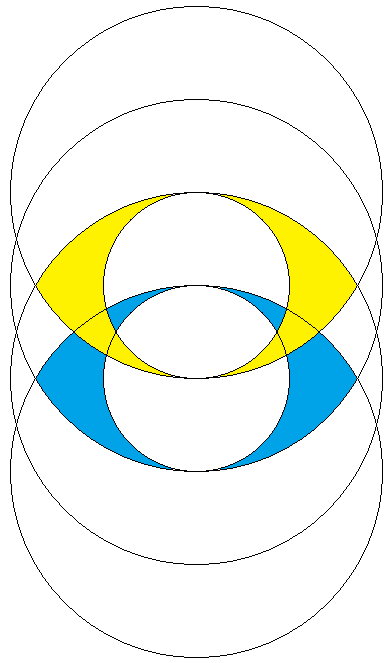
The glove puppet referenced in the title of that post is from an episode of the British TV show Pipkins. As WanderingGondola pointed out in a comment, the broadcaster's logo features a vesica piscis -- actually, two overlapping vesicae, each with a circle inscribed in it to make an eye shape (as in the Locust Grove formation), and these circles overlap to form a third vesica. The whole thing bears more than a passing resemblance to the 2004 Miamisburg crop formation.


Here's a schematic representation of the geometry of the ATV logo, which is based on four overlapping circles forming two vesicae piscium in which smaller circles are inscribed.


There's another well-known logo that approximates this same geometry pretty closely.


WanderingGondola also calls attention to two other interesting features of the Pipkins video. At the end of the glove puppet story, Johnny asks Moony to ask Michael to say the word it's, which he does. Then a series of images of clocks flashes on the screen for a few seconds, and then the word Time. Johnny then appears, completing the sentence: "[It's time] for me to make a glove puppet."


This fits with recent syncs involving such phrases as "It's time," "Now is the time," "The time is now," and "Time's up." (See "Owl time, and cold noodles." I notice now that the owl featured on that post is blue, like X and Meneer de Uil.)

Also, the credits at the end feature a name which is interesting in the context of the Mormon doctrine that Adam, the first man, is the same individual as Michael the Archangel.


WanderingGondola also notes that X the Owl get his name from the word escape, mispronounced by Daniel Striped Tiger as X-scape, and that Xscape also happens to be the name of a posthumously released Michael Jackson song and album. Check out what, according to IMDb, Michael Eve was doing just before his work on Pipkins.


Of course the series is a decade too early to have anything to do with Michael Jackson's Thriller, but the name is still quite a coincidence. It's not a just a Michael Jackson album; it's the Michael Jackson album, the only one a non-fan like myself would be able to name off the top of my head.

Michael Eve also worked on a series called Knock on Any Door in 1966. In the O. Henry story "The Green Door," the protagonist, Rudolf Steiner (no relation!) is handed a mysterious card with "The Green Door" written on it, and responds by entering a nearby apartment building, seeing a green door, and knocking on it. Only much later does he discover that all the doors in the building are green, and that he could have knocked on any one of them.

Thursday, July 28, 2022

More Mr. Owl

Last night, I read this in Clelland's book about owls:

The woman I spoke with is Jacquelin Smith, and along with having UFO contact experiences, she is an author, psychic and animal communicator. Her first book from 2005 was titled, plainly enough, Animal Communication.

This reminded me that I had on one of my bookshelves a book with the very similar title Animal Speak, by Ted Andrews, which I had picked up for a dollar years ago at a used bookstore but had never so much as opened. Today I decided to take it down from the shelf and see if it had anything interesting to say about owls.

I opened the book at random -- a 383-page book which, the cover promises, covers "creatures great and small" and "includes a comprehensive dictionary of animal, bird, and reptile symbolism" -- and these are the pages I got:


That's right, I just happened to open up directly to the first page of the entry for "Owl." Either the book's previous owner consulted the owl article a lot, or else it's just one of those weird coincidences.

Skimming what Mr. Andrews has to say about owls, I don't find too much that's new to me. However, a few passages caught my eye. The first:

To the early Christians and Gnostics, [the owl] is associated with Lilith, the first wife of Adam who refused to be submissive to him.

In my last post, I said that Adam is (according to Joseph Smith) the same personage as Michael the Archangel, and the title of the post was "Immediate confirmation that Michael is Mr. Owl." One possible meaning of the title "Mr. Owl" would be a man who is married to an owl.

Andrews also mentions how owls blink:

Like humans, they blink by closing the upper eyelids, giving them a human expression which has added to the mysticism of owls.

In "The Locust Grove crop circle," where I first proposed that Michael was Mr. Owl, I said that Michael means "Who is like God?" I wanted to add a picture of an owl with the word "Who?" so I searched the Web for one. As it happens, I ended up choosing an animated gif of an owl blinking.


Finally, this passage suggests that "Mr. Owl" might not actually be an owl at all but a hawk.

Some owls have a balancing raptor. The owl is lunar and nocturnal, while some raptors are diurnal and solar. Owls and some hawks will share the same territory, one hunting and using it by day, and the other by night. They don't necessarily get along, but they do tolerate each other in varying degrees. These can be seen as balancing medicines, and rituals and meditations can be used with the owl and its solar equivalent. They can be used to balance the male and female.

There follows a table of owls species, each with its corresponding species of hawk or falcon.

According to this article on "The Archangels and their Divine Responsibilities,"

Of all the Archangels, Michael is the head of this order. He is often depicted with sword in hand. He appears to me as bright and shimmering golden energy (this color is associated with the higher heavenly energy chakras located well above the head), as an image of a brilliant golden wing, in human form dressed in white with wings and carrying a sword or glowing with a gold aura, and in the form of birds of prey, such as falcons and hawks. 

Immediate confirmation that Michael is Mr. Owl

More syncs? More syncs. True player don't get no time to sleep. I see there are some comments on my last post already, but I haven't read them yet. I need to get this typed up first.

In my last post, I identified the constellations Hercules and Draco with St. Michael and the Dragon. I further identified the Dragon with the Metal Worm and Michael with Mr. Owl (as in the palindrome "Mr. Owl ate my metal worm") -- this latter connection being made on the rather flimsy grounds that Michael’s name means "Who is like God?"

Shortly after posting that, I went outside to take out the trash. I noticed a big gecko on a wall I was walking past, and I stopped to watch it for a bit, thinking, "Hey, it’s a dragon!" This is uncharacteristic behavior; geckos are extremely common in this part of the world, and ordinarily I would no more take notice of one than I would of a cockroach. This one felt like a significant "dragon," though, and I sort of expected something synchromystically relevant to happen with it. Nothing did, though, so after a minute or so I went on my way.

Later, I checked my blog for new comments, and then I checked the stats, which I don't do very often. I saw that I had had about 12,000 hits last month and about 10,000 so far this month. I used the calculator app on my phone to work out about how many hits per day that was.

Then I started reading, you guessed it, Mike Clelland's The Messengers. I came to a section with the heading "333 and orchestrated clues." Seeing that numerologically significant number reminded me that I wanted to check the gematria value of a particular word. I brought up the calculator app to do so and found that my last calculation was still on the screen:


So that got my attention. In this section, Clelland tells the story of a woman who kept running into the number 333 and the time 3:33. It seemed significant, but she couldn't figure out what it meant. Then, on what I infer from astrological clues given later in the text was January 24, 2003, she had a close-range sighting of a large triangular UFO with three lights on it, and the 333 syncs abruptly stopped. This woman was an astrologer, and later she was browsing her ephemeris and noticed this:

For the entirety of 2003, the number 3:33 appeared just one and only time for the Sun, the brightest and most important astrological luminary, and this fell on the very day of her triangle sighting.

Of course in the course of a year, the Sun will pass the 3°33′ mark in each of the 12 zodiac signs, but the standard Swiss ephemeris only gives the planets' positions for midnight Greenwich time each day of the year. That's how I inferred that her triangle sighting was on January 24 (Clelland only says "a winter's evening in 2003"); the emphemeris gives the Sun's position for that date as 3Aqu33′56.

The woman was still at a loss regarding the meaning of 333 until her epiphany finally came in the strangest way imaginable:

Kaye looked at a fish aquarium in the office. She was shocked to see that the little catfish Draco had been chewing on his favorite treat, an English cucumber. She said, "It was almost like a magnet drew my eyes to the cucumber!"

The fish had eaten out the middle of the cucumber slice, so there was now a perfectly formed hole in the precise shape of an equilateral triangle. Seeing this, she realized instantly how all the clues were related and couldn't believe that she had missed something so obvious.

Sounds like one of those koan stories, doesn't it? "At that moment, Kaye became enlightened."

This first caught my attention because of the name Draco (italicized in the original), since I had just posted about the constellation Draco. Then I noticed a really weird coincidence: Kaye saw that a catfish had eaten a triangle out of  a cucumber. It just so happens that I have in my house a cat called Triangle and another cat called Cucumber.

And finally we come to the Michael part. Clelland comments:

While there is no owl in this account, it does show up indirectly. The catfish shares its name with Draco the Dragon, a constellation that wraps itself around Polaris, the North Star. In Greek legend, Draco was a dragon killed by the goddess Minerva and thrown into the heavens where we still see it each night. Minerva, as we know, has a companion little owl.

That's actually just one of many myths relating to Draco (others identify it with Ladon, the dragon that guarded the Golden Apples and was killed by Hercules). But Clelland identifies the (female) conqueror of Draco with the owl. That makes Michael, the male conqueror of the the Dragon, Mr. Owl.

Hercules killed the dragon in order to secure the Golden Apples from the Garden of the Hesperides. This combination of garden, serpent, and forbidden apples naturally leads one to identify Hercules with Adam. The Locust Grove crop circle was in Adams County, Ohio; and Mormonism holds that Adam is the same person as the Archangel Michael.

What time did I read this story in Clelland's book? Well, my calculator screenshot was at 2:06, and I took a screenshot of the bit about Draco and Minerva at 2:29. That means that at 2:27 -- exactly 3 hours and 33 minutes after posting about Draco in my last post -- I was reading this Clelland story about Draco and the significance of 3:33.

I was going to post all this last night, but it was already very late, so I decided to go to bed and leave it for the morning. I had only been in bed for a few minutes when my wife (who is even more of a night owl than myself) called me to come downstairs. There was a baby gecko in the living room, and she wanted me to catch it and take it outside before the cats killed it.

How's that for a nice synchronistic punctuation mark?

Friday, July 2, 2021

The naming of Eve

When it was decided that Adam needed a partner, God created the various beasts of the field and fowls of the air and brought them to him. Adam named them all, but no suitable partner was found. Finally God removed one of Adam's ribs and made it into a woman -- and Adam named her, too: "She shall be called Woman [ishshah], because she was taken out of Man [ish]" (Gen. 2:23).

Later, after this first couple had eaten the forbidden fruit, but before they had been driven out of the garden, God came to them in the garden and cursed them -- the serpent to go on its belly and eat dust, the woman to suffer painful childbirth and be ruled by her husband, and the man to eat bread in the sweat of his face till he return unto the ground.

Immediately after these cursings -- but still before receiving coats of skins, being driven out of the garden, or "knowing" his wife and begetting a son -- Adam changed his wife's name: "And Adam called his wife's name Eve [chavvah], because she was the mother of all living [chay]" (Gen. 3:20).

Consider how strange this is. Certainly now we would say that Eve is the mother of all living -- that all living human beings are her descendants -- but what could it have meant to Adam when he said it then? Eve had not yet become the mother of anyone at all, and of "all living" at that time -- the plants, the animals, the man, and herself -- she was the very last to have been created. In fact one could almost say that Adam was her "mother," since she had been "taken out of Man."

(A minority of Bible translations try to elide the difficulty with such renditions as "she is," "she was to be," or "she would become"; but I can see no justification for this in the Hebrew, which uses the perfect aspect.)

Later, when Cain was cursed by the Lord for the murder he had committed, he whined, "My punishment is greater than I can bear" (Gen. 4:13). We see no such reaction from Adam -- no reaction at all, in fact. As the Lord laid out all the ways in which Adam was to be cursed "because thou hast hearkened unto the voice of thy wife," Adam seems to have been thinking of something else entirely; and when the Lord had finally finished, instead of expressing sorrow or begging for mercy or anything like that, Adam said, "I think I'm going to call my wife the Mother of All Living."

In Dante, there is an "ante-hell" and an "ante-purgatory" before one enters each of those realms; one is almost in hell or purgatory, but not quite, not fully. The garden had been a sort of "ante-Earth," where Adam and Ishshah were existing, surviving, but not yet fully living. Without knowledge of good and evil, possibly without fully physical bodies (if that is what "coats of skins" means), they had not yet fully embarked on the adventure of mortality. Living -- real living -- Eve was the mother of that.

Popular posts