Showing posts with label Green Lantern. Show all posts

Tuesday, May 23, 2023

Syncs: At the Back of the North Wind

As documented in my May 13 post "Syncs: The World Beneath," I recently ran across the James Gurney book Dinotopia: The World Beneath, and I did eventually manage to read the whole thing. Of all the dinos and other prehistoric creatures in the story, only one of them has an invented name: skybax, a fictional species of Quetzalcoatlus. I asked Mr. Gurney if the second element of that name meant anything in particular, but he said he could no longer remember; he had invented it because he thought Quetzalcoatlus was too much of a mouthful.

I thought skybax sounded like sky-back, which made me think of the Flammarion engraving, in which a man pokes his head through the firmament and can see what is in back of the sky. An email correspondent was reminded of skybox, a method used in video-game graphics to create the illusion of an infinitely distant sky. This "sky" actually consists of the inner surfaces of a finite cube, though; Wikipedia notes that a similar device, the skydome, works on a similar principle but uses a sphere or hemisphere instead of a cube. So two quite different free-association etymologies for skybax each leads to the Flammarion concept.

In addition to Q. skybax, the (non-fictional) type species, Q. northropi, also appears in The World Beneath, but the "northies" are only mentioned on one page: p. 150, next to a picture captioned "Casting away the ruby sunstone."


As I had already connected skybax with the idea of "the back of the sky," the juxtaposition with northies made me think of a book I had bought over a year ago but had not yet read: At the Back of the North Wind by George MacDonald. It was actually sitting right there on my desk, since I had been rearranging some of my books and had not yet found a suitable place for it in any of my bookcases. I picked it up, glanced at the table of contents, and saw that one of the chapter titles is "Ruby."

Then, remembering that I had used the Flammarion engraving a few times on my blog, I looked up those old posts and discovered that one of them, "Break on through to the other side" (July 2022) features an epigram from none other than George MacDonald.

That was enough to make me start reading At the Back of the North Wind, and as I write this post I'm about halfway through it. The main character is a boy named Diamond, and the reason he has such an unusual name is that he was named after his father's favorite horse. As he explains to the title character when they first meet, "Diamond is a great and good horse; . . . he's big Diamond and I'm little Diamond; and I don't know which of us my father likes best."

This talk of big and little diamonds is another link to the sunstones of The World Beneath:


As I mentioned, I have been rearranging some of the books in my rather large library, and last night I ran across my copy of Shelley's Poetry and Prose (Norton), which I had forgotten I owned. Since Shelley's poem about the sensitive plant was in the sync-stream a while back, I took it down and looked up that poem. Lines 106-07 caught my eye:

And a northern whirlwind, wandering about
Like a wolf that had smelt a dead child out

The North Wind of MacDonald's story typically takes the form of a beautiful long-haired woman who is sometimes extremely large and other times "just about the height a dragon-fly would be, if it stood on end." (Dragonflies again!) At one point, though, she takes on rather different appearance:

At the foot of the stair North Wind stood still, and Diamond, hearing a great growl, started in terror, and there, instead of North Wind, was a huge wolf by his side. He let go of his hold in dismay, and the wolf bounded up the stair. The windows of the house rattled and shook as if guns were firing, and the sound of a great fall came from above. Diamond stood with white face staring up at the landing.

"Surely," he thought, "North Wind can't be eating one of the children!"

Incidentally, I started At the Back of the North Wind just after finishing The Uninscribed by Stephanie South (which is just about the new-agiest thing I've encountered in my puff, and I say this as someone who has read Pleiadian Perspectives on Human Evolution by Amorah Quan Yin) -- from South to North. South calls herself the Red Queen -- a reference to the nickname of an unidentified Mayan woman, but also a Lewis Carroll character who, since Carroll made it clear she is a different person from the Queen of Hearts, could only be the Queen of Diamonds. Here's the opening paragraph of The Uninscribed:

As a child, I had recurring visions of underground time tunnels in the earth. The tunnels were connected to a transport system with openings that led into past, present, and future. Through these tunnels, I witnessed world wars, a time of dinosaurs and giants, as well as possible futures.

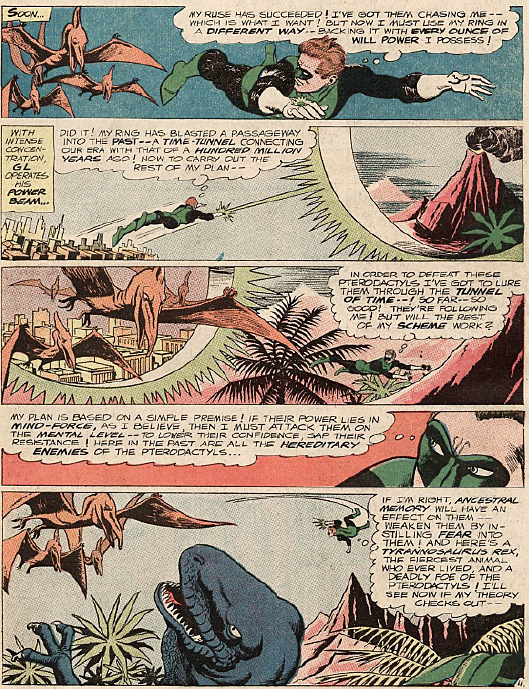
Underground tunnels and dinosaurs are another link to The World Beneath, but also note that the very first sentence mentions time tunnels -- as in my February 24 post "Green Lantern pterosaur time-tunnel story here!" (That was a gematria-inspired title, by the way. In S:E:G:, Green Lantern = pterosaur = time tunnel = story here = 133.)

Today I gave some of my very young English students a test. It was an old test I had made for a different group of students two years ago, well before the pterosaur or dragonfly syncs started. It's testing extremely basic English grammar -- the use of is and are, and giving short answers to yes/no questions. There's a picture and a question of the form "Is it . . .?" or "Are they . . .?" and they have to complete and answer the question. If the correct answer is "No," of course, almost any picture will do, so just for kicks I had thrown in a few random prehistoric creatures. For example:


This is the one that really got my attention today, though:


Not only is it a pterosaur, I'm pretty sure it's supposed to be a Quetzalcoatlus northropi. I may have chosen it as a sort of pun (pterosaurs are called "winged dragons" in Chinese), or maybe it was just totally random, like the hamster titanotheres. Either way, it was a strange coincidence running into it again now.

Wednesday, May 17, 2023

Mini T. rex, dragonfly, One33

Yesterday, May 16, in the very same spot where I had earlier found an iron Green Lantern emblem, I found yet another mini T. rex.

996 + 996 = 1992, when the first Dinotopia book was published.

This is the Lonely T. Rex, protagonist of Google Chrome's Dinosaur Game. As in Green Lantern #30, the T. rex and the ptero are enemies. According to Wikipedia:

During the game, the Lonely T-Rex continuously moves from left to right across a black-and-white desert landscape, with the player attempting to avoid oncoming obstacles such as cacti and Pteranodons by jumping or ducking. . . . As the game progresses, the speed of play gradually increases until the user hits an obstacle or a Pterosaur, prompting an instant game over.

Later the same day, I went to Taichung, which I don't do very often, and saw this new-to-me billboard:

One33. As noted in my February 22 post "Will Power is the flame of the Green Lantern!" 133 is the S:E:G: value of Green Lantern, will power, and pterosaur. In Dinotopia, the pterosaur ("skybax") rider is named Will. Note also that the S:E:G: value of the word one is 34, so here's another juxtaposition of 34 and 33.

In the evening, I went to my school. (I have most of Tuesday off, with just two classes in the evening.) We have a big magnetic bulletin board, and several of the magnets used to hold things up there have the form of insects: eight or nine butterflies and one dragonfly. When I arrived last night, I found that one of these had been placed on my desk because the magnetic part had fallen off, making it unusable. No points for guessing which one it was.

Monday, May 15, 2023

Yet another mini T. rex, and the Black Dog Star trifecta

On my way home on Saturday (May 13), I was about to pass a little mom-and-pop general store that I always pass, when I suddenly thought, "Oh, I should stop there. I need to buy -- uh, peanuts and whiskey. I think we're running low on peanuts and whiskey." Actually, we had no peanuts or whiskey at all, which was quite normal, as neither of those items is a regular part of my diet. This was obviously just the left brain spinning its wheels trying to rationalize a hunch, but whatever; I stopped and bought some peanuts and whiskey. When I came out, I found this lying on the pavement just inches from my parked motorcycle:


This is what we call a mini T. rex. It's like, how much more of a mini T. rex could this be? And the answer is none. None more. I'm pretty sure it wasn't there when I parked, though I suppose I could have missed it. Back on April 7, I came out of a shop and found near my motorcycle a piece of rusted metal in the shape of the Green Lantern emblem.


I was pretty sure that hadn't been there when I had arrived, either, but in fact it had. When I had arrived, I had snapped a photo of a scooter that had paw prints and "Let's Go" on it, and the Green Lantern object is clearly visible in the background.


I had taken that photo because black dogs and paw prints had begun to appear in my sync stream. This made me go back and read the first post on Black Dog Star, from 2009. (Unfortunately, all the images from that post are now dead links, making it a little hard to follow.) The very first synchronistic pattern that Arrowsmith identified was the co-occurrence of three things: (1) paw prints, (2) a pair of pentagrams (five-pointed stars), and (3) a name with the initials PP. One of the early instances of this pattern was the 2002 Spider-Man movie:

In this sequence we see Peter Parker chasing his school bus which has a banner displaying the Paw Prints and a Pair of (green) Pentagrams

On Saturday evening, shortly after finding the mini T. rex, I stopped at a pet supply store I had never been inside before: Pet Park. I had actually posted a photo of this place back in 2021, in a post called "Secretly Spid-Man." That is, the whole point of the post was to note the similarity of the name to Peter Parker.


Although I had cropped it off in the photo posted in 2021, the logo also includes -- unsurprisingly for a pet shop -- a paw print.


So that's two out of three: the paw print, and a name with the initials PP -- and not just any name, but one that I had already noticed was very similar to Peter Parker. No pair of pentagrams, though, until on Saturday I finally went inside and found this:


There's a pair of pentagrams just above the Shiba Inu, so that's the trifecta. Later on, Arrowsmith decided that the two pentagrams represented the Sun and the Black Dog Star (Sirius), so it's appropriate that the Pet Park pentagrams include a bright white star and its dark shadow.

Tuesday, March 28, 2023

A ptero more to Green Lantern's liking

I went to Project Gutenberg to look something up, and this was one of the recent releases (March 26, 2023) featured on the homepage.

It's not yellow, but pterodactyls of any color grace the covers of few enough books to make it a noteworthy coincidence nonetheless.

I scrolled down to the table of contents and saw that the third chapter, about pterosaurs, is called "Pirates of the Air" -- pretty similar to "winged raiders," isn't it?

According to the rather dated science of The Monster-hunters (1916), all mass-extinction events were caused by ice ages, and the periods punctuated by these ice ages are characterized as "empires."

With this upheaving, came the First Age of Cold. The coal-forests died, the pine-trees took their places. The marshes became plains. Nearly all species of life belonging to that warm age died. The Empire of the Fishes and Amphibians ended. The Mediterranean slowly diminished in size and again became an inland sea, while in Europe to the north, Africa to the south and in America, beyond the Atlantic, the Empire of the Reptiles began. . . . Yet the slow death of cold which had awaited the Fishes and Amphibians in the Permian Revolution was awaiting the Reptiles also. The Second Age of Cold was near. After the Cretaceous Period, the land began to rise, until, when hundreds of thousands of years had elapsed, the northern part of Europe was elevated, the Mediterranean lost its opening to the ocean, and became once more an inland sea. Then came the Second Ice Age, the second cataclysm of want and death. The Pterodactyls died away completely, the huge reptile monsters fell by thousands and all the giant Saurians had to give place to the warmer-blooded mammals.

The above quote is not in the "Pirates of the Air" chapter but in the next one, "Seeing the Sea-serpent," so the fact that pterodactyls get top billing in the list of casualties of the K-T extinction event is curious. This syncs with my March 18 post "Sync: Another yellow ptero, St. Valentine's Day, Empire of the Ants."

There, too, pteros are unexpectedly highlighted (in the thumbnail) in an account of the K-T extinction. And, as the title indicates, the same post features a sync having to do with the phrase "Empire of the Ants" -- paralleling the similar "Empire" phrases in The Monster-hunters.

The "Seeing the Sea-serpent" chapter also features this illustration, captioned "The Fiercest Monster That Ever Lived."

Isn't that a familiar turn of phrase? Where have we seen that before? Oh, right.

Looking at the list of illustrations after the table of contents, I noticed that the second one on the list was called "Scylla of the Seven Heads" -- one of a small collection of images of "Monsters Thought Real by the Ancients."

This got my attention because on March 17 I had posted old (2015-16) Scylla and Charybdis syncs in "Sync: Skylark and Charybdis" and included a picture of Scylla, though with the canonical six heads rather than seven.

I Ctrl-F'ed Scylla to see if she put in any other appearances in The Monster-hunters, and lo and behold:

"No signs of Scylla and Charybdis," said a voice behind him.

"That's so, Uncle George," the boy said, turning, "this is where the old Greeks believed Scylla to be, isn't it? But I'd rather tackle that six-headed monster, in spite of all her appetite, even though each head took a man from the crew, as it did from Ulysses' ship, than I would run the gauntlet of the guns of Gibraltar let loose on us. Still, even Scylla might be uncomfortable. What do you suppose was the basis of that old story, Uncle George!”

"Personification of the peril of adventure,” was the reply. “That is why Scylla and Charybdis were first said to hold guard over the Straits of Messina, between Sicily and Italy, while afterwards the twin terrors of the ravening whirlpool and the six-headed man-eating woman monster were located at Gibraltar. As the Straits of Messina became more familiar, the terror had to be put farther away, where only the most daring would venture.

"Remember, Perry, that the Greeks believed they saw a god or a goddess or a demon in all the forces of Nature. The sea was under the rule of Poseidon, or Neptune, as the Romans called him; the dawn goddess Eos, or Aurora, was the mother of the Winds, such as Boreas, the North Wind and Zephyr, the West Wind. So, you see, the Greeks felt sure that every point of danger must be guarded by some kind of demon or monstrous form, while beautiful places were inhabited by fair maidens. After all, Perry, it's not so very long ago since people believed in mermaids. So far as that goes, some people believe in them still."

Right after the references to Scylla and Charybdis, characterized as "the twin terrors," we read of "the dawn goddess Eos, or Aurora." In my March 7 post "Fever dreams and sync: Popol Vuh twins, Spinal Pap, stone worship, and more," I discuss terrible twins in Mayan myth and The Matrix Reloaded, and I also mention this:

In my flytrap post, the key phrase was "blushing trap," which I interpreted as a description of the rosy lobes of the Venus flytrap. The expression made me think of the Homeric "young Eos with fingertips of rose." In her comment, Debbie quotes Ovid on the Roman equivalent of Eos: "Aurora, watchful in the reddening dawn, threw wide her crimson doors and rose-filled halls." These rose references link back to William John's carnivorous "Poison Rose of Poetry."

Monday, March 20, 2023

Further green motorcycle syncs

In my St. Patrick's Day post "You can set your watch by the green motorcycle," I relate a dream in which "wherever you were in the world, if you kept your eyes open at 5:00 Tuesday morning, Liverpool time, you would see a green motorcycle go by, timed to sync with the Beatles singing about it on Sergeant Pepper." Because of the 5:00 connection, I included a picture of this Vogues record:


Debbie left several comments. First, she related a dream of her own, from 2017, which was primarily about the Moon but also prominently featured both the color green and a mysterious motorcycle. I quote only a few relevant excerpts:

I felt as if the house was in a large valley type of area. It was in the summer because there were green plush leaves on the trees and the grass was green. . . . I could feel that something wasn’t right. I then looked outside the window to see what was going on and I could see the moon bouncing (like a ball) in the sky. . . . At one point we could see a motorcycle with a young White man and his girlfriend. What was bizarre is that the motorcycle came down from the sky!! It landed in the field where my mother and I were standing.

In a follow-up comment, she noticed that the Five O'Clock World record features the Jonathan King song "Everyone's Gone to the Moon."

Imagine my surprise when I researched the lyrics and OMG! Check out the reference to MOTOR CAR, Painted GREEN. Although a car is not a motorcycle but do in keep in mind they both are vehicles.

Here are the lyrics to the relevant verse:

Long time ago
Life has begun
Everyone went to the sun
Cars full of motors
Painted green
Mouths full of chocolate
Covered cream
Arms that can only
Lift a spoon
Everyone's gone to the moon

Though the song uses the odd expression "cars full of motors painted green," Debbie refers to it as "MOTOR CAR, Painted GREEN," noting that this is not quite the same as a motorcycle. Here in Taiwan, though, motorcycles are quite literally called motor cars. The usual word for motorcycle is 摩托車, pronounced mótuōchē; chē is the Chinese for "car," and mótuō is a transliteration of the English motor. Sometimes mótuō is used by itself to mean "motorcycle," since the word motor itself is now more usually rendered 馬達 (mǎdá). Another word used for "motorcycle" in Taiwan is 機車 (jīchē), which is also used as a euphemism for the Taiwanese equivalent of the c-word. Calling someone a "motorcycle" is roughly equivalent to calling him a jackass. Years ago, when Motorola was using the slogan "Hello Moto" to advertise their cell phones, the Taiwanese found it amusing.

My green motorcycle dream associated "Tuesday morning at five o'clock, Liverpool time" with the Sergeant Pepper album -- apparently a garbled reference to the song "She's Leaving Home," which begins "Wednesday morning at five o'clock, as the day begins." Debbie notes that another line from that song is relevant to the "motor" theme:

Friday morning at nine o’clock, she is far away.
Waiting to keep the appointment she made,
Meeting a man from the motor trade

Just after reading Debbie's comments, I checked The Secret Sun and found a new meme post, "Meme Work Makes the Dream Work." One of the memes there features a motor car painted green:


Apparently, Green Lantern sometimes rides a green motorcycle, too:


And there's also this:


Notice the 101 (Green Lantern symbol) hidden in the word HOLY.

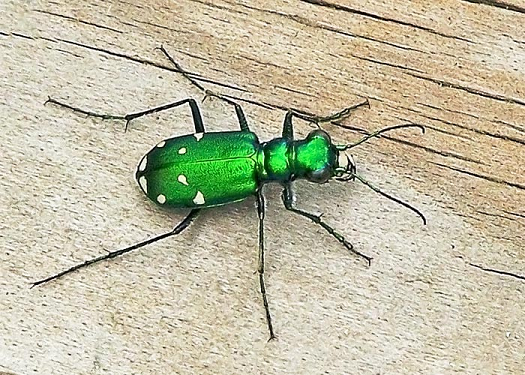
On the theme of dreams and green cars, probably about 30 years ago I had a dream about a man who called himself Elder Case the Fallen Angel and drove a bright green sports car that was always described as being "tiger beetle green." The dream stuck in my memory because I used to think of it every time I saw a six-spotted tiger.


Note added: Running an image search for green motorcycle movie turned up a familiar film.


Matrix lighting sometimes makes everything look greenish, but in this case it really is a green motorcycle.


Here is the scene. Note that it includes the death of the white dreadlocked twins (recently featured in my post "Fever dreams and syncs"), and also shows a driver's shocked reaction when the green Ducati motorcycle seems to come down from the sky, as in Debbie's dream.

Wednesday, March 15, 2023

Sync: Don't be confused. Back up the heavy burds.

I went out randonauting this morning with "yellow pterodactyl" as my target. I found this:


I know that's not the clearest shot -- one has to be discreet when snapping photos of random strangers -- but it reads, "Don't be confused. Back up the heavy burds."

(This shirt saying "Don’t be confused" is kind of like when angels show up in the Bible and say "Fear not" -- it’s a nice thought, but just saying it doesn’t actually help very much!)

I thought "heavy burds" could be interpreted as a pterodactyl reference. Like the word burd, a pterodactyl looks similar to a bird but isn't one, and one of the most salient differences is that most people's stereotypical "pterodactyl" is much larger and heavier than any bird.

As for myself, my mental image of "pterodactyl" has always been centered on the smaller genera (Pterodactylus, Rhamphorhynchus, Dimorphodon) -- possibly because the paleontologically correct books I read never used pterodactyl in the colloquial sense, and so I connected it exclusively with the genus Pterodactylus. I vividly remember encountering this 1980 Garfield strip as a child and being confused by it.


Everyone thinks of pterodactyls as basically being "dinosaurs" and therefore huge, but I never did. And I certainly never would have thought of a pterosaur -- basically a huge flying mouth -- as having particularly large legs. Because it introduced me to this novel concept of pterodactyls having big fat legs, this Garfield strip was burned into my memory, and I remember later thinking of one of my elementary school classmates (a rather "heavy burd" who always wore short skirts) as having "pterodactyl legs."

"Heavy burds" also made me think of the Sesame Street character Big Bird -- who of course is yellow and also looks a bit pterodactylish, especially as conceptualized in Jim Henson's original 1969 design sketch:


"Heavy burds" -- the heaviest bird ever to fly is believed to have been Argentavis magnificens, an extinct relative of the condors; the genus name refers to Argentina, where it was found, but literally means "silver bird." What species is Big Bird? In a 1981 cameo on Mister Rogers' Neighborhood, he claimed to be a "golden condor." Both silver and gold are classified as heavy metals. While the condors are considered "New World vultures" today, they ranged much more widely in the past, so perhaps the bronze birds of Stymphalia, exterminated by Hercules, were members of the same family.

At other times, Big Bird has claimed to be a lark. Skylark = l'arc-en-ciel.

Before he he made it big as Big Bird, puppeteer Carrol Spinney performed on The Judy and Goggle Show, manning the puppet Goggle opposite Judy Valentine. "Jimmy Goggles the God" and St. Valentine's Day have both been in the sync-stream recently.


Before we leave the subject of Sesame Street birds and pterodactyls, here's "Eggs Are Oval":


What about the "back up" part? Well, back up can mean "make a spare copy" or "move backwards," both of which fit what happens to the "heavy burds" in Green Lantern #30. Alien pterodactyls, seeing that their brethren on Earth have gone extinct, recreate the race by bringing a few pterodactyls back from the past -- similar to restoring from a backup copy. Then Green Lantern defeats the pteros by taking them back in time -- "backing up" to the Mesozoic.

Thursday, March 9, 2023

Weirdly specific sync: Meerkats and piranhas

I taught a children's English class this evening. We read this article:


The article consists of one paragraph about baboons and one about meerkats, but the emphasis is clearly on the meerkats, which are featured both in the illustration and in the "weird but true" factoid. Meerkat is a Dutch word.

After the class, two of the children, a brother and sister, were playing a card game while they waited for their parents to pick them up. I heard them saying, "Red fish! . . . Blue fish! . . . Special fish!" Since special is the modifier they usually use if they don't know how to say something properly in English, I checked to see what they were playing so I could give them the needed vocabulary. The "special fish" turned out to be none other than the namesake of this game:


Less than an hour later, I had finished work and decided to check a few blogs. Clicking on a link to a Vox Day post with the uninformative title "You Can't Say I Didn't Warn You," and vaguely expecting something medical or political, I found this instead:


This is obviously not the sort of topic Vox usually covers. His very first sentence calls meerkats "the Piranha of the Serengheti."

Immediately after this, I checked my own blog comments. In my recent "Fever dreams" post, I recount a dream in which D∞D = D&D = "Death & Death." A new comment there by Rara Avis reads:

"Dood" literally means "death" and "dead" in Dutch; I was wondering whether to tell you this before.

Another Dutch word, like meerkat, and it's linked to the double-D. Then I realized that piranha has also been associated with double-D.


Not only is it a double-D, but the numeral 3 is very close to being a lemniscate.

Piranha 3DD was released in 2012, the same year as Life of Pi, which prominently features meerkats. It's called Life of Pi because the main character is called Pi -- short for Piscene, meaning "of or pertaining to fish." Piranha, of course, is a fish name that begins with the letters pi. One also notes in passing that Green Lantern's Eskimo sidekick is called Pie.

Wednesday, March 8, 2023

Venus flytrap in Green Lantern

From Green Lantern vol. 2 #24 (October 1963):


A picture of a Venus flytrap is certainly an odd way of illustrating the fact that there are about 850,000 different species of insects.

Sunday, February 26, 2023

The other 666 restaurant

On January 6, I posted "Roast beast for lunch, roast Beast for dinner," noting the coincidence of having eaten on the same day at two different restaurants with a street address of 666. Ten days later, I posted "The Doors," in which one of those two restaurants, Cafe D&D, began to play a prominent role in the sync-stream.

Today, for the second time, we had dinner at the other 666 restaurant -- at the Evergreen Laurel Hotel in Taichung. I hadn't noticed it before, but their logo prominently features an eight-pointed star:


The other part of the logo -- a globe with lines of latitude and longitude -- also syncs with D&D, since the vertical line divides the circle into two D-shaped hemispheres.

The branch I dined at -- the one numbered 666 -- is the Evergreen Laurel Hotel. On October 17, 2022, I had a dream in which laurels featured.

I dreamed that I was visiting a hunting lodge that had bottles of "owl wine" for sale -- a generic term, not a brand name. This was an amber-colored white wine which I thought looked like Tokay and would therefore probably be too sweet for my taste. Later in the dream I looked up why it was called "owl wine" and found that bay leaves were used in the wine-making process, and that the name originated when an Italian word meaning "laurel" was mistranslated as owl. (I think this Italian word was lava or lavva or something like that.)

If the 666 hotel were mistranslated in the same way, it would be called Evergreen Owl. Oddly enough, when I went to the hotel website so I could screenshot their logo, I saw this in the footer.


That's the logo for Tripadvisor, which of course is going to appear on a lot of hotel websites -- but that doesn't change the fact that it's a green owl with lemniscate eyes. The double-o of the Tripadvisor logo coming right after the Facebook f  also brings to mind Mr. T, whose trademark line is sometimes rendered "I pity da foo'."

Note added: That latitude-and-longitude globe has also been paired with the Green Lantern symbol.

Saturday, February 25, 2023

Green Lantern’s yellow pterodactyls — and my own

In order to get my hands on the story posted in "Green Lantern pterosaur time-tunnel story here!" (from Green Lantern vol. 2 #30, July 1964) I had to download a huge zipped file of more than 200 Green Lantern comic books. Although the alien pterodactyls from that story are obviously not supposed to be recurring villains -- the story ends with them giving up all attempts to interfere on Earth, since any such interference will be impossible for the next 100 million years -- I nevertheless thought I should look through all the other issues I had downloaded to see if they did reappear after all.

They don't, but there's another alien pterodactyl story in vol. 2 #88 (March 1972). Yes, that's number eighty-eight. Like the first pterodactyl story, it's written by John Broome and penciled by Gil Kane, but it's a completely different race of alien pterodactyls this time. Instead of pterodactyls on a distant planet trying to arrange for Earth pterodactyls to take over Earth, we have pterodactyls on Venus menacing cavemen on Venus, and Green Lantern is sent to save his fellow humans. Apparently humans and pterodactyls just sort of spontaneously evolve on lots of different planets.

In #30, Green Lantern can't use his Power Ring against the pterodactyls because of the "energo-shield" their leader has created using his "super-mentality." In #88, he can't use his Power Ring against the pterodactyls because they're yellow. The color yellow, as you may know, is Green Lantern's kryptonite. His power is basically unlimited unless it involves anything yellow.

In #30, Green Lantern defeats the pterodactyls by scaring them -- taking them back to the Mesozoic, where they see a very scary T. rex that weakens the "super-mentality" enough to allow Green Lantern to strike. In #88, he also defeats the pterodactyls by scaring them.-- conjuring up a giant illusory hawk which chases them into a cave, and then collapsing the entrance to the cave.

In #30, the pterodactyls are referred to as pteros -- and I noted that ptero has the same S:E:G: value as Tarot, namely 74. In #88, they are called bird-raiders or just raiders, and raiders also has an S:E:G: value of 74. (The longer name, bird-raiders, has an S:E:G: value of 107 -- which is the value of The Tarot, and of each of the three parts of the Tarot: the trumps, the Minor Arcana, and the the Fool card.)

Just hours before discovering this Green Lantern story, I read H. G. Wells's 1896 short story "The Sea Raiders," which also uses the word raiders to refer to monstrous animals (man-eating cephalopods in Wells's case). Wells came up in the last Green Lantern pterodactyl post, too.


The main thing that got me, though, was the fact that the story is about yellow pterodactyls. I mentioned in my last post that "pterosaurs have at times been a sort of personal totem animal for me." Well, it's specifically yellow pterosaurs -- even more specifically, quite small yellow pterosaurs, possibly juveniles of Pterodactylus or some closely related genus (not the giant Pteranodon-type animals of the Green Lantern stories).

"Ghosts of pterosaurs" -- for lack of any better way of describing a sort of experience I am really at a loss to classify -- have been an occasional feature of my life for a long time, especially when I lived in Maryland, although I've had two experiences of this type in Taiwan as well (one of which I have blogged about), but my big "pterodactyl experience" took place around 2002 or 2003 at Ohio State University, when touching a fossil caused me to have a very brief but extremely vivid vision of a living pterodactylus, bright yellow in color, in its natural habitat, with a few others flying about in the background. The sheer alienness of the scene -- the color of the sky, the quality of the light, the humming of the insects, the feeling of goodness -- overwhelmed me. It lasted a second or two and was gone, and I was left with an intense feeling of grief -- that that world was gone, that all the pterodactyls were dead, that the universe would go on forever without them. (I was an atheist at the time.)

That little yellow pterodactylus has been there in the back of my mind ever since. I think about it every time I read Isaiah's vision of the seraphim, imagining resurrected and glorified pterodactyls singing "Holy, holy, holy" around the Throne. I have sometimes used Flavius Pterodactylus as a username, the etymological meaning of Flavius being "yellow." I don't know why this particular creature is resurfacing now -- particularly through the goofy medium of a Green Lantern comic book! -- but it's got to mean something. A yellow pterodactyl can never be for me anything other than a good omen. Teros, not Deros.


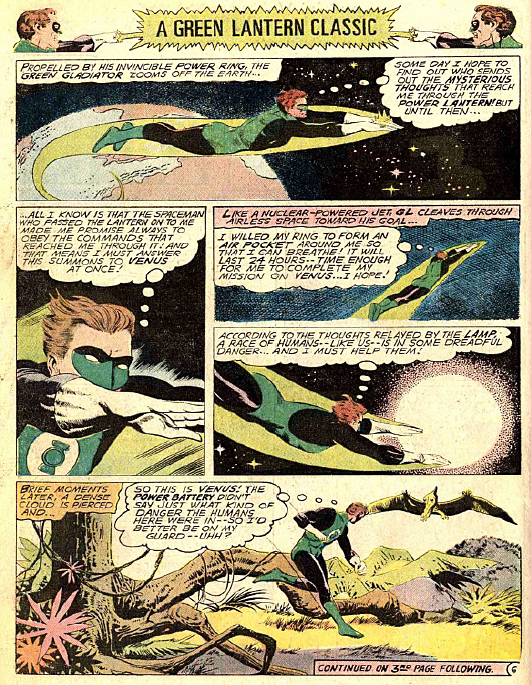
Here's the story. I'm only posting the part that takes place on Venus, not the frame story about Green Lantern's love life.


Friday, February 24, 2023

Green Lantern pterosaur time-tunnel story here!

I finally managed to track down the complete story of Green Lantern, the pterosaurs, and the time-tunnel. It wasn't easy to find, but if you've got WILL POWER you can overcome every obstacle and difficulty in life!

The synopsis I read earlier, which said Green Lantern was facing alien pterodactyls, was an oversimplification. There are intelligent alien pterodactyls in the story, but they live many light years away and can't invade Earth directly.  However, they have the technology to observe distant worlds, and millions of years ago, they noticed that primitive pterodactyls had evolved on Earth. Wanting to ensure that their kind will dominate that distant planet, they direct "a blot of instantaneous M-energy" toward Earth, knowing that "when the M-energy strikes one or more of our race on Earth, it will endow them with super-mental powers! They and their descendants will be able to conquer all their enemies with ease!" I'm not too clear on how they ensured this M-energy would hit pterodactyls and only pterodactyls, but you know what they say: any sufficiently advanced technology is indistinguishable from bad writing.

However, the best-laid schemes o' alien pterodactlys gang aft agley. Having lost sight of the Earth for millions of years due to an "ionic disturbance," the alien pterodactyls finally regain contact and are dismayed to discover that Earth no longer has any pterodactlys at all! Apparently their energy beam missed! Well, mistakes happen, and space villains are notoriously bad at aiming their ray-based weaponry. Luckily, there is a Plan B for bringing about an Age of Pterodactyls on what is for them Planet B.

To give their "brethren on Earth a second chance to conquer the planet," the alien pterodactyls first send a "time-reversal beam" which temporarily sends a small area of the Earth back to the Mesozoic, causing a small number of pterodactyls to reappear. They then send a second M-energy beam, and this time they succeed in striking a pterodactyl! Armed with "super-mentality," this pterodactyl takes control of the other, still primitive, pterodactlys and begins wreaking havoc in the 20th century. His super-mentality also enables him to create an "energo-shield" which makes him and his fellow pterodactyls invincible, even against Green Lantern's Power Ring.

Since it is the "super-mentality" of their leader that makes the pterodactyls invincible, Green Lantern needs to find a way of sapping the lead ptero's mental force through fear. That's where the time-tunnel strategy comes in. He leads them through the time-tunnel back to the Mesozoic, where they encounter their ancient ancestral enemy, the T. rex. The fear this induces weakens the super-mentality enough to allow Green Lantern to defeat them, after which he returns to the 20th century.

Conveniently, just after this, Earth passes out of the alien pterodactyls' "scanner sight -- not to return again for 100 million years!" It's not clear why this is a big deal to a species that has time-travel technology, but apparently it is. The ptero king says, "I propose we abandon our hope of making our fellow-pterodactyls masters of Earth! Nothing else to be done," to which his subjects reply, "We agree, O superior one, we agree!" The End.

And thus we see the triumph of those who have Will Power over those who do not. If those space-pterodactyls had been a little less quick to abandon hope -- if they had only realized the importance of keeping on doing the thing that has you licked -- we might all be speaking ptero right now. Will Power, boys and girls, gets you what you want. Lack of Will Power loses you what you've got.


Throughout this story, Green Lantern refers to his enemies by the abbreviated name ptero. This is obviously a sync with Tero, former surname of Mr. T, and with the Deros and Teros of the Shaver Mystery. Like the alien pteros, the Deros use various sorts of "rays" as their main weapon.

Ptero is also interesting because of the gematria connection. (As noted before, Green Lantern, time-tunnel, will power, and pterosaur all add up to 133 in S:E:G:.) Pterosaurs have at times been a sort of personal totem animal for me, and a very long time ago (c. 2003?) I noticed that ptero has the same S:E:G: value as its homophone tarot, and I even designed a handful of "ptero cards."

Pterosaurs in a superhero comic also reminded me of this classic meme:


What's the name of this pterosaur guy Spider-Man is talking to? Sauron. What is Green Lantern's only weapon against the pterosaurs? The Power Ring.

When I went to Know Your Meme to find the above meme, I found this:


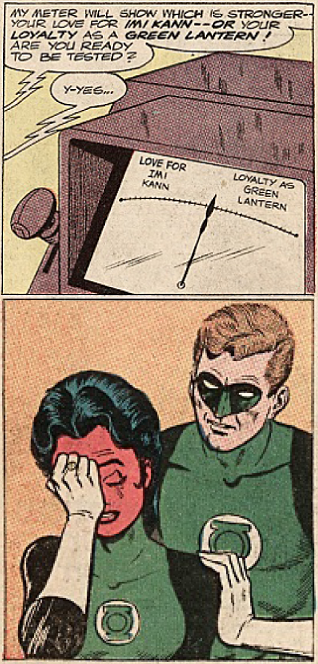
This meme format reminded me a lot of something from "Once a Green Lantern, Always a Green Lantern," from the same comic book issue as the time-tunnel story. I'll upload it later and add it to this post. For now, you get this instead:


Update: Here it is.


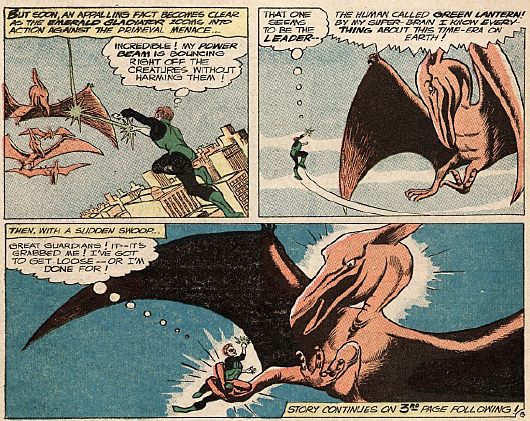
And now, finally, what you came here to see:


I don't know about you, but I would totally shell out for tickets to see a movie version of this.

Desert scenes

My recent post " Half under the sea " began with this image, an adaptation of an existing meme: Commenter NLR determined that the ...