Showing posts with label Knight of Wands. Show all posts

Thursday, June 27, 2024

Nautical Newts

At this rate I'm going to go through the whole freaking alphabet.


A newt is a kind of salamander. Although the picture is captioned "Nine Nautical Newts Navigating Near Norway," there are only six newts in the boat. The remaining three are in the water and are only partially visible. This immediately made me think of the Knight of Wands, recently discussed in "More on Joan and Claire." The Knight's outer garment is printed with salamanders -- six full salamanders plus a few partially visible ones.


The newts are navigating the open sea, while the Knight and his salamanders are traveling through the deserts of Egypt. That's a pretty big discrepancy, but as it happens, I just mentioned in a comment on "The horrible hairy homeward-hurrying hogs of Hieronymus" that "Egypt was also underwater when it was discovered" according to the Book of Abraham. This was following a train of thought started by the fact that the Hog Knight on the cover of Animalia is accompanied by an ostrich, which had made me think of a passage from The Satanic Verses related to the Norman Conquest. The Nautical Newts are also accompanied by an ostrich.

Actually, the Hog Knight has a lot in common with the Knight of Wands:


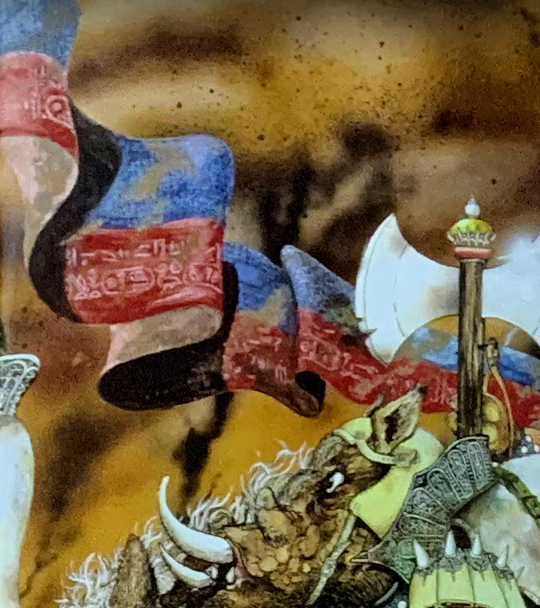
Both are wearing armor and riding in the same direction. The helmet of the Knight of Wands even appears to have one of those hounskull-style visors which, when closed, would give the Knight a "pig-faced" appearance. The Hog Knight holds a flagpole with a banner; the Knight of Wands holds a staff which, in my post, I connected with a flagpole as well. The Knight of Wands is in Egypt; the Hog Knight's banner, as seen inside the book, is decorated with what appear to be Egyptian hieroglyphics:

In the comment, I quote the statement that the discoverer of this underwater Egypt was "the daughter of Ham" and that she "afterward settled her sons in it," and I suggest that "hogs could be a punning reference to 'Ham.'" That Ham pun in its classic form, the one famously referenced by Bloom in Ulysses, includes a desert reference:

Why should no man starve on the deserts of Arabia?
Because of the sand which is there.
How came the sandwiches there?
The tribe of Ham was bred there and mustered.

Ham, bread, and mustard -- a very respectable pun. "Mustering" is something that military men do, which fits with the warlike portrayal of the tribe of ham in Animalia. Mustard is also interesting in connection with the Nautical Newts. It is the scholarly consensus that "eye of newt," the famous witches'-brew ingredient, originally referred to mustard seed. The Synoptic Gospels have Jesus compare the Kingdom to a grain of mustard seed, and Joseph Smith adapted the parable to apply to the Book of Mormon:

Let us take the Book of Mormon, which a man took and hid in his field, securing it by his faith, to spring up in the last days, or in due time; let us behold it coming forth out of the ground, which is indeed accounted the least of all seeds, but behold it branching forth, yea, even towering, with lofty branches, and God-like majesty, until it, like the mustard seed, becomes the greatest of all herbs. And it is truth, and it has sprouted and come forth out of the earth, and righteousness begins to look down from heaven, and God is sending down His powers, gifts and angels, to lodge in the branches thereof.

The mustard seed is planted and grows in a field, but the mustard seed is also mentioned in Luke in connection with the idea that a tree could be planted in the sea by those with sufficient faith:

And the Lord said, If ye had faith as a grain of mustard seed, ye might say unto this sycamine tree, Be thou plucked up by the root, and be thou planted in the sea; and it should obey you (Luke 17:6).

Joseph Smith connected the mustard seed with a book of scripture buried in the earth. The Nautical Newts appear to have their own seaborne scripture -- a Nautical New T., or New Testament. Keeping in mind that the word translated as gospel in the Bible literally means "good news," the symbolism is pretty clear:


The name of the newspaper is The Northern Star, which makes me think that this "gospel" is the writings of the Lost Tribes, as mentioned in 2 Nephi 29, since those tribes are traditionally thought of as being "in the North." We typically speak of the Ten Lost Tribes, but they could also be reckoned as nine, if (as is often the case in the Bible) Joseph is counted as a single tribe rather than being divided into the half-tribes of Ephraim and Manasseh. The Book of Mormon never gives them a number, though we know that there were 12 tribes in all and that three (Judah, Benjamin, and Levi) were not "lost."

Touching the newspaper is a snail shell. Well, I suppose it's actually a nautilus shell, given the alphabet theme, but it certainly looks like a snail shell. In "The Gospel of Luke on lobsterback," I specifically brought in snails as a symbol of a Gospel being transported across the sea. The snail in that analysis (from Lewis Carroll) was paired with the whiting, and here the snail shell is white. In Carroll, the idea of whiting having their tails in their mouths is emphasized; we see the same pose in the salamanders on the Knight of Wands.

To the right of the snail shell, we can see the ghostly image of what I suppose is meant to be a nurse, but her hat -- a rectangular shape marked with a cross -- is symbolic shorthand for "Bible," confirming our interpretation of the newspaper.

The Newts are navigating "Near Norway." Norway is, etymologically, "the northern way," which fits in with the Lost Tribes theme. The Old English name for Norway was Norðmanna land -- "Northman Land" -- which is also the etymological meaning of Normandy. Since Armorica (comprising Normandy and Brittany) has been so prominent in the sync-stream of late, we could think of "Near Norway" as referring to the Northman Land nearer to Britain -- i.e., Normandy as opposed to Norway in Scandinavia.

Finally, coming back to Ham for a moment, note that he is also implicitly present in the Nautical Newts picture, as one of the eight passengers on Noah's Ark:


By the way, I wasn't kidding about going through almost the whole alphabet. Stay tuned next time for the esoteric significance of Zany Zebras Zigzagging in Zinc Zeppelins.

Saturday, June 8, 2024

More on Joan and Claire

As discussed in my June 6 post "What's the connection between Joan and Claire?" William Wright now believes that the beings I have interacted with under the names of Joan and Claire are in fact one and the same, an identification I have been somewhat hesitant to accept.

Well, why not ask Claire herself to mettre les choses au clair, so to speak? Yesterday, June 7, I had some free time, so I prepared for a read and said, "Okay, Claire, you've got one shot to convince me. One card. Make it count." I shuffled and cut the deck while repeating in my mind, "Joan and Claire: Are they the same or different? The same or different?" I put a single card face down in front of me and returned the rest of the deck to its ark.

When I read, it's my habit to try to engage whatever psychic faculties I may possess by trying to visualize the face of each card before I turn it over. Fairly often I am able to do this successfully: A mental image of a particular card comes to mind, and when I turn over the card in front of me, that's what it is. Sometimes a different image comes to mind, which doesn't match what's on the card but sheds light on how to interpret it. Or sometimes, of course, I just get random noise, or nothing.

When I tried to visualize this card, I got a fairly hazy image of a large metal chalice. The image was not at all detailed, and I couldn't even be sure what metal it was, but my impression was that it was supposed to be the Holy Grail. Unsurprisingly, my guess was that the card was going to be the Ace of Cups. Though this visual impression was fairly weak, it was accompanied by a much stronger and clearer aural impression: a piano playing the first three notes of a C major scale: do re mi. This seemed potentially relevant to my question, since some years ago an online friend had pointed out that Domrémy, the birthplace of Joan of Arc (now called Domrémy-la-Pucelle in her honor), is pronounced almost exactly as do re mi, the only difference being the nasalization of the first vowel.

I turned the card over. It was the Knight of Wands:


The first thing I noticed was that this was not a "new" card but one I had drawn before. This was only my fifth reading with this deck, and I rarely use more than three cards per reading, so this was the first time the same card had come up a second time. That in itself suggests an answer of "same" rather than "different" to the question I had posed. What's more, the first time I had drawn this card -- which was on June 2, in my very first reading with the deck -- it had been about Claire. My brief notes for that first reading are as follows:

2024 June 2 Sunday
First read with consecrated RWS, acquired on Joan's Day.

1. Who is CdL? 2. What is her role in my life? 3. Who am I to her?

1. Nine of Cups - very pleased, granter of wishes, full of joy
2. Knight of Wands - call to adventure, risk, Ahuric action, and yes fun
3. Four of Swords - sleeper, calm knight, deep and slow

CdL is of course Claire de Lune. I've usually written her surname as Delune -- one word, capital D -- but for whatever reason I'd abbreviated it as CdL in my notes that day.

So the Knight of Swords has already been associated with Claire. If I can see anything in it that unambiguously indicates Joan, then I'll have my answer.

Because of the do re mi impression I'd had before turning over the card, I tried to see if there was any possible way do re mi was encoded in the image. I couldn't find anything. I thought of different ways do re mi might be expressed -- C D E, for example. (Even though I don't have anything like perfect pitch, my impression had been clear that it was the beginning of a C major scale I had heard.) I noticed that the abbreviation I had used in my notes, CdL, was frustratingly close to this, but of course there is no such musical note as L.

But wait. If there were a musical note called L, which note would it be? Well, imagine if after G you just kept going instead of starting over at A. L would then be an octave above E, and would thus also be mi:


So, in a fairly straightforward way, CdL = do re mi.

Coming back to the image on the card itself, its an armored person on horseback, and in my opinion the face is even sexually ambiguous and could be seen as that of a woman. So that matches Joan in a general way. And the yellow leaves on the horse's bridle bear a certain resemblance to fleurs-de-lis. The suit of Wands has been seen as symbolizing the peasant class, so the Knight of Wands is someone from a peasant background raised to knightly status, like Joan.

Then I realized that the wooden staff resembles a stake, and that the Knight looks as if he is on fire.Those aren't actually flames on his helmet, though, but feathers -- just as a bird reportedly rose from the flames when Joan was burned. Then I noticed the black lizards printed on the Knight's outer garment -- which, I know from reading Waite, are not actually lizards but salamanders, representing the element of Fire. Wait, didn't I post something about salamanders recently, and wasn't it about Joan?

I put salamanders in the search box on this blog, and a single post came up: "The arrow through the window," dated June 2, 2024. It was an unfinished draft, last edited in 2021, but I'd decided to publish it on that day -- the same day I did that first reading and drew the Knight of Wands. The post does indeed deal with Joan, and it also mentions that story about a bird flying up out of the flames. Keep in mind the title of the post, with its reference to a window.

My attention next turned to the horse on the card. Did Joan ride a brown horse? She's often shown on a white horse in art.I ran a search for joan of arc's horse, and the very first result was "Stories of Joan of Arc at Orléans," from a site called Sacred Windows. It says her horse was "dark-coated," but I was more interested in what it had to say about her banner:

It was twelve feet long, silky white, and emblazoned with the names of Jesus and Mary – a warrior’s banner. It was mounted on a tall pole for all to see, the resolute declaration of a conquering hero, like David against Goliath: "You come against me with sword and spear and scimitar, but I come against you in the name of the Lord of hosts" (1 Samuel 17:45).

Thus did Joan of Arc ride into battle – holding high the banner, declaring her identity as a Christian soldier. Joan knew who she was, and announced it to her friends and enemies alike. Such a bold, bright, obstinate declaration of a warrior’s character must have struck mortal fear into the hearts of every foe, as the maiden, clad in armor and fire, rode onto the battlefield bringing war to their strongholds.

It specifically mentions the "tall pole" from which the banner flew, and that Joan held it high as she rode into battle. The card doesn't show a banner, but the Knight is holding up a pole. "Clad in armor and fire" also matches our Knight pretty exactly. 

After the reading, since piano music had come up in connection with Claire, I thought I'd listen to Clair de Lune, the piano piece by Debussy. I found it on the YouTube Music app on my phone, but it had to play an ad first. The ad began with footage of people fighting with lightsabers, and a voice said in English something like "You have the weapon of a Jedi, but you are not a Jedi yet," after which it switched to Chinese. I didn't quite catch the exact quote, nor had I processed what exactly was being advertised when, a few seconds later, the ad ended and Clair de Lune began playing.

It took me a second to remember why I associated lightsabers with Joan of Arc. Then I remembered: In my January 2021 post "Darkest hour," I relate dreaming the phrase épée d'Arc ("sword of Arc") and relating it to a Babylon Bee article about Trump having "the Darksaber," which I guess must be from one of those Star Wars sequels I've never watched. Dark and d'Arc are homophones, and épée and sabre are two different (but not very different) fencing weapons.  As it turns out, it's also this post that brings up how Domrémy sounds like do re mi.

It's been decades since I fenced, and I only ever did foil. and just after typing the above, I wanted to check whether I had remembered correctly how the three weapons differ. The first search result, "Foil, Epee or Sabre? Choose Your Weapon," had mugs for sale comparing the weapons to wands.


Besides the link to the Knight of Wands, "My wand chose me" is also a link back to my post about my first two encounters with Joan, called "Can you just choose a patron saint?" The first two comments there took issue with my title, saying, "It sounds like your Saint chose you."

I really wanted to see that lightsaber ad again and get the exact quote and the context, but no amount of Googling turned up anything, so I figured all I could do was keep playing songs on YouTube Music and hope it would come up again. It never did, but the music (which I let the algorithm choose) was remarkably synchy. The second song it played was "The Sound of Silence" by Simon and Garfunkel, which begins with these lines:

Hello, darkness, my old friend
I've come to talk with you again

Since I had just been thinking about the dark/d'Arc connection, this obviously caught my attention. Then the very next song was Emily Linge singing "Stand by Me," which begins thus:

When the night has come
And the land is dark
And the moon is the only light we'll see

Another dark reference, immediately followed by a reference to moonlight -- or, in French, clair de lune.

Popular posts