Showing posts with label William Wildblood. Show all posts

Thursday, April 14, 2022

The Star Whale, Brian Wilson, and God


Back in 2014, I dreamed of seeing a whale with many eyes on TV, and the dream "came true" the next day when I saw a very similar image in a Keanu Reeves movie on TV. It seemed like such a pointless thing to be made precognitively aware of, and I commented at the time, "None of my precognitions so far have been of anything that could even remotely be considered important or meaningful."

That was eight years ago. The arc of the synchronistic universe is long, but it does sometimes bend toward meaning.


In a comment yesterday, Carol has alerted me to the possible relevance of "The Beast Below," an episode of Doctor Who which was first broadcast on April 10, 2010. I've never seen it, or any other Doctor Who episode, but judging from Carol's summary and others found online, I think she's right.

"The Beast Below" is set in the distant future (29th century), when Earth has become uninhabitable due to solar flares. The British population, led by Queen Elizabeth X, survives aboard the gigantic Starship UK. They are all unaware of the fact that their starship has been built around the body of a "star whale" which serves as its means of propulsion, and the whale is controlled by sending painful electrical impulses into its brain. It is believed that if they stop torturing the whale, it will break free and the people of Starship UK will be doomed. This unpleasant fact is revealed to each citizen from time to time, at which point they must choose either to accept it and have their memory of the revelation erased or else register protest and -- well . . .

Amy is taken . . . to one of many voting booths set up on the ship . . . . She is shown a video about the truth of Starship UK, and then asked if she wants to protest the truth or forget it, the latter causing her short-term memory to be wiped. Amy chooses to forget, and creates a video to herself to prevent the Doctor from learning the truth, before the mind wipe. The Doctor is curious as what "protest" will cause and activates it, sending him and Amy into the maw of a giant creature below the ship. The Doctor induces the creature to vomit, allowing them to escape back to the ship. The Doctor and Amy meet Queen Elizabeth X, known as Liz 10, the ruler of the ship.

The Doctor's meeting a Queen Elizabeth parallels Dr. Dee's relationship with Elizabeth I -- and just like Dee, the Doctor enters the maw of a otherworldly whale and survives. As you can see in the illustration at the top of this post, the "star whale" shares an unwhalelike feature with the many-eyed whale (also called a "beast") I saw in my 2014 dream: "feelers on the sides of its mouth like a catfish."

In "The Beast Below," it is eventually discovered that the star whale came to Earth willingly, moved by compassion, to help the people of the UK escape, and that none of the torture had ever been necessary in the first place. The people had thought they had captured this beast and forced it to serve them, but in fact the whale was motivated by selfless love and willingly endured the unnecessary tortures inflicted on it by the ignorant humans. In the end, the torture is stopped and the starship continues on its way. It is decided that the people should no longer be kept in ignorance of the whale. Amy recites this rhyme:

In bed above, we're deep asleep
While greater love lies further deep.
This dream must end, this world must know:
We all depend on the beast below.

I don't know if the allusion is intentional, but to me this calls to mind Zarathustra's roundelay (Nietzsche), which I translated in 2019.

O man, give ear!
Deep midnight speaketh; canst thou hear?
"From sleep, from sleep,
From dreaming deep I woke and rose;
The world is deep,
More deep than day would e’er suppose.
How deep her woe!
Joy—deeper still than heartache, she.
Though woe cry, 'Go!'
All joys long for eternity—
For deep on deep eternity!" 

"In bed above, we're deep asleep" also calls to mind the chorus of the Barenaked Ladies song "Brian Wilson," which recently came up in connection with Dee's whale.

Because I'm lying in bed
Just like Brian Wilson did
Well I am lying in bed
Just like Brian Wilson did, yeah

Carol ended her comment with this:

Final point: John Dee's whale was God - Doctor Who's star whale was a savior, responding to the cries of frightened children.

Carol is not the only one to have made this connection. When I was searching for an image of the star whale with which to illustrate this post, one of the first hits that came up was an old post by Carmen Andres called "The great love of star whales and God." Andres writes:

I’m thinking more of the idea of a being enduring suffering of great proportions and yet responding not by withdrawing life giving and sustaining power and salvation but increasing it. I see that a profound echo of Jesus, who came to earth in love and compassion to save us from destruction and darkness. Yet none of us understood; even the best of us who did not abandon him did not comprehend who he really was and what he could do, and the worst of us tortured and executed him. And after voluntarily enduring unimaginable pain and suffering, he could have justly and understandably abandoned us, even destroyed us. But instead he explodes with abundance—with a profusion of unimaginable love, life and salvation.

I also think of a passage in Joseph Smiths's writings, about -- who else? -- Enoch, in which the Earth itself is the longsuffering "beast below":

And it came to pass that Enoch looked upon the earth; and he heard a voice from the bowels thereof, saying: Wo, wo is me, the mother of men; I am pained, I am weary, because of the wickedness of my children. When shall I rest, and be cleansed from the filthiness which is gone forth out of me? When will my Creator sanctify me, that I may rest, and righteousness for a season abide upon my face?

And when Enoch heard the earth mourn, he wept, and cried unto the Lord, saying: O Lord, wilt thou not have compassion upon the earth? Wilt thou not bless the children of Noah? (Moses 7:48-49)

I come back again to Dee's vision of a whale on a hill, "roaring like a cave of lions." In the angels' interpretation, the hill is the world, the waters are the bosom of God, and the whale is the Spirit of God. Why is the Holy Spirit -- more often characterized as a gentle dove or a still, small voice -- roaring like a cave of lions? Is it not a cry of pain? A beached whale is in agony. The Spirit of God leaves its natural home in the bosom of God and enters this corrupt and broken world, the devil's domain, suffering whatever is necessary to save God's children. "Knowest thou the condescension of God?" (1 Ne. 11:16). "Grieve not the Holy Spirit of God" (Eph. 4:30).


In "The Beast Below," the people are "deep asleep," wilfully deluded, having chosen to make themselves forget the uncomfortable fact of their dependence on the suffering whale. Despite their status as "sleeper," they are not passive and surrendered but precisely the opposite: They have seized the whale by force and tortured it into doing what they want -- not realizing that none of that was ever necessary, that it had come to them of its own free will and wanted to help them all along. This ties into the LSD theme of the current sync-stream and William Wildblood's 2017 post "Drugs and Spirituality." Taking psychedelics is of course an attempt to lose oneself, to abdicate will and enter an egoless state in which things just happen -- but Wildblood points out that it is at the same time an attempt to force a transcendent state.

The point is that it is an artificial means to try to take the kingdom of heaven by storm and therefore a fundamentally irreligious thing to do. It is putting your will above God’s. If he wants you to experience transcendent states he is perfectly capable of giving them to you. However he knows the strong likelihood that a person gets attached to these states and loses the reason for being on the spiritual path in the first place which is to get closer to God through the heart not by means of drugs. The latter will make the former more difficult not less so.

I have never used drugs, but many years ago when I was tempted to try to force things through roughly analogous "magical" means, I used to chide myself with a line from the Book of Job: "Canst thou draw out Leviathan with a hook? or his tongue with a cord which thou lettest down?" -- the point being that what is forced is not real, that if you can draw it out with a hook it's not the genuine Leviathan. I haven't thought about that for years, but now how strange it seems that I should have chosen landing a whale, of all things, as my metaphor!

To the Doctor Who line "In bed above, we're deep asleep" the synchronicity fairies have added "just like Brian Wilson." The name Brian is thought to derive from the Old Celtic element bre, meaning "hill"; and Wilson is of course from Will (the first element of William), meaning "will, desire." There is a clear connection here to idea of forcefully drawing a whale out of the water and up onto a hill -- which is what Brian Wilson was symbolically attempting with his drug use. In Dee's vision, though, the whale comes to the hill of its own accord.

And suddenly The Firmament and the waters were joyned together, and the Whale CAME, like unto a legion of stormes: or as the bottomless Cave of the North when it is opened: and she was full of eyes of every side.

The Prophet said, Stand still, but they trembled. The waters sank, and fell suddenly away, so that the Whale lay upon the Hill, roaring like a Cave of Lions

In "Whale Music," I noted Brian Wilson's (and Dee's) characterization as a naked man. This connects with another part of William Wildblood's drug post.

You see, drugs operate in the world of experience but spirituality, true spirituality, the spirituality of the saints, is a matter of innocence meaning precisely that it is a natural not artificial expression of what you are inside.

Nakedness is innocence -- in animals, babies, and prelapsarian man -- but for a grown man to go naked is an artificial attempt to force or simulate innocence (a self-contradictory pursuit), to crawl back into the womb or return to Eden. Drugs, seen as an artificial way of simulating the spontaneous mystical consciousness of primitive man, are the same sort of thing.

On April 6, I left this comment on my own post:

I could swear that when I checked the THC website last night, the latest episode was called “The Book of Enoch,” but I just checked it again now to get the link, and it’s not there. I must have dreamed it.

This drove me crazy for a week. I knew I hadn't dreamed it. I could even remember the background illustration -- what looked at first like three dark, hunched figures, until two of them resolved themselves into the wings of the other. I thought the episode must have been posted and then removed for some reason, maybe because Carlwood had accidentally posted it too soon. I kept checking THC every day to see if it would reappear, but it never did. Last night the mystery was finally resolved, when I happened to click the wrong thing on YouTube and found that the April 6 "Book of Enoch" show wasn't on THC but on Jonathan Pageau's channel: "The Book of Enoch: Fallen Angels and the Modern Crisis." I haven't watched the whole thing yet, but he begins by talking about the fall of Adam and Eve.

There's a sense in which the fruit of the knowledge of good and evil was going to be given to Adam and Eve ultimately, but the reason why it made them fall was because they took it too fast. They took it through an act of desire. It says that, you know, the woman saw that the fruit was good to eat, and so she reached up and grabbed it for herself, and because of that gesture of taking it for yourself and taking it in desire, that is what will ultimately lead to a fall.

In other words, they tried to draw out Leviathan with a hook -- or, as William Wildblood puts it, to "take the kingdom of heaven by storm." They took by force what God was actually willing to give them, just like the people of Starship UK torturing the star whale.

The ideal is to be the opposite of our metaphorical "Brian Wilson," or of the citizens of Starship UK; to do the opposite of lying in bed naked doing drugs, the opposite of torturing a star whale into submission an then lying to yourself about it. ("For every one that doeth evil hateth the light, neither cometh to the light, lest his deeds should be reproved.") This dream must end, this world must know. The ideal is to be fully awake and conscious, knowing what we do and why, and at the same time to be fully surrendered to God.

It's not meant to be a struggle uphill.

Friday, January 21, 2022

Non volo peccare


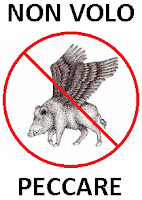
Back in July 2021, William Wildblood wrote a post about the birdemic pecks titled "Non Volo Peccare," ending with this: "Note: I translate the title I Do Not Want to be Pecked but it's been a long time since I studied Latin so that may not be entirely accurate" -- a pun on our code-word peck and the Latin peccare, "to sin." Noticing that peccare is even closer to peccary than to peck, I left a comment saying that his title actually meant "I don't want a javelina pig." Then William, taking advantage of the double meaning of volo ("I want" or "I fly"), said that the real translation was "Pigs don't fly."

Today it occurred to me that, leaving aside the whole "peck" angle, it's quite appropriate that Non volo peccare, "I don't want to sin," can be punningly mistranslated as "Pigs don't fly." The pig is proverbially unclean, debased, and addicted to earthly pleasures, and "when pigs fly" means "never." To want to ascend to Heaven ("fly") whilst remaining a "pig" is to want the impossible.

But behold, your days of probation are past; ye have procrastinated the day of your salvation until it is everlastingly too late, and your destruction is made sure; yea, for ye have sought all the days of your lives for that which ye could not obtain; and ye have sought for happiness in doing iniquity, which thing is contrary to the nature of that righteousness which is in our great and Eternal Head (Helaman 13:38).

One also thinks of this story.

In the Hindu tradition there is this story: The God of the Universe became curious about how it felt to be a pig. So he entered the body of one. He found it delightful beyond compare -- how good the sty smelled, how sweet were the slops, how desirable were the female pigs. But the universe needed tending. There was work to be done. So the helpers and handmaidens went and said, "God, you must come out of there. The universe needs you." God said, "Who are you talking to? I am just a pig! Leave me alone!" So they killed the pig, and God came out, and refused to believe he had ever refused to leave (Whitley Strieber, The Key).

Wednesday, October 20, 2021

Jonas, Jason, Sonja

In my last post, "Dove and serpent," I mentioned reading in the Wikipedia article on Jonah about a possible link, proposed by Joseph Campbell, between Jonah and Gilgamesh. Campbell also made another link:

Campbell also noted several similarities between the story of Jonah and that of Jason in Greek mythology. The Greek rendering of the name Jonah is Jonas, which differs from Jason only in the order of sounds—both os are omegas suggesting that Jason may have been confused with Jonah

So Jason and Jonas are anagrams, both in English and an Greek. There is a third such name, in English anyway: Sonja. In yesterday's "Look who's still showing up in syncs," I quoted a passage from Unsong about Jonah. In last December's post "American politician spontaneously combusts," I quoted a passage from the same novel that prominently featured the name Sonja.

"[. . .] But with the help of all the brave people in different government departments and all around the country working on this case, we’ve got Alvarez on the run and are tightening the noose around his neck. Some of these people are here with us tonight. People like Robert Mueller, director of the FBI. Like Michael Gellers, a police officer who successfully defused a BOOJUM bomb in Philadelphia. Like Sonja Horah . . .”

President Bush spontaneously caught fire. “HELLLPPP!” he screamed as the entire executive, legislative, and judicial branches watched on in horror. “HELLLPPP . . . HELL . . .”. By the time Secret Service agents reached him at the podium, he was already a charred corpse.

In the novel, the reason Bush caught fire was that the name Sonja Horah contained the sequence Jahorah, a magical "name of God" that causes anyone who pronounces it to die on the spot.

What does the name Sonja mean? It's a Russian diminutive of Sophia -- so, wisdom, but a lesser wisdom. This is precisely what William Wildblood ascribes to the serpent in his recent post "The Serpent and the Dove":

The dove is the Holy Spirit, and the innocence of the dove is true spiritual wisdom compared to the earthly, even if it is occult or esoteric, wisdom of the serpent. The serpent represents the wisdom of experience or evolution. In a way, it is the wisdom of matter. But the dove symbolises the wisdom of purity and innocence and truth that comes from God.

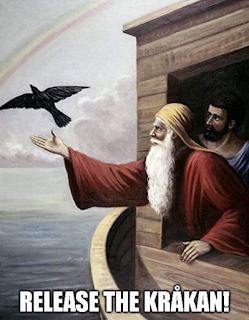
Jonas is the dove. Sonja is the serpent. What about Jason? Etymologically, Jason means "healer" -- but in English it sounds like "son of the jay," and I've known several Jasons who went by Jay or even Jaybird. Jason is a corvid, then -- perhaps even the solar crow ("jay-sun"). Jesus paired the dove with the serpent, but Noah (who is also part of the Joan/Jonah pun) paired it with the raven.

Dove and serpent

Shortly after I posted "Look who's still showing up in syncs," William Wildblood posted "The Serpent and the Dove."

My post connects Jonah, whose name means "dove" in Hebrew, with the "sign of the dove" given at the baptism of Christ. I also quote Joseph Smith on the sign of the dove and discuss the gourd that is eaten by a worm at the end of the Book of Jonah.

William, discussing Christ's injunction to be "as wise as serpents and as innocent as doves," also refers to the baptismal dove.

And what is the dove? For information on that we can go to John the Baptist who was the first to recognise the adult Jesus as the Messiah and who proclaimed when he baptised him that he saw the Holy Spirit descend on him in the form of a dove. The dove is the Holy Spirit, and the innocence of the dove is true spiritual wisdom compared to the earthly, even if it is occult or esoteric, wisdom of the serpent.

My own post makes no direct reference to the serpent, but it was certainly present in the context. I discuss perusing the Wikipedia article on Jonah. One of the things I read there, but did not mention in my post, was this:

Joseph Campbell suggests that the story of Jonah parallels a scene from the Epic of Gilgamesh, in which Gilgamesh obtains a plant from the bottom of the sea. In the Book of Jonah, a worm (in Hebrew tola'ath, "maggot") bites the shade-giving plant's root causing it to wither; whereas in the Epic of Gilgamesh, Gilgamesh ties stones to his feet and plucks his plant from the floor of the sea. Once he returns to the shore, the rejuvenating plant is eaten by a serpent.

Jonah's worm is equated with Gilgamesh's serpent.

Another thing that I didn't mention is that, when I was searching for the Joseph Smith quote about the sign of the dove, I misremembered the specific phrase "sign of the dove" as coming from the notes on the Second Facsimile from the Book of Abraham. Actually, all the Facsimile notes say is that one of the pictures "Represents God sitting upon his throne, revealing through the heavens the grand Key-words of the Priesthood; as also, the sign of the Holy Ghost unto Abraham, in the form of a dove."

I remembered, though, from my anti-Mormon reading back in the day, that the Facsimile was Smith's restoration of an incomplete Egyptian hypocephalus, and that he had restored it "incorrectly" by Egyptological standards. Specifically, the sign of the dove was based on a fragmentary figure that was probably originally an ithyphallic serpent.


It is probably indicative of my spiritual state at the time that when I discovered this serpent/dove connection I thought not of Christ but of Aleister Crowley: "Nor let the fools mistake love; for there are love and love. There is the dove, and there is the serpent. Choose ye well!" However, Joseph Smith's (unintentional) dove-serpent hybrid is more suggestive of Christ's doctrine than Crowley's -- not "choose ye well" but "be as wise as serpents and as innocent as doves."

Although it was posted back in July and linked to by the Junior Ganymede on October 18, I didn't see it until after writing my own post and reading William's: "On pills, blue and red" from Calculated Bravery. In this very interesting and perceptive post, the writer compares the red pill to the forbidden fruit and discusses the complementary roles of knowledge (the serpent) and innocence (the dove).

Tuesday, July 27, 2021

Why this is hell, nor are we out of it.

Faust. Where are you damn’d?
Meph. In hell.
Faust. How comes it then that thou art out of hell?
Meph. Why this is hell, nor am I out of it.
-- Marlowe, Doctor Faustus

In an insightful new post, William Wildblood asks, "Are we in hell now?" You will want to read the whole thing, but here are a few highlights, interspersed with my own thoughts.

It would be my contention that just as there is a divine plan for mankind so there is also a demonic plan. . . . Their aim is to absorb the energy from human souls for their own benefit and use. They have cut themselves off from the source of life and need life energy to maintain their existence. So they seek to corrupt souls. 

I found this an interesting take on demonic motivation, which has always been hard for me to understand. Pure spite just doesn't seem like enough of a reason for the devil to keep working tirelessly, millennium after millennium, for something that brings no benefit to him personally. It seems plausible that the devils must in some way need human damnation, that they must be soul-predators, vampires.

William suggests that, just as plants get their life energy from the Sun, so non-demonic beings get their life from God. The demons, who have cut themselves off from God, would be analogous to animals, which, because they cannot photosynthesize for themselves, must prey directly or indirectly on those who can. Not for nothing is the Satanic system called the beast. The devils "seek to corrupt souls" in order to cut them off from God -- which either "kills" them, making them suitable food for the devils, or forces them to become soul-predators themselves. I'm not entirely sure this is true, but if it is, it has some interesting ramifications -- including that there are likely two different sorts of damnation: that of the cannibalized, and that of the cannibals.

What is their aim? It is still the corruption of souls as it always has been but now there is something else. I believe, and I believe this because of what I can observe around me, because of the pattern of recent history and because of intuition, that they are seeking to make hell on Earth. That is to say, they are seeking to externalise hell onto the physical plane, to extend their domain, as it were.

The whole demon-possession subplot in the Synoptic Gospels -- especially the story of the devils who, being cast out of a man, begged to be allowed to possess a herd of swine -- strongly suggests a strong desire among the devils to extend their domain into the physical. Something similar is hinted at in the Genesis 6 story of the fallen angels who descended to earth and took human wives. The motivation behind this is not obvious, but perhaps we should make more of an effort to understand it.

If hell can be defined as separation from God then it should be obvious that we are in hell now.

And if the speculation above is true, it means that those who are sufficiently separated from God to have entered a hell state here on earth have two possible fates: to "die" spiritually or to turn to soul-cannibalism. And isn't that what we see all around us -- the zombie masses and the vampire elite?

You don't have to go out and do anything publicly but through your thoughts and prayers you can serve God and help souls struggling for truth in the spiritual quagmire of the contemporary world. This world may be turning into hell but heaven awaits those who simply wake up to that fact.

"This is hell," said Mephisto to Faust, "nor am I out of it" -- because hell is in the last analysis not a geographical location but a state of the soul, and wherever you go, there you are. One likes to imagine Jesus responding to a similar question -- "How comes it then that thou art out of heaven?" -- with, "Why this is heaven, nor am I out of it." Wherever you go, there you are.

To an extent unprecedented in history, we walk through the valley of the shadow of death -- but for those who turn to God, it is possible at the same time to lie down in green pastures and walk beside the still waters, to sit at table in the presence of our enemies.

"Ho, every one that thirsteth, come ye to the waters, and he that hath no money; come ye, buy, and eat; yea, come, buy wine and milk without money and without price. Wherefore do ye spend money for that which is not bread? and your labour for that which satisfieth not? . . . Incline your ear, and come unto me: hear, and your soul shall live" (Isa. 55:1-3).

Tuesday, June 29, 2021

Joyfully, joyfully marching

One of the hymns I grew up singing as a Mormon was "We Are All Enlisted," from the 1866 hymnal The New Golden Chain of Sabbath School Melodies. The first verse ends thus:

Haste to the battle, quick to the field;
Truth is our helmet, buckler, and shield.
Stand by our colors; proudly they wave!
We're joyfully, joyfully marching to our ----

And of course we kids would always belt out "GRA-AVE!" -- which, unlike the printed lyric, "home," at least rhymes. It was supposed to be a joke -- imagine joyfully marching to one's grave! -- but I actually think it's better than the New Golden Chain version in terms of both rhyme and reason. Johnny comes marching home again when the war is over, not when he's hasting to the battle. And countless martyrs have joyfully marched to their grave.

Only the first verse features this subverted rhyme. Is it possible that this not mere ineptitude on the part of our anonymous Sabbath School Melodian but rather an intentional evocation of the unspoken ghost-rhyme "grave" -- like the evocation of "hell" in "I Worry So for Dear Old Bill"?


In the Norse myth of Ragnarok the prophecy is that, at the end, the gods will fight the giants; and will lose. So why do the gods fight?

The gods fight because that is how they win.


The gods are Men - the giants are demons. 

Ragnarok is the final battle of the spiritual war on earth. 

And Men will lose the last battle - on earth. 

(How could it be otherwise? The giants are just too powerful.)


But choosing to fight against the giants, the demons; we win in Heaven, and eternally.

So - like the Norse gods; we prepare for Ragnarok.  

We are all enlisted till the conflict is o'er -- and at the material level, yes, we are marching to our grave. Defeat is assured. At the spiritual level, though, the true destination of our march is God, who is our home.


Note: Checking William Wildblood's blog, I find a new post, "Be Cheerful." Something in the air.

Thursday, August 27, 2020

Not with a bang

We are living in times which are both extraordinary and just plain dull. Nothing of any real interest is taking place even though recent events have been both dramatic and unprecedented.

-- William Wildblood

That about sums it up! I had not been prepared for just how stupid the apocalypse would be, how obscene, how inane. Nothing so romantic as an Armageddon, no grand Last Battle, no stern Götterdämmerung. No, the earthy expression turns out to have been nearest the truth all along: when the shit hits the fan.

And how interesting is that?

Popular posts