Q: What's a buccaneer?
A: A terrible price to pay for corn.
It may be corny, but my guilty musical pleasure these days is Thunderclash's version of "Shiver My Timbers" from Muppet Treasure Island.
Q: What's a buccaneer?
A: A terrible price to pay for corn.
It may be corny, but my guilty musical pleasure these days is Thunderclash's version of "Shiver My Timbers" from Muppet Treasure Island.
We are living in times which are both extraordinary and just plain dull. Nothing of any real interest is taking place even though recent events have been both dramatic and unprecedented.
That about sums it up! I had not been prepared for just how stupid the apocalypse would be, how obscene, how inane. Nothing so romantic as an Armageddon, no grand Last Battle, no stern Götterdämmerung. No, the earthy expression turns out to have been nearest the truth all along: when the shit hits the fan.
And how interesting is that?
There are several pretty good vegetarian restaurants in my city, and I get lunch there from time to time -- and virtually every time, one of the other patrons will say something like, "Wow, that's so great that you're a vegetarian!" ("老師很棒,吃素很棒!"; a direct translation would sound more childish than it sounds in Chinese.)
Back in America, I used to eat at kosher delis fairly often. Not once did anyone ever say, "That's so great that you keep kosher!" or even "I never knew you were Jewish." That's because everyone understands that kosher food is awesome and that there's nothing strange about a goy enjoying it. Vegetarian fare, on the other hand, is apparently understood to be so unappetizing that no one would ever eat it unless his moral or religious principles required him to do so.
⁂
Or maybe everyone did assume I was a kosher Jew (big nose, East European name, it wouldn't be surprising) but just didn't say anything -- either because discussing religion with strangers is taboo in America in a way that it isn't in Taiwan, or because vegetarianism is much more of a missionary faith than kashrut is.
I am sometimes tempted to congratulate myself on choosing to live in Taiwan, where common sense is only near-threatened rather than critically endangered and where people tend to be relatively laid-back about the Burning Issues of the Day.
Sometimes.
If the press is to be believed, the mild-mannered mayor of Changhua, the city which has been my home for the past decade and a half, has announced that he is (I swear I am not making this up) Energy-Saving Carbon-Reducing Tree Man -- and even has a snazzy superhero costume that makes him look a bit like Poison Ivy's male sidekick, Poison Ivan. (Not nearly as catchy a moniker as Energy-Saving Carbon-Reducing Tree Man, mind you.)

Energy-Saving Carbon-Reducing Tree Man went on to declare Changhua "the first Climate Emergency City" in Taiwan (summers on this subtropical island are, he astutely observed, "very hot") and to demand a green new carbon zero carbon justice extinction something something.
His speech was cheered by crowds of ivy-crowned maenads -- and, apparently, one heckler holding up a sign that said "How dare you!" (presumably a reference to ESCRTM's failure to wear a mask).

As I was saying, crowds.

You can read the original story here (in Chinese) if you feel so inclined.
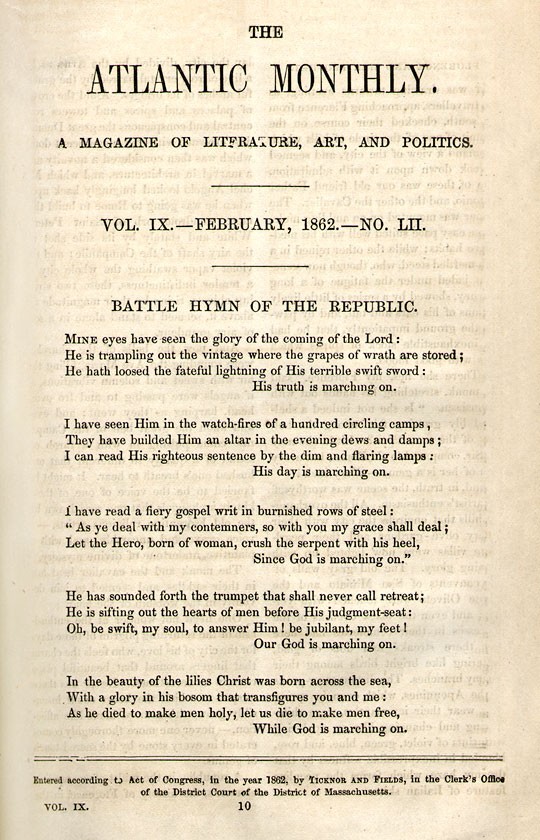
I recently had occasion to read the original version of the "Battle Hymn of the Republic" -- the American Civil War song written by abolitionist Julia Ward Howe to the tune of "John Brown's Body" -- as it appeared in the February 1862 issue of The Atlantic (jpg).
The first two verse are well known and strike the tone of righteous vengeance that one would expect from a "battle hymn."
Mine eyes have seen the glory of the coming of the Lord:
He is trampling out the vintage where the grapes of wrath are stored;
He hath loosed the fateful lightning of His terrible swift sword:
His truth is marching on.I have seen Him in the watch-fires of a hundred circling camps,
They have builded Him an altar in the evening dews and damps;
I can read His righteous sentence by the dim and flaring lamps:
His day is marching on.
The third verse, not much sung anymore, really surprised me.
I have read a fiery gospel writ in burnished rows of steel:
"As ye deal with my contemners, so with you my grace shall deal;
Let the Hero, born of woman, crush the serpent with his heel,
Since God is marching on."
A "fiery gospel writ in burnished rows of steel" sounds appropriately wrathful, but it actually turns out to be about as far from smiting the wicked as it is possible to be: "As ye deal with my contemners, so with you my grace shall deal" -- that is, God will treat you the same way you treat those who show contempt for God. Smite the infidel, and God will smite you! How did a line like that find its way into a holy-war battle hymn?
I keep thinking that Howe must have meant something else by it, but I can't see any other way of reading it.
Regular readers will know that I just recently read Whitley Strieber's 2007 novel 2012: The War for Souls. While it has a certain Strieberian charm that kept me reading to the end, it is basically a very poorly written book, and I can't recommend it. The story has to do with three versions of earth that exist in parallel universes. One of these is the earth we know. Another is a world in which the dinosaurs never went extinct but rather evolved into a race of (mostly) evil humanoid reptiles. The third is very close to our world but has several differences; they have McDonald's, for example, but it has "emerald arches" rather than golden ones, that sort of thing. (They also had no World Wars and no Communism -- but inexplicably somehow still had a Manhattan Project and have the hydrogen bomb! As I said, it's poorly written.) The most obvious difference, though, is that this parallel earth has two moons -- and "two-moon earth" and "one-moon earth" are used throughout the novel to refer to these two similar worlds.
Meanwhile, back in the real world, it just so happens that NASA has recently discovered a tiny asteroid that has been orbiting the earth for a few years, and the press is hyping it a "second moon" despite its diminutive size (just a few meters wide). I discovered this a few days after finishing 2012 when Vox Day linked to a news story about it, titling his post (qv) "We're living in 1Q84."
I knew that 1Q84 was a novel by Haruki Murakami, and that the title is equivalent to 1984 (the Japanese word for "nine" sounds like the English name of the letter Q) but had not read it and knew nothing else about it. (I read A Wild Sheep Chase years ago and enjoyed it, but not enough to try anything else by the author.) A bit of Googling revealed that, just like Strieber's 2012, it is about a parallel earth that has two moons.
Reading the Vox Day post so shortly after finishing 2012 was a coincidence, but it's also a coincidence that two novels were written within a few years of each other -- by very different authors in different countries -- but each with a year as the title, and each featuring a parallel two-moon earth. Strieber's novel was published in 2007; Murakami's in 2009 and 2010 in Japanese, with the English version following in 2011. Therefore, any direct influence would have to have been from Strieber to Murakami rather than vice versa, which seems highly unlikely.
It occurs to me that the film 2010: The Year We Make Contact -- released in 1984, just as the final volume of Murakami's 1Q84 was released in 2010 -- also has a plot that revolves around two moons, in this case two of the moons of Jupiter, not those of a parallel earth. Coincidence, or deliberate homage?
Today, following a link from the Junior Ganymede, I read an essay (qv) by the presumably pseudonymous Peachy Keenan. I liked it enough to read a few other essays by the same writer, who I’d never heard of before today. The name is obviously a reference to the dated slang expression “peachy keen.”
Right after that, I went out to buy some things and saw someone on the street wearing a T-shirt that said (in English) “Feelin’ Peachy.”