Saturday, November 5, 2022

Further syncs related to my Kanye dream and Facsimile 1

 Yesterday (November 4), I taught a children's English class in which the word ancient came up (from an article saying that surfing was "an ancient sport," originating in the fourth century BC). After explaining the meaning of ancient, I checked comprehension by asking, "Have you ever seen anything ancient?" A 10-year-old girl immediately replied that she had visited a museum a few years ago and seen an Egyptian mummy case -- and then added that there were also "four little things with different heads, like a person and a dog and an eagle, and I don't remember what the other one was" -- clearly a description of the canopic jars ("Elkenah" and friends) which have featured in my recent posts.

Today, following a link on AC, I read an article called "MK Ultra, Transgenderism, and Feminization of Men." This bit pinged my syncdar:

The term “hypnosis” comes from the Greek word hypno, meaning sleep. Hypnotic trance has its roots in Earth’s oldest civilizations. The first mentions of it date back 5,000 years to ancient Egypt where it was used in rituals in the Temple of Imhotep. “Temple sleep" was an hours-long ritual using herbs, rhythmic drumming, and prayer recitation to induce a hypnotic dreamlike state. This ritual trance was believed to allow a person to heal ailments, see the future, or contact the gods. The ancient Greeks adapted their own forms of temple sleep used by Oracles to divine the future for powerful men like Alexander the Great. Shamans around the world have used similar techniques since ancient times with drumming, chant, and natural hallucinogens to induce ritual trance in the same way. In the 18th and 19th centuries, esoteric physicians and psychologists like Franz Mesmer gave hypnosis techniques new life. French scientists at the Nancy School were the first to formally study hypnotism as we know it today. This led to hypnosis being used by psychologists like Sigmund Freud and Carl Jung.  

In the 1920’s, hypnosis was often portrayed comically in Vaudeville stage acts and later in Hollywood, leading to its modern association with quackery. [. . .]

This was only the second time I had heard of the Egyptian ritual of "temple sleep"; the first was yesterday, when I found a reference to it in Mission des juifs, where Alexandre Saint-Yves d'Alveydre attributes its invention to no lesser a personage than Moses himself -- pre-Exodus, when he was (Saint-Yves claims) a priest of Osiris:

He [Moses] recommended that well-chosen persons sleep at night in the Temple, to receive oneirocritical or other communications of interest to either the individual or the Society.

(Definition of oneirocritical: "of, relating to, or specializing in the interpretation of dreams" -- c.f. Sigmund Freud's best-known work.)

When I had read this reference in Saint-Yves, I had vaguely imagined initiates sleeping on the floor of the temple, but when I read the second reference, in the MK Ultra article, it occurred to me in a flash of insight that, no, they probably used some sort of ritual bed --and that I was almost 100% certain what that bed looked like. A quick Google search confirmed what I already intuitively knew: One of the first results had a picture of someone sleeping on a lion couch:

The image is just from some random YouTube video, and I have no idea how archaeologically sound it is, but the sync fairies don't care about that. The fact is that, rightly or wrongly, people have connected "temple sleep" with the lion couch. Saint-Yves, rather improbably, connects "temple sleep" with Moses -- just as Joseph Smith had, equally improbably, connected the lion couch with another major biblical figure.

In the MK Ultra article, "the Nancy School" appears in the same paragraph as "temple sleep." In my Kanye dream, Ye was carrying a coffin-like plywood box and said that "Aunt Nancy" had gone to sleep in it and never woken up.

At the end of the passage I have quoted, "Vaudeville" is juxtaposed with "quackery." Yesterday, in a post that probably left my readers scratching their heads, I felt an urgent need to post about some imagined spiritual kinship between Marx Brothers comedies and the music of Billy Joel. In this post, I characterized the Marx Brothers as "classic Jewish Vaudeville" and provided as a sample of their style a clip from the 1933 film Duck Soup.

The Billy Joel thing wasn't my only sudden strange idea about pop music yesterday. Out of the blue, I suddenly got a bee in my bonnet about the song "You're the One" as performed by the Vogues and, moved by a strange sense of certainty about a song with which I have only a passing familiarity, I spent quite a bit of time scouring YouTube in vain for any evidence that they had ever sung "Ooh, never leave me, DO NOT deceive me" (definitely the correct lyrics!) rather than the vastly inferior Mandela-effect version "please don't deceive me," which is all that can be found in the current timeline. It was an extremely strange thing to get hung up on, but in the course of my searching I stumbled upon another old Vogues song I had completely forgotten about: "Five O'Clock World" -- which begins with the words "Up every morning just to keep a job" and later says "in my five o'clock world she waits for me." In my Kanye dream, Aunt Nancy had written a note saying "Wake me up at 5 p.m." before going to sleep forever.

Friday, November 4, 2022

Kanye and El Kanah

After I posted my dream about "Kanye with Aunt Nancy's coffin," my next post was "Synchronicity: Mandrakes and El Kanah." At first, I didn't see any connection between the two, but then I realized that Kanah is a Chinese anagram of Kanye.


In the comments on my Kanye dream, Debbie twice referred to Ye as "Kayne" -- either a typo or an intentional allusion to the biblical figure Cain. Where does the name Cain come from? Glad you asked.


The biblical name Elkanah (father of the prophet Samuel) is from this same root and is more properly transliterated as Elqanah -- so there's a direct etymological link between Cain and El Kanah, both of which are more properly transliterated with the letter q. This is significant because my Kanye dream included the line "Wake me up at 5 p.m." and I connected this with Q because 5 p.m. is 17:00, and Q is the 17th letter of the alphabet; and because the Q conspiracy theory is associated with the phrase "Great Awakening." The Hebrew letter transliterated as q is not the 17th letter of the Hebrew alphabet, but it does bear a certain resemblance to the numerals 17.


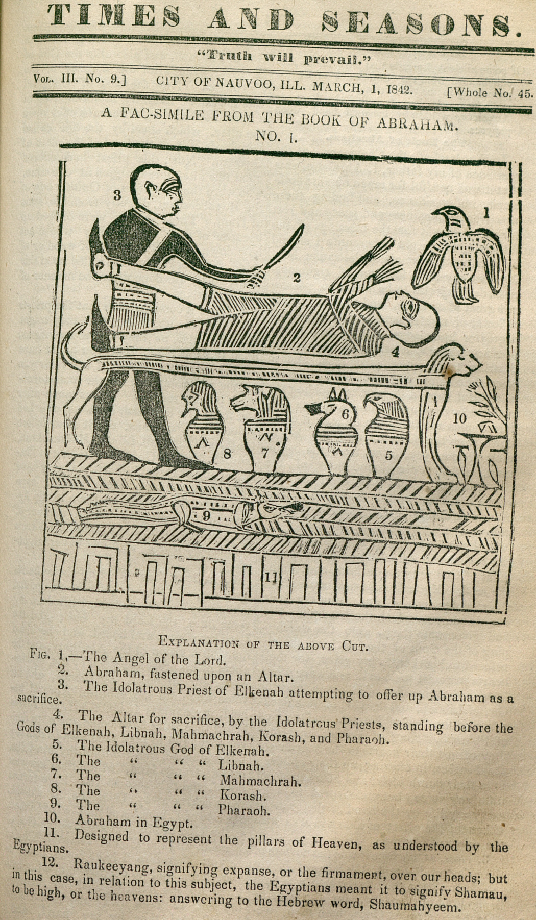
The reason I considered running into the name El Kanah a synchronicity was because I had just (in "Maha-makara whiteboard telepathy") made reference to the very similar name Elkenah, which occurs in Joseph Smith's Book of Abraham as the name of a god supposedly worshiped by the Egyptians of Abraham's day. In the "facsimile" accompanying the text, Elkenah is identified with the falcon-headed canopic jar in an Egyptian lion-couch scene.

Egyptologists, knowing nothing of "Elkenah" and company, say that the four canopic jars represent the four sons of Horus, each of which is associated with one of the cardinal directions. Keeping in mind that we have connected El Kanah with the letter Q and with Kanye West, what name and direction do Egyptologists assign to the falcon-headed jar?


A name beginning with Q and the direction West!

Note also that the canopic jars were used in the mummification and burial process, as receptacles for certain of the deceased's internal organs. This syncs with my dream, in which Kanye was carrying a coffin.

My sync post about El Kanah also featured mandrakes. Ye has been in the news recently for his supposedly controversial statements about the Jews, which have overshadowed his much more outrageous recent claim that the "greatest rapper of all time" is a man called Drake. 

Billy Joel channeled the Marx Brothers

I've pretty much got the Marx Brothers' entire oeuvre committed to memory, having watched all their films dozens and dozens of times as a child, but for those of my readers who lack the ability to replay the whole thing in their head at will, there's YouTube:


I don't think I would include this little sequence on any "best of the Marx Brothers" list or anything, but I think it's a very succinct encapsulation of the overall spirit of Marx Brothersness. (In particular, Zeppo's dance steps in the few seconds after he finishes playing the banjo are the definitive Zeppo moment, a snapshot of his whole character.)

Now watch this, and tell me Billy Joel isn't literally possessed by the spirit of Groucho Marx.


Starting with the intro scene ("Nah, not much longer"), I could see every movement of Billy Joel's face and body being performed by Groucho, and I could hear his lines in Groucho's voice, and now I can't not perceive that. I watch the video, seeing and hearing Billy Joel, while at the same time I see vividly in my mind's eye Groucho performing the same routine and hear Groucho's voice singing the whole song in my mind's ear. In fact, I can see a whole parallel video, in black and white, being performed by the four brothers and a crowd of extras.

Then I realized it's not just that one song. Take "Piano Man." This is a much more serious song, but doesn't it still have an awful lot of the air of classic Jewish Vaudeville about it? This one is harder to imagine as a literal Marx Brothers performance -- mostly because it would be Groucho singing and Chico playing the piano, but the singer and the piano man have to be the same person -- but the piano work has a distinct whiff of Chico about it, and the who can deny that the lyrics are very Grouchonian -- what Groucho might have written if he had taken himself just a bit more seriously and gone just a bit darker and deeper with his smart-alecky remarks?

Thursday, November 3, 2022

Random sync: The relative danger of shark attacks

Today one of my students had a reading assignment which told the story of a surfer who had lost an arm in a shark attack. A sidebar said, "Weird but true: More people are killed every year by soda machines than by sharks!"

Tonight, approximately five hours after reading the shark vs. vending machine comparison, I did a bit of random browsing on YouTube and ended up watching a Leather Apron Club video called "Why You Can't Get Anyone to Change Their Mind." Near the end, I heard this:

Okay, so in example one, imagine that a child want to convince his parents to take him to the carnival that's in town, but they're concerned about the safety of the rides. So an a posteriori argument from the kid might sound something like this: "I want to go to the carnival. The rides are actually totally safe. I've read a research paper saying how more people actually die from shark bites than get killed on carnival rides every year."

What are the odds? I bet more people are killed by drinking too much soda at carnivals than run into two unrelated shark attack comparisons in a five-hour period.

Sunday, October 30, 2022

Synchronicity: Mandrakes and El Kanah

On October 1, I started reading the Old Testament a chapter a day; thus today, October 30, at around two or three in the afternoon, I read Genesis 30. This includes the "mandrake episode":

And Reuben went in the days of wheat harvest, and found mandrakes in the field, and brought them unto his mother Leah.

Then Rachel said to Leah, "Give me, I pray thee, of thy son's mandrakes."

And she said unto her, "Is it a small matter that thou hast taken my husband? and wouldest thou take away my son's mandrakes also?"

And Rachel said, "Therefore he shall lie with thee to night for thy son's mandrakes."

And Jacob came out of the field in the evening, and Leah went out to meet him, and said, "Thou must come in unto me; for surely I have hired thee with my son's mandrakes."

And he lay with her that night (vv. 14-16).

At around 9:00 p.m. the same day, I checked /x/ and found this:


So that's unusual. I'm posting this now, about an hour later, so I went back to /x/ to see if the post was still there (yes), and if anyone had said anything interesting (no). To find it, I did a Ctrl-F for mand, and the first hit was this:


Like most "Bible Mandela effect" claims, this is BS. I've been reading the Bible since forever, and it's always said that (minus the word very in the KJV). On a whim, I decided to look up other translations of the verse in question (Ex. 34:14) on BibleGateway. In the list of 50-some translations that came up, only one used boldface and italics, and it therefore jumped out at me.


One of the other versions, a half-translation with many untranslated Hebrew words, had a spelling that was even more of a sync.


El Kanah -- just one letter different from Elkenah, a supposed Egyptian god mentioned in Joseph Smith's Book of Abraham, which I had recently posted about in "Maha-makara whiteboard telepathy." I even referenced Kevin Barney's theory that the name means "El of Canaan." It's quite ironic that the name might actually mean "Jealous God" -- not tolerating rivals -- since Elkenah is depicted as being worshiped alongside four other gods.


It is appropriate that El Kanah, the Jealous God, would be synchronistically associated with the mandrake story in Genesis 30, since that story has to do with jealousy and sexual rivalry.

Thursday, October 27, 2022

Kanye with Aunt Nancy's coffin

When something is repeated several times in a dream, I take it as potentially significant.

⁂

It was snowy and windy outside, and I was inside a structure that I thought of as a "pillbox," but when I pictured what it looked like from the outside, I thought of it as looking more like a pink Thermos bottle. It was the same shade of pink as Jackie Kennedy's famous pillbox hat, so I suppose that was the connection. Inside, it wasn't pink and seemed like a garage or storage unit -- concrete floors and walls, no furniture.

I could hear someone outside in the snow, coming up to the door. It was the artist formerly known as Kanye West, and his stopping by seemed utterly unremarkable, as if he were just some regular guy we happened to know.

Ye was carrying a big box shaped like a coffin, but obviously not a real coffin. It was made of pieces of plywood nailed together and looked like some cheap prop that hadn't been painted yet. The ease with which he was carrying it made it clear that it was quite light and therefore empty.

Ye explained to me that "Aunt Nancy" had gone to sleep in that box and never woken up, and then he showed me why. He lifted up the coffin so that the bottom surface was visible, and there was something written there in pencil: "Please wake me up at 5 p.m. Aunt Nancy." Apparently no one had seen the message, because she had carelessly written it on the bottom of the box, and that's why she had never woken up.

I wasn't sure if this was supposed to be some sort of weird joke, or if I was to understand that Aunt Nancy had died from sleeping too long, or had been mistaken for dead and buried alive, or what -- but I was pretty sure that that was Ye's own handwriting and that the whole thing was fake.

"Ye, where did you get this?" I asked, and he said the name of some generic American retailer you wouldn't expect a billionaire celebrity to frequent -- Best Buy or Home Depot or something of that nature. I took this as an admission that he had bought plywood and made the coffin himself, and that "Aunt Nancy" was either alive and well or had never existed at all. Ye took the coffin back outside, put it in the back of a white van, and drove off.

A few minutes later, my mother showed up at the pillbox. I said, "Hey, 'Yeeaay' was just here" -- drawling the diphthong in an exaggerated way -- and then proceeded to tell her everything, about the plywood coffin and the Aunt Nancy story and all that. Since my mother's name is also Nancy, I made sure to clarify that Ye had obviously meant his own aunt, not her. She listened to the story without particular interest and later left.

A few minutes after that, a generic "man" came in, and I told him about what had happened with Ye and then about my telling my mother.

⁂

So the Ye-with-a-coffin story occurred four times in the dream: First I experienced it, then I told my mother about it, then I told the man about it, and then I told the man about telling my mother about it. No idea what it means, if anything, but the repetition itself seems to make it worth noting.

I assume "Aunt Nancy" has something to do with Anansi, the anthropomorphic spider trickster of West African folklore. I know very few Anansi stories -- just the usual stuff an American child is exposed to in the name of diversity -- but running a search for anansi coffin turned up this:

As time passed, Dew worked especially hard and tirelessly to build up a large amount of wealth. He bought a scythe, hoe, axe, new clothes, and other equipment. Dew then told his mother his plan: he would tell Anansi that she had died and would then make a mock coffin in which to bury her. In the meanwhile, Dew wished for his mother to hide in their home upstairs while he prepared, so she did. Dew then made a coffin and announced her death to the village, inviting them to come see her burial. Once they had arrived, he snuck his mother from upstairs and had her hide underneath the floor where the mock coffin lay, as well as the many things he'd purchased, as he knew Anansi's greed would spurn him to steal from Dew if he saw them laying around. Now that the plan was in order, it was time for the mock burial to begin. . . .

I'm quite sure I had never encountered this particular story before, but the coincidence with the dream is impressive: the name Anansi/Aunt Nancy, the "mock coffin," the mother. I'll see if anything develops from this sync-wise.

Wednesday, October 26, 2022

Maha-makara whiteboard telepathy

I've been occasionally dipping into Mission des juifs by Alexandre Saint-Yves d'Alveydre, and today I read a passage in which he mentioned the similarity between the names Abraham and Brahma, and between those of Abraham's sister/wife Sarah and Brahma's sister/wife Sarasvati. Once this idea had been brought up -- to look for Sanskrit names in the story of Abraham -- it made me think of the "First Facsimile from the Book of Abraham." This was an incomplete Egyptian funerary papyrus, "restored" and "translated" by Joseph Smith in a way that is very obviously incorrect by the standards of modern Egyptology. For example, the four canopic jars representing the four sons of Horus (Imsety, Duamutef, Hapi, and Qebehsenuef) were said by Smith to represent four otherwise unknown pagan gods called Elkenah, Libnah, Mahmachrah, and Korash.


There have been various fanciful attempts by Mormon apologists to make these names archaeologically respectable. Elkenah must be derived from El-Cana, meaning the Canaanite god El (who of course was not one of the sons of Horus, didn't have a falcon's head, and was not worshiped in Egypt); Libnah is connected to a Hebrew (not Egyptian!) root meaning "white," and it is said that that particular son of Horus was associated with the color white; that sort of thing.

Well, if we're going to go Sanskrit on the Abraham story, isn't it obvious that Mahmachrah must be Maha-makara, the Great Makara? Makara is a Sanskrit name for, among other things, the crocodile, and a crocodile appears in Facsimile 1. Perhaps Smith just misnumbered the figures, and it is the crocodile that he intended to call Mahmachrah. I'm not proposing any of this seriously, of course; it just popped into my mind when I read about the supposed Sanskrit derivation of the names Abraham and Sarah.

Makara doesn't just mean "crocodile," though. It is also the Sanskrit term for the zodiac sign of Capricorn and refers to a sea creature which is variously depicted, but one of the most common forms it takes is that of a huge fish with the trunk of an elephant.


I hadn't said or written any of this; I had only been thinking about it, and picturing the elephant-nosed makara in my mind -- a very distinctive image, I think, and not one that comes to mind very often -- when I walked into my classroom and found that one of my students had drawn this on the whiteboard:


I still find this whole phenomenon baffling. It's happened enough times, and with such weirdly specific content, that I would ordinarily dismiss "coincidence" as an explanation -- but on the other hand, seemingly impossible coincidences are pretty much an everyday occurrence in my life!

If it's not just another manifestation of "synchronicity" -- that infuriating non-explanation! -- I do tend to think it must be some sort of subconscious telepathy on the kids' part rather than precognition on my own. My mental images in these cases don't just pop into my head inexplicably; the train of thought can be traced back with little effort. When I ask the kid why he happened to draw an "elephant fish," though -- or a king holding an apple, or whatever the image may be -- there's never any explanation. I think they just cast about in the ether for something to draw and sometimes "pick up" something from my mind without realizing that that's where it came from.

I never tell the kids about these incidents, and they are none the wiser. As far as this young artist knows, he just happened to think of an "elephant fish" for no particular reason. Likewise, if some of the random ideas or images that pop into my head were actually pilfered from the private thoughts of other people, I would normally have no way of knowing that. I wonder just how common this sort of thing is.

Popular posts