Showing posts sorted by relevance for query whiteboard telepathy. Sort by date Show all posts

Wednesday, October 26, 2022

Maha-makara whiteboard telepathy

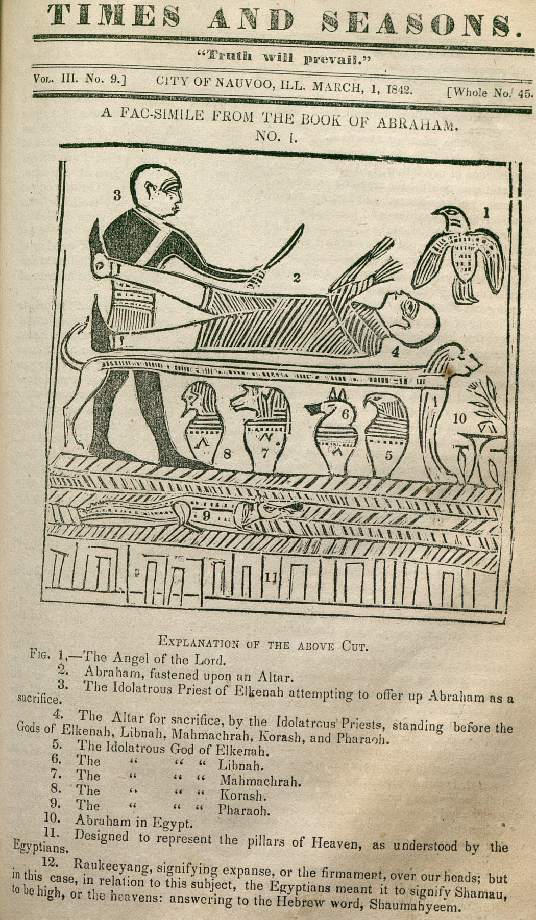
I've been occasionally dipping into Mission des juifs by Alexandre Saint-Yves d'Alveydre, and today I read a passage in which he mentioned the similarity between the names Abraham and Brahma, and between those of Abraham's sister/wife Sarah and Brahma's sister/wife Sarasvati. Once this idea had been brought up -- to look for Sanskrit names in the story of Abraham -- it made me think of the "First Facsimile from the Book of Abraham." This was an incomplete Egyptian funerary papyrus, "restored" and "translated" by Joseph Smith in a way that is very obviously incorrect by the standards of modern Egyptology. For example, the four canopic jars representing the four sons of Horus (Imsety, Duamutef, Hapi, and Qebehsenuef) were said by Smith to represent four otherwise unknown pagan gods called Elkenah, Libnah, Mahmachrah, and Korash.


There have been various fanciful attempts by Mormon apologists to make these names archaeologically respectable. Elkenah must be derived from El-Cana, meaning the Canaanite god El (who of course was not one of the sons of Horus, didn't have a falcon's head, and was not worshiped in Egypt); Libnah is connected to a Hebrew (not Egyptian!) root meaning "white," and it is said that that particular son of Horus was associated with the color white; that sort of thing.

Well, if we're going to go Sanskrit on the Abraham story, isn't it obvious that Mahmachrah must be Maha-makara, the Great Makara? Makara is a Sanskrit name for, among other things, the crocodile, and a crocodile appears in Facsimile 1. Perhaps Smith just misnumbered the figures, and it is the crocodile that he intended to call Mahmachrah. I'm not proposing any of this seriously, of course; it just popped into my mind when I read about the supposed Sanskrit derivation of the names Abraham and Sarah.

Makara doesn't just mean "crocodile," though. It is also the Sanskrit term for the zodiac sign of Capricorn and refers to a sea creature which is variously depicted, but one of the most common forms it takes is that of a huge fish with the trunk of an elephant.


I hadn't said or written any of this; I had only been thinking about it, and picturing the elephant-nosed makara in my mind -- a very distinctive image, I think, and not one that comes to mind very often -- when I walked into my classroom and found that one of my students had drawn this on the whiteboard:


I still find this whole phenomenon baffling. It's happened enough times, and with such weirdly specific content, that I would ordinarily dismiss "coincidence" as an explanation -- but on the other hand, seemingly impossible coincidences are pretty much an everyday occurrence in my life!

If it's not just another manifestation of "synchronicity" -- that infuriating non-explanation! -- I do tend to think it must be some sort of subconscious telepathy on the kids' part rather than precognition on my own. My mental images in these cases don't just pop into my head inexplicably; the train of thought can be traced back with little effort. When I ask the kid why he happened to draw an "elephant fish," though -- or a king holding an apple, or whatever the image may be -- there's never any explanation. I think they just cast about in the ether for something to draw and sometimes "pick up" something from my mind without realizing that that's where it came from.

I never tell the kids about these incidents, and they are none the wiser. As far as this young artist knows, he just happened to think of an "elephant fish" for no particular reason. Likewise, if some of the random ideas or images that pop into my head were actually pilfered from the private thoughts of other people, I would normally have no way of knowing that. I wonder just how common this sort of thing is.

Sunday, July 31, 2022

More student telepathy

Many times now (see "More whiteboard telepathy!" and follow the links), I have had the experience of one of my young students -- always young children, and different ones every time -- writing, drawing, or saying something that seems to have been pulled directly from my own mind, something so specific and bizarre that chance seems to be ruled out as an explanation.

This one is not quite so specific as some of the others, but I though it was worth noting. This is from a highly intelligent nine-year-old I tutor in English. Not quite a child prodigy, but definitely what is called "gifted and talented" (though fortunately her parents, like my own, have been smart enough to keep her far away from those sinister "gifted and talented" programs). Basically, she reads a dozen or so English books every week, and then we talk about them.

For those who came in late, the background is that I have spent several weeks reading a book about owls, which brought with it a large volume of owl-related synchronicities. I have not discussed the book, or owls, with anyone except on my blog, which none of my students read or even know about. I read the book of Kindle, so there's no chance anyone could have seen the cover or anything.

Yesterday, July 30, we were talking about the border between the United States and Mexico, and she said, "I guess if people want to smuggle drugs from Colombia into the United States, they probably try to sneak across that border at night. It's probably pretty hard to guard the whole thing, especially after dark." I said that that stood to reason, and then she joked, "Soooo . . . the border patrol needs to invest in some trained owls!"

Later in the same tutoring session, the conversation had turned to the French and Indian War and how the British victory, and the need to pay for soldiers to garrison their newly annexed territory, had led the king to raise taxes, setting in motion the chain of events that led to the American Revolution. My student said, "So obviously in a situation like that, you're going to need a lot more soldiers -- and owls!"

Unlike the previous reference, this made no sense even as a joke. "Owls?" I said. "Why would they need owls?"

"Well, they could work as alarm clocks to wake up the soldiers, and they could also scare the enemy by hooting."

Owls hoot at night, when people are sleeping, not in the morning, when they want to wake up, so they wouldn't make very effective alarm clocks. However, in The Messengers, Clelland refers four times to owls metaphorically "playing the role of an alarm clock."

Friday, January 14, 2022

More whiteboard telepathy!

What I looked at on my computer at home just before going to my school:


What I found one of the kids had drawn on the whiteboard when I arrived:


See "A familiar face" and "Pondering his orb" for more examples of the same thing. This is starting to get a bit creepy! (Different kids every time, by the way. It's not like we have a special psychic kid or anything.)

Friday, January 28, 2022

Fish and eagle

A few days ago, I posted “Why do birds suddenly appear?” — about seeing a pair of golden eagles (highly unusual here in Taiwan) just after thinking about an eagle, and then discovering that the bird I had been contemplating was not an eagle but a Dapengniao, a gigantic bird that transforms from a giant fish called a Kun.

Today, in yet another instance of “whiteboard telepathy,” one of my very young students randomly wrote on the whiteboard, “老鷹,兩隻” (“eagles, two”). When I asked what it meant, it was a pun: the English word eagle sounds a bit like the Taiwanese word for “one,” and then two is the next number after one.

This evening, I started reading the Upanishads. I’d bought a copy ages ago but never felt moved to pick it up until just now. I began with the introduction by the translator, Eknath Easwaran, explaining how he had one day suddenly been moved to read the Upanishads (just after studying William James, of all authors!). This is the passage he quoted in telling the story:

As a great fish swims between the banks of a river as it likes, so does the shining Self move between the states of dreaming and waking.

As an eagle, weary after soaring in the sky, folds its wings and flies down to rest in its nest, so does the shining Self enter the state of dreamless sleep, where one is free from all desires. The Self is free from desire, free from evil, free from fear.

Wednesday, September 11, 2024

Whiteboard telepathy strikes again

I continue to be haunted by the Ace of Hearts. I found this on my whiteboard today:


I guess a heart's not such an unusual thing to draw -- not nearly as improbable as an elephant fish, the "Sickos" guy, or a king with an apple and scepter. Still, I think it counts as a significant coincidence. Just a heart, nothing else, colored in red, on a white background.

Saturday, May 16, 2026

Maha Bharata

I read in Flying Saucers Have Landed a mention of "a mother civilization that preceded even that of India." This reference to India as a particularly ancient civilization prompted the thought that Bharat is a much older name for that civilization than India.

Two pages later, I found a reference to the Maha Bharata, written like that as two separate words. Surprisingly, even though I'm quite familiar with the maha- prefix, it had never occurred to me until I saw it written that way ("tunnelled into" like Carroll's Under Ground) that Mahabharata is etymologically related to Bharat. I've never actually read most of the Mahabharata (only the Gita), but it's still strange that I'd never thought about the likely meaning of the name.

A further coincidence is that I was just thinking about the maha- prefix this morning. As mentioned in "Ladder-day Cinq," I had taught the signs of the zodiac to a group including the girl born on January 16. This drew my attention to the fact that she was born under the sign of the Makara (Capricorn), which made me think of my 2022 post "Maha-makara whiteboard telepathy."

Friday, November 4, 2022

Kanye and El Kanah

After I posted my dream about "Kanye with Aunt Nancy's coffin," my next post was "Synchronicity: Mandrakes and El Kanah." At first, I didn't see any connection between the two, but then I realized that Kanah is a Chinese anagram of Kanye.


In the comments on my Kanye dream, Debbie twice referred to Ye as "Kayne" -- either a typo or an intentional allusion to the biblical figure Cain. Where does the name Cain come from? Glad you asked.


The biblical name Elkanah (father of the prophet Samuel) is from this same root and is more properly transliterated as Elqanah -- so there's a direct etymological link between Cain and El Kanah, both of which are more properly transliterated with the letter q. This is significant because my Kanye dream included the line "Wake me up at 5 p.m." and I connected this with Q because 5 p.m. is 17:00, and Q is the 17th letter of the alphabet; and because the Q conspiracy theory is associated with the phrase "Great Awakening." The Hebrew letter transliterated as q is not the 17th letter of the Hebrew alphabet, but it does bear a certain resemblance to the numerals 17.


The reason I considered running into the name El Kanah a synchronicity was because I had just (in "Maha-makara whiteboard telepathy") made reference to the very similar name Elkenah, which occurs in Joseph Smith's Book of Abraham as the name of a god supposedly worshiped by the Egyptians of Abraham's day. In the "facsimile" accompanying the text, Elkenah is identified with the falcon-headed canopic jar in an Egyptian lion-couch scene.

Egyptologists, knowing nothing of "Elkenah" and company, say that the four canopic jars represent the four sons of Horus, each of which is associated with one of the cardinal directions. Keeping in mind that we have connected El Kanah with the letter Q and with Kanye West, what name and direction do Egyptologists assign to the falcon-headed jar?


A name beginning with Q and the direction West!

Note also that the canopic jars were used in the mummification and burial process, as receptacles for certain of the deceased's internal organs. This syncs with my dream, in which Kanye was carrying a coffin.

My sync post about El Kanah also featured mandrakes. Ye has been in the news recently for his supposedly controversial statements about the Jews, which have overshadowed his much more outrageous recent claim that the "greatest rapper of all time" is a man called Drake

Sunday, October 30, 2022

Synchronicity: Mandrakes and El Kanah

On October 1, I started reading the Old Testament a chapter a day; thus today, October 30, at around two or three in the afternoon, I read Genesis 30. This includes the "mandrake episode":

And Reuben went in the days of wheat harvest, and found mandrakes in the field, and brought them unto his mother Leah.

Then Rachel said to Leah, "Give me, I pray thee, of thy son's mandrakes."

And she said unto her, "Is it a small matter that thou hast taken my husband? and wouldest thou take away my son's mandrakes also?"

And Rachel said, "Therefore he shall lie with thee to night for thy son's mandrakes."

And Jacob came out of the field in the evening, and Leah went out to meet him, and said, "Thou must come in unto me; for surely I have hired thee with my son's mandrakes."

And he lay with her that night (vv. 14-16).

At around 9:00 p.m. the same day, I checked /x/ and found this:


So that's unusual. I'm posting this now, about an hour later, so I went back to /x/ to see if the post was still there (yes), and if anyone had said anything interesting (no). To find it, I did a Ctrl-F for mand, and the first hit was this:


Like most "Bible Mandela effect" claims, this is BS. I've been reading the Bible since forever, and it's always said that (minus the word very in the KJV). On a whim, I decided to look up other translations of the verse in question (Ex. 34:14) on BibleGateway. In the list of 50-some translations that came up, only one used boldface and italics, and it therefore jumped out at me.


One of the other versions, a half-translation with many untranslated Hebrew words, had a spelling that was even more of a sync.


El Kanah -- just one letter different from Elkenah, a supposed Egyptian god mentioned in Joseph Smith's Book of Abraham, which I had recently posted about in "Maha-makara whiteboard telepathy." I even referenced Kevin Barney's theory that the name means "El of Canaan." It's quite ironic that the name might actually mean "Jealous God" -- not tolerating rivals -- since Elkenah is depicted as being worshiped alongside four other gods.


It is appropriate that El Kanah, the Jealous God, would be synchronistically associated with the mandrake story in Genesis 30, since that story has to do with jealousy and sexual rivalry.

Wednesday, December 7, 2022

More weird student telepathy/coincidences

The solfeggio scale has been in the sync stream recently, and I have written a few posts about it. Today one of my young students ran up to the stairs to the classroom, shouting, "Do re me fa sol la ti do!" as he did so. (I suppose this highlights one of the metaphorical meanings of the scale: step-by-step ascent. Likewise, the descending scale which begins "Joy to the World" is an appropriate symbol of the descent of the Lord to earth.)

When I myself entered the classroom, I found someone had doodled this on the board:


This was just a quick freehand sketch, obviously, but it demonstrates some of the geometric properties of the pentagram (five-pointed star), and of stars whose points touch the points of other stars.

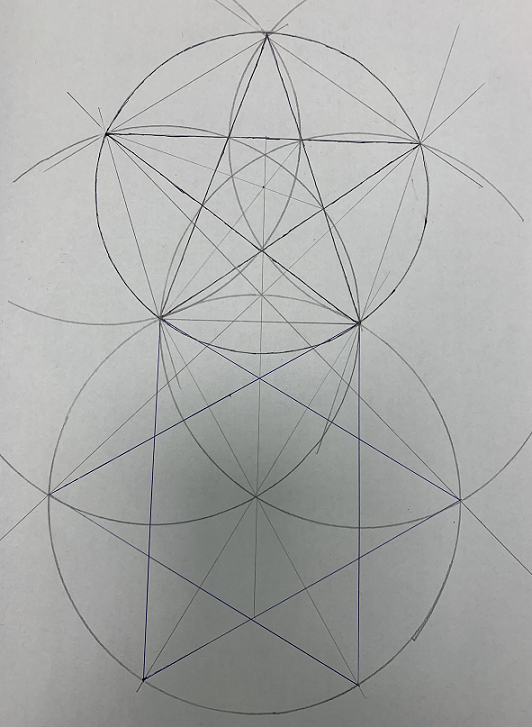
Sometimes, as a way of focusing my mind, I like to do some traditional geometric construction work with a compass and straightedge. Just this morning, I had done this:


After finishing this, I noticed that, as a by-product of the process of constructing the pentacle, I had drawn a circle below it, with four of the six vertices of a hexagon already marked. I intended to use these to construct a hexagram (six-pointed star), two of the tips of which would touch two of the tips of the pentagram. Unfortunately, I had to go to work and didn't have time to finish this last step. Then later in the day I found an extremely similar geometric concept illustrated on my whiteboard!

Update: This is what I had intended to draw, and did finish drawing after the class.


Update 2: In the 1990s, the Church of Jesus Christ of Latter-day Saints changed their logo so that the name "JESUS CHRIST" was much, much larger than everything else -- presumably under the misapprehension that this would put an end to the whole "Mormons aren't Christians" thing. Yesterday, after posting this, I wanted to look up when exactly this happened, and in the course of researching the history of the Mormon logo, I ended up perusing a post by architect Brandon Ro called "Sacred Geometry in new Church Symbol." Mr. Ro writes:

About six years ago I had a memorable lunch conversation with a couple of friends who were in the process of working on a new symbol/logo for The Church of Jesus Christ of Latter-day Saints. They told me that the symbol needed to emphasize the importance and centrality of Jesus Christ within the Church. It also needed to speak a universal language applicable to people around the world through iconography and symbolism. From a cross, star of David (6-pointed star), squared circle, pentagram (5-pointed star), and seal of Melchizedek (8-pointed star) just about everything was considered. I provided them with a few resources on sacred geometry and symbols.

Besides being another synchronicity, isn't that just weird? How could they possibly have considered the star of David (universally recognized as a symbol of Judaism) or the pentagram (associated in the popular mind with Satanism) as potential symbols of Mormonism? (The symbol they finally ended up with looks an awful lot like the Catholic "Mary on the Half Shell.")

Of course I have to comment on the eight-pointed star, too. (Hi, Debbie!) I'm not exactly a stranger to sacred geometry, but this was the first I'd ever heard of the "seal of Melchizedek." It turns out this is a fairly recent bit of Mormon folklore, derived from a illustrator's caption in one of Hugh Nibley's books. Pre-Nibley, there's no tradition of associating the eight-pointed star with Melchizedek (A separate bit of Mormon folklore postulates that Melchizedek was the same person as Shem, son of Noah, one of the "eight souls saved by water," so there's that.)


It's a striking symbol, and an easy one to draw in MSPaint, but I think the Church was right not to go with it. It looks either Islamic or New-Agey and would reinforce the unwanted association between Mormonism and such "cults" as Scientology and Raelism.

Thursday, October 19, 2023

Syncfest: Drowned boy, aliens, ceiling lights, finger of God, Michelangelo, Brother of Jared, Moria, and more

Let's see, where to start with this tangled web of syncs?

On October 14, I posted "Syncs: Drowned boy, unmask, gold medal, The King in Yellow." Wandering Gondola posted a comment saying that the mask theme made her think of the 2000 video game Legend of Zelda: Majora's Mask, adding:

It took a little longer to realise the "drowning boy" figures into this too. Majora is rather dark and disturbing, to the point it spawned a popular creepypasta-thing, Ben Drowned. I knew little about it before reading Wiki; figures it started on /x/.

I do a bit of lurking on /x/, and something that gets posted there from time to time -- I think I've run into it there three or four times -- is the 1996 video game Drowned God: Conspiracy of the Ages, with an indignant-looking Gray on the cover:


So when Wandering Gondola mentioned video games, /x/, and the word drowned, that's what I immediately thought of. I thought it was kind of a minor sync, since I'm currently reading Majestic, Whitley Strieber's 1989 novel about the Roswell incident -- but then I'm quite often reading something Gray-related, so it's not that impressive a coincidence. And a novel set in the New Mexican desert obviously isn't going to have anything about drowning in it, right? I mean, you can't very well drown in a desert.

Oh, wait, scratch that. Late last night I read this in Majestic. The speaker is intelligence officer Will Stone.

The light was boring down on us, glaring malevolently through the evening. Fear literally rolled over me, transforming me in an instant from a competent if slightly uneasy CIG officer into a terrified little boy.

One moment I was standing there and the next I was racing through the underbrush. I had no clear thoughts. I just wanted to get away from that light. I was drowning in the ocean of desert.

Not just drowning, but a little boy drowning -- even though it's actually describing a grown man running through a desert.

Just now I looked up the cover art for the first edition of Majestic. Here it is:


That's a nod to E.T., of course, but an even more direct nod to Michelangelo. E.T. copied the general finger-touching theme from Michelangelo,  but the Majestic cover includes even the cracks in the paint on the Sistine Chapel ceiling, and its human hand is in exactly the same position as God's in the Michelangelo painting. It's the finger of God, producing a flash of electric light. (On a ceiling. Remember that.)


Michelangelo was a bit of a sync, since I had randomly thought of him last night. I had been writing notes to myself about the chronology of the Exodus and wrote that the mention of "a new king, who knew not Joseph" didn't really make sense if (as per Deuteronomy) Joseph lived four centuries before the Exodus. I wrote: "It would be like saying of some early 20th-century figure that he had never met Michelangelo. I mean, of course he hadn't!"

Why was that the example that came to mind? Why the early 20th century? Why Michelangelo? Why hadn't I thought of some figure who lived 430 years before my own era? Trying to figure that out now, the best guess I have is that I was subconsciously primed by the recent "drowning" syncs. The Love Song of J. Alfred Prufrock, the early 20th-century poem with its refrain about "talking of Michelangelo," famously ends with the line "Till human voices wake us, and we drown." Here's how it begins:

Let us go then, you and I,
When the evening is spread out against the sky
Like a patient etherized upon a table;
Let us go, through certain half-deserted streets,
The muttering retreats
Of restless nights in one-night cheap hotels
And sawdust restaurants with oyster-shells:
Streets that follow like a tedious argument
Of insidious intent
To lead you to an overwhelming question ...
Oh, do not ask, “What is it?”
Let us go and make our visit.

In the room the women come and go
Talking of Michelangelo.

Strieber's work constantly focuses on the importance of the "overwhelming question"; and in order to avoid assuming an answer to the question "What is it?" he steers clear of talk of "aliens" and always refers to the Other People with the neutral term visitors. Also, keep in mind that bit about being etherized upon a table. The general image suggests the classic "alien abduction" scenario, of course, but the precise choice of words is also relevant.

Oh, before I forget, Wandering Gondola's comment which led me to Drowned God, although it was responding to my "drowned boy" sync, was actually appended to a different post, October 15's "The world was fair in Durin's day." That's a line from Tolkien's Song of Durin, sung by Gimli in Moria. The song also refers to shining crystals:

The light of sun and star and moon
In shining lamps of crystal hewn
Undimmed by cloud or shade of night
There shone for ever fair and bright.

The ending of the Song of Durin, like that of Prufrock, references both drowning and waking:

But still the sunken stars appear
In dark and windless Mirrormere;
There lies his crown in water deep,
Till Durin wakes again from sleep.

Yesterday one of my employees and I went through the twice-yearly ritual of completing the meaningless fire-safety paperwork that gives the fire department something to do between fires. As always, a series of photos have to be attached: of a staff member holding a fire extinguisher, opening the door, answering the phone, etc. One of the required photos was this:


That's a pointing finger and an electric ceiling light, plus a mask for good measure.

This morning, less than 24 hours after taking the above photo, I was browsing a meme dump and found this:


The ceiling-light "sun" also suggests a UFO, of course, and it reminded me of "The time I mistook the sun for the Andromeda Galaxy."

I had no morning classes today, so, as is my habit these days, I went to a coffee shop to read the Book of Mormon -- Chapters 2 through 5 of the Book of Ether. Ether is the name of a prophet, no relation to the quintessence or to anaesthesia ("etherized upon a table"), though plenty of jokes have been made about the latter (cf. Mark Twain's quip that the BoM is "chloroform in print"). This section covers the Jaredites' creation of "barges" (actually hermetically sealed vessels) to cross the ocean, with supernatural shining crystals providing the illumination. The main character is the unnamed "Brother of Jared," whose real name Mormon tradition holds was Mahonri Moriancumer. In his September 2 post "Jaredites in Moria: Making sense out of the Brother of Jared and his shining stones," William Wright proposes that the first element in the name Moriancumer refers to Moria -- the Dwarrowdelf of Tolkien, subject of the Song of Durin -- and that there is a hidden reference in the Book of Mormon to the Brother of Jared, like Gandalf, opening the gates of Khazad-dûm by uttering the password friend.

The shining stones in Ether shine because -- fitting right into a major theme of this post -- they were literally touched by the finger of God:

And I know, O Lord, that thou hast all power, and can do whatsoever thou wilt for the benefit of man; therefore touch these stones, O Lord, with thy finger, and prepare them that they may shine forth in darkness; and they shall shine forth unto us in the vessels which we have prepared, that we may have light while we shall cross the sea. . . .

And it came to pass that when the brother of Jared had said these words, behold, the Lord stretched forth his hand and touched the stones one by one with his finger. And the veil was taken from off the eyes of the brother of Jared, and he saw the finger of the Lord; and it was as the finger of a man, like unto flesh and blood; and the brother of Jared fell down before the Lord, for he was struck with fear (Ether 3:4, 6).

Note how this also syncs with the Majestic passage quoted above, where a character named Will Stone is suddenly struck with fear when he sees a bright light. Here, the Brother of Jared says the Lord "can do whatsoever thou wilt . . . therefore touch these stones . . . that they may shine," and is then "struck with fear" when the Lord does just that.

The Majestic passage comes right after Will Stone has been inside the crashed alien craft -- generally called a "disk" and sometimes a "saucer." In the description of the Jaredite vessels, we are told over and over again that they were "like unto a dish":

And they were built after a manner that they were exceedingly tight, even that they would hold water like unto a dish; and the bottom thereof was tight like unto a dish; and the sides thereof were tight like unto a dish; and the ends thereof were peaked; and the top thereof was tight like unto a dish; and the length thereof was the length of a tree; and the door thereof, when it was shut, was tight like unto a dish (Ether 2:17).

Saucer, dish, disk -- it's all the same thing.


Drowning -- or asphyxiating underwater, anyway -- is also a concern as the dish-tight vessels are being created:

And it came to pass that the brother of Jared cried unto the Lord, saying: O Lord, I have performed the work which thou hast commanded me, and I have made the barges according as thou hast directed me. And behold, O Lord, in them . . . we shall perish, for in them we cannot breathe, save it is the air which is in them; therefore we shall perish.

And the Lord said unto the brother of Jared: Behold, thou shalt make a hole in the top, and also in the bottom; and when thou shalt suffer for air thou shalt unstop the hole and receive air. And if it be so that the water come in upon thee, behold, ye shall stop the hole, that ye may not perish in the flood (Ether 2:18-20).

Just as I was reading this, I became aware of the background music playing in the coffee shop, something about "a rainbow hanging over your head" -- Ha! I thought, like the sword of Damocles! -- fitting given the modern connotation of rainbow. I Googled the line to see what the song was. Here's how it starts:

When it rains, it pours
But you didn't even notice it ain't rainin' anymore
It's hard to breathe when all you know is
The struggle of stayin' above the risin' water line

An unpredictably rising water line was a worry for the Jaredites, too: "ye shall be as a whale in the midst of the sea; for the mountain waves shall dash upon you" (Ether 2:24).

Remember that Will Stone describes himself as "drowning in the ocean of the desert." In my September 15 post "When life gives you lemons, make le monde," I mentioned that as a child I always thought the Mormon word Deseret was just desert, expanded to three syllables to fit the meter of the song "In Our Lovely Deseret." The word originates in the Book of Ether, where it refers to the honeybees the Jaredites carry with them across the ocean: "And they did also carry with them deseret, which, by interpretation, is a honey bee; and thus they did carry with them swarms of bees" (Ether 2:3).

Here's a coloring-book page from the CJCLDS, showing UFO-esque "barges" complete with honeybees and shining stones:


When I returned home from the coffee shop and went into my study, I found that the desk (etymologically another disk or dish) where I usually read had several small stones on it. They weren't there when I left; I later found my wife had just acquired them and hadn't found a place to put them yet.


Small stones sync with the Brother of Jared story, as he prepared "sixteen small stones" (Ether 3:1) for God to touch with his finger. There weren't 16 stones on my desk, but I guess there were 1 + 6, since the pyrite is clearly the odd man out.

In the afternoon, I taught an English class for very young children who are just beginning to learn the language. When I walked into the classroom, I saw that someone had started and abandoned drawing a rainbow on the whiteboard:


This syncs with the "Rainbow" song I heard in the coffee shop. A mostly-red rainbow also made me think of Ted Hughes -- "Where sun and moon alternate their weathers / To hatch a crow, a black rainbow" -- in connection with "Red crows of the Sun" and my childhood belief that all crows "were in fact red birds from outer space, cleverly disguised as black ones from Earth." If Hughes had been aware of that fact, he would have realized that the sun and moon were actually hatching a red rainbow, bent in emptiness, over emptiness, but flying.

Chinese students of English often forget to add -s to plurals and such, and sometimes they overcompensate by adding it where they shouldn't. In the red-rainbow class today, a girl answered a question with "Nose, I don't." One of her classmates responded, "Nose I don't 就是我沒有鼻子的意思!沒有鼻子的人一定是外星人!妳知道外星人嗎?" ("Nose I don't means 'I don't have a nose'! A person without a nose must be an alien! Do you know about aliens?")

I have never said one word to these kids about "aliens," but I swear sometimes they pick up on things through subconscious telepathy.

Popular posts