Showing posts with label Of Monsters and Men. Show all posts
Showing posts with label Of Monsters and Men. Show all posts
Monday, May 6, 2024
Happy birthday, Nanna Bryndís Hilmarsdóttir
Today I was listening to "Mountain Sound" by Of Monsters and Men and wondered what the lead vocalist's name was. I looked her up and found that today -- May 6, the day I randomly decided to look her up -- is her 34th birthday.

Tuesday, January 30, 2024
Hearts of gold, new shoes, dirty paws, and walking on air
On a brief hike this morning before work, I found myself humming "Greensleeves" to myself:
Greensleeves was all my joy
Greensleeves was my delight
Greensleeves was my heart of gold
And who but my lady Greensleeves?
Then when I had lunch, the restaurant was playing Neil Young's "Heart of Gold":
In the afternoon, I taught an English class. The textbook used statements about superstitions to model first-conditional grammar, and one of the examples provided had to do with new shoes.

This got my attention because my January 28 post "Assorted syncs: Finnegans Wake, Kubla Khan, and dayholes" had quoted some rap lyrics about new shoes, and William Wright had picked this up and run with it in yesterday's "Needing new shoes to roller skate in Xanadu." So I was in sync-noticing mode.
After going through the examples with the students, I asked them to describe local superstitions using the same grammar. This led to this little conversation:
"Many people believe that if a dog or cat has white paws, it will bring its owner bad luck."
"So the Black man in the picture is lucky. His dog is white, but its paws are brown."
"I think its paws are really white. They're dirty because it was digging."
"So the horseshoe really brought him good luck, because now his dog doesn't have white paws."
After the class, I put on some background music while I did some paperwork, letting the YouTube Music algorithm do its thing. The very first song it served up was "Dirty Paws" by Of Monsters and Men. I looked at the screen and saw that the accompanying video was a montage from The Secret Life of Walter Mitty, a 2013 Ben Stiller movie based (very loosely, one assumes!) on the Thurber story.
For me, Ben Stiller's most iconic role will always be that of Tugg Speedman playing Four Leaf Tayback in Tropic Thunder, so there's a link back to the four-leaf clover in the textbook.
William Wright's "Needing new shoes to roller skate in Xanadu" post includes several references to "walking on air." Here's the poster for the Stiller movie:

And yes, that's the sync fairies' favorite building in the bottom right corner.
Here's another poster:

Where have I seen that imagery before? Oh, right. Here's a still from the Panic! at the Disco video "High Hopes," from my December 7 post "Mr. Mxyztplk revisited":

Mr. Mxyztplk is often called Mxy for short, not too far from Mitty.
I must say, this sync-synergy with William Wright is going on much longer than I had expected.
Monday, January 22, 2024
White Feathers, Strange Sights
In the late afternoon, the waxing gibbous Moon, high in the bright blue sky, kept catching my eye -- or drawing my eye, rather; I kept craning my neck up to look at it. It seemed somehow smaller than usual -- I would have estimated it at 25 arcminutes if I didn't know better -- and very, very white, without the slightest hint of yellow. Something about it made me think of a small white feather, pennaceous along the edge, plumulaceous along the ragged-looking terminator. Once while I was looking at it, a bone-white egret -- a black-legged E. garzetta, as free as the moon of any hint of yellow -- flew across my field of vision, reinforcing the white-feather imagery.


Then, as I crested a hill, the Sun came into view -- low on the horizon, deep red-orange in color, and absolutely enormous, subjectively appearing to be close to three degrees in diameter. The contrast with the Moon -- appearing under normal conditions to be the same size and color as the Sun -- couldn't have been greater.
Ordinarily, a red setting Sun will redden the whole sky around it, but in this case, perhaps due to the complete lack of clouds, this huge engorged Sun somehow coexisted with a regular blue sky. This strange combination made me think of a picture I painted in New Hampshire in 1983, when I was four years old, which I still have for some reason. I think at first it survived many years more or less by chance, and after that it was just too old to consider throwing away. When I got home, I dug it out of my files and photographed it:

(I like to think Vincent van Gogh might have painted something like this when he was four years old, and called it Wheatfield with Brontosauruses. Unfortunately, Vincent was already in his twenties when sauropods began to emerge in popular consciousness.)
I photographed the painting with my phone and uploaded it so that I could download it from my laptop for this post. When I went to get it from the cloud, I ran across this meme I had saved on January 9, which also features a dinosaur silhouetted against the setting Sun:

Come to think of it, my dinosaur painting also bears a certain resemblance to this image I posted two months ago, in "Yellow Light and the Mushroom Planet":

The dinosaurs are walking to the right, as in my painting. This despite the fact that people -- myself very much included! -- almost always find it much easier and more natural to draw animals facing left rather than right.
⁂
Since I haven't posted anything for a while, I'll go ahead and tack a random dream onto this. It's from a few nights ago, but I wasn't online at the time.
In the dream, it was common knowledge that in a normal forest, the canopy is more or less one continuous beehive. There are leaves and things on the lower levels, but once you get up high enough, the branches are all coated with black honey-dripping material created by bees.
I was working in a library where we were trying to create the same effect. We wanted all the bookcases to have books and books and books and then when you get high enough just this tarry black material full of bees and honey. The trick was to find a way of attracting bees to set up shop on the tops of the bookcases, and I had discovered that the best way to do this was to get big brown waxed-paper bags of frozen shoestring potatoes -- the kind they use to make French fries at fast-food places -- and put a few bags on top of each bookcase. Bees would come to eat the potatoes and then stay and build the sticky black hives we were after. This was very successful, and it made our library look very old and respectable and forest-like.
One of the very special features of this library was that we had a whole bookcase devoted to books written by members of the Moody Blues, with one shelf for each member. We had to pad out Mike Pinder's shelf with a few volumes of Pindar, the Theban poet, and there were a few other random books thrown in, including Octopus and Squid: The Soft Intelligence by Jacques Cousteau, but conceptually it was all Moody Blues. We were very proud of it. For some reason, we put all the books on the shelves while the bookcase was lying down on the floor, and then we had to carefully lift it up into position without any of the books falling out. We successfully did this and kept commenting on how great it was that we had managed to get it "perfectly vertical." We had also managed to get the sticky black beehive at the top perfectly flush with the ceiling without damaging either hive or ceiling. All in all, it was extremely satisfactory and was something no other library could offer its patrons.
Wednesday, November 22, 2023
They shall take up serpents
When I got up this morning, I found that the wallpaper image on my phone had inexplicably been changed from an astronomical photograph to one of a coiled rattlesnake -- a photo I had found online and saved on October 18. I guess I must somehow have set it to wallpaper while asleep or half-asleep, but I have absolutely no hint of any memory of doing so. Changing the wallpaper would have been a multi-step process -- tapping through several screens in Settings, scrolling through to a not-so-recent photo -- and I don't see how I could possibly have done it without the benefit of full waking consciousness, but I did, obviously.
As discussed in my last post, my thoughts after waking soon turned to Jannes and Jambres, the Egyptian magicians who duplicated some of the miracles of Moses and Aaron -- including turning rods into snakes:
And the Lord spake unto Moses and unto Aaron, saying, "When Pharaoh shall speak unto you, saying, Shew a miracle for you: then thou shalt say unto Aaron, Take thy rod, and cast it before Pharaoh, and it shall become a serpent."And Moses and Aaron went in unto Pharaoh, and they did so as the Lord had commanded: and Aaron cast down his rod before Pharaoh, and before his servants, and it became a serpent.Then Pharaoh also called the wise men and the sorcerers: now the magicians of Egypt, they also did in like manner with their enchantments. For they cast down every man his rod, and they became serpents: but Aaron's rod swallowed up their rods (Ex. 7:8-12).
This echoes an earlier miracle, the first shown to Moses after he was called by the burning bush:
And Moses answered and said, "But, behold, they will not believe me, nor hearken unto my voice: for they will say, The Lord hath not appeared unto thee."And the Lord said unto him, "What is that in thine hand?"And he said, "A rod."And he said, "Cast it on the ground."And he cast it on the ground, and it became a serpent; and Moses fled from before it.And the Lord said unto Moses, "Put forth thine hand, and take it by the tail" -- and he put forth his hand, and caught it, and it became a rod in his hand -- "that they may believe that the Lord God of their fathers, the God of Abraham, the God of Isaac, and the God of Jacob, hath appeared unto thee" (Ex. 4:1-5).
Taking a snake by the tail is crazy, suicidal behavior -- but Moses did it, and it became a rod in his hand. Not until today did I think to connect this story with the strange promise in the epilogue to the Gospel of Mark:
And these signs shall follow them that believe; In my name shall they cast out devils; they shall speak with new tongues; they shall take up serpents; and if they drink any deadly thing, it shall not hurt them; they shall lay hands on the sick, and they shall recover (Mark 16:17-18).
A few fringe groups like the Church of God with Signs Following take this as an invitation to practice ritual snake-handling as a demonstration of faith. I suppose most "normal" Christians are taught what I was: that the intended meaning was that God could miraculously protect believers from snakebite when necessary (as reportedly happened with Paul in Acts 28), not that we should "tempt God" by intentionally risking it. The Bible does say they shall actively take up serpents, though. The only biblical account of someone doing that is that of Moses -- and in his case what had been a serpent became a rod in his hand.
I think this miracle has a similar symbolic meaning to that of Jesus walking on the surface of the stormy sea: You take something slithery and treacherous, treat it as firm and solid, and it becomes so for you. This is shown in the "King and Lionheart" video, where slithery insubstantial creatures of light become solid enough to climb or run across when treated as such:
I think this may also be related to Samuel's prophecy about all things becoming slippery:
Behold, we lay a tool here and on the morrow it is gone; and behold, our swords are taken from us in the day we have sought them for battle. Yea, we have hid up our treasures and they have slipped away from us, because of the curse of the land. O that we had repented in the day that the word of the Lord came unto us; for behold the land is cursed, and all things are become slippery, and we cannot hold them (Hel. 13:34-36).
Isn't this Moses' first miracle in reverse -- or rather the first part of the two-part miracle? Lay a tool down -- a rod, say -- and it comes to life and slithers away. The difference is that the accursed "cannot hold them" again, but Moses can -- provided he has the courage to reach out and take a living snake by the tail.
This connection came to me in a meditative state this afternoon while I was saying my Rosary. It struck me how like a snake the string of beads was, and how when I took it up it became as solid and reliable as the iron rod of Lehi. Then I remembered that very similar imagery had been used in The Wonderful Flight to the Mushroom Planet:
And now, to the boys' amazement, Ta drew from around his neck the beautiful necklace of stones and flung it up to them -- and as it came slithering and swerving upward through the green air, it seemed almost like something alive. "You must divide the stones between you," said Ta, "and because of them, you will always remember me . . . . Those stones were taken from our Sacred Hall in the depths of the mountains, and are given only to the kings of our people" (p. 117).
Stones -- more solid and inflexible even than a rod -- slither like something alive. Despite Ta's instruction, the boys never do divide the stones between them; the necklace remains intact.
Back on Earth, the boys believe the necklace has been lost, washed away to sea, but later Chuck produces it, and it is explicitly likened to a serpent:
And like some marvelous rainbow-colored serpent the necklace of Ta poured from his fingers and hung there, swaying back and forth in the bright air (p. 168).
Asked how he had recovered it, Chuck explains:
I looked down into one of those little rock pools, and I thought, 'What a beautiful crab.' And then I thought, 'But there's never been a crab as beautiful as that!' and I got down on my knees and put my hand in the rock pool -- and pulled out Ta's necklace (p. 168).
There's an echo of Moses here, too. Reaching for a crab in a rock pool may be considerably less foolhardy than taking a serpent by the tail, but in ordinary circumstances you would still be risking a nasty nip. When he grasped the "crab," though, it became a necklace of stones in his hand.
Given all the brilliant colors of Ta's necklace, I almost think that the crustacean Chuck saw in the pool must have looked more like this:

Tuesday, November 21, 2023
Yellow Light and the Mushroom Planet
I posted the lyric video for "Yellow Light" by Of Monsters and Man because it synched with my post "Golden light, and going 'overseas.'" The whole video shows the same scene: low clouds stretched out horizontally, a huge planet in the sky dwarfing the sun, and people traveling from the left side of the scene to the right on the backs of dinosaur-like creatures:

The same day, I read and posted about The Wonderful Flight to the Mushroom Planet, the cover of which shows a very similar scene:

The same low clouds, the same giant planet in the sky, the same travelers from left to right. The Sun does not appear on the cover, but it is mentioned in the story that the Earth dwarfs the Sun in the sky of Basidium. As Basidium is only 50,000 miles from Earth, I think the Earth would have about 18 times the diameter of the Sun in its sky, roughly matching the proportions seen in the "Yellow Light" video.
I read The Wonderful Flight because Kevin McCall mentioned it as a story that features a very small planet. I watched the "Yellow Light" video because I heard a different Of Monsters and Men song in a restaurant a few days ago and looked it up, after which YouTube recommended other videos from the same channel. Unrelated, except by synchronicity.
Monday, November 20, 2023
Thursday, November 16, 2023
Giant slugs, twirling girls in green costumes, pools in the west of Ireland, frenzied dancing, renovated megaliths, invisibles among us -- you name it, we've got it!
In my November 9 post "Well, that didn't take long," the Chrysler Building (which I wouldn't have been able to pick out of a police lineup a month ago) entered the sync-stream. I looked up the etymology of Chrysler and found that it came from the German word for a spinning top, which in turn made me think of a line from Twelfth Night: "And thus the whirligig of time brings in his revenges." It also made me think of Calvin's reference to "a slug the size of the Chrysler Building":



This syncs with the "Little Talks" video, where five men fall through the ice they are walking on into the sea, where they are menaced by a gigantic sea monster before it is zapped by their fairy protectress.
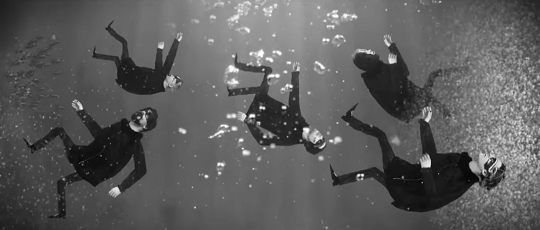

This in turn led me to search my own blog for slug and revisit the June 2021 post "Horseshoes, leatherleafs, and inattentional blindness."
Whirligig isn't a word you see everyday, so it jumped out at me when I found it on p. 177 of The Philosopher's Pupil a day or two ago:
"There's Alex!""Where?""There.""You mean the girl in the green costume who's kicking up the water and twirling round and round like a corkscrew?""Yes. She likes doing that.""She reminds me of something I saw once in a pool in the west of Ireland.""Well, I'm going swimming now. Be good."Tom dived in and swam towards Alex. Like Adam, he felt easier with her in the water. She had stopped her whirligig and waved to him.
So far, Scarlett-Taylor hasn't explain what he saw in the pool in the west of Ireland; perhaps it will come into the story later. For now, all we know is that it was a something, not a someone.
Two pages later, Tom is discussing gastropods with Adam. Asked to come up with a good line for a pop song, the latter suggests "It's only me," and then explains:
"Yes. There's two snails on a leaf, one on each side. Then one comes round the leaf and says to the other one, 'It's only me.'""Must they be snails?" said Tom after a moment's though."I see them as snails," Adam said firmly."I think it's brilliant," said Tom.
I had actually encountered that line about the two snails before, as Jorn Barger (who introduced me to Murdoch's work lo these many years ago) used to quote it. So this is where it's from.
⁂
Last night, after my staff had gone home, I was doing some final paperwork and such before closing up the school for the night. I had YouTube Music playing on my phone, using the "tuner" function, so that music was chosen for me by an algorithm. I wasn't paying much attention to the background music until I heard the line "no more counting dollars" while I was literally counting a stack of banknotes. This made me stop and look at the video, which was "Counting Stars" by OneRepublic, a group I'm unfamiliar with:
In the video, the band is playing downstairs, while upstairs there's some kind of charismatic revival meeting going on, with people jumping around and dancing and being "slain by the Spirit" and that sort of thing. One and only one of them twirls round and round like a corkscrew: a girl in a green costume.

Near the end of the video, one of the holy rollers, like Rumpelstiltskin, stamps too hard and falls through the floor. We then look down through the hole in the floor and see five men standing there looking up.

This syncs with the "Little Talks" video, where five men fall through the ice they are walking on into the sea, where they are menaced by a gigantic sea monster before it is zapped by their fairy protectress.

⁂
Today during my lunch break (which is several hours on Thursdays), I read a little more in The Philosopher's Pupil. On p. 194 there is mention of a Stonehenge-style monument which has been restored in modern times:
The priest and the philosopher gazed at the megaliths which were arranged in a broken circle some sixty yards in diameter. There were nine stones. The earliest reference to them is eighteenth-century, when four of them were standing. The others were uncovered and collected and erected in their present still-disputed positions by a nineteenth-century archaeologist.
After reading, I was in my study when a book inexplicably caught my eye. It was on a shelf with a lot of other short paperbacks, mostly children's literature, which my wife had picked up somewhere at a flea market or something. One of these was World Famous Strange but True by Colin, Damon, and Rowan Wilson. Colin Wilson is a writer I know and like, but I'd never paid any attention to this book before because it was on a shelf I rarely looked at and anyway appeared too tabloidish to be worth reading -- like a side-gig potboiler, not a serious part of Wilson's oeuvre. Today, though, I felt a strong nudge to take it down from the shelf, something I had never done before. I looked at the table of contents, which had summaries for each chapter. The summary for Chapter Six began "The monster of Lough Nahooin. The Loch Ness monster. UFOs and monster: Ted Holiday's theory. . . ." That seemed relevant, given the recent water-monster syncs, so I read that chapter -- only 10 pages, not counting the full-page photo of Nessie.
Here's how it begins, on p. 58:
Lough Nahooin is a small brown-coloured lake in Connemara on the west coast of Ireland.
A monster is spotted in the lake by Stephen Coyne and his family:
Describing it later to an investigator, F. W. Holiday, the Coynes said the monster was about twelve feet long. It had no eyes, but there were two horns like those of a snail on top of its head.Holiday was the author of a book on the famous Loch Ness monster, which he believed to be some kind of giant slug. From the description of the Coyne family, he had no doubt that this Lough Nahooin monster was another member of the same species. Since Lough Nahooin is a mere 100 yards long -- compared with the twenty-four miles of Loch Ness -- there seemed a reasonable chance of catching the Irish lake monster.
A mere hundred yards long -- so really more of a pool than a lake. In the west of Ireland. Inhabited by "some kind of giant slug." The monster had "two horns like those of a snail" -- or of a giraffe.
Later in the chapter, on p. 64, we are introduced to T. C. Lethbridge and his theory about Stonehenge:
Lethbridge's starting point is the mystery of ancient stone monuments like Stonehenge and the Merry Maidens. . . . Lethbridge became convinced that the power that apparently emanates from such monoliths is a form of energy that comes from living creatures. He calls it bio-energy, or bio-electricity. He believes that such energy can be generated by the frenzied kind of dancing that forms part of many ancient religious rituals.
Frenzied dancing as part of a religious ritual appears in the "Counting Stars" video.
On p. 65, we even get a reference to modern renovations of Stonehenge:
When modern engineers set about replacing one of the giant lintels at Stonehenge, they had the full benefit of modern cranes and lifting equipment, and the operation was still a difficult and costly one.
On p. 66, another theory of Lethbridge's is discussed:
Lethbridge also points out that if these other levels are characterized by a higher vibrational rate of energy, then creatures from these levels could actually be walking among us now -- completely invisible to us.
In a July 2021 comment on "Horseshoes, leatherleafs, and inattentional blindness" -- the post I recently revisited because it contains the word slug -- I write:
"Aliens" (or whatever the hell they are!) walk our streets undetected.
This post is a good illustration of what makes it so hard for me to get a handle on synchronicity or what it means. That I should be "prompted" to read a relevant book by some spiritual agency -- God, Tim, the sync fairies, my own psychic subconscious, whatever -- is an understandable hypothesis, and we can ask who or what did it and why. But something much more involved than that seems to be going on.
Both The Philosopher's Pupil and World Famous Strange but True were, let us say, brought to my attention by the sync fairies. But how to account for the fact that in an 18-page section of the former book and a 9-page section of the latter, we find references to (a) a lake or pool specified as being in the west of Ireland, (b) snails, and (c) an ancient circle of standing stones in England being repaired in modern times. These three things have no logical connection whatsoever. The books were written in 1983 and 1994, respectively, and belong to entirely different genres. Are we to suppose that the sync fairies were feeding ideas to one of both of these writers, setting up my little syncs decades in advance? Or that they travel back in time and edit the past to keep the sync-stream going? Colin Wilson and Iris Murdoch knew and liked each other -- she offered to get him a scholarship at Oxford, which he declined -- but is that a possible mundane explanation (Wilson being unconsciously influenced by his friend's novel of a decade before), or is it just another improbable coincidence to add to the list? The unconscious-influence theory would be more believable if it went the other direction, from the nonfiction writer to the novelist. After all, Wilson didn't choose for a snail-horned monster to be seen in a lake in the west of Ireland; that happened in 1968. And of course the links between these two texts are just a tiny part of the vast interconnected web of syncs in which they are embedded. How does it all get set up, and by whom, and why? Even if we postulate that syncs are the work of an omnipotent God (and something pretty close to omnipotence seems to be called for), it's still hard to make sense of what exactly he is doing and how and why. And hypothesizing that sync is instead a naturally-occurring phenomenon, or something my own mind is doing, doesn't make it any more comprehensible -- au contraire. It's starting to feel more and more as if there must be some wibbly-wobbly timey-wimey shenanigans involved.
And for what? All these borderline-impossible coincidences painstakingly orchestrated for what? What's the point of having me experience all this?
Wednesday, November 15, 2023
Little Skinny Planet
I've posted quite a bit recently about an unfinished story I wrote in 1997 about William Alizio. An excerpt is posted in "Pleased to meet you, hope you guess my name." It was a deliberately silly story, deliberately badly written, and not consciously intended to mean anything. Attempts at nonsense and randomness are, of course, openings for material to come in from elsewhere.
The excerpt I posted ended with Alizio being taken away in Tim and Patrick's spaceship. Here's what comes next:
"What is your planet called?" asked William Alizio after they had been in space for several hours."Its name is Vilum-el-Prika-Vlein," said Patrick."What language is that?" asked William Alizio. "And what does it mean?""It is Znorg-el-Bop," said Patrick, "and it means Little Skinny Planet. We usually call it the Little Skinny Planet, because nobody speaks Znorg-el-Bop anymore.""Oh? What do you speak now?""English.""English?" said William Alizio, a little surprised. "Why English?""It's a long story," said Patrick."Oh. Well, how did your planet get its name? Is it little and skinny?""Of course not!" said Patrick in disgust. "How could a planet be skinny?""I don't know," admitted William Alizio."When Bop the Great discovered our planet," said Partick, "he noticed that all the animals on it were little and skinny, so he said, 'Fi-el-krumi prika-vlein bister yorg.""What does that mean?""It means 'all the animals are little and skinny.'""Why are all the animals little and skinny?" asked William Alizio."They aren't. Bop the Great just happened to land in someone's giraffe sty.""Giraffes are little on your planet?" said William Alizio. "And you keep them in sties?""Bop the Great just thought they were little. He was a giant."
Little Skinny Planet was not a name I coined for this story. I used to talk about the Little Skinny Planet when I was a toddler. I have no memory of this, but I know it from the journal entries I used to dictate to my mother before I was able to write. This was a name comparable to "Black Africa" -- not a description of the place itself, but a reference to its inhabitants. It was where I imagined the Little Skinnies must come from.
Rereading this now, remembering that prika-vlein apparently means "little and skinny," and that the planet got this name on account of giraffes which were raised as livestock, I made a connection I hadn't before.
In my May 2021 post "On the threshold of a dream," I described my experience of a dream taking form. A spiral of fiery letters in "para-color" slowly transforming into blobs and then . . .
Then, with an abruptness that startled me, everything snapped into focus just like that, as if someone had flipped a switch. The vague blobs of "color" immediately transformed into a "photorealistic" scene. (Not the sort of thing that could be captured in a photo, of course. I refer to the level of clarity, detail, and definition.) I saw rolling farmland in what I felt was perhaps Ohio or Kentucky, a couple of small houses with white aluminum siding, and in the distance what were unmistakably two giraffes picking their way across the fields on their spindle legs. Actually, the giraffes looked somewhat less real than the surrounding countryside, as if they might have been some sort of holographic projection. They were just-perceptibly shimmering, and the ratio of para-color to ordinary spectral color was higher than in the surrounding scene.
Farmland with giraffes -- notably skinny giraffes with "spindle legs." And why are they described as "picking their way across the fields"? I remember that when I wrote this, it felt like "pricking on the plain" -- from the famous opening line of Spenser's Faerie Queene -- was the perfect way of describing the giraffes' movements, but I didn't know why. Spenser is referring to the knight pricking his horse with his spurs, which makes no sense when applied to riderless giraffes. I therefore went with the nearest somewhat semantically defensible phonetic approximation of the word I wanted, and pricking on the plain became picking their way. Now, though, it seems likely that some dim memory of prika-vlein in connection with skinny giraffes on a farm may have suggested those words to me.
The other thing about the giraffes in the dream is that they were "shimmering" with impossible colors.
Yesterday, as documented in "Blue Boat Home," I discovered the song "Little Talks" by Of Monsters and Men.
I heard it in a restaurant and didn't actually watch the music video until after posting. The beginning syncs with Swiss Family Manhattan, as we see an "airship" crash in a giant tree after being attacked by Ziz in the form of a black two-headed bird of prey -- symbol of the Holy Roman Empire. (The Swiss family crashes their airship on the Empire State Building, which they believe is a giant tree.) The synchronized insect-like way the men in the video move their spindly legs has a creepy "uncanny valley" effect that reminded me very much of trooping fairies or Little Skinnies. The floating fairy-like creature that accompanies and protects the Little Skinnies reminded me of Tim the Enchanter with the way she keeps zapping things and making them explode.
After she has zapped Ziz, Behemoth, and Leviathan, a final gigantic creature appears which she does not zap. It is full of shimmering colors and presented in such a way as to suggest that -- although I first thought of it as "Humbaba" -- it is meant to represent God:

Its rams' horns were another link to Tim the Enchanter, but its gigantic size and many eyes made me think of something else:

That's a screenshot from the Keanu Reeves film 47 Ronin, from my April 27, 2014, post "A beast with many eyes." I compared it to a qilin (a creature from Chinese myth) in the post. The night before seeing it on TV, I had dreamed of a whale "blue in color, with a row of eyes on the left and a row of eyes on the right — perhaps eight eyes in all. It also had feelers on the sides of its mouth like a catfish." The qilin-type beast "aside from the fur, horns, and nostrils, [looked] exactly like the many-eyed 'whale' I saw in my dream." Later, in 2022, I found that I posted my many-eyed whale dream on the 430th anniversary of Dee and Kelley's many-eyed whale vision.
The beast from "Little Talks" doesn't suggest a whale at all, but I think it does suggest the qilin-creature from 47 Ronin. Here's a traditional Chinese depiction of a qilin; the link with the 47 Ronin beast is indisputable:

The Humbaba creature at the end of the "Little Talks" video has shimmering colors like the farmyard giraffes in my dream (in a video that also features Little Skinnies, remember) -- but surely none of these fantastic creatures bears the slightest resemblance to a giraffe, right? Here's Wikipedia:
The legendary image of the qilin became associated with the image of the giraffe in the Ming dynasty. The identification of the qilin with giraffes began after Zheng He's 15th-century voyage to East Africa (landing, among other places, in modern-day Somalia). The Ming Dynasty bought giraffes from the Somali merchants along with zebras, incense, and various other exotic animals. Zheng He's fleet brought back two giraffes to Nanjing and they were mistaken by the emperor for the mythical creature, with geri meaning giraffe in Somali. The identification of qilin with giraffes has had a lasting influence: even today, the same word is used for the mythical animal and the giraffe in both Korean and Japanese.Axel Schuessler reconstructs Old Chinese pronunciation of 麒麟 as *gərin. Finnish linguist Juha Janhunen tentatively compares *gərin to an etymon reconstructed as *kalimV, denoting "whale"; and represented in the language isolate Nivkh and four different language families Tungusic, Mongolic, Turkic and Samoyedic, wherein *kalay(ә)ng means "whale" (in Nenets) and *kalVyǝ "mammoth" (in Enets and Nganasan). As even aborigines "vaguely familiar with the underlying real animals" often confuse the whale, mammoth, and unicorn: they conceptualized the mammoth and whale as aquatic, as well as the mammoth and unicorn possessing a single horn; for inland populations, the extant whale "remains ... an abstraction, in this respect being no different from the extinct mammoth or the truly mythical unicorn."
So the qilin is linked not only to the giraffe but to the whale as well! Keep in mind that my 2014 dream whale, like the qilin, "had feelers on the sides of its mouth like a catfish." A whale with such accoutrements was a novel idea to me at the time, but here it is in the 1997 William Alizio story:
"Are those ducks out there?" asked Jessica Nolin."I don't know," said William Alizio. "I never could tell ducks from geese.""I think they're ducks," said Jessica Nolin."Yes," said William Alizio. "They must be ducks."There was a loud, disgusting slurping sound, and the ducks (or geese) disappeared in a little whirlpool which appeared out of nowhere. Then the whirlpool went away and an enormous fish, golden-brown in color, broke the surface of the lake and dove back under the water. . . . William Alizio could see its bulging eyes staring up at them. Its enormous sucker-like mouth, flanked by fleshy feelers, was gaping open.
I think I conceptualized this at the time of writing as a gigantic carp, but big fish and whales have been interchangeable since the time of Jonah.
And then, in the sort of scene familiar from the "Little Talks" video, the monster is zapped and explodes. Some intelligent extraterrestrial monkeys, minions of the villain Thomas Hosey, have stolen Tim's laser gun and are trying to shoot Alizio and Nolin:
There was a rapid series of loud splashes behind them. William Alizio glanced back and saw that the lake was full of monkeys. They spotted him and Jessica Nolin almost immediately, and a teal-colored ray whizzed over his head. A tree on the island was reduced to rectangles.No sooner had William Alizio taken all this in than he heard a horrible slurping sound beneath him. He felt something pulling him down and struggled to stay afloat."Do something!" shouted Jessica Nolin. She was slowly sinking towards the fish. Another tree exploded, sprinkling them with rectangles. . . .A third teal ray flew towards them, hitting the water. For a moment, all William Alizio could see was a cloud of multicolored rectangles. He heard a scream.When the rectangles had settled, William Alizio and Jessica Nolin were both floating again. The fish was nowhere to be seen.
Go back and watch Time the Enchanter and "Little Talks" again and tell me there's no connection. Tim the Enchanter makes a tree explode for no apparent reason -- and here Tim's laser gun (Patrick's having been destroyed) does the same thing. The fairy in "Little Talks" zaps an enormous sea monster just as it is about to eat one of the Little Skinnies. I first saw Monty Python and the Holy Grail no earlier than 2000, three years after writing the Alizio story, and of course the "Little Talks" video didn't even exist until 2012.
I haven't even begun to figure out what this all means, but it clearly means something.
One more thing: William Wright has hinted several times on his blog that he thinks the sea voyages in the Book of Mormon -- those of Lehites and the Jaredites -- may actually have been space voyages. As anyone at all familiar with the field will know, every theory of Book of Mormon geography begins with postulating the identity of the Narrow Neck of Land. Narrow Neck of Land. Little Skinny Planet. Despite its central importance for would-be BoM geographers, the exact phrase "narrow neck of land" only actually occurs once in the text. Care to guess which chapter?
Yes, it's Ether 10.
Tuesday, November 14, 2023
Blue Boat Home
On yesterday's post, "William Alizio's links to other stories," I left this comment at 9:20 this morning:
The rainbow is another link to 42, since a rainbow has a radius of 42 degrees.
At 10:50, William Wright left this comment (quoted only in part here):
While in the process of playing hymn #172 "In Humility Our Savior", I suddenly realized that the hymnbook was green. Based on your dream, I became curious what the lettering on the spine was like. Sure enough, gold lettering "Hymns of the Church of Jesus Christ of Latter-day Saints" running down the spine.[. . .]Lastly, blue does come into this as well. Hymn #172 is also the tune for a song that was my daughter's favorite for awhile - the song is called "Blue Boat Home" arranged by Peter Mayer (original by Rowland Pritchard back in the 1800s), which likens the Earth to a boat flying through space with all of us as passengers.
I looked up and listened to "Blue Boat Home," which is apparently a Unitarian Universalist hymn. (UUs have a thing for space. I remember them reciting some thing about "the womb of stars" the handful of times I attended their services in Columbus, Ohio.)
It's funny how the same melody can have a completely different feel when the lyrics and instrumentation are changed. "In Humility, Our Savior" is a "sacrament hymn" and thus brings back the smell of white bread and chlorine. Funny how chlorine -- not incense or whatever, but chlorine -- should be a "churchy" smell for me, but sacrament and baptisms were almost the only times I had any exposure to chlorinated water growing up. "Blue Boat Home" evokes no such memories, and I rather like it. Here's the first stanza:
Though below me, I feel no motion standing on these mountains and plains.Far away from the rolling ocean still my dry land heart can say:I’ve been sailing all my life now, never harbor or port have I known.The wide universe is the ocean I travel and the earth is my blue boat home.
Googling the lyrics led me to a blog called Blue Boat Home, and one of the recent posts there caught my eye: "One Night in Cleveland," because of its first paragraph:
In 1996, my sister and her boyfriend had just moved into a new apartment in Pittsburgh, and they invited my family to join them for Christmas. I decided to take the bus there from my college in Grinnell, Iowa, which meant I had layovers in Des Moines, Chicago, and Cleveland. As I recall, the Cleveland layover was from roughly 11pm to 2am.
The year 1996 was an important year in my own life, and I was living in the Cleveland area at that time. (Seeing that year made me think "When will be the next 1996?" -- meaning the next year to have the same calendar. Next year, it turns out.) The mention of "college in Grinnell" also jumped out at me, as I did first grade at Grinnell Elementary School when I lived in New Hampshire.
The post is an anecdote. At the bus terminal in Cleveland, the author met a scruffy-looking man who gave him "a drinking glass that had clearly been stolen from a restaurant." Later, in Oakland, the author runs into a similar-looking person on the sidewalk:
It was a different guy but seemed cut from the same cloth. I opened my backpack and took out the drinking glass. I looked him straight in the eye and said, "I met a friend of yours this morning in Cleveland. He'd want you to have this." I gave him the glass and walked off.
That's the end of the story. I'm not sure what relevance it has, but I have a hunch that it will turn out to have some, so I'm documenting it for future reference. (Tim made Strieber drink something from a glass he had taken from the hotel bathroom, but that's a rather tenuous connection.)
Now for the real syncs.
Shortly after 4:00 this afternoon, I went out for early dinner, as I have classes from 6:00 to 9:30 with no breaks. The Alice Merton song "No Roots" was playing in the restaurant:
The chorus is "I've got no roots, but my home was never on the ground," repeated many times. Compare this to "Blue Boat Home": Although I feel as if I'm on solid ground, in fact "I’ve been sailing all my life now, never harbor or port have I known."
As soon as that song was over, the next song that came on was "Little Talks" by Of Monsters and Men:
In this song, the repeated line is "Though the truth may vary, this ship will carry our bodies safe to shore" -- a very strong sync with "Blue Boat Home," since both imply that it is only in death that we reach the shore.
I was not familiar with either of these songs before. I made a note of the lyrics I was hearing and looked them up later.
After I'd finished eating, I sat in the restaurant for a while reading The Philosopher's Pupil, by Iris (literally "Rainbow") Murdoch. I turned to page 172 and thought, "Hey, that's the hymn number William Wright mentioned," the hymn that has the same tune as "Blue Boat Home." This is what I read on that page:
His bath was a large boat-shaped affair made of white tiles with blunt ends. . . . the steaming water fell from the taps at a controlled temperature of forty-two degrees Centigrade.
The very first sentence on the next page, 173, is this:
He had not been there [the Methodist church in his hometown] for a long time and felt a weird shock when he recognised the numbers of the hymns.
Subscribe to:
Posts (Atom)
Popular posts
-
 Following up on the idea that the pecked are no longer alone in their bodies , reader Ben Pratt has brought to my attention these remarks by...
 -
But Men shall remember Atlantis's name Come hell or high water! Sith both of them came, It rests unforgotten, and what we now tell Skill...
-
 Mark your calendars, and in the meantime find something else to read. Note added: For those who have asked, nothing is wrong, and my decisi...
 -
 It's been a while since I clicked for a randomly selected /x/ thread . I tried it today just in the spirit of "Is this thing on?...
 -
 In a comment on " Ascending to the black star ," Bill brought up a game called The Blue Prince , and so on a random whim I searche...
 -
 My mention of a "Buddhist text" in my last post was probably misleading, making it sound like I was poring over Mahayana scriptur...
 -
Back on August 17, Bruce Charlton posted an episode from the old children's TV show Pipkins (which I had never heard of), in which Hart...
-
I had had a meeting scheduled for this afternoon, but the client called to ask if we could reschedule it to 7/22. Minutes later, I was readi...
-
 Google is being weird again. Update: I published this post at 10:59 a.m. Exactly 47 minutes later, at 11:46, I photographed this logo, whic...
 -
As I have mentioned before, I regularly have to create cloze tests for which write a brief article using a dozen or so of the vocabulary ite...

