Last night, while in the hypnagogic state (i.e. in the process of falling asleep), I heard a woman's voice repeating "Pika thlein, pika thlein" -- which I recognized as the Elvish words so similar in sound and meaning to Prika-Vlein, the name of the Little Skinny Planet. (See "Prika-vlein . . . is Elvish?")
I was close enough to the dreaming state to experience auditory hallucinations like that but still sufficiently awake for a conscious and somewhat coherent train of thought. I thought about how a commenter on the Prika-vlein post had suggested that a word like pika just naturally sounds like it should mean something small, citing the metric prefix pico- (one-trillionth). Yes, I thought, but nano- doesn't sound phonaesthetically small. I remembered that as a child, before I knew the scientific meaning of nano-, I had invented an imaginary creature called a nanosnake. This was a dinosaur-scale beast with the general body shape of a very long-necked plesiosaur, but with no flippers or other limbs. It had a beak like a parrot and a pair of small wings on the back of its head, which it used to keep its head held high for long periods without its neck tiring.
At this point I lapsed into a full dreaming state, and my reminiscences about the nanosnake gave way to the sudden panicked thought that perhaps I had accidentally swallowed a nanosnake -- meaning, this time, a microscopically small snake. This felt like an extremely urgent problem, and I was panicking, unable to think clearly. An immaterial woman was nearby, trying to help me by shouting advice. "Mudra! Mudra! Mudra!" she kept saying, the way you might say, "Stop, drop, and roll" to someone who was on fire.
She was telling me to do a mudra -- one of a number of named hand gestures that carry symbolic meaning in Buddhism and Hinduism -- but that just made me panic even more. There are lots of different mudras, and my knowledge of them is pretty much limited to what little I can still remember from that Central Asian Art class I took back in college to meet a diversity requirement. I had no idea which one I was supposed to do. I tentatively raised my right hand in a half-assed "fear not" abhaya mudra. Nataraja (dancing Shiva) makes that mudra with the arm that has a snake wrapped around it, which I guess is what made me think it might be relevant to my "nanosnake" problem. I still had no idea if it was what I was supposed to be doing, though.
Apparently not, as the ghostly woman kept right on shouting, "Mudra! Mudra! Mudra!" Finally, as if in exasperation at my thick-headedness, she spelled it out: "Menelmacar mudra!"
As soon as she had said that, I woke up.
Menelmacar, I know thanks to recent posts by William Wright, is one of the Elvish names for the constellation Orion. (The only Elvish name for Orion I had known previously was Telumehtar.) A few days ago he posted "Orion and his most excellent pose," about the position of Orion's arms -- a mudra in a broad sense -- and how the same gesture appears in a Lionel Richie music video and in Bill and Ted's Excellent Adventure.
So this is the Menelmacar mudra, I guess. Remember it in case you ever accidentally swallow a nanosnake.
⁂
One of the reasons my half-awake mind had jumped from pico- to nano- was that shortly before going to bed, I had listened to the They Might Be Giants song "Stone Cold Coup d'Etat," which is from the album Nanobots.
The song is full of off-the-wall metaphors for inversions of the usual order of things: "The words assassinated the book / The kitchen cooked and ate the cook," etc. This reminded me of William Wright's first post to feature the Menelmacar mudra, "Dancing on the ceiling," in which he quotes a Book of Mormon variant of Isaiah:
And wo unto them that seek deep to hide their counsel from the Lord! And their works are in the dark; and they say: Who seeth us, and who knoweth us? And they also say: Surely, your turning of things upside down shall be esteemed as the potter’s clay. But behold, I will show unto them, saith the Lord of Hosts, that I know all their works. For shall the work say of him that made it, he made me not? Or shall the thing framed say of him that framed it, he had no understanding? (2 Ne. 27:27)
Here's the biblical version, modified from the King James Version to correct what is universally considered today to have been a translation error:
Woe unto them that seek deep to hide their counsel from the Lord, and their works are in the dark, and they say, Who seeth us? and who knoweth us? Surely you turn things upside down! Shall the potter be esteemed as the clay? or shall the work say of him that made it, He made me not? or shall the thing framed say of him that framed it, He had no understanding? (Isa. 29:15-16)
The difference is quite significant: In the biblical version of Isaiah, it is the workers in darkness who are accused of turning things upside down. In Nephi's version, they accuse the Lord of doing so. The accusation of turning things upside down is itself turned upside down!
Two lines from "Stone Cold Coup d'Etat" in particular caught my imagination:
The bark now commands the trees The queen is overruled by the bees
I had just been reading in John Keel's Operation Trojan Horse about the Fatima apparitions of 1917:
One of the witnesses, a woman named Maria Carreira, testified that she saw nothing when the children suddenly knelt and began talking to an unseen entity, but she did hear a peculiar sound -- like the buzzing of a bee.
The children understood their mysterious visitor, who finally identified herself somewhat cagily as "the Lady of the Rosary," to be the Blessed Virgin Mary, Queen of Heaven. In Maria Carreira's perception, though, the Queen was overruled by the bees. This association of bees with the Queen of Heaven made me think of the Sugarcubes song "The Bee":
The key lines are these:
Oh, hot bee
Queen of heaven
With glossy trunk
Buzz to me
I don't know what "glossy trunk" was intended to mean -- I guess a bee's thorax is its "trunk," or torso? -- but it sounds more like a description of a tree than of a bee. Specifically, it would be a reference to the texture or appearance of a tree's bark, so that's another tie-in with "Stone Cold Coup d'Etat."
The odd phrase "Oh, hot bee" is another link to the bee-buzzing Lady of Fatima. In the grand culminating apparition on October 13, 1917, Keel reports that "A wave of heat swept over the crowd, drying their rain-soaked clothes instantly."
⁂
I had started reading this Fatima stuff last night, after reading William's post "Twos-day: San Ramon, another Walt, and flying into the Sun." In that post, he mentions seeing the date 02/22 and realizing that the number 22 (which had been appearing in syncs) could be a date, and that his own birthday was such as date: July 22. I left a comment saying that in the past I had thought of Monday the 22nd as a day of good omen, the reverse of Friday the 13th, and that my first spiritual experience had taken place on Monday, July 22, 1996.
It was just after reading that post and leaving the comment that I picked up Operation Trojan Horse and read this, in the lead-up to the account of the Fatima events:
One of the girls was named Lucia Abobora. She was born on March 22, 1907, and she was to become one of the central figures in the earthshaking drama to follow.
There is no apparent reason for giving this girl's exact date of birth. In a book that mentions hundreds of different individuals, a word search for the word born confirms that no other person's exact date of birth is given. For some reason, Keel made a point of mentioning that Lucia Abobora, later of Fatima fame, was born on the 22nd.
This morning, reading on in Keel, I found a much more specific sync. Recall that in my comment on William's blog I had mentioned one particular date: Monday, July 22, 1996, and gave it as the date of a spiritual experience. The year 1996 was a leap year beginning on a Monday; these occur every 28 years. The last one before 1996 was 1968. The next one after 1996 is the present year, 2024. Today I read this in Keel:
Six young Canadian girls, ranging from seven to thirteen years old, allegedly saw the Virgin Mary on the evening of Monday, July 22, 1968.
That's Monday, July 22, in year with a calendar identical to that of 1996 (and 2024). And seeing the Blessed Virgin obviously qualifies as a spiritual experience.
The upcoming total eclipse of the sun has been in the sync-stream of late, which is probably what put Bonnie Tyler's 1983 song "Total Eclipse of the Heart" in my head.
That in turn made me think of the audition scene from the 2010 movie Diary of a Wimpy Kid, where the sing the intro to the Tyler song, with the repeated line "Turn around":
That led to the Tyler song being replaced in my head by "Turn Around" (1992) by They Might Be Giants, which is about turning around and seeing a human skull:
Turn around, turn around
There's a thing there that can be found
Turn around, turn around
It's a human skull on the ground
Human skull on the ground
Turn around
This train of thought occurred while I was on the road, and while I was thinking about the human skull on the ground, I saw this on the back of the jacket of the motorcyclist in front of me:
This reinforced the skull theme, and I found myself thinking about the scene in Hamlet where he addresses the skull and trying to remember the lines: "Alas, poor Yorick! I knew him, Horatio, a fellow of infinite jest, of most excellent fancy. He hath borne me on his back a thousand times . . . ." And that was about as much as I could remember; I've only read Hamlet a couple of times.
Hamlet was borne on the back of Yorick, who is now a skull -- and now a skull was borne on the back of a motorcyclist.
After posting "Booby trap," which ends with a meme of a cat saying, "It's a booby trap!" I had a vague memory of having seen a meme years ago involving a cat and the Admiral Ackbar "It's a trap!" line. I couldn't remember any details, but I ran an image search for admiral ackbar cat just to see what would turn up. I didn't find what I was looking for, but among the search results was this old New Yorker cartoon:
I liked the drawing style, so I forgot about Admiral Ackbar and cats and just searched for benjamin schwartz cartoon. One of the results immediately got my attention:
That's the iconic Hamlet scene I had just been thinking of, with the twist that the prince is turning around.
On a whim, I searched for skull solar eclipse, and the first result was this T-shirt, about the very eclipse that started this whole train of thought:
The date of the eclipse is written as 04.08. In Hamlet, the next scene after Act 4, Scene 7, is the scene with the skull.
Searching for bonnie tyler skull also turned up "Total Eclipse of the Heart":
I woke up with a few lines of verse in my head, all I could remember from a dream:
Gilgamesh was an elven king.
Of him the harpers sadly sing.
The sun and moon of heart's desire --
Oh, Troy town's down, tall Troy's on fire!
After jotting that down, while I was trying to remember more of the dream, a few more lines, in a different meter, came to me. I'm not at all confident that these were from the dream -- in fact I'm rather sure they were not -- but they came to mind as I was trying to call back the dream, suggesting that there is some connection:
O Smith, declared th' earth-shaking god:
Should Mars the debt refuse,
Thou hast my word that I will pay
To thee thy lawful dues.
None of this material is original. The quatrain from the dream takes, with minimal modification, two lines from a poem in The Lord of the Rings and two from "Troy Town" by Dante Gabriel Rossetti. The main change is the replacement of Tolkien's Gil-galad with the much less "elven" name Gilgamesh.
The second quatrain is taken nearly verbatim from Sir Charles Du Cane's 1880 translation of the Odyssey. The lines are from Book VIII, and the context is that Poseidon is trying to convince Hephaestus to release Ares from the golden chains with which he bound him after catching him in bed with Aphrodite. (In Du Cane's original text, the god is addressed as Vulcan, not Smith, but the lines are immediately followed by "Him answered then the smith renowned . . . .") The larger context of the Odyssey is, of course, that Troy town's down.
Torn from that context, though, Du Cane's lines suggest another reading: If Smith is not avenged by war, he will be avenged by natural disaster.
⁂
Shortly after writing down the two quatrains, I checked William Wright's blog and read his latest post, "Coriantumr and Donald Trump, the light-minded highness," in which he proposes that Trump is the reincarnation of the Book of Mormon figure Coriantumr. Unlike some of the other reincarnations William has proposed, this one immediately clicked with me at an intuitive level and made more sense the more I thought about it. I'm calling it a bull's-eye.
Then my mind jumped from Coriantumr back to Gilgamesh. Here's how Coriantumr's name is first introduced in the Book of Mormon:
And it came to pass in the days of Mosiah, there was a large stone brought unto him with engravings on it; and he did interpret the engravings by the gift and power of God. And they gave an account of one Coriantumr, and the slain of his people. And Coriantumr was discovered by the people of Zarahemla; and he dwelt with them for the space of nine moons (Omni 1:20-21).
Since Coriantumr was the only survivor of the carnage recounted on the stone, he must have engraved it himself. This reminds me of the famous ending of Gilgamesh, after the hero goes on an epic quest for immortality and utterly fails:
He went on a long journey, was weary, worn-out with labor, returning he rested, he engraved on a stone the whole story.
Coriantumr was the last of the Jaredites, who spoke a lost language no one else could understand. That's why his engravings on the stone had to be translated "by the gift and power of God" rather than by ordinary means. Similarly, in the They Might Be Giants song "The Mesopotamians," Gilgamesh and friends say:
And they wouldn't understand a word we say
So we'll scratch it all down into the clay
Half believing there will sometime come a day
Someone gives a damn
Maybe when the concrete has crumbled to sand
The "secret combination" theme from the Coriantumr story also appears in that song:
In Mesopotamia
(But no one's ever seen us)
The kingdom where we secretly reign
(And no one's ever heard of our band)
The land where we invisibly rule
⁂
My dream, and William Wright's post, were both on February 22, and it's still February 22 now in the US. While I was in the act of writing this post, which quotes a little-read translation of the Odyssey, Zenith of the Alpha posted a new video saying:
The strongest Synchronicities I've ever experienced connected with THE ODYSSEY and the date 2/2/22. Now, 2 years later I see ODYSSEUS is news on 2/22.
A few weeks ago I discovered and started listening to a second Vampire Weekend song, "Step":
This is the chorus:
The gloves are off, the wisdom teeth are out What you on about? I feel it in my bones, I feel it in my bones I'm stronger now, I'm ready for the house Such a modest mouse I can't do it alone, I can't do it alone
Given the immediate context, I don't think "the wisdom teeth are out" refers to routine dental surgery. It means "the snake has bared its fangs," snakes being a metonym for wisdom ("wise as serpents"). The third line reinforces this reading with its (probably unintentional) nod to Emily Dickinson's "A narrow Fellow in the Grass":
But never met this Fellow Attended or alone Without a tighter Breathing And Zero at the Bone.
Listening to "Step" now, I naturally think of Narrow Brain, "the snake-pale, narrow-faced one," the malevolent spirit in Time and Mr. Bass. In the post I've just linked, I noted with concern the link between Narrow Brain and my blog title From the Narrow Desert. It's a line from a poem by George MacDonald in Phantastes. The complete couplet is:
From the narrow desert, O man of pride, Come into the house, so high and wide.
I've been thinking of the implications of that last line because of the recent syncs relating to the Wise Men: "And when they were come into the house, they saw the young child with Mary his mother, and fell down, and worshipped him" (Matt. 2:11).
And what does the chorus of "Step" say? "I'm stronger now, I'm ready for the house."
I started to think that maybe it was time to retire the name From the Narrow Desert. I started the blog in 2018, when I was circling around Christianity like a moth but had not yet made the plunge. It expressed my aspiration to find my way out of the narrow desert of know-nothing materialism and into the "house" of a coherent Christian worldview. And, I thought, haven't I done that? I made it -- right, guys? Whatever else you might say about me, I'm not a narrow materialist anymore. I've made it into the house. Maybe I should change the blog name to High and Wide.
When I played "Step" just now, YouTube queued up after it an unfamiliar song by an unfamiliar band: "High Hopes" by Panic! at the Disco:
The video shows Brendon Urie walking up the side of a skyscraper in Los Angeles until he reaches the roof, where he performs with his band. At first I took this as confirmation -- it's a house that's very high -- but almost immediately I realized that this interpretation didn't sit well with me. Urie (a lapsed Mormon, incidentally, and not in a good way) never actually goes into the building. He stays on the outside, never entering its heart, and uses it to realize his "high hopes" -- which turn out to be no higher than some vapid dream of being a famous pop star. This isn't the imagery of the Wise Men bowing down to the infant Christ, but of the people who wanted "a tower sufficiently high that they might get to heaven," an idea planted in their hearts by the same being who plotted with Gadianton (Hel. 6:28).
Returning to "Step," "Such a modest mouse!" now seems like a sarcastic response to "I'm stronger now, I'm ready for the house."
In 2002, They Might Be Giants released their first children's album, No!, and these lines from "The House at the Top of the Tree" startled me:
There's a plan to eat the house In the mind of a mouse in the woods.
Back when I lived in Maryland, more than a decade before this song was released, we had a big tree house which was the site of some strange goings-on. We had a big antique radio in there, with which we picked up transmissions we imagined were from outer space, dealing with a sort of bomb called "the Big Herbie," which they regularly threatened to drop on us. The tree was down in a ravine, so the tree house could be entered by a ramp connecting it to higher ground, without the need for a ladder. One time my sister and I went into the tree house only to find two large snakes coiled around the radio. They looked like colubrids of some kind, and therefore non-venomous, but they still scared us enough that we turned tail and ran back down the ramp.
A persistent mental image or fantasy I used to have while in that tree house was that somewhere deep in the woods but not far away was a "mouse" that wanted to eat the tree house. I could feel its presence and its thoughts, like those of the nightmare toad. Although I thought of it as a "mouse," my mental image was of a very large animal almost like a rodent grizzly bear. When I saw the illustration associated with the TMBG song, it startled me even more:
Where do mental images come from? Why would we get the same one like that?
I've been reading the Psalms, a few a day, and today these two passages jumped out at me:
Lord, my heart is not haughty, nor mine eyes lofty: neither do I exercise myself in great matters, or in things too high for me (Ps. 131:1).
Lord, remember David, and all his afflictions: How he sware unto the Lord, and vowed unto the mighty God of Jacob; Surely I will not come into the tabernacle of my house . . . until I find out a place for the Lord, an habitation for the mighty God of Jacob (Ps. 132:1-5).
So no, I'm not going to rename the blog. High hopes to one side, these posts remain dispatches from the narrow desert.
In another sequence, I did not see anybody, but heard a woman's voice say some things which I could not clearly make out. I responded with "Huh?", to which she said much more clearly "Oh, it was just Empire State Building stuff."
This was the only dream fragment that baffled him: "everything except for the reference to the Empire State Building I think I have a pretty good read on the meaning." Later, though, in a comment on his own post, he speculates:
I continued to think about it this afternoon after writing this post and I *think* this could be a reference to the great and spacious building mentioned in the Book of Mormon. In Lehi's dream (and Nephi's) he saw that building high above the Earth in the sky. The fact that it was high above the Earth might be more than just symbolism (as I was taught: pride, riches, evil, etc. being without a foundation, etc.) but also in some way indicate that this building is literally high above the Earth... as in, upon a different world. . . . Perhaps the building Lehi dream of the building and this Empire State Building are about the same place.
On October 24, after discovering that Mr. Wright had resumed blogging, I posted "William Wright is back -- and he's bringing syncs." Some of these syncs had to do with the They Might Be Giants song "The Statue Got Me High." He had mentioned "three triangles" in a Tom Petty music video, and for some unknown reason I have a very strong association between the intro to "The Statue Got Me High" and seeing three glowing triangles on my ceiling. Then I realized that the lyrics -- "The stone, it called to me / And now I see the things the stone has shown to me" -- fit right in with Mr. Wright's obsession with supernatural stones that could be used for communication.
The Empire State Building puts in an appearance in the music video for "The Statue Got Me High":
And then it blasts into space:
Whether or not this counts as a sync depends on whether or not Mr. Wright watched the music video when I posted it. If he did, as seems reasonably likely, then his dream, and his hunch that the Empire State Building might be "literally high above the earth," probably reflect a subconscious memory of this moment in the video. If not, then, well, it's just the sync fairies showing off again.
The October 24 post "William Wright is back -- and he's bringing syncs" introduced the 1992 They Might Be Giants song "The Statue Got Me High" into the sync-stream. I connected it with this photo I took last year:
I had originally posted this photo in "Blasphemy against Zeus, F. Scott Fitzgerald, and whale vision," the name Dick being the central connecting link. A white Starbucks cup had been in the sync-stream at that time, and the name Starbucks comes from Moby-Dick. Dick Diver is Fitzgerald's autobiographical character in Tender Is the Night. The cup on Fitzgerald's head made him look like Serapis, which is a link to Zeus. Zeus Is a Dick tied in with the John Dee "God is a whale" theme. Oh, speaking of whales, "The Statue Got Me High" is from this album:
I had linked the photo of the two books to "The Statue Got Me High" because a giant white teacup and saucer feature prominently in the music video, and because of the line "The monument of granite sent a beam into my eye."
Last night, someone posted on /x/, asking "How do I have psychedelic experiences without taking any drugs?" -- a statue getting you high would be one obvious example of this! -- with this accompanying picture:
One of the commenters identified the man in the picture: "That's Philip K. Dick receiving info from VALIS. True story." VALIS is God. The name Philip has been in the sync-stream, associated with headlessness.
A couple of days ago I started reading Rilke, my previous exposure to his work having been limited to cultural osmosis. I posted one of his poems on my Book of Mormon blog on October 24. Not until this present post brought in the name Apollo and the theme of headlessness did I think of what is arguably his best-known poem (not among those I've read recently, but everyone knows it), which may have been one of the inspirations (Don Giovanni being the other obvious one) for "The Statue Got Me High":
Archaic Torso of Apollo
We cannot know his legendary head
with eyes like ripening fruit. And yet his torso
is still suffused with brilliance from inside,
like a lamp, in which his gaze, now turned to low,
gleams in all its power. Otherwise
the curved breast could not dazzle you so, nor could
From the music video for "The Waiting" (1981) by Tom Petty and the Heartbreakers:
Note that all three of these have a "time" theme: Past, present, future. Ocarina of Time. Waiting.
In the Galahad Eridanus video, the object is a rotating octahedron, often appearing, as in the screenshot above, as two triangles, one upright and the other inverted. Seen from another angle, an octahedron can appear as four triangles: a central triangle with each of its edges shared by one of the other three:
The Legend of Zelda "Triforce" symbol can be seen as consisting either of two triangles (a large upright one and a small inverted one) or of four (the central inverted triangle sharing one of its edges with each of the other three). And of course one can also ignore the negative-space inverted triangle and see it as three triangles -- that being the point of the name Triforce.
Look back at the Zelda screencap. The radiating lines are blue, and the central inverted triangle appears blue, too. Rotate it 90 degrees to the left, and you have what we see in the Tom Petty video. The blue triangle seen above is one of a set of three triangles, as in the Triforce:
There's perhaps a nod to Crowley in this theme, too:
Nothing in that logo is original to Crowley. The Eye of Providence, in a triangle, radiating light, is a ubiquitous theme (and no, it's not exclusively Masonic).
"The Statue Got Me High" -- the TMBG song I associate with a Triforce-like image -- says "The monument of granite sent a beam into my eye." Beams being sent into eyes, rather than radiating from them, are covered in the Eridanus video, too:
Note added: The Walk the Moon video "One Foot" (posted by William Wright here) includes somewhat similar imagery:
Further note added (October 28): John A. Keel's book The Eighth Tower came up in an /x/ thread, so I looked it up on Anna's Archive. Here's the cover art:
Yesterday I happened to be discussing psychedelic drugs with the logistics staff of an auto parts company (I wear many hats), and on the way home I passed Presbyterian church, which caught my eye because its burning-bush logo synched with something I had been thinking about earlier. My brother Luther likes to say that Presbyterian literally means "cowboy" -- since presbys, the Greek for "elder," may originally have meant "one who leads the cattle." That, combined with the recent discussion, made me think of Bizarro cartoonist Dan Piraro's graphic novel Peyote Cowboy, which I have never read but know about because he's always talking it up on his blog.
Then I realized I hadn't checked that blog in well over a year. I popped over to see what was new. The second-newest post, "Unidentified Flying Tableware" (October 15), featured this cartoon:
I suppose the greenness of the aliens in the Bizarro cartoon also syncs with the Jaredites, since more than one skeptic of the Book of Mormon has wondered, given Joseph Smith's interest in stones, whether the Jaredites and Nephites were inspired by green minerals.
Note added: Dan Piraro's October 8 post also seems like a link to "The Statue Got Me High":
I'm not sure what's supposed to be going on here. The statue is sculpting itself, but what happened to the artist? He's fainted from shock? He's dreaming that the statue is sculpting itself? The statue killed him?
The statue made me die
The statue made me die
It took my hand, it killed me, and it turned me to the sky
Whatever happened to the guy, he's lying face-up, turned to the sky.
Yesterday's post "Michelangelo conflated with Archangel Michael, Crowley's headless God, 42 in the Tenth Aethyr" left me on the lookout for synchronistic occurrences of the numbers 42, 126 and 333. I was mostly expecting to see those numbers themselves, maybe on license plates or something, but another idea also popped into my head with a curious clarity: Three triangles could represent 333.
I never saw any of the expected numbers. Nor did I run into three triangles anywhere.
William Wright proposes that the first element in the name Moriancumer refers to Moria -- the Dwarrowdelf of Tolkien, subject of the Song of Durin -- and that there is a hidden reference in the Book of Mormon to the Brother of Jared, like Gandalf, opening the gates of Khazad-dûm by uttering the password friend.
William Wright stopped blogging on September 17, announcing that he was finished. When I visited his blog on October 19 to get the Brother of Jared link, that was still where things stood.
Wandering Gondola's comment of this morning ends with this paragraph:
While writing this I thought to check William Wright's blog, and found he's posting again. (A second small sync: Another Will Wright is famous for simulation games, most notably The Sims, which lets players create and somewhat control virtual people. Not-quite-free men!)
Her use of the variant form Will Wright led me to make a connection I hadn't before: I am currently reading Whitley Strieber's novel Majestic. An air force base called Wright Field, often shortened to Wright, is mentioned many times; and the main character's name is Will Stone. Stones -- supernatural, capitalized Stones -- are a central theme on William Wright's blog.
I went straight to Mr. Wright's blog and read his first post since he resumed blogging: "The Great Pumpkin and 'waiting.'" It was posted on October 20, the day after "Syncfest," and it mentions the same Brother of Jared story I mentioned there:
I look to the story, or rather my updated story, of the Brother of Jared to demonstrate the truth of that sentence I just wrote. He moved a mountain by faith. In an earlier post, I suggest that the mountain that he moved was actually Durin's Door in order to access the mines of Moria, obtain Mithril that could be fashioned into stones, and have Jesus fill those stones with light.
That could be a striking coincidence -- or, more likely, he reads this blog, and my shout-out influenced his decision to start posting again. Be that as it may, it certainly is a striking coincidence that Mr. Wright ends his post by talking about three triangles in a Tom Petty music video:
In the video, there are 3 colored triangles and also loose colored string on the set. At the midpoint of the video (about the 2 minute mark), we find Petty singing in front of a black backdrop. He then proceeds to smash through this backdrop to reveal a member of the band behind it. With that band member is the red triangle, and the red string now seeming to extend out from both him and the triangle. We then see the blue triangle with the same band member now with blue string, and lastly the yellow triangle, but this triangle is inverted and now, to me at least, resembles more something like a jewel or diamond.
And then I suddenly remembered what "three triangles" had meant to me decades ago.
Approximately 20 years ago, when my brother and I were rooming together in college, he asked to borrow my battered copy of Whitley Strieber's Communion. When he was near the end, he brought it to me, showed me one of the pages, and said, "Why on earth did you write 'The Statue Got Me High' in the margin?"
Well.
In 1994 or thereabouts, I discovered They Might Be Giants and Whitley Strieber, in that order. The first time I listened to the TMBG song "The Statue Got Me High" (from the 1992 album Apollo 18), it just absolutely scared the bejesus out of me. As soon as I heard the very brief instrumental intro before the singing starts, I got goosebumps and my mouth went dry, and it jogged loose a free-floating memory, unattached to anything else, of looking up at my bedroom ceiling and seeing three small triangles of bright white light, themselves arranged in a triangular pattern. I still don't know why, or why I had such an extreme emotional reaction to that image. I decided the song was "satanic" but from time to time felt the urge to listen to it again anyway -- which would always leave me terrified and vowing never to play it again.
Communion also scared me to death. I guess I spent quite a lot of time being scared to death in those days. But nothing scared me more than the shock of recognition when I read this passage, from a transcript of an abductee support-group meeting:
Sam: Does anybody ever experience light without any source? You see it on the wall or on the ceiling. It could be in a triangular shape or round. Sometimes I see a triangle. Three triangles together on the ceiling. Has anybody else seen that?
Notice that the comment that led me to William Wright's "three triangles" post was on a post of mine with "ceiling lights" in the title. Part of Mr. Wright's explanation for his decision to start blogging again is "I just find stones are on my mind constantly, even as I go about other things. It is just always there."
Now check out some of the lyrics to "The Statue Got Me High":
The stone it called to me
And now I see the things the stone has shown to me
A rock that spoke a word
An animated mineral it can be heard
. . .
And now it is your turn
Your turn to hear the stone and then your turn to burn
The stone it calls to you
You can't refuse to do the things it tells you to
Fortunately I am no longer capable of being scared to death, but this is still really, really weird.
In the dream, I was back in the house I grew up in (and that my parents still live in). I was talking with my dad about something, and I started to say something like "It just feels like things are close, because I can hear you guys upstairs on your ceramics making a lot of noise". As I was saying this, my dad's face transformed into that of Keanu Reeves as the character of Neo in the Matrix movies, which was a bit strange, and I found that it was difficult to tell whether the words I said were coming from me or the person I was now facing as Neo. As soon as I became aware of this, I woke up.
In the video for "The Statue Got Me High," as the intro is playing -- the part that freaked me out so much when I first heard it and made me remember the three triangles -- the camera zooms in on a giant ceramic cup and saucer:
As they sing, "And now I see the things the stone has shown to me," we see this:
This video was made seven years before The Matrix, but it certainly seems to prefigure it:
After reading Mr. Wright's posts, I found a new comment from Wandering Gondola -- who plays lots of video games so I don't have to -- pointing out that my three triangles in a triangular configuration suggest the Triforce from the Legend of Zelda franchise. It's a bit different (Zelda on the left, a reconstruction of what I saw on the right) but certainly suggestive:
Zelda made me think of F. Scott Fitzgerald's wife, and then I seemed to remember that Fitzgerald had appeared on this blog once before. He had indeed, in the October 2022 post "Blasphemy against Zeus, F. Scott Fitzgerald, and whale vision," featuring this image:
What's that on F. Scott's head? Look familiar? The image on the Zeus Is a Dick book also suggests a line from "Statue": "The monument of granite sent a beam into my eye."
In my 2022 post, I connect this juxtaposition of Fitzgerald and dick with Tender Is the Night -- a novel in which the main characters, Dick and Nicole Diver, are based on the author and his wife, Zelda.
Oh, by the way, the F stands for Francis.
I've also just noticed that "Statue" contains an indirect Michelangelo reference: "The truth is where the sculptor's chisel chipped away the lie" -- alluding to the apocryphal story about Michelangelo saying he created his masterpiece by "just chipping away anything that doesn't look like David."
Yesterday morning (October 20), I was reading Whitley Strieber's 1989 Roswell-incident novel Majestic on my phone's Kindle app. I flipped to a new "page" and read:
O that I had clasped my hand and had no intention of letting go. I was damned and I knew it.
That didn't make any sense in context, so I backtracked a couple of lines and read what was actually on the screen.
I occasionally make errors like this, where my mind mis-gestalts a block of text, and have documented several of these on this blog. This one seemed meaningful, though, since the content so strongly suggested a particular passage from the Book of Mormon:
O that we had remembered the Lord our God in the day that he gave us our riches, and then they would not have become slippery that we should lose them; for behold, our riches are gone from us. Behold, we lay a tool here and on the morrow it is gone; and behold, our swords are taken from us in the day we have sought them for battle. Yea, we have hid up our treasures and they have slipped away from us, because of the curse of the land. O that we had repented in the day that the word of the Lord came unto us; for behold the land is cursed, and all things are become slippery, and we cannot hold them. Behold, we are surrounded by demons, yea, we are encircled about by the angels of him who hath sought to destroy our souls. Behold, our iniquities are great. O Lord, canst thou not turn away thine anger from us?
As related in my 2020 post "All things are become slippery," this passage was the subject of a strange experience I had in 2006, when a line from it suddenly popped into my mind, together with the knowledge that the "complete quote" of which it was a part had some extremely unusual mathematical properties, which it did indeed turn out to have. I was an atheist at the time and hadn't touched the Book of Mormon in years, and the whole thing just seemed to come out of nowhere.
What was I doing when I had this 2006 "revelation"? I was worrying about my relationship with the woman I later married (October 20 is our anniversary) and reading The Grays, another Whitley Strieber novel about aliens. (Strieber has written lots of novels and lots of non-fiction books about aliens, but relatively few novels about aliens.)
I thought, "2006. That was 17 years ago." Then I noticed that the publication of Majestic (on September 11, incidentally) was 17 years before that.
That evening, I taught a children's English class. We had just started a new textbook, and I asked everyone to open to page 8. One of the girls for some reason instead opened up to pages 80 and 81 and, delighted by one of the pictures she saw there, help up her book and said, "Teacher, look at this!" It was a Wallace's flying frog, spreadeagled in mid-leap:
Early this morning (October 21), I was at a local coffee shop which always has BBC programs playing on the TV. I happened to glance up at the screen and saw three big vertical bars:
That seemed strange, so I kept watching to see what it meant. As soon as the bars faded from the screen, the next thing to appear was "17 years ago our eyes were opened":
There followed a series of short clips of wildlife: a couple of close-ups of animals' eyes, migrating Monarch butterflies, a jaguar jumping down from a tree, an undersea scene -- and then a spreadeagled Wallace's flying frog!
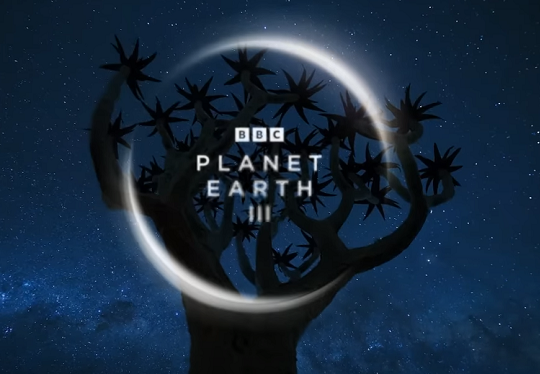
It was a trailer for Planet Earth III. The name of the program was displayed within an eclipse:
Here's the whole trailer on YouTube:
The rest of the opening sentence is "17 years ago our eyes were opened to the sheer wonder of our planet." On Thursday, one of my students, for an assignment about superlative adjectives, had written: "The Earth is the most beautiful place I know." It's an odd thing to say, since we have no experience of any other place, and it fits in with the "interplanetary" theme of the Strieber novels.
In the Majestic passage I misread, the aliens are causing Will Stone to fly through the air. He flies down low over a soldier and snatches his hat, after which he nearly collides with an enormous alien spacecraft. This made me think, for reasons I trust are obvious, of the Chairlift song "Le Flying Saucer Hat":
The song mentions celebrating the "universal eclipse," which is a link to the BBC trailer:
It's also a strong sync with a video I happened to watch last night, in which eclipse-like imagery was a symbol of totality ("l'eclipse universelle"). I haven't finished the video yet. As it happens, I stopped just at the moment of the eclipse and then went to bed, planning to finish it later.
Here's the video:
Note added:
When I was writing this post, I originally wrote, "2006. That was 17 years ago. Time flies" -- but then I deleted the last two words because they were trite and not really true. People say "time flies" to express surprise that a great deal of time has elapsed in what feels like a much shorter time, but I have no such feeling. My experiences of 2006 feel like they were, yeah, about 17 years ago.
When I posted this I added the tag "Chairlift" and was surprised to notice that this was not the first post thus tagged. When had I mentioned Chairlift before? In my November 2021 post "Bee like a sunflower." In that post, I write:
"Bee like a sunflower" -- because it begins with an insect/verb pun followed by the word like -- made think of "Time flies like an arrow; fruit flies like a banana."
An added note at the end of the post (like the one you're reading now) said:
I found a dude wearing a sombrero . . . Only later did I remember that the line "Time is flying like an arrow" occurs in the TMBG song "Hovering Sombrero."
I then included a video of "Hovering Sombrero" and -- apparently just because it was another song about a flying hat, "Le Flying Saucer Hat."
In the present post, I mention that Majestic was published on September 11, 1989. "Hovering Sombrero" is from the album Mink Car, which was released on September 11, 2001.
"Time flies like an arrow; fruit flies like a banana" is normally attributed to Groucho Marx. This morning -- after writing most of this post but before adding this note -- I taught from a textbook page which used a picture of Groucho and Harpo to illustrate the meaning of comedy.
When did Groucho say that "time flies" line, though? I pretty much have all the Marx Brothers movies memorized, and I can't place it. A search turned up this:
This line has been attributed to the famous comedian Groucho Marx, but I have never seen a solid citation. Would you please explore this topic?
Reply from Quote Investigator: QI has not yet found any substantive evidence that Groucho Marx used the comical line under examination. He died in 1977, and he received credit for the line by 1989.
By 1989.
Second note added:
The last thing the BBC trailer begins with "our eyes were opened" and ends (just before the logo in an eclipse is shown) with a clip of a rhinoceros walking through a city street:
I remembered that a few years ago a sync post had featured a text from the Douay-Rheims Bible in which Balaam mentions a rhinoceros. I found the post, "A bit of political prognostication from a correspondent -- plus rhinoceroses!" -- posted on December 14, 2020 (also the first mention of Joan of Arc on this blog). The passage about Balaam was from the daily Mass reading for that date:
He took up his parable and said: Balaam the son of Beor hath said . . . The hearer of the words of God hath said, he that hath beheld the vision of the Almighty, he that falleth, and so his eyes are opened:
How beautiful are thy tabernacles, O Jacob, and thy tents, O Israel! . . . God hath brought him out of Egypt, whose strength is like to the rhinoceros (Num. 24:3-5, 8).
Now get this: That video I watched half of? I've finished it. Absolutely central to it is an eclipse that took place on December 14, 2020!
I know I'm a bit jaded, but that is one hell of a coincidence even by my standards!