Showing posts with label Ace of Swords. Show all posts

Saturday, June 1, 2024

Joan: Look out the window. Come over to the window.

In his latest post, "Spelling Bee, Abseil, and Waiting for a Star to Fall," William Wright revisits his son's math homework in which he had to solve an anagram for "a spelling bee." He notes that the Scripps National Spelling Bee final coincided with Joan of Arc's feast day this year, and he also finds the Elvish word for "bow" (the weapon) hidden in the homework assignment. I left a comment pointing out that the French for "bow" is arc.

A few hours after reading that post, I taught a student who is working on improving his pronunciation. We use a book where each unit focuses on a particular sound and includes dialogues that use that sound a lot. Today's lesson was brought to you by the letter O -- or, rather, the phoneme /o/, the "long o" sound. You know what name includes that sound? Here's the dialogue from the book:

Joan woke up a few minutes ago, but Joe is still sleeping.

Joan: Joe! Joe! JOE! Hello!?

Joe: (groans) Oh, no. What's the problem?

Joan: Look out the window.

Joe: No. My eyes are closed, and I'm going back to sleep.

Joan: Don't go to sleep now, Joe. Come look at the snow.

Joe: Snow? It's only October. I know there's no snow. Leave me alone.

Joan: Come over to the window.

Joe: Stop joking, Joan. There's no snow.

Joan: OK, I'll show you. I'm going to put on my coat and go out and make a snowball and throw it at you! Then you'll open your eyes!

(If the first line of that dialogue made you think of the Garden of Eden, you might be a Mormon.)

The way Joan keeps trying to get Joe to go to the window made me think of a scene from the Beatles movie Help!, so I looked it up:


I haven't watched that movie since I was a kid, and I had forgotten that the scene also includes a bow. The Leo McKern character is trying to hypnotize Ringo (Japanese for "apple"; his real name, Richard Starkey, is also interesting) into approaching the window so that they can shoot him with an arrow that has a balloon full of red paint attached to it.

Joan's line "I'm going to put on my coat" also caught my eye, since the immediate context is William's blog, which is called Coat of Skins -- referring to the physical body. "I'm going to put on my coat" could mean something like "I'm going to assume physical form."

The baddies in Help! want to hit Ringo with red paint. Joan threatens to hit Joe with a snowball. Snow and red dye are connected in a famous passage in Isaiah: "Though your sins be as scarlet, they shall be as white as snow."

Later, I thought I should go through all my 50-some posts tagged "Joan of Arc," but I got sidetracked by this one: "The Stadium Arcadium covers." There's lots of Eden symbolism there -- the bitten apple, the four rivers -- but what really caught my eye was this:


Here, Joan's coat of arms is juxtaposed with the words snow and arc ("bow"), and with two red swords (though Joan's own is white). Red weapons sync with the red-paint arrow in Help! and also with my comments in "Humpty Dumpty sat on the counter" about stained swords becoming bright as a symbol of repentance and redemption.

Thursday, May 30, 2024

Makmahod in France?

Sometimes while I am praying my daily Rosary -- my discursive mind preoccupied with rattling off the Latin formulae, my imaginative mind centered on Christ -- I will receive flashes of extremely vivid mental imagery. These are typically very brief but of such intense clarity that they seem somehow clearer than ordinary physical vision. I received such an image today.

It was essentially the image seen on the Ace of Swords in the Tarot: a luminous hand holding aloft a sword with a gold crown hovering like a halo around the blade. This is a very familiar image to me, and I was not surprised to see it today, as it closely resembles the coat of arms of Joan of Arc, my patron saint, who was executed 593 years ago today. A novel feature had been added, though: Something was written on the blade, in capital letters separated by centered dots. I have reconstructed the inscription as follows:

· L · R · D · M · E · R · A · N · S · E · A · S · C ·

The image was only visible for a fraction of a second, so it was impossible to take in and remember the exact sequence of letters. However, I am 100% confident that I have reconstructed it correctly, triangulating from three different impressions about what it means.

My first impression was that it essentially said, in somewhat garbled spelling, "Lord, me answer. Ask." I understood this to mean that if you want to receive knowledge from God, it is necessary to formulate and ask a specific question -- though that point is somewhat undercut by the fact that I received what is in this post without asking anything in particular!

My second impression was that it was an anagram of "Arc's realm ends." Given the context, I of course thought first of Joan of Arc and the Kingdom of France. That kingdom did indeed end, and Joan's banner was burned in the Revolution. Joan was never known as Arc in her lifetime, though, and arc also means the rainbow, l'arc-en-ciel. As I mentioned in my 2018 post "The Throne and the World," for me a rainbow represents the word world:

In my very early childhood my thinking was mostly visual, and abstract words generally each had a specific mental picture associated with them. I remember that I often used to pray "Thank you for the world," and that the image that always accompanied the word world was a rainbow.

"Arc's realm," then, refers not only to France but to all the kingdoms of the world.

My third impression was that each of the letters stood for a word -- and no sooner had I formulated that thought than I knew, conceptually if not literally, what words they stood for. As soon as I'd finished my Rosary, I went straight to a French Bible to confirm my hunch. The inscription stands for this:

Le royaume du monde est remis à notre Seigneur et à son Christ.

The kingdoms of this world are become the kingdoms of our Lord, and of his Christ (Rev. 11:15).

I'm sure many of my Mormon readers will immediately have recognized the significance of this being written on a sword. According to a discourse by Brigham Young, this very phrase was written on the blade of the Sword of Laban:

When Joseph got the plates, the angel instructed him to carry them back to the hill Cumorah, which he did. Oliver says that when Joseph and Oliver went there, the hill opened, and they walked into a cave, in which there was a large and spacious room. He says he did not think, at the time, whether they had the light of the sun or artificial light; but that it was just as light as day. They laid the plates on a table; it  was a large table that stood in the room. Under this table there was a pile of plates as much as two feet high, and there were altogether in this room more plates than probably many wagon loads; they were piled up in the corners and along the walls. The first time they went there the sword of Laban hung upon the wall; but when they went again it had been taken down and laid upon the table across the gold plates; it was unsheathed, and on it was written these words: "This sword will never be sheathed again until the kingdoms of this world become the kingdom of our God and his Christ."

We call it the Sword of Laban, but it may well be of nobler origin than that. According to several secondhand reports, collected by Don Bradley in his indispensable book The Lost 116 Pages, it was also the sword of Joshua, wielded in the conquest of Canaan, and was very likely originally made for (or even by) Joseph in Egypt and carried out of that country in the Exodus with his bones.

Can we add Joan of Arc to the list of possible bearers of this storied blade? Perhaps. The origins of her sword are mysterious. She found it behind a church altar, having been led to it by her voices, and it appeared to be of great antiquity. Who knows who put it there or where it originally came from? At any rate, whether or not Joan's sword was literally and historically the Sword of Laban, it seems undeniable that today's vision is identifying the two, at least symbolically.

Tuesday, September 19, 2023

The Stadium Arcadium covers

On September 11, I received an email from a sporadic correspondent who wishes to be anonymous. Among the things it mentioned was that Storm Thorgerson, who did the cover art for the Muse album Black Holes and Revelations, "did some other synchy (and famous) album art."

This sent me to Thorgerson's Wikipedia page, where I found that he designed the iconic Dark Side of the Moon cover for Pink Floyd. Scrolling through a list of other album covers he had designed, I found a few that had been in the sync stream before (Ween's The Mollusk, for example), but the entry that jumped out at me was this one:

  • Red Hot Chili Peppers
    • Stadium Arcadium (2006) (unused)

The last time I had received an email from this person, which was in May, I noticed that my correspondent's pseudonym and real name were linked to Lorenzo Snow (an old sync theme) by both gematria and etymology. This is what I was referring to when I wrote this in my May 8 post "Random Syncs: Ace of Swords, 1320."

I had recently been brooding over the Ace of Swords, the Marseille version, which features a red sword passing through a crown, and at the same time had (again!) been experiencing some synchronicities related to the name Lorenzo Snow. These latter had made me think of various other things with snow in their name. I listened to that Red Hot Chili Peppers song, and then I thought of the novel Snow Crash, which I read back in 2001.

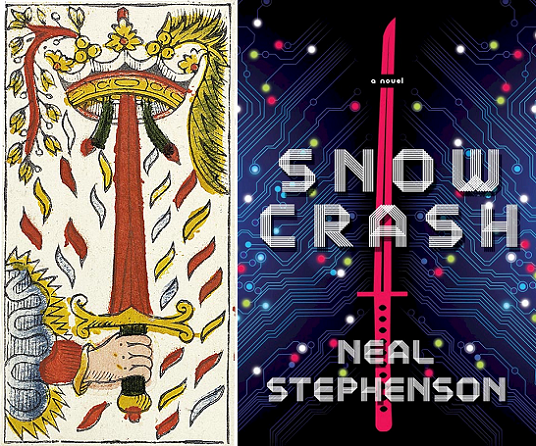
In this post, and in the same-day follow up "Crowns, martyrs, and Mithras," I noted connections between the Marseille Ace of Swords, the cover of Neal Stephenson's Snow Crash, and Joan of Arc's coat of arms.


The Ace shows an upright red-bladed sword passing through a crown from which hang a laurel branch (etymologically related to Lorenzo) and a palm frond; colorful bits of flame fill the background. The Snow Crash cover shows an upright red sword passing through both the name Stephen (meaning "crown") and the anagram CRNOW, as well as the word Snow; colorful dots fill the background. The sword also passes through ARC spelled backwards.

As mentioned above, Lorenzo Snow made me first think of the Red Hot Chili Peppers song "Snow (Hey Oh)," which I listened to, after which I moved on to Snow Crash. I've never been a big RHCP fan and don't know their music very well, so it wasn't until June 29 that I found out what album "Snow" is from: Stadium Arcadium.


There's no sword here, but there's a crown-like ring around the album title, and if you remove the repeated -adium element, what's left is St. Arc.

Going back to Storm Thorgerson's unused cover ideas for Stadium Arcadium, it turns out that he submitted three of them. Here are two:


Four rivers meeting at a central point, where a tree grows, and an eaten apple -- clear Garden of Eden symbolism. I am currently reading William Fairfield Warren's Paradise Found, which argues that Eden was located at the North Pole. Here's part of the table of contents.


Here's Mercator's famous map of the Arctic:


The third proposed Stadium Arcadium cover has no Eden symbolism but turned out to be the synchiest of all:


In the very same email that had mentioned Thorgerson's album art, my correspondent included a screenshot of a glitching video game in which only half of the character's body was sticking up from the ground:


The character even has a Scandinavian name, like Storm Thorgerson.

Monday, May 8, 2023

Crowns, martyrs, and Mithras (sync but not only sync)

My last post dealt with syncs related to the Ace of Swords and the cover of the Neal Stephenson novel Snow Crash.


Later I noticed that, in addition to passing through Stephen (from the Greek for "crown"), the sword on the Snow Crash cover also passes through the letters of the English word crown.


The Ace of Swords also resembles the coat of arms granted to Joan of Arc. Since the sword-and-crown design originates in France (Tarot de Marseille) and does not appear on pre-Marseille Italian cards (Visconti-Sforza), this is probably not a coincidence. The Snow Crash cover features the the word Arc spelled backwards.


On May 4, I happened to read this in Manly P. Hall's The Secret Teachings of All Ages:

Initiation into the rites of Mithras, like initiation into many other ancient schools of philosophy, apparently consisted of three important degrees. Preparation for these degrees consisted of self-purification, the building up of intellectual powers, and the control of the animal nature. In the first degree the candidate was given a crown upon the point of a sword and instructed in the mysteries of Mithras' hidden power. Probably he was taught that the golden crown represented his own spiritual nature, which must be objectified and unfolded before he could truly glorify Mithras; for Mithras was his own soul, standing as mediator between Ormuzd, his spirit, and Ahriman, his animal nature.

Is this relevant to the image on the Ace of Swords? The bolded passage could mean that a crown is hung on the point of a sword and thus presented to the candidate, but Hall's Masonic background suggests another reading:

Senior Deacon steps back, while the Junior Deacon, with candidate, enters the Lodge, followed by the two Stewards. As they advance they are stopped by the Senior Deacon, who presents one point of the compasses to the candidate's naked left breast, and says:

S. D. -- Mr. Gabe, on entering this Lodge for the first time, I receive you on the point of a sharp instrument pressing your naked left breast, which is to teach you, as it is a torture to your flesh, so should the recollection of it ever be to your mind and conscience, should you attempt to reveal the secrets of Masonry unlawfully.

In the above passage, from Duncan's Masonic Ritual and Monitor, receiving the candidate "on the point of a sharp instrument" means receiving him while pressing the point of such an instrument against his body. In the same way, "upon the point of a sword" may have a meaning corresponding to that of "at gunpoint," meaning that the candidate is threatened with a sword as he is given a crown, as if the crown is being forced upon him.

Trying to track down Hall's possible sources in ancient literature, I found only a couple of passages in Tertullian. The first is from Prescription Against Heretics, Chapter LX:

He [the devil], too, baptizes some -- that is, his own believers and faithful followers; he promises the putting away of sins by a laver (of his own); and if my memory still serves me, Mithra there, (in the kingdom of Satan,) sets his marks on the foreheads of his soldiers; celebrates also the oblation of bread, and introduces an image of a resurrection, and before a sword wreathes a crown [sub gladio redimit coronam].

The translator calls the clause I have bolded "obscure," which it certainly is. A strictly literal reading would be "under a sword redeems a crown." Whatever that may mean, sub gladio ("under a sword") can't very well mean that the crown was on the sword.

The other Tertullian passage, from De Corona, Chapter XV, goes into somewhat more detail and seems likely to be Hall's source:

Blush, ye fellow-soldiers of his [Christ's], henceforth not to be condemned even by him, but by some soldier of Mithras, who, at his initiation in the gloomy cavern, in the camp, it may well be said, of darkness, when at the sword’s point a crown is presented to him [coronam interposito gladio sibi oblatam], as though in mimicry of martyrdom, and thereupon put upon his head, is admonished to resist and cast it off, and, if you like, transfer it to his shoulder, saying that Mithras is his crown. And thenceforth he is never crowned; and he has that for a mark to show who he is, if anywhere he be subjected to trial in respect of his religion; and he is at once believed to be a soldier of Mithras if he throws the crown away -- if he say that in his god he has his crown. Let us take note of the devices of the devil, who is wont to ape some of God’s things with no other design than, by the faithfulness of his servants, to put us to shame, and to condemn us.

This is literally "he is presented a crown with a sword interposed," which again seems unlikely to mean that the sword itself was "crowned," as in the Ace. I think that what Tertullian means is that the candidate is "forced" at swordpoint to accept the crown but is nevertheless supposed to reject it, expressing the fact that he would rather die than accept any other crown than Mithras himself. (Is there a pun here on Mithras and mitra, "mitre"?) It seems strange to us today, when almost nobody ever wears a crown, that not wearing one could be "a mark to show who" is a true follower of Mithras, but things were different in Tertullian's time. De Corona opens with this anecdote:

Very lately it happened thus: while the bounty of our most excellent emperors was dispensed in the camp, the soldiers, laurel-crowned, were approaching. One of them, more a soldier of God, more stedfast than the rest of his brethren, who had imagined that they could serve two masters, his head alone uncovered, the useless crown in his hand -- already even by that peculiarity known to every one as a Christian -- was nobly conspicuous. Accordingly, all began to mark him out, jeering him at a distance, gnashing on him near at hand. The murmur is wafted to the tribune, when the person had just left the ranks. 

The tribune at once puts the question to him, "Why are you so different in your attire?" 

He declared that he had no liberty to wear the crown with the rest. 

Being urgently asked for his reasons, he answered, "I am a Christian." 

O soldier! boasting thyself in God. Then the case was considered and voted on; the matter was remitted to a higher tribunal; the offender was conducted to the prefects. . . . and now, purple-clad with the hope of his own blood . . . and crowned more worthily with the white crown of martyrdom, he awaits in prison the largess of Christ.

Apparently, it was common practice for all the soldiers in a victorious army to be given laurel crowns, thus making Christians (and Mithraists) conspicuous in their refusal to wear them. In this story, the Christian expects to be put to death for this refusal, so he has, figuratively speaking, been presented with a crown "at the sword's point." Since Tertullians point is that the Mithraists sometimes put Christians to shame, we may presume that the Mithraic story has the same meaning: The sword symbolizes a threat should he refuse to wear the crown, and yet he is to defy the threat and refuse.

Tertullian's reference to "the white crown of martyrdom" is curious, since the term "white martyr," as contrasted with "red martyr," typically refers to someone who is persecuted for his faith but not killed. In the 1906 vision of Maximilian Kolbe, the white crown "meant that I should persevere in purity and the red that I should become a martyr. I said that I would accept them both." White apparently did not yet have this connotation for Tertullian, though, since he describes his white-crowned martyr as "purple-clad with the hope of his own blood."

Whatever Tertullian's reason for calling the crown of martyrdom "white," it syncs with the Snow Crash cover, where the word snow appears in place of the crown.

Random syncs: Ace of Swords, 1320

In my recent post "Good Shepherd Sunday (knock, knock)," I describe how I went to a used bookstore and found two books -- one by French archbishop  -- which both prominently referenced Jesus' saying "Knock, and it shall be opened unto you" and had other coincidental connections as well (such as each quoting Thomas Merton on page 18).

I bought a few other books while I was there, too, including one which was pretty clearly what I believe is vulgarly yclept "woo" but which I picked up anyway for sync-related reasons. The spine caught my eye for no other reason than that it was red and the author's name was Stephanie -- which I suppose requires some explanation. I had recently been brooding over the Ace of Swords, the Marseille version, which features a red sword passing through a crown, and at the same time had (again!) been experiencing some synchronicities related to the name Lorenzo Snow. These latter had made me think of various other things with snow in their name. I listened to that Red Hot Chili Peppers song, and then I thought of the novel Snow Crash, which I read back in 2001. Vaguely remembering that there had been a Sumerian god or something on the cover, I googled it. I did find the cover I had remembered, but the first image result was the cover of a more recent edition:

The similarity to the Ace of Swords is obvious. Besides the red sword pointing upward, there are the bits of radiance off to the sides, in the same colors -- red, yellow, white, and light blue. On the Ace, the sword passes through a crown from which a laurel branch and a palm frond hang. The laurel (from which the name Lorenzo ultimately derives) is a symbol of victory, and the palm is a symbol of martyrdom. On the novel cover, the sword passes through Snow, a big letter A (Ace), Neal (of uncertain etymology, but often taken to mean "victory" or "champion"), and Stephen (meaning "crown," and also the name of the first Christian martyr).

Returning to the bookstore, the color red and the name Stephanie (feminine of Stephen) isn't much of a link, but it was enough to make me pull the book off the shelf and look at it. Something on the back cover caught my eye:

"We can never find the Truth without seeking" -- yet another reference to "Ask, and ye shall receive; seek, and ye shall find; knock, and it shall be opened unto you." On top of that, it appeared to have something to do with an unorthodox understanding of time, which is a major interest of mine. That was enough to make me buy it, in spite of all the goofy "Galactic Mayan mind lineage" stuff.

That was a week ago. On May 7, having just finished the François Fénelon and Ravi Shankar books, I turned to The Uninscribed. Opening it up, I found this on the page just before the first chapter:

Oh, my.

If some of the contents your brain can't hack
See the synchronic notes in the back

Since synchronicity was my whole reason for buying the book in the first place, I immediately turned to the back of the book to see these "synchronic notes" -- which turn out to be a set of completely unintelligible endnotes that say things like this:

July 25, 2003. Red Planetary Skywalker, Kin 153. Day out of Time. Gateway to the White Spectral Wizard year. Fire initiation.

Alberto Ruz Buenfil. Blue Cosmic Monkey, Kin 91. 

What if my brain can't hack the synchronic notes, either? Then what?

Before finding the notes themselves, though, I turned to the very last page in the book, where I found this:

One of the author's websites is called 1320frequencyshift. Remembering that the number 1320 had been in the sync-stream before, I checked my blog to find where. It was from my "planet n00b" posts ("Where's planet n00b? Oh, there it is!" and "I hate coincidence: From planet n00b to Mr. T cereal and back again").


A commenter had noted the "ACT" placard in the background and, replacing each of the letters with its ordinal value, arrived at 1320. When my second post included references to "planet 133t" and Mr. T, he noted that 133t = 13320, and Mr. T's initials, MT = 1320.

Another commenter had asked me to explain why 133t was the opposite of n00b, so I obliged:

n00b = newbie
133t = elite h4x0r (opposite of n00b)

So the same posts that reference 1320 also say that a newb is the opposite of a hacker. I found the 1320 reference in Uninscribed by following instructions intended for those who "can't hack." The string newb also appears on the back cover, where it says, "this book is a New Beam Genesis story."

Popular posts