Today an obscure song from 30 years ago, one I haven't listened to or thought of in ages, came to mind. In order to establish that its coming to mind had nothing to do with my recent posts about The Matrix, I will have to describe my train of thought in some detail.
First of all, few days ago, I happened to be looking through my old sync log from 2016-17. One of the notes I read was this one:
2016 Mar 3 (Thu) – I read a few pages (pp. 87-89) of Ray Bradbury’s Dandelion Wine in [a cafe called] FM Station. They were playing the Lukas Graham song “7 Years,” which I had never heard before. It begins:
Once I was seven years old, my mama told me
Go make yourself some friends or you'll be lonely.
Once I was seven years old.
It then goes through various other ages: once I was 11, 20; soon I’ll be 30, 60. It ends by repeating the opening lines quoted above.
While listening to this, I was reading pp. 88-87 [sic] of Dandelion Wine. The children are discussing how Colonel Freeleigh is a “Time Machine” because he can remember so many of his past experiences.
‘Maybe old people were never children, like we claim with Mrs. Bentley, but, big or little, some of them were standing around at Appomattox the summer of 1865.’
Tom and Doug discuss what Doug calls “far-traveling” – meaning going back in time through memory.
“Far-traveling. You make that up?”
“Maybe yes and maybe no.”
“Far-traveling,” whispered Tom.
“Only one thing I’m sure of,” said Douglas, closing his eyes. “It sure sounds lonely.”
Thus the chapter ends.
A bit earlier in the book, on pp. 72-73, old Mrs. Bentley insists that she was once a little girl, but the children refuse to believe it. She shows them a photo to prove that she was 7 years old once.
In triumph she flashed her trump card, a postal picture of herself when she was seven years old…
“Who’s this little girl?” asked Jane.
“It’s me!”
The two girls held onto it.
“But it doesn’t look like you,” said Jane simply. “Anybody could get a picture like this, somewhere.”
They looked at her for a long moment.
“Any more pictures, Mrs. Bentley?” asked Alice. “Of you, later? You got a picture of you at fifteen, and one at twenty, and one at forty and fifty?”
The girls chortled.
“I don’t have to show you anything!” said Mrs. Bentley.
“Then we don’t have to believe you,” replied Jane.
“But this picture proves I was young!”
“That’s some other little girl, like us. You borrowed it.”
Like the song, this focuses on the fact that one was younger in the past – with a specific focus on “seven years old.” Both also emphasize loneliness.
That was several days ago. Today I was doing some mindless paperwork and humming to myself and discovered that what I was humming was the 1967 Monkees song "Look Out (Here Comes Tomorrow)," with the repeated line, "Oh, how I wish tomorrow would never come." It occurred to me that this was similar to Bob Dylan's line "The present now will later be past," in that both highlighted the need for a Dunnean model in order to make sense of the passage of time. If there is only one dimension of time, then the past never was -- and the future never will be -- the present. Tomorrow will never come, and Mrs. Bentley never was seven years old.
This made me think of the sync notes quoted above, and I tried to remember the term the children in Dandelion Wine had used for revisiting the past through memory -- "long-journeying"? I see now that it was actually "far-traveling," but "long-journeying" is what came to mind and what made me think of the 1993 Moxy Früvous song "Morphée," which begins with the words "Longue journée." It's all in French, a language of which I am relatively ignorant, and I never was very clear on most of the lyrics. I tried to sing it to myself but had to lapse into humming and dum-de-dumming for most of it. All I could remember was "Longue journée . . . chez Morphée . . . ce doux piège . . . et je fuis, je fuis . . . je rêne
Nemo en exil sur mes rêves fragiles" -- which I figured meant "Long journey . . . at Morpheus's place . . . something-something . . . and I went, I went . . . I reign, Nemo in exile, over my fragile dreams." Translating je fuis as "I went" was just a guess (wrong, it turns out), based on Spanish, and I hadn't the slightest idea what ce doux piège might mean, though it was one of the lines I remembered most clearly.
Then I thought: Morpheus! Nemo! I've just been posting about Morpheus and Neo -- and "Morphée" was released six years before The Matrix. Morpheus is the god of dreams, of course, but why "Nemo"? Is it a reference to those trippy old Little Nemo in Slumberland comics?
Sure enough, the very first panel of the very first Little Nemo strip (1905) mentions "His Majesty, Morpheus of Slumberland."
And what does ce doux piège mean? It turns out it means "this sweet trap." Here's the French Wikipedia article on the Venus flytrap:
Here are the complete lyrics of "Morphée":
Longue journée
Qui s'achève dans une chambre foncée
J'entends au loin les sirènes
Qui comme une vague me tirent, m'amènent
Chez Morphée
Émerveillé
Ce doux piège
Ou les gammes en délire s'arpègent
M'emportent si loin des villes
Et je fuis,
je fuis les escadrilles du privilège
Beau sortilège
On solde les vieux pays au marché des gorilles
Caché dans les bras de Morphée je rêne
Nemo en exil
Sur mes rêves fragiles
And here, since no real translation seems to be available and I can't be bothered to do it myself (at least not now; I probably will do later), is the Google Translate version:
Long day
That ends in a dark room
I hear the sirens in the distance
Which like a wave pulls me, brings me
To Morpheus
Amazed
This sweet trap
Where delirious scales arpeggio
Take me so far from the cities
And I run away
I flee the squadrons of privilege
beautiful spell
We sell the old countries at the gorilla market (???)
In my St. Patrick's Day post "You can set your watch by the green motorcycle," I relate a dream in which "wherever you were in the world, if you kept your eyes open at 5:00 Tuesday morning, Liverpool time, you would see a green motorcycle go by, timed to sync with the Beatles singing about it on Sergeant Pepper." Because of the 5:00 connection, I included a picture of this Vogues record:
Debbie left several comments. First, she related a dream of her own, from 2017, which was primarily about the Moon but also prominently featured both the color green and a mysterious motorcycle. I quote only a few relevant excerpts:
I felt as if the house was in a large valley type of area. It was in the summer because there were green plush leaves on the trees and the grass was green. . . . I could feel that something wasn’t right. I then looked outside the window to see what was going on and I could see the moon bouncing (like a ball) in the sky. . . . At one point we could see a motorcycle with a young White man and his girlfriend. What was bizarre is that the motorcycle came down from the sky!! It landed in the field where my mother and I were standing.
In a follow-up comment, she noticed that the Five O'Clock World record features the Jonathan King song "Everyone's Gone to the Moon."
Imagine my surprise when I researched the lyrics and OMG! Check out the reference to MOTOR CAR, Painted GREEN. Although a car is not a motorcycle but do in keep in mind they both are vehicles.
Here are the lyrics to the relevant verse:
Long time ago
Life has begun
Everyone went to the sun
Cars full of motors
Painted green
Mouths full of chocolate
Covered cream
Arms that can only
Lift a spoon
Everyone's gone to the moon
Though the song uses the odd expression "cars full of motors painted green," Debbie refers to it as "MOTOR CAR, Painted GREEN," noting that this is not quite the same as a motorcycle. Here in Taiwan, though, motorcycles are quite literally called motor cars. The usual word for motorcycle is 摩托車, pronounced mótuōchē; chē is the Chinese for "car," and mótuō is a transliteration of the English motor. Sometimes mótuō is used by itself to mean "motorcycle," since the word motor itself is now more usually rendered 馬達 (mǎdá). Another word used for "motorcycle" in Taiwan is 機車 (jīchē), which is also used as a euphemism for the Taiwanese equivalent of the c-word. Calling someone a "motorcycle" is roughly equivalent to calling him a jackass. Years ago, when Motorola was using the slogan "Hello Moto" to advertise their cell phones, the Taiwanese found it amusing.
My green motorcycle dream associated "Tuesday morning at five o'clock, Liverpool time" with the Sergeant Pepper album -- apparently a garbled reference to the song "She's Leaving Home," which begins "Wednesday morning at five o'clock, as the day begins." Debbie notes that another line from that song is relevant to the "motor" theme:
Friday morning at nine o’clock, she is far away.
Waiting to keep the appointment she made,
Meeting a man from the motor trade
Just after reading Debbie's comments, I checked The Secret Sun and found a new meme post, "Meme Work Makes the Dream Work." One of the memes there features a motor car painted green:
Apparently, Green Lantern sometimes rides a green motorcycle, too:
And there's also this:
Notice the 101 (Green Lantern symbol) hidden in the word HOLY.
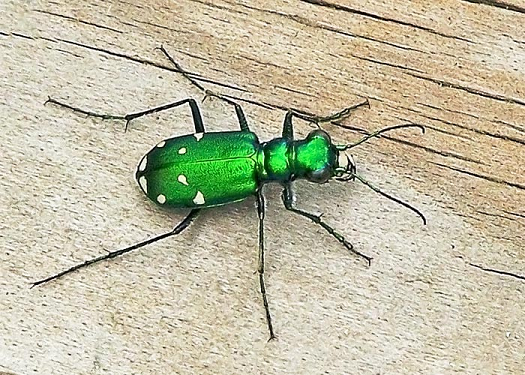
On the theme of dreams and green cars, probably about 30 years ago I had a dream about a man who called himself Elder Case the Fallen Angel and drove a bright green sports car that was always described as being "tiger beetle green." The dream stuck in my memory because I used to think of it every time I saw a six-spotted tiger.
Note added: Running an image search for green motorcycle movie turned up a familiar film.
Matrix lighting sometimes makes everything look greenish, but in this case it really is a green motorcycle.
Here is the scene. Note that it includes the death of the white dreadlocked twins (recently featured in my post "Fever dreams and syncs"), and also shows a driver's shocked reaction when the green Ducati motorcycle seems to come down from the sky, as in Debbie's dream.
This year-old video was for some reason featured for me on the front page of YouTube. Note the non-dinosaur they chose for the thumbnail and what color it is.
The first part of the video itself closely parallels the H. G. Wells story "The Star," which I recently read. Later, it talks about an asteroid that may come dangerously close to Earth on Valentine's Day 2060.
Update: I mentioned that the video parallels an H. G. Wells story I read recently. The Wells story I am currently reading is called "Empire of the Ants." Hours after posting this, I got on YouTube again, and this was one of the recommended videos:
I'm not going to watch it -- not interested in seeing legs being ripped off -- but "Empire Of The . . . Ants" exactly parallels the title of the Wells story. I have not posted or searched for anything ant-related recently. The only thing Google could possibly know is that some time ago I downloaded The Country of the Blind and Other Stories, a collection of 33 short stories including "The Empire of the Ants."
I dreamed that I was on a city sidewalk with a group of professional-looking people who were discussing something important. In the middle of the discussion, I noticed the time -- in a few seconds it would be 2:00 p.m. -- and interrupted:
"Excuse me, sorry to interrupt, but it's nearly two, and the green motorcycle is due to pass by. I believe you should be able to see it over in that direction."
But no one showed the slightest interest in what I was saying or inclination to look in the direction in which I was pointing. They just looked annoyed at the interruption. A few seconds later, the green motorcycle did in fact pass by, exactly when and where I had predicted. None of them was looking, and I didn't get a very good look at it, either, because some of them were standing in the way, blocking my view.
"Oh, you just missed it," I said, "and the chance only comes once a week -- Tuesday morning at five o'clock, Liverpool time. Also, it's a little known fact that if you play Sergeant Pepper on repeat all week, you'll find that the green motorcycle always comes by right when they're singing about it."
One of the group took me aside and said in a low voice, "Look, no one cares about this, and no one is impressed. Why even bring it up?"
⁂
My understanding in the dream was that wherever you were in the world, if you kept your eyes open at 5:00 Tuesday morning, Liverpool time, you would see a green motorcycle go by, timed to sync with the Beatles singing about it on Sergeant Pepper. Only there are no motorcycles, green or otherwise, in any of the Beatles' lyrics. And the time mentioned on Sergeant Pepper is "Wednesday morning at five o'clock." And two p.m. in Taiwan is six a.m. in Liverpool.
Here in Taiwan, green motorcycles are closely associated with the postal service. Not sure if that means anything.
The emphasis on the time five o'clock also makes me think of this record, with its hourglass and ampersand.
2015 Nov 1 (Sun) – Ate at a Korean restaurant in Taichung. On the way, passed signs for a restaurant called “Skylark,” and I explained to V what a skylark was. Went to Mollie [Used Books]. V got The Odyssey, retold by Robin Lister and illustrated by Alan Baker. I skimmed it and was struck by the unusual rendition of Scylla:
Later that night I was reading Dunne’s Intrusions? and found the following (p. 52):
Ward writes: ‘A whole swarm of meteors might have streaked the sky unheeded while Ulysses, life in hand, steered between Scylla and Charybdis.’
2015 Nov 2 (Mon) – Finished Intrusion?. Later, on pp 113-114, Scylla and Charybdis put in another appearance, this time in an extended metaphor:
On to turmoil and destruction! Forward to the Mindless Automaton! There is the Scylla and there is the Charybdis between which Man the Flaming Soul has to steer a course which Nature herself has not yet been able to discover.
Scylla is the nearest, now. We have to dodge those snapping jaws before we can give heed to anything else; and, fortunately, our ship’s crew is in complete accord on that point. Unfortunately, however, the majority of them are clamouring for a helm hard down and a course –– the shortest possible –– laid straight for the centre of Charybdis.
If we reached that, what would it matter whether we circled there for a thousand years or a million years before disappearing down the vortex? We should have bungled the whole voyage, and have missed making the open sea.
What lies in the open sea? All our hopes for the future of the Human Race.
I do not believe that Man has reached his zenith. I do not believe that a woman moaning ‘ye-ew’ down her nose to the accompaniment of a tom-tom is the acme of musical achievement (and this notwithstanding the bandmaster’s assurance that the nasal trouble in question is a ‘great voice’). I do not believe that the Painter has no choice save that which lies betwixt the Representational and the Disgusting. I do not imagine that the cigar-box indicates the apotheosis of Architectural Form. On the contrary, I hold that Music has barely unfolded its skylark wings, that Art has not yet wandered beyond the fringe of its powers, that Invention is in its infancy, and that the common man’s ability to appreciate beauty is only just awaking from its natal sleep. And I believe that in those aspects of the Open Sea, the Flaming Soul will find satisfaction for its needs. For Creation –– Creation untrammelled by tradition, unheeding the discouragement of the multitude, undaunted by the opposition of Nature –– is the greatest of all adventures.
Oh, God! allow us to reach the Open Sea!
From my 2016 sync notes:
2016 Aug 6-7 (Sat-Sun) – Finished rereading J. W. Dunne’s Intrusions? On Saturday. Finished The New Immortality a day or two before. On Sunday, reread the entirety of Shakespeare’s Merchant of Venice (except the first page or two, which I’d read much earlier and then taken a long break).
From Dunne:
But God, thank God! Is not ‘just’. Justice is of Man. God is, to us, what the Seers have seen in Him. He is the Escape from Self. He is Allah the Compassionate, the Merciful. He is the Father Who does not will that one of these little ones shall perish. He is Love. But he is not a distributor of rewards for ‘virtues’ and of punishments for ‘iniquities’. (New Immortality, p. 106)
Ward writes: ‘A whole swarm of meteors might have streaked the sky unheeded while Ulysses, life in hand, steered between Scylla and Charybdis.’ (Intrusions?, p. 52)
I was extremely keen on singing, and had just discovered that a callous choir-master had ruined my voice (I had been the school soloist) by making me continue to sing alto long after that voice had begun to crack. I had waited for two years before trying my new, man’s register; but, when I did so, I heard to my dismay a horrible reedy thing with a range of barely twelve notes. (p. 76)
On to turmoil and destruction! Forward to the Mindless Automaton! There is the Scylla and there is the Charybdis between which Man the Flaming Soul has to steer a course which Nature herself has not yet been able to discover. Scylla is the nearest now. We have to dodge those snapping jaws before we can give heed to anything else; and, fortunately, our ship’s crew is in complete accord on that point. Unfortunately, however, the majority of them are clamouring for a helm hard down and a course -- the shortest possible -- laid straight for the centre of Charybdis. … I do not believe that Man has reached his zenith. I do not believe that a woman moaning ‘ye-ew’ down her nose to the accompaniment of a tom-tom is the acme of musical achievement (and this notwithstanding the bandmaster’s assurance that the nasal trouble in question is a ‘great voice’). … On the contrary, I hold that music has barely unfolded its skylark wings,...” (pp. 113-114)
From Shakespeare (page numbers from my edition of the Complete Works):
When we are both accouter’d like young men,
I’ll prove the prettier fellow of the two,
And wear my dagger with a braver grace;
And speak, between the change of man and boy,
With a reed voice; (p. 219)
Truly then I fear you are damned by both father and mother; thus when I shun Scylla your father, I fall into Charybdis, your mother; well, you are gone both ways. (p. 220)
But mercy is above this scepter’d sway,––
It is enthroned in the heart of kings,
It is an attribute of God himself;...
Though justice be thy plea, consider this––
That in the course of justice none of us
Should see salvation: we do pray for mercy; (p. 222)
Music! hark! …
The crow doth sing as sweetly as the lark
When neither in attended… (p. 226)
I noticed the Scylla and Charybdis link first, then the reedy voice. The other two are less specific.
I've only read Intrusions? three times. Two out of those three times, it was accompanied by skylark and Scylla-and-Charybdis synchronicities.
What sent me back through my sync files to dig those up was "Sync: Don't be confused. Back up the heavy burds," in which I noted that Big Bird has sometimes claimed to be a lark, and that skylark is punningly equivalent to l'arc-en-ciel. (WanderingGondola left a comment mentioning a Japanese band called L'arc-en-Ciel which sometimes goes by D'ark-en-Ciel, which made me think of "Ark in the dark".) Remembering that I had noted that equivalence before, I searched for it and found that it was in a post that began with Bertie Wooster's unwitting allusion to Shelley's "Sensitive Plant." Recently, in the comments on "Weirdly specific sync: Meerkats and piranhas," I quoted the very same Wodehouse line, this time in connection with the Venus flytrap.
While I was browsing through the 2016 sync log, I found a reference to Doob2, a restaurant I used to frequent in those days, though it closed down years ago. I had completely forgotten about it. Their logo featured a white rabbit.
Nowadays, of course, I frequent an unrelated place called Cafe D&D, though I had originally thought its name was supposed to be D00D. B + 2 = D.
Here, for whatever it's worth, is my sync note that mentioned Doob2. I notice it was on March 17, seven years ago today.
2016 Mar 17 (Thu) – I was checking . . . homework at Doob2. I was just correcting a line [a student] had written: “She looked like an angel,” when it should be “She was like an angel.” At the same time, the music playing in the restaurant had a repeating line that sounded like “She seems like an angel.” I looked it up later, and it turned out to be “She sings like an angel”; the song was “Unforgivable Sinner” by Lene Marlin.
Some days previous, the idea had come out of nowhere that if I ever quote my Mosquito Song (“O brother, shrink not from the kill / ‘Tis but your own suck’d blood you spill”) I should attribute it to “the West Alleghany Singing Devils.” This idea came back to me on 3/17 and I wrote it down in my planner. I can’t be sure if it was before or after hearing the Lene Marlin song, though.
This led me to search my blog for mosquito to see if I had ever quoted the Mosquito Song and if I had attributed it to the West Alleghany Singing Devils. (Yes, and no.) The other two hits for mosquito were both examples of the Byron-influenced comic tetrameters I used to write: "The mosquito question" and -- of all things! -- "Ark in the dark."