Saturday, January 21, 2023

Desert Portal Death Cult

“I’m thinking the red door is bad, green door good,” writes commenter ben. Hey, not so fast!

There’s a podcast called “The Confessionals,” which features eyewitness accounts of paranormal experiences. I subscribed to the YouTube channel quite some time ago after hearing about it on THC because it seemed potentially interesting but have never actually listened to it. Last night, though, I checked my YouTube subscriptions and saw the latest episode, posted on January 18, just days after my Green Door syncs started up again.


It caught my eye because the thumbnail showed a green portal. I haven’t listened to the whole thing yet because it’s nearly four hours long, but apparently it’s about a guy who went to a party out in the desert with a stranger and saw a lot of disturbing demonic stuff (so far nothing inconsistent with the null hypothesis that someone just drugged his drink, but you never know).

The portal is first mentioned just after the 58-minute mark, and yes, it’s green.

I hear this ear-piercing scream, like a bunch of people screaming at this high frequency, and I turn around. I see the tent from the dance floor fly up into the air, I see people flying into the sky, and I see this green portal.

The guest who is telling this story uses the pseudonym Mark for the stranger who took him to this party. It reminds me of this old sync: “Today  is a strange day. Suddenly Mark is flying into the sky. No one knows the reason.”

Friday, January 20, 2023

"The gate is strait, deep and wide" -- and doves

The Doors song "Break on Through (to the Other Side)" has been back in the sync stream recently. I've been trying to make sense of these lines:

The gate is strait
Deep and wide
Break on through to the other side

Many lyrics sites have "The gate is straight," but this is surely an error. You might describe a road as "straight" but not a gate, and in any case the expression is pretty obviously an allusion to Matthew 7:13-14.

Enter ye in at the strait gate:
 
For wide is the gate, 
and broad is the way, 
that leadeth to destruction, 
and many there be which go in thereat: 
 
Because strait is the gate, 
and narrow is the way, 
which leadeth unto life, 
and few there be that find it.

Strait and narrow are synonyms, as are the contrasting pair wide and broad, and notice how Jesus explicitly presents the wide gate as the opposite of the strait gate -- one leading to destruction, the other to life. So what can Jim Morrison have meant by "The gate is strait, deep and wide"? How can it be both strait and wide? And what does it mean to say that a gate is "deep"?

Of course, "deep and wide" is no more Morrison's own turn of phrase than is "strait is the gate." It's from an old Salvation Army song.

There's a wondrous fountain, filled with living water,
Flowing from the Saviour's wounded side.
There's an invitation to the heavy laden,
To this fountain flowing deep and wide.

Deep and wide, deep and wide,
There's a fountain flowing deep and wide.
Yes, 'tis deep and wide, deep and wide,
There's a fountain flowing deep and wide.

What did Morrison mean by this? Quite possibly nothing, or nothing coherent. The sync fairies, on the other hand, must have some reason for bringing it to my attention.


Yesterday, the red dove reappeared -- I mean a literal red turtle dove that had been following me everywhere back in August and then disappeared until yesterday. In my original red turtle dove post, I linked to my 2018 post on "The Rider-Waite Magician," which pairs the red dove from the Magician card with the white dove from the Ace of Cups -- and which also, I see now, includes an extensive discussion of the lemniscate symbol!


The Ace of Cups is also relevant to the song "Deep and Wide," in which the fountain flows "from the Saviour's wounded side." This is a reference to the Fourth Gospel account of the crucifixion, in which a soldier stabs Jesus in the side with a spear and both water and blood come out. The Rider-Waite Ace of Cups has five streams of water for the five wounds of Jesus, and it has water in a context where one would instead expect wine as a symbol of blood.

Yesterday, the red dove was not accompanied by a white one but by a green one. I saw the red turtle in the morning, and then in the evening I saw this:


Later that evening, I ran across this on /x/. It's a reference to the running joke that "birds are fake" and are actually surveillance devices -- but in synchronistic context it seems like a warning against "false spirits," manufactured simulacra of the Holy Ghost.


My orginal red turtle dove post didn't mention green doves, but it did pair turtles with the color green by quoting the Song of Solomon: "the voice of the turtle is heard in our land; the fig tree putteth forth her green figs." I had recently had an experience with green banyan figs at the time. That was five months ago. Now that the dove is green, I should go back and see if those figs are ripe yet. Ripe banyan figs are red. A couple of days ago, in "The invincible Lizard King," I quoted King Lear: "Ripeness is all."

First only green doors, now red and green. First only a red dove, now red and green. Is the dove linked to the door? I decided to look up the etymology of dove. The Online Etymology Dictionary says it's "from Proto-Germanic *dubon . . ., perhaps related to words for 'dive,' but the application is not clear unless it be somehow in reference to its flight." Wiktionary traces it back further, saying that the Proto-Germanic (which it spells *dūbǭ) is from Proto-Indo-European *dʰewbʰ- (“to whisk, smoke, be obscure”) -- so perhaps the original sense was "smoke-gray bird" or something? What about the possible link to dive? According to the OED, dive is "from Proto-Germanic verb *dubijan, from PIE *dheub- "deep, hollow" (see deep (adj.))." According to Wiktionary, that Proto-Germanic verb is made by adding a suffix to *dūbǭ, "dove, pigeon." As for deep, it traces it back to PIE *dʰewbʰ-, the same ultimate source it gives for dove.

So dove and deep are probably etymological cousins. The red and green doves implicitly correspond to the red and green doors, and the Doors song mentions a "deep gate."


Today, in my daily three-chapter Bible reading, I read this:

"Verily, verily, I say unto you, He that entereth not by the door into the sheepfold, but climbeth up some other way, the same is a thief and a robber. But he that entereth in by the door is the shepherd of the sheep. . . . Verily, verily, I say unto you, I am the door of the sheep. All that ever came before me are thieves and robbers: but the sheep did not hear them. I am the door: by me if any man enter in, he shall be saved, and shall go in and out, and find pasture. The thief cometh not, but for to steal, and to kill, and to destroy: I am come that they might have life, and that they might have it more abundantly. I am the good shepherd: the good shepherd giveth his life for the sheep" (John 10:1-2, 7-11).

This is a bit confusing, since Jesus identifies himself both as the door through which the shepherd enters and with the shepherd himself. Note that this passage about the door is also where the Christian phrase "abundant life" comes from; this is referenced in the last verse of "Deep and Wide":

There is life abundant -- gift from God our Father --
Source, whence ev’ry need may be supplied --
It is offered freely, without price or money,
Drink from Heav’nly fountains, deep and wide.

Thursday, January 19, 2023

Lots of old syncs resurfacing: red turtle dove, vesica piscis, crop circles

Sequence of events this morning:

1. At home on my computer, I prepare an English-to-Chinese glossary for something my students have to read. One of the words that needs to be glossed is dove. I know it, but I type the Chinese into Google Translate translate it back into English, just to be sure I've got the correct character. It's a single morpheme which means only "dove, pigeon" -- but oddly, dove is only the second suggestion from Google; the first is bird of peace.


I also notice in passing the phonetic similarity of 鴿子 (gēzi, "dove") to 哥吉拉 (Gējílā, "Godzilla")

2. I go to my school, and he's back! The red turtle dove that was following me everywhere back in August and then disappeared after I posted about him.

3. I have about half an hour before anyone else will arrive, so I pray my daily Rosary and then mess around a bit with a compass and straightedge, trying to work out a new way of constructing a regular pentagon. I try to get creative, but my first steps are still straight out of Euclid: draw a line segment, and then use it to construct a vesica piscis.

4. I have my morning tutoring session, in which I discuss magazine articles with my student. He's read an article about, of all things, why rugby balls are shaped the way they are, which apparently has to do with the fact that they used to be made from pig bladders. Of course the shape of a rugby ball approximates a vesica piscis, and the word vesica literally means "bladder."

5. Having some more free time, I look up and skim my old "red turtle dove" post. In connection with the "bird of peace" translation, I notice that the post includes this image. It's from this same student's magazine.


Since recent syncs have focused on time, and even on the word time itself (e.g. how its S:E:G: value is 44), this image from the "red turtle dove" post also seems relevant:


5. Since I've got my blog up, I idly check my stats and notice that an old post from August 28 of last year -- the time when I was being followed by the red turtle dove -- is for some reason getting a lot of visits these days, fare more than it got back when I posted it. The post is "More syncs related to the 'Glove Puppet' video and crop circles" -- just another ephemeral sync post, not the sort of thing I would expect to attract a lot of attention months later. I click on the post and see that it prominently features vesica piscis imagery.


Then I scroll down and find that it also includes this image again!


To top things off, the post ends with a reference to the O. Henry story "The Green Door" -- an old sync theme which has suddenly resurfaced in the past few days.

6. I go to YouTube to put on some music. I've been listening to the Muse album Black Holes and Revelations, and YouTube suggests the "official video" for the opening track, "Take a Bow." I didn't know there was a video, so I put it on. It soon becomes obvious that it's not the "official" video at all but something put together by a fan. It's a good song, though -- and very 2020s-relevant -- so I play it anyway.


It begins with a clip from 2001: A Space Odyssey and then footage of Nazis. Then this flashes on the screen repeatedly:


Shortly after that, we get a rapid-fire series of crop circle images.


A bit later, we see a surgeon putting on a glove, and then the Masonic square and compass flashes on the screen. (I had just been using a compass, and then looking at a post about a "glove puppet.")

Wednesday, January 18, 2023

One morning he awoke in a green hotel

 
Oh, uh, "content warning," I suppose. I mean, it's Jim Morrison.

Red Door, Green Door


There's a children's book with this title written by Methodist pastor Keith Tonkel. As best I can tell from the blurb and the preview on Amazon, the red and green doors symbolize the two ways in which children may enter a family: birth and adoption. The blurb says only that "Author Keith Tonkel explores families, adoption and being chosen in this delightful and meaningful children's book," and this is an excerpt.

Then Mike said: "And I'm glad that you are my sister, Jessie. I always wondered what it would be like to have a sister, and now I know. It's good when you can have a sister. Not everybody has one, you know."

"I know," Jessie replied. "What you said was really nice, and I am very happy that you are here. I remember the very day when you came in through the green door over there."

"Well," Mike went on to say, "Mama told me all about your coming in through the red door, and that's good, too. But what is even better is that we have both come into this house, this room, and have become this family."

Jessie remembers the day Mike came in through the green door, so she was already a member of the family when Mike joined it. But Mike says he always wondered what it would be like to have a sister, which means he didn't originally have a sister. Therefore, Jessie was born into the family (the red door), and Mike was adopted (the green door).

Jesse means "God exists"; Michael means "Who is like God?"

The invincible Lizard King

The sync-storm continues.

It was more than a month ago that I received an email with the subject line "Black holes and revelations," with a link in the opening sentence to the 2006 Muse album of that name. I knew nothing of that album or band, and not until the past few days did I feel the need to look it up and listen to it. Ripeness is all.

Recent posts have featured the T. rex and the Doors -- both literal doors and the rock band fronted by Jim Morrison.  It took me a surprisingly long time to make the connection between Tyrannosaurus rex -- typically glossed as "tyrant lizard king" -- and Morrison's most famous nickname:


Anyone familiar with the Doors song "The End" will know that the Lizard King linked himself with the T. part of T. rex as well, via Oedipus Tyrannos (often Oedipus Rex in translation, for a double T. rex connection). "Father? / Yes, son? / I want to kill you / Mother, I want to . . ." -- well, you get the idea.

"I am the Lizard King. I can do anything." This connection between T. rex and unlimited power made me think of one of those Jurassic Park sequels, which featured a manmade dinosaur called Indominus rex -- dog-Latin presumably intended to suggest indominable, a non-standard variant of indomitable, meaning "invincible." This was basically a super T. rex, and one of the main ways it differed from the Coca-Cola Classic version was that it had much longer forelimbs, with three or four fingers instead of T. rex's two.

I was thinking about this while I was on the road. When I got home, after doing some chores and such, I continued where I had left off with Black Holes and Revelations (an album which was, as it happens, released on the 35th anniversary of Jim Morrison's death). After I had listened to "Map of the Problematique" and "Soldier's Poem," the next track up was "Invincible" -- and this one had a video.


In my post "The Doors," which dealt with red and green doors as time-travel portals, I linked to an article about the game "Red Door, Yellow Door." In the same post, I discussed the lemniscate as an infinity symbol, and the sideways-S symbol used by Euler as a variant of the classic lazy-8. Wandering Gondola left a comment: "In the first image in the Red Door, Yellow Door article, the red door is marked 88. Lemniscate dubs, nice." This is true.


There's a red door marked with a golden "88," and above it is the top half of a circle, also numbered 88. WG connected this with the lemniscate infinity sign. Leonhard Euler's infinity sign was a sideways S -- or rather a sideways mirror-image S, but a footnote on Wikipedia notes, "Cajori (1929) displays this symbol incorrectly, as a turned S without reflection." I checked all these footnotes and even tracked down a scan of Euler's own writing showing his infinity symbol, which I guess was a pretty strange thing for me to do.

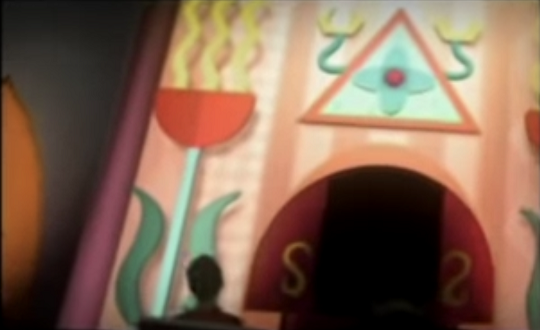
So, back to the Muse video. As it begins, we see red double-doors shaped like the top half of a circle. Instead of two golden eights (sideways infinity symbols), these doors bear a golden S and mirror-image S (sideways versions of Euler’s infinity symbol and Cajori’s “incorrectly displayed” variant). Some pretty impressive synchronistic bull’s-eyes there.


The red doors open, and as we pass through them we find that they we have traveled through time, because there are dinosaurs! Is that a T. Rex? Almost, but it has too many fingers. Must be an Indominus. But then we see the band members going past this dinosaur and realize that it’s not all that big; it’s another mini-rex.

As the video continues, so does the journey through time. We see cavemen, then ancient and medieval civilizations, then ultramodern skyscrapers — and then the apocalypse. There are tornadoes everywhere, and then giant Mickey Mouse robots with big teeth.

A few weeks ago, I found this AI-generated image on The Secret Sun, thought it was funny, and saved it.


As the apocalypse continues, all time periods seem to be mixed together, and there are a few shots where we can see modern fighter jets flying past dinosaurs.

As Calvin and Hobbes would say, “This is so cool.” “This is so stupid.”

Tuesday, January 17, 2023

Heading outdoors

Heading outdoors -- because I'm the sort of person that notices such things -- is an anagram of The Good Dinosaur.

The syncs documented in my recent post "The Doors" began when I noticed the cover of the magazine at the top of a stack of old magazines in a little-used room of my school. Today, the thought occurred to me that I should look at the magazine at the bottom of the stack, and -- well, if it isn't our favorite coelurosaur species again!


They look a bit big to be considered mini T. rexes, but two of them do appear to be much smaller than the other, perhaps juveniles?

I opened up to the cover story. Page 10 is just a full-page illustration, the same one that's on the cover, and p. 11 is a one-paragraph plug -- printed on a green background -- for a movie I had never heard of. The opening sentence is a (metaphorical) reference to time travel: "Pixar's new movie The Good Dinosaur takes us back in time."

Since there was no explanation in the magazine for how a human boy came to be consorting with dinosaurs -- literal time travel? another "boy stranded in the Mesozoic"? -- I checked the Wikipedia article for the movie. The first thing I noticed was the movie poster with which the article is illustrated:


Doesn't that remind you a bit of this image from my last post?


According to Wikipedia, it's not actually a time travel story; it's an alternate history in which the K-T extinction never happened.

Since The Good Dinosaur is set in a world in which dinosaurs never became extinct, they were instead able to evolve. Herbivores like [the Apatosaurus protagonist] Arlo and his family become farmers, and carnivores like the T. rex become ranchers. Because they are meant to be reminiscent of cowboys, when the T. rex run, their lower bodies mimic a galloping horse, while their upper bodies have the feel of a riding cowboy. To help inspire [the T. rex father] Butch's physical look and performance, the filmmakers looked at classic film cowboys such as characters portrayed by Clint Eastwood and Jack Palance.

I checked, and yes, the two smaller T. rexes are juveniles, the son and daughter of the big one. A more significant sync, though, is the fact that the T. rexes were intended to be reminiscent of people riding horses. See my January 11 post "Beware the ideas of Mach!" which features a mini T. rex race at Emerald Downs, which is a racetrack for thoroughbred horses -- T. rexes playing the role of men on horseback.

Popular posts