Showing posts with label The Script. Show all posts

Sunday, August 7, 2022

Standing in the Hall of Fame, and Christ at the door

I published "The Wizard at the green door" yesterday (August 6) at 4:14 p.m. Taiwan time. The post included  Let Him In, a painting by Mormon artist Greg Olsen illustrating Revelation 3:20 ("Behold, I stand at the door, and knock . . ."), and it references the Script song "Hall of Fame" (featuring, incidentally, my black doppelgänger will.i.am), a song which had come to my attention a few days previous, as documented in "When that gorilla beats his chest."

That evening, I received two emails 27 minutes apart, from two different people named Andrew.

The first, received at 11:09 Taiwan time, had the subject line "Romans 13" and was just a link, with no comment but the two words "spot on," to this YouTube video:

Notice that the thumbnail features the word GOD with a green circle around it, a link to the circular green door imagery of my post.

The video cites various Bible verses in support of the argument that Christians have no absolute obligation to obey secular (or church) authority. At one point there is a pretty in-your-face synchronistic reference to "Hall of Fame" by The Script.
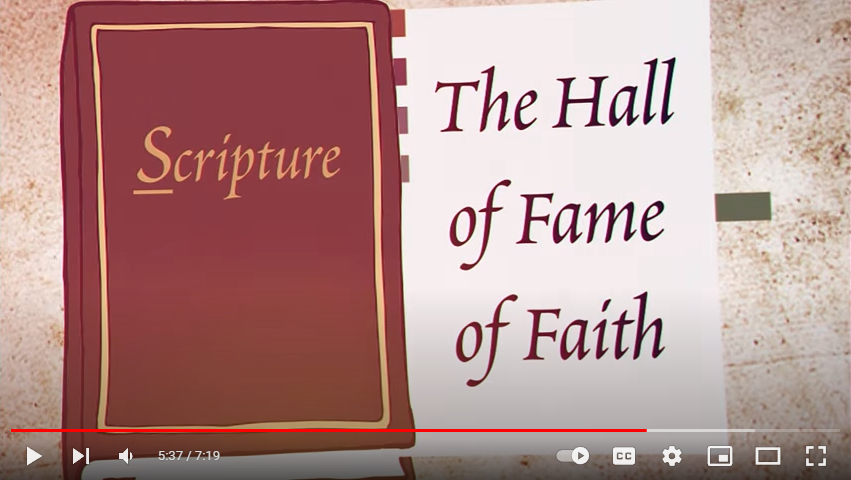
That this was sent in direct response to my posts about that song seems vanishingly unlikely. It was sent to five other people (mostly public figures not known to me personally) in addition to myself, and the video itself is a year old.

The second email, sent by a different Andrew and received at 11:36 p.m. Taiwan time, obviously was a direct response to my post. It had the subject line "Wizard at the door?" and had no text, only this image:
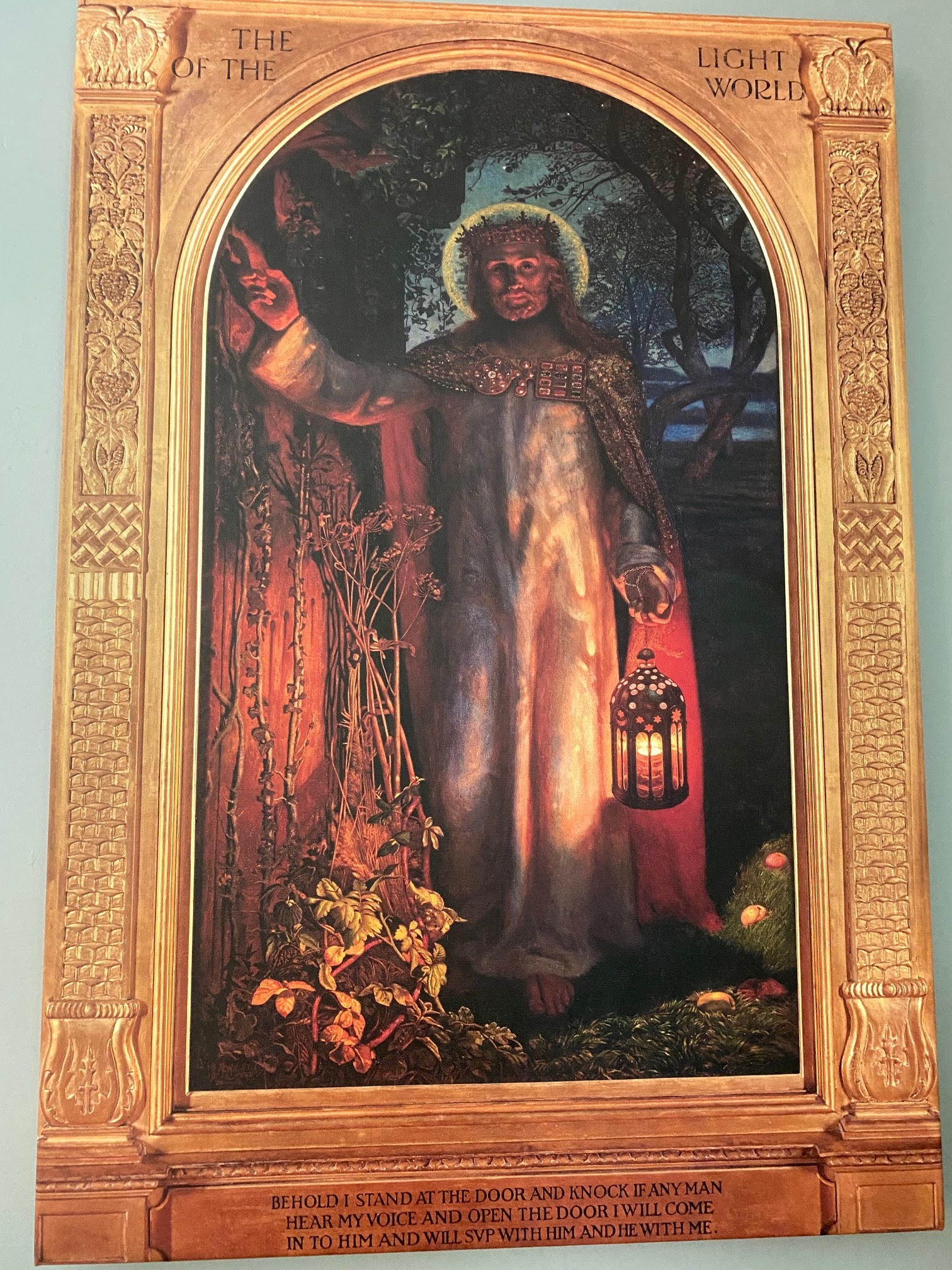
This was, as I have said, very clearly sent in response to my post, which featured a different image of Jesus knocking on a door, so it can't be considered a "meaningful coincidence," right?

Wrong.

On August 1, I posted "The most important teaching of the Book of Mormon" -- also about a Christian's lack of absolute obligation to obey any external authority -- and wanted to illustrate it with an appropriate picture. My first thought was Blake's Glad Day, but I decided its meaning was too obscure. I wanted to show that the ultimate authority is simultaneously God and each individual's God-given intuition or discernment. This made me think of how Jesus said both "I am the light of the world" and "Ye are the light of the world" (I thought of this again when I posted "The Wizard at the green door," which mentions that Jesus said both "Knock and it shall be opened unto you" and "Behold, I stand at the door and knock.") This led me to run an image search for i am the light of the world painting -- and the first result was the very painting, by William Holman Hunt, that the second Andrew would later send me by email. In the end I decided against using it, opting instead of Vrubel's painting of the descent of the Holy Spirit, but I did take note of the painting, which I had not seen before and which captures a powerful aspect of who Jesus Christ is.

I had not noticed, though, that it depicts Jesus knocking on a door. (The door is overgrown with vegetation and not immediately recognizable as such.) The search results showed only the painting itself, but the image Andrew sent included the frame, which features the text of Revelation 3:20.

While I was writing "The Wizard at the green door," I had the thought that the Statue of Liberty is green and is associated with the Emma Lazarus poem ending "I lift my lamp beside the golden door," but I dismissed the connection to the Green Door theme as too tenuous to be worthy of note. Now, though, it occurs to me that Liberty Enlightening the World -- finished about 30 years after Hunt's The Light of the World -- almost appears as a parody of that painting. Hunt's Christ wears a greenish robe and a crown, holds a lamp, and stands beside a golden door. Bartholdi's statue replaces Christ with Mithras, and the Light of Christ with the "light" of revolution.

It is interesting that I considered Hunt's painting as an illustration for a post about the Book of Mormon, and then in my "Wizard at the green door" post I used a Mormon artist's rendition of the same verse from Revelation.

Looking for Greg Olsen's painting of Christ knocking, I ran across this picture, Even a Sparrow, by the same artist.

This is clearly a reference to Jesus' saying about God taking note even of the fall of a sparrow, but what it first made me think of was the apocryphal legend about the child Jesus breathing life into sparrows made of clay. Today I happened to read a reference to this same legend in Éliphas Lévi's Histoire de la magie:

There is a beautiful allegorical exposition in the apocryphal gospels of this criterion of certitude in respect of Christianity: its evidence is that of realisation. Some children were amusing themselves by fashioning birds of clay, and among them was the child Jesus. Each little artist praised his own work, and only Jesus said nothing; but when He had moulded His birds, He clapped His hands, telling them to fly, and they flew. So did Christian institutions shew their superiority over those of the ancient world; the latter are dead, but Christianity is alive.

The painting also reminded me of a vivid dream I had as a child, in which I had written a trilogy with the evocative titles Like Sheep, Many Sparrows, and The Sign of the Dove. From time to time it occurs to me that I should try to write those three books, but I have never known what should be in them. I suppose their time has not yet come.

One last thing to note: My post featured Gandalf knocking at the green door. The Hunt painting features Christ at the door, with a lamp. Some time ago (I can't seem to find the original post), Bruce Charlton posted about a Tolkien-themed Tarot deck which portrayed the Magician as Gandalf. I left a comment saying that this was wrong, that the Magician should be Fëanor, while Mithrandir was clearly the Hermit. The Hermit of the Tarot holds a lamp much like that of Hunt's Christ.

Friday, August 5, 2022

God vs. King

My last post, "When that gorilla beats his chest," featured this poster for the movie Godzilla vs. Kong, which was originally going to be released in 2020 but was delayed for the usual reason.

This synched with, among other things, these lyrics from The Script:

Yeah, you can be the greatest, you can be the best
You can be the King Kong bangin' on your chest
You can beat the world, you can beat the war
You can talk to God, go bangin' on his door

Besides the explicit mention of King Kong, it also says "You can talk to God," a link to the "God vs. King" tagline. Doing a little research online, I find that Godzilla vs. Kong features a deaf character played by a deaf half-Asian actress (Kaylee Hottle, Korean-Caucasian). The music video for the Script song, "Hall of Fame" (2012), also features a deaf character played by a half-Asian actress (Ariana Emnace, Filipino-Mexican).

Godzilla is a giant reptile from the sea, but (a commenter informs me), his name comes partly from the English word gorilla. The original Japanese name, Gojira, apparently created before the monster's reptilian nature had been decided on, is a portmanteau of gorira ("gorilla," from English) and kujira ("whale").

Kong, of course, is a giant gorilla. Where did his name come from? According to Wikipedia:

[King Kong creator Merian C.] Cooper was fascinated by [his friend Douglas] Burden's adventures as chronicled in his book Dragon Lizards of Komodo where he referred to the animal as the "King of Komodo". It was this phrase . . . that gave him the idea to name the giant ape "Kong."

So Godzilla, the giant lizard, has a name partly inspired by gorilla; and Kong, the gorilla, has a name partly inspired by a giant lizard.

The land-monster Kong and the sea-monster Godzilla made me think of Behemoth and Leviathan. In my post "Mr. Owl ate my metal worm," I noted that the giant fish Bahamut, the Arabic equivalent of Leviathan, has a name that comes from Behemoth; while Behemoth-equivalent Kuyutha, the giant bull, has a name that is likely a corruption of Leviathan. There is an obvious parallel here to the way in which Godzilla and Kong got their respective names.

Bahamut is also the name, in D&D, of the king of all metallic dragons, so I connected the name with the Metal Worm in the palindrome. Bahamut -- the sea monster whose name comes from a land monster -- corresponds to Godzilla, so Godzilla is the Metal Worm. The Metal Worm's antagonist is Mr. Owl. As it happens, there is an extremely popular YouTube video (nearly 30 million views) that takes the Godzilla vs. Kong trailer and digitally replaces Kong with a cat -- a cat named, of all things, OwlKitty.

Cat vs. Godzilla also ties in with "Immediate confirmation that Michael is Mr. Owl," in which -- besides referencing the Metal Worm palindrome yet again -- I mention seeing a gecko and thinking "Hey, it's a dragon!" and then later having to rescue a different gecko from my cats. "When that gorilla beats his chest" also included a gecko anecdote, pairing the gecko not with a cat but with a moth -- Godzilla vs. Mothra?

To the Japanese, Gojira suggests "gorilla-whale." To my own ear, Godzilla is God + Zillah. Adah and Zillah are the two wives of Lamech in Genesis and were a source of deep fascination to me as a child. The contrast of A and Z, together with the fact that Zillah probably means "shadow" in Hebrew, led me to envision them as opposites -- Adah as a very pale white woman, and Zillah as a very dark-skinned Indian woman.

Much later, in college, I knew two women, roommates, who exactly resembled my childhood image of Adah and Zillah; I always thought of them by those names, and now I find I can only remember the real name of one of them! For some reason, the 2002 Steve Earle song "Ashes to Ashes" is also closely associated in my mind with these two women. (I think it's just that I started listening to the song about the same time I met them, and its overall vibe fit "Adah's" personality.) The lyrics do have a bit of Godzilla-vs.-Kong type imagery.

A long time ago
Before the ice and the snow
Giants walked this land
Each step they took
The mighty mountains shook
And the trees took a knee
And the seas rolled in

Searching my own blog for godzilla just now, I found a dream I had forgotten about, recounted in the post "On the threshold of lucidity," in which I watched a sea serpent (Leviathan) transform first into "a bipedal Godzilla-type creature" and then into a woman "who reminded me a bit of the actress Sarita Choudhury." As you may have gathered from the name, Sarita Choudhury is of Indian extraction, and she has dark skin. Looking her up, I find that, like the other two actresses mentioned in this post, she is only half-Asian -- though as far as I know, she has never played a deaf character. That dream ends with me being bitten by a poisonous snake, though, and adders are proverbially deaf.

Anyway, God-zillah means "God's shadow." In one of J. W. Dunne's books (I'll have to look it up later), he relates a dream in which he became aware that God's shadow was cast over the entire world, and he asked his angel guide how it was possible that people could not see something so obvious as that enormous shadow. "Because it has no edges" was the angel's reply.

(I am working on a theological post that keeps being delayed by these syncs. In it, I happen to quote Dunne: "Oh, God! Allow us to reach the open sea!")

When that gorilla beats his chest

Yesterday evening (August 4) I taught a children's English class. They had read an article about the eating utensils used in different cultures -- forks, spoons, chopsticks, etc. -- and a sidebar mentioned that some chimpanzees used sticks to eat ants.

I asked if everyone knew what chimpanzee meant, and one of the kids responded by beating his chest. I said, "No, that's a gorilla. A chimpanzee is a bit like a gorilla, but it's a lot smaller."

"King Kong!" said one of the kids.

"King Kong is a giant gorilla," I said. "A chimpanzee is a big ape with black fur, like a gorilla, but it's a lot smaller than a gorilla, and certainly a lot smaller than King Kong."

"Oh, I know!" said another student, finally getting it right. "A chimpanzee is a 'black star'!"

They're not allowed to use Chinese in class without permission, so they often take advantage of the pun-translation loophole. The Chinese for "chimpanzee" is 黑猩猩, literally "black ape," and the word for "ape" is a homophone of the word for "star" (星星).

One of the other kids asked if the ants the chimpanzees ate were honey ants. I said, "No, because honey ants live in Australia, but chimpanzees live in Africa. I think the 'ants' they eat are actually white ants, or termites."


The day before that (August 3), in the comments on "Good riddance, Big Ben!" I had left a link to the 2020 Black Dog Star post "The Cronus Virus - It's Time!" without actually rereading the post myself. After the class, though, I checked my blog comments and saw one from Debbie that began thus:

I clicked on the Black Dog Star link and I'm very impressed with a lot of the information that mirrors my own. . . .

Her wording put the They Might Be Giants song "I'm Impressed" in my head:

I'm impressed, I'm impressed
When that gorilla beats his chest
Fall to bits, I confess, I admit, I'm impressed . . .

With this playing in my head, I clicked my own link and reread the Black Dog Star post.  I had linked to it because it connected Saturn and clocks with the birdemic and was thus relevant to my own post giving "Taiwan's Dr. Fauci" (whose Chinese name sounds like the Chinese for "clock," just as Fauci means "sickle") the nickname Big Ben. I had forgotten that it also included this image:


King Kong and the Black (Dog) Star!


That night, I listened to music on YouTube while doing the dishes, as usual. One of the songs it played was a Kill_mR_DJ mashup of Toto's "Africa" and Enigma's "Return to Innocence." 


Looking at the screen, I saw that, in addition to Toto and Enigma, a band called "The Script" was credited, as the source of the instrumentals. I'd never heard of them.

Today (August 5), I had lunch at a restaurant, where a TV was playing music videos. I wasn't really paying attention until a live video from a concert came on. Before the song actually started, the singer was giving a little speech on the stage, in which he kept repeating that their band was The Script. Something like, "Whether you've been a Script fan since our first song, or whether this is your first Script concert, we want to say welcome to the Script family!" Then the music started, and I instantly recognized it as the track Kill_mR_DJ had sampled. My attention was now fully engaged, and then the lyrics started:

Yeah, you can be the greatest, you can be the best
You can be the King Kong bangin' on your chest
You can beat the world, you can beat the war
You can talk to God, go bangin' on his door

King Kong beating his chest again! No black stars in this song, but Kill_mR_DJ had put it together with a song by Toto (the name of a famous black dog) -- called "Africa" (home of the "black stars," a.k.a. chimpanzees).


The reference to banging on God's door also caught my attention. Just before lunch I had, on a sudden whim, paid a visit to the Guashan Shaolin Temple, which I hadn't been to in years. It was the middle of a weekday, and the temple was virtually empty. On the ground floor is an emormous statue of Bodhidharma which has a very powerful presence, but I was there for the meditation room on the second floor. There's framed Chinese calligraphy on the walls -- 18 channeled poems dedicated to each of the 18 Arhats. When I first visited this temple, 12 years ago or so, one of these 18 poems attracted me as if by magnetism (it really feels pretty literally like magnetism!) even though I was basically illiterate in Chinese at that time, and when I touched the paper, I felt a powerful stream of energy flowing through me. (I hate to use "energy" in a New-Agey way like that, but I'm afraid it's the mot juste.) Today I immediately recognized the poem again, felt the same magnetic attraction, and felt the same rush of energy when I touched it. I'm much better at reading Chinese now, and it is the poem dedicated to Cudapanthaka -- called in Chinese 看門羅漢, literally "the Arhat who watches the door."

As I exited the meditation room, I looked back and realized that I had not entered by the main doorway -- a large circular opening with no door -- but by a side door.. This was a green door which, though it was propped open with a chair, had a sign saying "Arhat Energy Room Temporarily Closed."


Way to watch the door, Cudapanthaka! It's not the first time in recent weeks I've passed through a green door into a place that was supposed to be closed.


In the temple stairwell, I passed a window where a moth had become trapped between the glass and the screen. After some coaxing and a lot of sliding the glass and the screen back and forth, I finally got it to fly outside. The exact moment the moth flew out the window, a gecko jumped in the window and onto my arm.


Update: Immediately after posting this, I taught a different children's English class. Their assignment for today included this:


Two references to Toto the dog. Also Oz, a nickname for Australia. (I had had to explain that chimps can't eat honey ants because they don't live in Australia.) See also the references to Dorothy and the Cowardly Lion in this recent comment by WanderingGondola.

Popular posts