Showing posts sorted by relevance for query Peter’s mind. Sort by date Show all posts

Wednesday, August 14, 2024

Where is Peter's mind?

The most censored publication in the history of the world has recently been using this as its header image (reformatted for legibility):


I'm not cool enough to know most of this music, but several of the band and album names caught my eye. The Dead Milkmen, for instance, tie in with the Milk/Malk/Milkommen theme. I've discussed the ambiguity in unpointed Hebrew between Milkom and malkam, "their king," so the Dead Milkmen could be Dead King-men. Then nearby is the Smiths album The Queen Is Dead. Echo and the Bunnymen tie in with echoes on William Wright's blog and Devil Bunny here. Depeche Mode's Behind the Wheel is a link to the Dangerous Potter's Wheel.

The only album in that header image that I really know and listen to, though, is Surfer Rosa by the Pixies, and my mind instantly went to what is probably its most iconic track (featured in the soundtracks of such blockbusters as Fight Club and Big Ass Spider!): "Where Is My Mind?"


St. Peter has been very much in the sync stream both here and at William's blog. In particular, the tradition that he was crucified upside down has repeatedly come up in different contexts. In his latest post, "Leaping from Lion's Heads and Peter's Keys," William connects Peter with the boy in House of Danger who has to access the power of a spinning disc inside his head, and he also hints that the legend of Peter's "walking on water" may actually refer to space travel. With that in mind, check out the opening lyrics to "Where Is My Mind?"

With your feet on the air and your head on the ground
Try this trick and spin it, (Yeah) yeah
Your head will collapse, but there's nothing in it
And you'll ask yourself

Where is my mind?
Where is my mind?
Where is my mind?
(Where is my mind? Where is my mind?)
(Where is my mind?)
Way out in the water, see it swimmin'

There's a reference to being upside down, and then "try this trick and spin it," the only possible antecedent for it being your head. The final result is that you'll be "way out in the water."

The lead singer's stage name, Black Francis, is also synchronistically interesting.

Saturday, October 12, 2024

On this rock

William Wright posted about some dreams he had in "Going swimming and Silver Stein Books." I mentioned in a comment that Silverstein was a common Jewish name, and then Bill thought of Shel Silverstein, who is probably best known as a children's author but who also did various other things, such as drawing cartoons for Playboy and writing some well-known songs performed by other artists (most notably "A Boy Named Sue" and "The Cover of the Rolling Stone"). I never read any of Silverstein's books as a child, my parents having correctly identified him as someone to whom children should give a wide berth, so I know him mainly for the two songs mentioned. "The Cover of the Rolling Stone" is very well-written, and of course the title -- a "rolling stone" which is also something you can read -- fits right in with Bill's ideas.

Bill's dream was specifically about Silver Stein books, though, so I searched for some of his children's poems. One of the ones I found caught my eye:

The narrator of the poem loses his head and can’t find it because he no longer has eyes with which to look or a brain with which to think. In the he decides to "sit down / On this rock / And rest for just a minute" -- the joke being that the "rock" is actually the missing head.

This made me think of Peter for two reasons. First, back in August I posted "Where is Peter's mind?" connecting Peter with that Pixies song and the idea of a missing mind or head. Second, the Silverstein poem devotes a whole line to the words “On this rock,” which is a familiar turn of phrase:

And I say also unto thee, That thou art Peter, and upon this rock I will build my church; and the gates of hell shall not prevail against it (Matt. 16:18).

Only after making those connections did I check Bill’s latest post and discover that he, for entirely different reasons, has also connected Silverstein with Peter. The title of the post is “Shel Silverstein, Michael’s Book, and Peter.”

I remembered that I had once used Silverstein on this blog as a general reference to Jews, but at first I couldn’t find where. It turns out it was actually the closely related name Silberstein, and it was in the March 2023 post “An odd stereotype from H. G. Wells: Orientals live fast, die young.” The post also has to do with quicksilver, or mercury.

Tuesday, May 18, 2021

The dragon and the subterranean swan

Back in December 2019, I posted about an allegorical picture of my sister Kat's -- a rather unconventional depiction of the Last Judgment, using a swan in an underground chamber as a symbol of Christ.

Then Cometh the End

I connected this with a drawing by Oswald Wirth which I had seen a few days earlier -- the Judgment card of the Tarot, with a huge swan replacing the angel who sounds the Last Trump. Just as Kat's swan is underground, Wirth's seems to be diving down into an open grave.


Wirth associates each of the Major Arcana with a constellation, and the constellation associated with the Judgment is Cygnus, the Swan. These correspondences are summarized in this diagram, taken from an English translation of Wirth's Le Tarot des imagiers du Moyen Âge.


Note that Cygnus is directly above Draco and oriented as if it were diving down towards the dragon. (These two constellations are not so oriented in the sky.) Notice also that Draco is labeled 13, meaning that it corresponds to the nameless 13th trump, which represents Death. Wirth's swan drawing also shows the swan diving down into a representation of death, while Kat's shows the swan already in a sort of "underworld."

In his 2006 article "Constellations Testify of Seven Angels," John P. Pratt connects the Swan with Simon Peter -- who was, famously, crucified upside down.

The constellation of the Cross is usually called the Southern Cross because another name for the Swan is the Northern Cross. Note how the stars in the Swan form a nearly perfect crucifix in the heavens. And also note that the Swan is upside-down on the cross, the head of the Swan being the foot of the cross. Could it be that Peter's upside-down crucifixion could have been represented in these heavenly figures thousands of years before it occurred? What do you think? There is no doubt in my mind that the answer is yes, because the symbolism is too clear and too perfect.

There is no dragon in the story of Peter's martyrdom, but it does feature the "swan" (Peter) being in an underground chamber. In the same article, Pratt quotes this account of the apostle's last days.

Maliciously condemned, Peter was cast into the horrible, fetid prison of the Mamertine. . . . described as a deep cell cut out of solid rock at the foot of the capitol, consisting of two chambers, one above the other. The only entrance is through an aperture in the ceiling. The lower chamber was the death cell. Light never entered it and it was never cleaned.

This deep cell, accessible only through an aperture in the ceiling, suggests the cavern in Kat's drawing, or the open grave in Wirth's. The use of the word "aperture" in this context also puts me in mind of one of the most laughably bad passages in the Bible translation used by Jehovah's Witnesses: "upon the light aperture of a poisonous snake will a weaned child actually put his own hand" (Isaiah 11:8; KJV "the weaned child shall put his hand on the cockatrice' den") -- giving us an indirect link to the serpent or dragon.

Finally, the identification of the swan with the angel of Judgment, and its association with the dragon, ties in with the Rider-Waite version of the Judgment card, where the angel bears the banner of St. George the Dragon-slayer.


In a recent post, I saw the name George paired not just with the dragon, but with Draco -- the Dragon as constellation.

Monday, January 24, 2022

Thought and conscious will

Every jumbled pile of person has a thinking part
That wonders what the part that isn't thinking, isn't thinking of

-- They Might Be Giants, "Where Your Eyes Don't Go"

If you make yourself small enough, you can externalize anything.

-- Daniel Dennett

Euryalus, is it
the gods who put this fire in our minds,
or is it that each man’s relentless longing
becomes a god to him?

-- Aeneid, Book IX, Mandelbaum trans.

How the Glunk got thunk

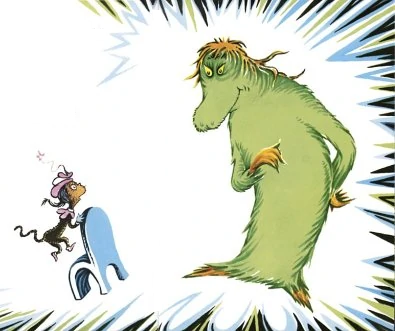
In the 1969 Dr. Seuss story "The Glunk That Got Thunk," the young Cat in the Hat's sister has the hobby of thinking things up.

A thing my sister likes to do
Some evenings after supper,
Is sit upstairs in her small room
And use her Thinker-Upper.

She turns her Thinker-Upper on.
She lets it softly purr.
It thinks up friendly little things
With smiles and fuzzy fur.

One day, having decided that her friendly little things are "just not fun enough," she determines to "think up bigger things."

"Think! Think!" she cried.
Her Thinker-Upper gave a snorty snore.
It started thunk-thunk-thunking
As it never had before.
With all he might, her eyes shut tight,
She cried, "Thunk-thunk some more!"

Then, BLUNK! Her Thinker-Upper thunked
A double klunker-klunk.
My sister's eyes flew open
And she saw she'd thunked a Glunk!

The rest of the story deals with the problem of getting rid of this "Glunk" -- an uncouth, greenish creature that threatens the family with financial ruin by running up their phone bill -- but we are here concerned not with that, nor even with the question of how the imagined creature somehow became "real" (a tulpa), but rather with the description of how it was thunk up in the first place.

I think Seuss expresses very clearly and memorably the way in which thinking-up -- having ideas -- is under conscious control and the way in which it is not. At one level, the sister is clearly responsible for the thinking-up of the Glunk. It is she who decides to use her Thinker-Upper and turns it on, and it is she who, dissatisfied with the usual "fuzzy little stuff," commands it to think up something bigger. The Thinker-Upper itself, though, is referred to as something almost external to the sister, almost a machine. She turns it on, and it thinks up things for her. I say "almost," though, because of the closing lines of the passage I have quoted: "My sister's eyes flew open, and she saw she'd thunked a Glunk!" This is a recognition that the Thinker-Upper is not really external but is an aspect of the sister's Self -- one which is, somewhat paradoxically, capable of surprising her. She is amazed to discover that she herself (the Thinker-Upper part of herself) has thought up something so unexpected.

Could the sister have consciously decided to think up a Glunk? Could she have deliberated a bit, decided, "I shall now think of a furry, green, blond-headed, halitotic alligator who phones his mother every day," and then proceeded to think it up? No. Not unless the idea of the Glunk was already in her mind -- that is to say, not unless she had already thought it up. You cannot choose to think about a particular thing until you have already thought of it. Before it can be subject to your conscious will, it has to occur to you -- an English expression which is precisely apropos. Having a new idea is not something you do; it is something that happens to you. Thinking-up cannot be conscious -- and when I say cannot, I mean cannot. It is impossible in principle, impossible by its very nature, impossible even for God.

In my 2013 posts "Agency and motive" and "Syllogisms, free will, and the role of attention," I discuss the paradox of being able to act for ourselves but requiring motives in order to do so -- motives which are not directly and consciously chosen by us but are ultimately "given." I describe how attention is the vehicle of the conscious will: As we hold a dilemma or a possible course of action in our minds, more and more relevant considerations to come to mind; by selectively focusing attention on some of these considerations, we cause them to become "stronger" and elicit the appearance of new but related ideas; and in the end we choose when to act -- that is, we choose which moment, which snapshot of the flux of waxing and waning motives, will be realized in action.

I would now expand that model to include not only motives and possible actions, but all thought. Every idea, even one as far removed from action as thinking up a Glunk, necessarily arises unconsciously, and the only role of the conscious will in the process is to direct attention. There is the Thinker-Upper, and there is the Attention-Director, and only the latter is or can be conscious. Because only the Attention-Director is conscious, only it is unambiguously us. In the Glunk story, the Thinker-Upper is largely if imperfectly externalized -- mostly "it" thinks, but occasionally a "she" slips through. The Attention-Director, though -- the part of the sister that turns the Thinker-Upper on and commands it to think -- cannot be externalized; it is simply she who does those things.

A sample train of thought

It will be convenient to have a more detailed example to refer to than the Glunk.

While I was writing this post, I received an email out of the blue from a stranger, sent to me and to a handful of public figures not known to me personally, consisting of nothing but the following Groucho Marx quip, quoted without context or comment.

"Behind that spaghetti is none other than Herman Gottlieb, director of The New York Opera Company. Do you follow me?"

"Yes."

"Well, stop following me or I’ll have you arrested!"

Where did the Thinker-Upper go with this? First, it served up another Groucho line, from Duck Soup: "Do you know you haven't stopped talking since I got here? You must have been vaccinated with a phonograph needle!" And then it thought of an imaginary movie, a longtime fantasy of mine, in which that line figures.

The movie begins with a montage, with quiet guitar music in the background, as a voice explains how the Greek gods of antiquity became the Roman gods and then later incarnated as various mortals -- Mercury as Wordsworth, Cupid as Tchaikovsky, Apollo as James Joyce, and so on -- "until," says the voice, "in the the 20th century the gods of old had finally reached rock bottom." We then realize what the meandering guitar melody has been leading up to: There is a brass fanfare, and the drums and vocals kick in: "Roll up! Roll up for the Mystery Tour, roll up!" The montage cuts to the Beatles, in their Sergeant Pepper duds, playing that song. The camera pans to John Lennon, and a caption appears labeling him "Mercury." Then it moves to Paul McCartney, "Mars." Then, as "Magical Mystery Tour" continues to play in the background, we cut to Duck Soup and Groucho suggesting that Margaret Dumont must have been vaccinated with a phonograph needle, with a caption labeling him "Zeus."

Next, the Thinker-Upper noticed that "Grouch O" suggests Oscar the Grouch, and the whole opening scene of the movie played again, only this time the voiceover was provided by Carroll Spinney as Oscar, and when the 20th century arrived and it was time for the music to kick in, we got not the Beatles but more Oscar, singing his trademark song, Jeff Moss's "I Love Trash." As various icons of 20th-century pop culture appear on the screen, Oscar belts out, "I have here a newspaper 13 months old / I wrapped fish inside it, it's smelly and cold / But I wouldn't trade it for a big pot of gold / I love it because it's tra-a-ash! . . ."

As I dismissed this movie and returned my attention to the original email, the Thinker-Upper informed me that opera is similar to Oprah, that Oprah Winfrey is famously named after a Marx Brother spelled backwards, and that opera is also famously spelled backwards in the Sator Square. I didn't pay much attention to that, so it offered instead that spaghetti suggests the Flying Spaghetti Monster, central figure of a joke-religion no less jokey than the one that sees Groucho Marx as the avatar of Zeus; and also Johnny Spaghetti, the legendary figure (invented by one of my young students) who walked across the country barefoot scattering not apple seeds but spaghetti noodles. It also noted in this connection that the late Charles Manson, likely the ultimate source of the Groucho-Zeus doctrine, once told my hippie uncle that he, Manson, was "Appleseed indeed."

Then, after these and a few other false starts, the Thinker-Upper informed me that the whole Groucho clip is actually a coded reference to a conspiracy theory. "Behind that spaghetti" -- that is, behind the superficially Roman trappings of political power -- "is none other than Herman Gottlieb" -- that is, a Jew -- "director of the New York Opera Company" -- that is, running the show. And who is delivering this line? Who but Julius "Groucho" Marx, a Jewish showman named after Caesar! And then the punchline: "Do you follow me? Well stop following me, or I'll have you arrested!" This is supposed to be an Elizabethan quibble on follow, which can mean either "understand" or "stalk," but the real joke is that it actually means "understand" both times. Do you understand what I've just told you? Well, you'd better stop understanding it, you anti-Semitic nutjob, if you know what's good for you! Pay no attention to the man behind the spaghetti.

And then I effectively turned the Thinker-Upper off -- or off this particular topic, anyway -- satisfied that it had come up with a pleasingly coherent (if fanciful) interpretation of the whole clip.

The quasi-Darwinian nature of thought

The Darwinian process depends on three elements: variation, selection, and heredity. Things vary; some varieties are selected over others; and it is these selected ones that give rise to the next generation, allowing for cumulative change in the direction being selected for.

There is an imperfect but still useful analogy to be made between the Darwinian process and the process of thought as described and illustrated above. The Thinker-Upper is continually generating new ideas, which provides variation. The Attention-Director exerts a selective force by "feeding" some of these ideas with attention and starving others. Then there is a strong tendency for the Thinker-Upper's next "generation" of ideas is be "related" to the survivors of the selection process, providing an analogue to heredity.

(This is not to be confused with the much more strictly Darwinian analysis of ideas as memes. In the memetic model, an idea reproduces when it is successfully communicated, thus making a copy of the same idea in another person's mind; and a maximally successful meme would instantiate itself in many minds with little or no variation. In the model I am proposing, an idea "reproduces" when it stimulates in the same mind the occurrence of other, but related, ideas; and making high-fidelity copies of itself doesn't enter into the equation.)

In biological Darwinism, it is understood that selection does all the heavy lifting, so much so that variation can be modeled as "random," ignoring the question of what specifically causes variation. (Not that science does ignore that question, but it can ignore it when providing Darwinian explanations for things.) In thought, which proceeds on a scale of fractions of a second rather than millions of years, it is obvious that something many orders of magnitude more sophisticated than "random mutation" is called for. While something like a "mutation" -- that is, an imperfect or modified copy -- does sometimes occur (as when, in my example, a second version of the movie was played, adding Oscar the Grouch), the more usual mechanism is association. Given as a stimulus the word spaghetti, the Thinker-Upper didn't propose random typo-like variants (spsgherti, spafhetto, spaghetaghetti, etc.) but rather came up with associated concepts: the Flying Spaghetti Monster, Johnny Spaghetti, and stereotypical Italian-ness.

It seems obvious that different people's Thinker-Uppers will provide very different associations given the same stimulus, and that the Thinker-Upper shapes the stream of thought in a much more substantive way than mutations shape the course of evolution. This is, again, because of the incredible speed of thought. Conscious processes can obviously only do a tiny fraction of the work of thinking, and the rest of it must be relegated to the unconscious Thinker-Upper. The Thinker-Upper presents thoughts that are already the end-products of a complicated process, and it is only these that are subject to the Attention-Director's conscious control.

So what is the Thinker-Upper? This is an important question in a way that "What are mutations?" is not particularly important to biological Darwinism.

The Thinker-Upper as machine

Dr. Seuss explicitly describes the Thinker-Upper as a machine. The sister turns it on and revs it up, and it makes the noises one would associate with an automobile engine. I have also tended to describe it in similar terms. Here, for example, in describing a particular step in my train of thought, I write, "And then the good old associative machinery threw up this."

In the information age, we would more naturally think of the Thinker-Upper as an algorithm than as a physical machine like an automobile. We might imagine it as something similar to the video recommendation algorithm on YouTube. When you watch a YouTube video, an algorithm generates a list of other videos you might be interested in and displays it in the sidebar; these are mostly "related" to the video you are currently watching, but the algorithm also takes into account your past search history and such, so that you and I might begin with the same video but get a rather different list of recommendations. If you click on one of the videos from the list, a new list appears, taking that video as its starting point. You could go to YouTube and, clicking only on recommended videos, still exercise a significant degree of control over your experience.

The analogy is severely flawed, though, because if videos are ideas, YouTube only connects one existing idea to another; it never generates anything new. Of course, one could argue that the same is largely true of the Thinker-Upper. In my sample train of thought, the Thinker-Upper didn't invent the Flying Spaghetti Monster, or Johnny Spaghetti, or the idea of spaghetti as stereotypically Italian. Those ideas were all already there in my mind, and the Thinker-Upper selected them as relevant in much the same way a recommendation algorithm might do: "You may also like these other spaghetti-related ideas." Someone invented them, though, using their own Thinker-Uppers, and even my own sample train of thought isn't just a concatenation of existing ideas but includes moments of originality. That "behind that spaghetti" might mean that political power might not lie where it appears to lie -- I'm pretty sure that's an original idea.

Hypothetically, could there be a YouTube algorithm so advanced that, instead of recommending existing videos, it could actually create entirely new videos that you might be interested in? Well, yes in a way, but I think ultimately no. So-called "AI" algorithms have (somewhat) successfully created news articles, paintings, musical compositions, and so on, but this "creativity" is always derivative and parasitic on actual human creativity. You feed it a lot of Chopin music, and it composes new music superficially "in the style of Chopin," that kind of thing. An algorithm can only do what its inputs and instructions cause it to do. How could it ever create anything truly new? Only by accident -- by the introduction of mutation-like random variation. And as I have said, thought occurs much too quickly for random mutation to be viable as a driving force.

Bruce Charlton's "Divine Self"

Joseph Smith, the Mormon prophet, held that "Man was also in the beginning with God. Intelligence, or the light of truth, was not created or made, neither indeed can be" (D&C 93:29) -- but that we are at the same time "spirit children" of God, created or spiritually "begotten" by him in some important sense. It is now fairly standard Mormon terminology to refer to the eternal and uncreated aspect of man as the intelligence and that aspect which is created by God as the spirit (though Smith himself used the two words more-or-less interchangeably). However, the distinction between these two, and the question of what changed in our eternal intelligences when we were begotten by God and became spirits, is never explained.

Also left ambiguous is how agency ("free will") relates to these two aspects of man. Most Mormons would probably say that is only by virtue of our nature as uncreated intelligences that we can have agency. If we are wholly created by God, then whatever we "do" is in fact done (indirectly) by God himself. If we can do otherwise than God made us to do, then those actions must come from something else, outside of God and not made by God. Only something that is ultimately an "uncaused cause" can truly be said to have agency. On the other hand, most Mormons would probably also say that agency is a gift from God. This introduction, from the official church website, begins, "Agency is the ability and privilege God gives us to choose and to act for ourselves." Agency is, apparently, something that depends on our dual nature as uncreated intelligences and created spirits.

Bruce Charlton, whose thought is much more profoundly influenced by Mormon theology than most of his readers probably realize, proposes the following model of this dual nature.

1. The creative power of the primordial Divine Self 

We are all Beings who have existed from eternity. And as Beings we have the capability to originate thought. Therefore, we are not merely passive and reactive - but can generate thought from our-selves. 

2. The directive power of the Conscious Self

For there to be free will - more is required; and that extra was provided by God when he 'created' us; that is, when he made us into Children of God ('Sons of God').  

What God provided was the Conscious Self, which has the ability to direct the attention of the Divine Self. 

The reader will have gathered from what I have already written above that I agree entirely with the basic premise behind this: the important distinction between the idea-generating ("Thinker-Upper") aspect of the self, which is necessarily non-conscious, and the potentially conscious attention-directing aspect. I think that calling the former the "Divine Self," is assuming too much, though, and leads to confusion down the line. It is also inconsistent with the way Charlton himself uses that term elsewhere. For example, just a few days after the post quoted above, he writes that "as sons and daughters of God - we all have a divine self; a core divine nature that enables us to receive and understand this directly-transmitted guidance." In "How does free will work?" though, it is the Conscious Self that we have by virtue of being sons and daughters of God, and the Divine Self is specifically that aspect of the self that was not in any way created by God.

Even within the "How does free will work?" post, there appear to be contradictions. Consider this description of the interplay of the two Selves.

The Conscious Self cannot 'control' what comes-out-of our Divine self. Because nothing can control the Divine Self - the Divine Self is the basis and reality of our ultimate freedom, autonomy; our capacity to create-from-ourselves. 

But we can consciously control the subject matter attended to by our Divine self - we can therefore choose what the Divine Self deploys-itself-upon.

So, conscious will can direct our Divine Self; and that is why we need to be conscious in order to be free. 

If the Conscious Self was not present, or not actually conscious; then the Divine Self only responds to whatever external circumstances present to it. But with consciousness, potentially we can voluntarily influence what we think about.

The last paragraph of the above quotation states that without the Conscious Self, the Divine Self would be purely passive and reactive, "only responding to whatever external circumstances present to it." Compare this to the original definition of the Divine Self: "We are all Beings who have existed from eternity. And as Beings we have the capability to originate thought. Therefore, we are not merely passive and reactive - but can generate thought from our-selves."

I point out these discrepancies not for the sake of caviling, but to demonstrate the need to think more clearly about what exactly this idea-generating aspect of the self (what Charlton is calling the "Divine Self") is and what role it plays in free will and creativity.

The Homeric model

The attention-directing Conscious Self, precisely because it is conscious, is relatively clearly defined and knowable. That which generates ideas, by contrast, is a black box. Its nature, because it is not directly accessible to consciousness, is unclear, and neither of Charlton's assumptions about it -- that it is Divine, and that is an aspect of each person's individual Self -- can be taken as obviously true.

Ancient people seem to have accepted that new ideas came from the Divine but not that they came from the Self. Consider how a creative genius like Homer, for example, understood what he was doing when he composed his poems. 

Muse, tell me of the man of many wiles,
the man who wandered many paths of exile
after he sacked Troy's sacred citadel. . . .
Muse, tell us of these matters. Daughter of Zeus,
my starting point is any point you choose.

Homer clearly understood that his ideas came not from himself but from the Muse, the Daughter of Zeus, and that his own role as poet was to direct her attention -- to begin by commanding her to sing in him of the man of many wiles, or of the rage of Achilles, and then to continue to direct the unfolding of the rest of the poem by countless other attentional decisions. I think Homer would have recognized that another man, channeling the same Muse on the same topic, would have produced a very different poem.

Homer conceptualized not only his own creative work in this way, but also the actions of his characters. Everything his heroes do is -- explicitly in many cases and by implication, I think, always -- put into their hearts by one or another of the gods. And yet men like Achilles are not, one feels, mere marionettes of the Olympians but direct the unfolding of their own lives just as Homer directs his poem.

In my Mormon youth, a recurring topic of discussion was the question of how to distinguish one's own thoughts from the promptings of the Spirit, but for Homer such a question could never have arisen. All thoughts that occur to us come from outside -- obviously; we can see from introspection that we are not consciously creating them ourselves -- and the unity behind such sources-of-thought is not personal but divine. To the best of my recollection (and I may have to reread Homer to check this), there is no concept of the personal daimon ("Divine Self") in the Homeric writings. If I myself write a poem or fall in love, I am moved by the same Muse and the same Aphodite who moved Homer and his heroes, manifesting differently because it is a different Conscious Self that directs their attentions.

It is not clear the extent to which the Book of Mormon contains genuinely ancient material, but I quote this passage anyway because it seems a clear example of what we might call Homeric Psychology: "For if ye would hearken unto the Spirit which teacheth a man to pray, ye would know that ye must pray; for the evil spirit teacheth not a man to pray, but teacheth him that he must not pray" (2 Ne. 32:8). Whatever idea comes into our minds -- whether the idea of praying or the idea of not praying -- is put there by an external "spirit" analogous to the Homeric gods. But it is we who choose which of the spirits to "hearken unto."

One can also find a partial analogue in Plato's allegory of the chariot (Phaedrus), in which the Conscious Self is likened to a charioteer driving a pair of horses which would, if left to themselves, pull the chariot in very different directions. This differs from the Homeric model in that there are only two horses (perhaps a simplified, schematic version of Homer's many gods) and, more importantly, in that each person's horses are his own -- my chariot is pulled by my two horses, your chariot by yours, and so on. Lost is the concept of one Muse, one Ares, one Aphrodite, and so on.

If we were to develop Homeric Psychology in a monotheistic direction, we might find an apt metaphor not in the chariot but in the sailing ship. Every ship on the sea is driven by the same, external, Wind (a word which is synonymous with spirit in all ancient languages), but how exactly the wind will manifest itself in the motion of each ship is up to each captain. To invert a common proverb, "God proposes, man disposes." There are perhaps hints of this Monotheistic Homerism in the New Testament. "A man can receive nothing," says John the Baptist, "except it be given him from heaven" (John 3:27). The writer to the Hebrews says, in a passage we have discussed before, "For every house is builded by some man; but he that built all things is God" (Heb. 3:4). Every ship is driven by some captain, but all ships are driven by the Wind.

This Monotheistic Homerism would be one possible approach to the paradoxical idea that, while everything that is done is done by God, we are also responsible for our own actions. It would also give an added meaning to Paul's execration of Elymas: "O full of all subtilty and all mischief, thou child of the devil, thou enemy of all righteousness, wilt thou not cease to pervert the right ways of the Lord?" (Acts 13:10). Under Monotheistic Homerism, Elymas would quite literally be perverting (literally, "turning in the wrong direction") the right ways of the Lord -- doing evil by the power of the Lord himself, causing God to manifest as evil.

In Whitley Strieber's book The Key, which presents itself as a dialogue between Streiber and a mysterious stranger, Strieber asks the stranger,

What is God?

An elemental body is a mechanism filled with millions of nerve endings that direct the attention of God into the physical.

That didn't answer my question.

It did.

The implication is that God is knowable to us only as that mind whose attention is directed by our physical bodies. This is Monotheistic Homerism -- Charlton's "Divine Self" as a single Divine Self, God, rather than as an aspect of each person's individuality -- and it further reduces Charlton's "Conscious Self" to a physical "mechanism." The psychology of The Key, or at least that implied by this passage, eliminates individual agency entirely: Only God thinks and acts, and that which directs his attention is mechanistic.

Know thyself

And he saith unto them, "Are ye so without understanding also? Do ye not perceive, that whatsoever thing from without entereth into the man, it cannot defile him; because it entereth not into his heart, but into the belly, and goeth out into the draught, purging all meats?"

And he said, "That which cometh out of the man, that defileth the man. For from within, out of the heart of men, proceed evil thoughts, adulteries, fornications, murders, thefts, covetousness, wickedness, deceit, lasciviousness, an evil eye, blasphemy, pride, foolishness: All these evil things come from within, and defile the man."

-- Mark 7:18-23

The Attention-Director is me, and it has free will. Because of its conscious nature, this is a matter of direct experience and necessary metaphysical assumption. Because the activities of the Thinker-Upper are opaque to consciousness, though, the extent to which they may or may not be "me" is uncertain. It is possible in theory to attribute all Thinking-Up to an external "machine" or Muse or God.

If the Thinker-Upper is all machine, then the Attention-Director is the whole self and the only thing that matters, and we should focus on conscious control of our thoughts, as that is the only way anything of value will come of them. This also raises the possibility that if (as seems likely) the mechanical Thinker-Upper is the brain, we will find ourselves without any Thinker-Upper at all upon physical death. (I have discussed the possibility of non-brain thinking, and how it might differ from the brain-mediated thinking we know, in "The twilight of the brain.") This would explain why "ghosts" seem to be demented and devoid of creativity (often observed to repeat the same actions again and again mindlessly) and why bodily resurrection is so essential. While we might imagine that a post-mortal ghost would still be capable of some limited "thought," since it might still have access to memories of ideas generated by the Thinker-Upper during mortality -- but even this is questionable since even calling up this or that specific memory seems to be a Thinker-Upper function. In any case, it is clear that an Attention-Director that had never had access to a Thinker-Upper would be absolutely incapable of thought. Therefore, conscious choice can have played no role in the origin of the first Thinker-Upper; it must have "evolved," primordial-soup style, rather than being created, and everything would fundamentally have its origin in chaos rather than in God. Taken to its logical conclusion, the thesis that the Thinker-Upper is a machine -- even if the Attention-Director is an immortal "spirit," and even if "gods" are assumed to exist -- leads directly to a metaphysics that can only be called Atheistic.

If the Thinker-Upper is God, nearly opposite conclusions follow. The true self is not my self or yours but the Self -- the universal Atman which is identical to Brahma. Rather than trying to control our thoughts or channel them in this or that direction, we should strive to surrender to the Thinker-Upper and become (to pinch a turn of phrase from Meister Eckhart) "a clear glass through which God can shine." (If the Thinker-Upper is just a meaningless machine, this would be a fantastically stupid thing to do, so it's pretty important to get it right!) This thesis leads to a metaphysics that might be called "Buddhist" in the same extended sense that the first model was called Atheistic. Under this model, it is not clear what the purpose of our existence might be or why God would have created us, since he would surely shine most clearly through no glass at all.

If the Thinker-Upper is a Homeric pantheon of disparate external influences -- well, I want to say that this leads to a "Homeric" metaphysics to set beside the Atheistic and Buddhist, but nothing very coherent emerges. I suppose the important thing would be to discern which influences were from which god, and which gods could be considered allies or enemies, and try to act accordingly.

If the Thinker-Upper is the True Self, though -- a self fundamentally different from God, the gods, and the material world -- well, then we are called to serve God not as a clear glass through which he can shine but as active participants in the ongoing work of Creation. This is, of course, the Romantic Christian metaphysics.

My own position is primarily the Romatic Christian one, but I think there is an element of truth in each of the other models as well. Some of the thoughts that present themselves to us really are mechanically generated by the brain, and we will lose access to that mode of thinking in the period between physical death and resurrection. Some thoughts come from other minds, including God himself, and may be termed inspiration, temptation, or telepathy depending on the individual nature and source of each. And some -- crucially -- come from an aspect of the True Self which, while it can necessarily never be conscious, is more our own than anything else can be.

How can the the thoughts that come from the True Self be identified as such? Asking that question sheds some light on a passage in William James's Principles of Psychology which really puzzled me when I first read it many years ago:

When Paul and Peter wake up in the same bed, and recognize that they have been asleep, each one of them mentally reaches back and makes connection with but one of the two streams of thought which were broken by the sleeping hours. As the current of an electrode buried in the ground unerringly finds its way to its own similarly buried mate, across no matter how much intervening earth; so Peter's present instantly finds out Peter's past, and never by mistake knits itself on to that of Paul. Paul's thought in turn is as little liable to go astray. The past thought of Peter is appropriated by the present Peter alone. He may have a knowledge, and a correct one too, of what Paul's last drowsy states of mind were as he sank into sleep, but it is an entirely different sort of knowledge from that which he has of his own last states. He remembers his own states, whilst he only conceives Paul's. Remembrance is like direct feeling; its object is suffused with a warmth and intimacy to which no object of mere conception ever attains. This quality of warmth and intimacy and immediacy is what Peter's present thought also possesses for itself. So sure as this present is me, is mine, it says, so sure is anything else that comes with the same warmth and intimacy and immediacy, me and mine.

I found this bizarre when I first read it. Of course Peter picks up his own train of thought, and never Paul's, because his own thoughts are the only ones he has access to. Any thought that comes to mind is Peter's thought, even if it is a thought about the probably content of Paul's train of thought. All James's talk of "warmth and intimacy and immediacy" seemed superfluous, solutions to a problem that could never arise. Now, though, this description of how we recognize our thought as our own seems to have some value.

More importantly, though, we are free agents who can choose which thoughts to embrace as our own and which to reject. I am reminded of the final sermon of Bruce R. McConkie, a great Mormon from a time when that word still meant something, delivered just 13 days before his death.

In speaking of these wondrous things I shall use my own words, though you may think they are the words of scripture, words spoken by other Apostles and prophets.

True it is they were first proclaimed by others, but they are now mine, for the Holy Spirit of God has borne witness to me that they are true, and it is now as though the Lord had revealed them to me in the first instance. I have thereby heard his voice and know his word.

Of any thought at all, we are free to say, "True it is it first came from another, but it is now mine" -- and this applies to the evil as well as to the Good. When evil thoughts present themselves, we are free to say, "This is who I am, and I need to be honest about it" -- or to say, "Get behind me, Satan!" It is not so much a question of asking whether it is my own thought as of declaring that it shall not be. Nothing can defile a man if it entereth not into his heart.

This has been a messy first attempt at tackling this difficult but important question. I shall probably return to it again in the future.

Tuesday, July 8, 2025

Terry the giant Irishman critiques my supposed literary preferences

When I dream, I dream about books.

Last night (July 7-8), I dreamt that I was walking through the corridor of a Mormon church, accompanied by a girl of four or five who was wearing a fancy white dress that made me think that, even though it’s not a Mormon thing, she was there for her First Communion.

In the corridor, we first passed an ordinary-looking middle-aged woman in business wear, who nodded a greeting as she walked past. Next we encountered what I thought of as a “giant Irishman,” a very tall overweight man who somehow reminded me simultaneously of Tim Dillon and J. P. Sears.

“I’m looking for Nemo the Mormon,” he said. (In real life, Nemo the Mormon is the online handle of the recently excommunicated British Mormon agitator Douglas Stilgoe.)

“He’ll be in the kitchen,” I said and led him to the kitchen. There were several men standing around in there, and I told him which one was Nemo. “He’s the one with the ponytail and the black waistcoat.” (Not what the real Nemo looks like.)

“Great,” said the giant Irishman. “I like Nemo. My name’s Terry.” He held out his hand.

“William,” I said.

Terry changed his mind about the handshake. “Yeah, I don’t like you.”

“You don’t like me? You don’t know me.”

“What I don’t like about you,” he continued, “is that you’d rather read this than this.”

He was holding a massive book in each hand, each of which he waggled in turn with its respective this. These were children’s adaptations of classic works, each with a colorful cover and a different title from the original. Despite clearly being intended for children, the books apparently hadn’t been shortened at all. Each was as thick as a Bible.

The first book, the one Terry claimed I’d rather read, had a title along the lines of Sometimes We Fight (I can’t remember the exact wording) and had a picture of a fat lion on the cover. This was clearly a rebus for the name Leo Tolstoy (whose surname means “fat” in Russian), and I understood the book to be an adaptation of War and Peace.

The second book, which Terry would have preferred I prefer, was called The Wily Whale. The cover illustration was a closeup of a ship, showing its name: HMS Tory. This, I immediately understood, meant HM story, the initials being those of Herman Melville. The book was a version of Moby-Dick.

I was indignant. “Look, I don’t know how you think you know me, but I’ve never even read War and Peace.”

The little girl interrupted, speaking in a musical voice and adult diction that made me think she must be some supernatural being disguised as a child.

To Terry she said, “Angelina. Pleasure.” Then, turning to me, “What I think the gentleman is trying to convey is that you have a tendency to prefer an intellectual like Keats over a straight shooter like Herman Melville.”

“Keats?” I said. “That’s War and Peace! Look, it’s got a fat lion on it. And I don’t read Keats, either. And intellectual? I’d trust Melville on whales over Keats on nightingales any day!”

Upon waking, I wondered if the giant Irishman might be yet another face of Gross Gaur, who was also referred to as “the gentleman” even though his name was known. Terry as in Terry Gross, from NPR? (Terry Gross is a slim Jewish woman, not a giant Irishman, but that’s no insuperable objection. Gawr Gura is the wrong size and sex, too.)

If it turns out there’s some obscure Keats poem about a fat lion, I will be suitably impressed.

“The wily whale” is a phrase from “Fare Away,” a song from the Christopher Guest film A Mighty Wind. One of the verses is a bit synchy:

First mate Peter's a hardened man
Says the captain's a charlatan
Don't know tackle from futtock plates
He’ll sail us into the pearly gates

Fare away, fare away under main topsail
To the furbelow of the wily whale

Sailing to the pearly gates calls to mind the “Gloria” music video I recently posted. Like me, Gloria wades into the sea and falls to her knees. Then the waters part as for Moses, revealing that a shining door had been hidden underwater.

Friday, July 3, 2020

Whitley Strieber in Italy with a dead owl

Doesn't that sound like the title of a Surrealist painting? Or perhaps something from a really weird version of Clue? (Colonel Mustard in the conservatory with the candlestick? No, it was Whitley Strieber in Italy with a dead owl!) Actually, it's just another in my series of footnotes to the works of this very unusual writer.


Cat Magic

In Whitley Strieber's 1986 fantasy/horror novel Cat Magic, this very strange memory of one of the characters is mentioned in passing; it just comes out of nowhere, has no effect on the plot, and is never mentioned again.

[The smell of paint] reminded him of the six weeks of the summer of 1968 he had spent in Florence. There had been college students from all over the world there, art students, working on the restoration of the Uffizi masterpieces which had been damaged in the flood of the year before.

He had met Irish magical Roisin, with whom he had cohabited for weeks, before he had found, jammed into her suitcase, the terrible rubble of a dead owl.

He had run terrified from her. Roisin, lost in the dangerous clutter of time.

George Walker, the character whose reminiscences these are, is unsympathetic and obviously deeply disturbed; one of his other memories involves setting fire to a live cat as a joke. While one can see the relevance of the cat-burning incident -- Walker's intense and strangely sexualized hatred of cats is an important plot point -- "Irish magical Roisin" with her suitcase full of owl rubble (rubble?) seems to have nothing to do with anything. The only possible purpose of the passage is to further establish that George Walker is a pretty seriously messed-up guy, and apparently delusional to boot.

Would any reader have guessed that this bit was actually pretty much 100% autobiographical?


Communion

Communion, Strieber's famous non-fiction book about his close-encounter experiences, was published in 1987, just a year after Cat Magic. Here we find the first hints that the incident of George Walker and the owl-rubble may be based on some real experience of Strieber's.

In 1968 I ended up with four to six weeks of "missing time" after a desperate and inexplicable chase across Europe.

So both Walker and Strieber spent six weeks in Europe in 1968. Walker spent the latter part of his trip "running terrified" from Roisin, while Strieber characterizes his trip as "a desperate and inexplicable chase."

Later, in a discussion of various times owls have unexpectedly turned up in his life, Strieber mentions this:

I saw an owl once before, too, during the events of 1968.

So not only were Walker and Strieber both in Europe at the same time, for the same period of time, but they also each saw an owl there. There is no indication (yet) that the one Strieber saw was a dead owl, in a suitcase, but that's still quite the coincidence.

Later Strieber adds more details about his trip in Europe.

I took the train to Italy, second class. On the train I met a young woman and we began to travel together. At this point my memories become extremely odd. If I do not think about them they seem fine, but when I try to put them together they don't make sense. I recall that we went to Rome, but that we spent a few days in Florence on the way. For eighteen years I told the story that I stayed in Florence for six weeks. But when I went there in the summer of 1984 [. . .] I realized that I had almost no memories of the place. Even so, I placidly accepted this anomaly. For some reason, I left the young woman in Rome and dashed off on the train with no ticket, traveling almost at random. I ended up in Strasbourg.
 
Now we know that he stayed -- or used to think that he had stayed -- in Florence for six weeks, just like George Walker, that he met a woman there, just like George Walker, and that his "desperate and inexplicable chase" apparently involved running away from her -- just like, as you may have noticed, George Walker.

At the time he wrote Communion, Strieber seemed to have no memory of why he had left the girl; it was just "for some reason."


Transformation

Transformation, Strieber's second non-fiction book about his close encounters, was published in 1988 -- a year after Communion and two years after Cat Magic. He once again revisits his travels in Italy in the summer of 1968.

In 1968 I was living in London. During the summer I spent between two and six weeks on the Continent, and have been unable to account for most of that time. As I reported in Communion, I crossed to the continent on a ferry and took a train south to Italy. On the trip I met a young woman. I remember her name and her nationality but have not been able to trace her. We went first to Florence and then to Rome. In Rome something happened that terrified me. My screen memory is that I got lost in the catacombs under the Vatican.

Whatever happened, I literally rushed back to my pensione and threw my things into my suitcase. Something I saw in the room horrified me. I have tried to recall what it was, but all I have been able to find out for certain is that I told a friend at the time that I had seen "a dried owl" somewhere in the room. If that is indeed what I saw, I am not surprised that I ran!

I made an unsuccessful attempt to extract more of this memory via hypnosis, but my feeling is that the material that emerged is not correct.

Strieber mentions that he remembers (but does not disclose) the woman's name and nationality. Given how much of this experience was apparently imported wholesale into Cat Magic -- leaving even such details as the date, the city, and the duration of the trip unchanged -- my money says she was an Irishwoman called Róisín, and I will go ahead and refer to her by that name. (It's just a guess of course, but it will be more convenient than constantly referring to "the young woman," "Strieber's traveling companion," etc.)

The owl puts in another appearance, and this time we are told that it was "dried" (and therefore presumably dead, as in Cat Magic). In the past I had always assumed that Strieber was referring to only one horrifying experience in this passage -- something that he (mis)remembered as getting lost in the catacombs under the Vatican and seeing a dried owl in one of the rooms there. Rereading it now in the light of Cat Magic and The Super Natural, I can see that the room where he saw the owl was probably the pensione he was sharing with Róisín, not in the catacombs. He saw something in Rome that spooked him, decided to leave, and then saw something else that spooked him in the pensione as he was packing.

Strieber still seems to have no memory of what exactly he saw; he "tried to recall what it was" but failed. The "dried owl" is something a friend remembers him saying at the time, not something that Strieber himself recalls at the time of writing Transformation.

What material, I wonder, emerged from the hypnosis session he mentions, and why did it seem incorrect? Did it involve seeing a dried owl (or the "terrible rubble" thereof) in Róisín's suitcase? And did he reject it as incorrect because he recognized it as coming from his fiction rather than from his life? We can only speculate.


The Super Natural

Cat Magic, Communion, and Transformation were published in three consecutive years, from 1986 to 1988. We now jump forward almost three decades (and nearly 50 years after the events of 1968) to The Super Natural (2016), a non-fiction book co-written with Jeffrey Kripal. The symbol of the owl comes up, and Strieber once again tells his story.

Later, in 1968, I had a profoundly unsettling experience involving an owl. That year, I was living in London and attending the London School of Film Technique, now called the London Film School. During the summer break, I decided to travel on the Continent. On an overnight train to Florence, I fell in which a girl. We began traveling together. For a couple of weeks in Florence, we had a lovely time, living together in chaste intimacy. But then we went on to Rome, and when we toured St. Peter's, she became crazy, stalking through the church in raging silence. She scared me. I was living with her in a small pensione near the railroad station. I decided, "No more," and headed off to the pensione to collect my suitcase and get out of there.

I went into our tiny room, threw my toothbrush into my suitcase, and started to leave. Then I stopped. Her suitcase was lying on the foot of the bed. I have always been a bit too curious, and I opened it. What I saw shocked me to my core. In it was a nun's habit and, lying beside it, a dry, flattened owl carcass. I didn't get off the train again until I was in Strasbourg.

And we've come full circle, back to the Cat Magic version of the story, in which the dead owl is in the girl's suitcase. It's a "flattened" carcass, too, so perhaps this damage is what is intended by Cat Magic's strange description of it as "rubble."

As in Transformation, there are two scary events that precipitate Strieber's flight from Rome and Róisín. The first, though is not getting lost in the catacombs (which even in Transformation is admitted to be a "screen," or false, memory) but rather seeing Róisín "stalking" through St. Peter's Basilica "in raging silence." The second, of course, is the dead owl -- described as being in her suitcase, for the first time since Cat Magic 30 years before.


What really happened?

If we take the anecdote in The Super Natural at face value, it means the one in Cat Magic is 100% true -- a real event from Strieber's life, inserted without any modification at all into one of his novels. (In fact it may even be truer than the non-fiction versions. Does anyone really believe that a 23-year-old American film student backpacking through Europe in 1968 would be "living together in chaste intimacy" with a young woman rather than "cohabiting"?) This raises the question of how many other bits of unmodified autobiography lie hiding in plain sight in Strieber's pre-Communion fiction. (I can think of a passage in The Wolfen that is a strong candidate.)

If we take the anecdote at face value -- but that would be just a tad naïve, wouldn't it? Strieber himself would be the first to admit that he is what is called an "unreliable narrator." Here are some possible ways of interpreting the texts.

1. The owl incident is fiction and was invented by Strieber for Cat Magic. As time went by, he began to get bits of this fictional incident mixed up in his mind with real memories from 1968 -- first "remembering" that an owl had somehow been involved and then finally, by 2016, adopting the Cat Magic incident in its entirety as a "memory." It's easy to imagine Strieber trying hard to remember as much as possible about that long-ago incident, coming up with a clear and distinct image of finding a dead owl in his girlfriend's suitcase, and assuming it to be a real memory, having long since forgotten that the image came from a novel he had written 30 years before. The question this interpretation raises is why Strieber would invent the owl-in-the-suitcase image in the first place -- given how bizarre it is, and how little it has to do with the plot of Cat Magic. Perhaps it was originally a dream or something.

2. The owl incident took place more-or-less as described in The Super Natural but was buried in traumatic amnesia, so that when Strieber wrote Communion and Transformation he no longer had conscious access to those memories. The memories returned decades later, after Strieber had to some degree managed to overcome his fear of the "visitors," which is why he was finally able to tell the story accurately in 2016. The question then is how some of the "forgotten" details recorded for the first time in The Super Natural managed to find their way into the fictionalized version in Cat Magic. Well, perhaps traumatic memories are only traumatic if they are thought of as memories. Perhaps when one is fantasizing or engaging in creative writing, otherwise censored memories may be able to slip into consciousness disguised as fantasies.

3. Strieber consciously remembered the owl incident all along, but for some reason didn't trust some of these memories during the time he was writing Communion and Transformation and was unwilling to commit them to writing. Given how many extremely bizarre memories he recounts in those two books, this hesitance seems a bit odd. Perhaps the similarity to Cat Magic made it seem as if the memories had been contaminated, but apparently he had overcome these misgivings by the time he wrote The Super Natural.

Monday, March 15, 2021

Lives, the universes, and everything

And thus we saw, in the heavenly vision, the glory of the Telestial, which surpasses all understanding; and no man knows it except him to whom God has revealed it.

-- D&C 76:89-90

For the Son of God, Jesus Christ, who was preached among you by us, even by me and Silvanus and Timotheus, was not yea and nay, but in him was yea.

-- 2 Cor. 1:19 

Eternity is in love with the productions of time.

-- Blake

Warning: This is going to be one of those posts -- yet there is method in't.

Degrees of glory

Joseph Smith, the Prophet, wrote of three "kingdoms" or "degrees of glory": the Celestial, the Terrestrial, and the Telestial. Celestial is self-explanatory: Heaven. Terrestrial refers not to the Earth as we know it now, but to the Earth as Moses tells us it was first created: Paradise, the Garden of Eden. "The world in which we now live" is a fallen one, no longer truly Earthly, and is given the designation Telestial. If this coinage of Smith's is not simply an arbitrary one made by analogy with Celestial and Terrestrial, it is presumably intended to evoke the Greek tele or teleos -- the Distant Kingdom, the Last Kingdom. The very outskirts of God's creation.

These "degrees" are not to be thought of as specific places, but as kinds of worlds, states of existence. People, and even entire planets, can and do pass from one of these states into another.

After death, some "go to Heaven" -- a Celestial glory. Others inherit a Terrestrial glory, perhaps along the lines of the Elysian Fields of Homer or the Paradise of Muhammad. Liars, adulterers, and other such riffraff go to the Telestial. This could be, but traditionally is not, interpreted as reincarnating back into "the world in which we now live"; at any rate, they remain at this world's general niveau -- and even this Last Kingdom has a glory "which surpasses all understanding."

Beyond the Telestial, "a kingdom which is not a kingdom of glory" -- for "the light shineth in darkness," and God and God's creation are not in the last analysis truly omnipresent. The nature of this "outer darkness" is not known -- that's kind of what they're getting at with that term darkness -- but might be conceptualized as chaos, or nothingness, or an illusory dreamworld of untethered solipsism -- if those are indeed not three ways of saying the same thing. Only the very damnedest of the damned wend their way there -- those "wandering stars, to whom is reserved the blackness of darkness for ever." None has been observed to return. Are they well and truly lost, those "sons of perdition" who sail off the edge of the cosmos and disappear into the black? Will nothing of value ever come bubbling up from that vasty deep, world without end? It is my rather unorthodox opinion that not even God knows the answer to that. They, no less than the rest of us, are sailing uncharted waters, and "it doth not yet appear what we shall be." I know what my own hunches on the matter are. There are more things in heaven and earth, Horatio -- yes, and in outer darkness, too. Even in outer darkness, Horatio, even in the abyss.

Worlds without number

The Book of Genesis is traditionally attributed to Moses -- but how did Moses, who by his own reckoning lived 24 centuries after Adam, know anything about what happened "in the beginning"? Joseph Smith must have asked the same question as he was doing his "translation" of the Old Testament, and the answer came in the form of an inspired prologue to Genesis, in which God appears to Moses and reveals the Creation to him. This has since been canonized as Moses 1 -- one of the most important and idea-rich documents Smith ever produced, and well worth reading in its entirety.

At first God says, "And now, behold, this one thing I show unto thee, Moses, my son, for thou art in the world, and now I show it unto thee" -- just this one little thing, the world! But after Moses has seen "the world and the ends thereof, and all the children of men which are, and which were created," God decides he is ready for a glimpse of the big picture.

And he beheld many lands; and each land was called Earth, and there were inhabitants on the face thereof.

And it came to pass that Moses called upon God, saying: "Tell me, I pray thee, why these things are so, and by what thou madest them?" . . .

And the Lord God said unto Moses: "For mine own purpose have I made these things. Here is wisdom and it remaineth in me. And by the word of my power, have I created them, which is mine Only Begotten Son, who is full of grace and truth. And worlds without number have I created; and I also created them for mine own purpose; . . . And the first man of all men have I called Adam, which is many."

And the Lord God spake unto Moses, saying: "The heavens, they are many, and they cannot be numbered unto man; but they are numbered unto me, for they are mine. . . . and there is no end to my works, neither to my words. For behold, this is my work and my glory -- to bring to pass the immortality and eternal life of man."

At first the reader thinks the "many lands" must be the many populated regions of our own planet, and that each land is called Earth for the same reason that every tribal people calls itself The People. Or perhaps the reference is to the innumerable other planets with intelligent life which must exist somewhere out there in space. As we read on, though, it seems more and more as if God is talking about parallel universes.

Many "Earths" -- inhabited planets -- is understandable enough, but many heavens? This surely means more than the trivial fact that each planet has its own atmosphere. Heaven, in this context, means "outer space." And there are many of them? Explain that without invoking parallel universes. And what are we to make of the strange statement that "the first man of all men have I called Adam" -- clearly a unique individual -- "which is many"?

The first man is called Adam, Moses -- but there are many Earths that have an Adam. Millions of them, quadrillions, numbers you can't even begin to fathom. Many of them have an Abraham, many a Melchizedek, many a Moses. Thou art Moses, but there is a larger Moses -- one who, like me, belongs to many worlds. For ye are gods, and all of you are children of the Most High.

Remember the old legend of Jacob, and the mysterious man who wrestled with him until the breaking of the day? (You should probably write that down, by the way, for posterity.)

And Jacob asked him, and said, "Tell me, I pray thee, thy name."

And he said, "Wherefore is it that thou dost ask after my name?" And he blessed him there.

And Jacob called the name of the place Peniel: "for I have seen God face to face, and my life is preserved."

Now why would Jacob say that? Surely he didn't think he had beaten God in a wrestling match! And notice what the wrestler said: "Wherefore is it that thou" -- thou of all people! -- "dost ask after my name?" Give it some thought, Moses. It shouldn't be too hard for a folklorist like yourself to figure out the man's name, and who he was, and what it all meant, and in what sense Jacob had seen God.

And it came to pass that it was for the space of many hours before Moses did again receive his natural strength like unto man; and he said unto himself: "Now, for this cause I know that man is nothing, which thing I never had supposed."

"O Solon, Solon, you Greeks are always children," said the learned Egyptian, "and there is not such a thing as an old Greek."

"O Moses, Moses," the Lord had said, "you learned Egyptians are also children. Come and enter into the kingdom of God."

God's friends, God's enemies

God has called many people his servants but only Abraham his friend. Ever wonder why? Because he pled for Sodom. Sodom! -- a city so cartoonishly wicked that when they were visited by heavenly messengers, the very angels of God, their first thought was, Let's gang-rape them. But when God announced that he was going to wipe them out, Abraham didn't say "About time! Deus vult!" Instead he said, "That be far from thee to do after this manner! Shall not the judge of all the earth do right?" and he started bargaining. Sodom, Lord, I know, I know, it's a horrible place, corrupt beyond imagining -- but isn't there some good even in Sodom? A few dozen righteous men, perhaps? Okay, probably not that many, but maybe ten? Five? And how heroically righteous they must be, to remain uncorrupted even in Sodom! Isn't that something beautiful, something that adds to your glory? Doesn't the city deserve to go on existing for the sake of that?

Well, God still ended up destroying Sodom -- sometimes these things have just got to be done -- but he thought, This Abraham guy really gets it! And that's the story of how God and Abraham became friends.

Those who harp on the Problem of Evil -- Voltaire and all his myriad spiritual progeny -- aren't they (aren't we) sort of anti-Abrahams? Abraham looked at Sodom -- hideously foul Sodom, the earthly City of Dis, the very embassy of the bottomless pit -- and said, "There is still good in it. It should be spared." We look at this vast, beautiful universe -- this Telestial world whose glory surpasses all understanding -- and say, "There is still evil in it. No good God would have created it." When God wanted to destroy Sodom, Abraham played the role of counsel for the defense. And we -- well, we play the other role, that of prosecutor, accuser. There's a Hebrew word for that role, a rather memorable one. It later came to be used as a proper name. The word is satan.

Peter was the first of the disciples to suss out that Jesus was the Messiah. So, after charging him and the other disciples to keep the secret, Jesus laid out his grand Messianic plan: Step one, ride in triumph into Jerusalem. Step two, get stripped naked, beaten bloody, and nailed to a cross. Step three -- but I see Peter's raising his hand. Yes, Peter, did you have a question?

Peter took Jesus aside and said -- in language strangely similar to Abraham's when he pled Sodom's case, as if subconsciously aware that he was playing the anti-Abraham -- "Be it far from thee, Lord: this shall not be unto thee!"

That didn't go over so well. "Get thee behind me, satan," said Jesus. "Thou art an offence unto me: for thou savourest not the things that be of God."

What the whirlwind said

But don't we Voltaireans after all have a point? As wonderful as this universe of ours is, shouldn't a perfect God have created a better one -- a perfect one, even?

Well, in the context of Moses' vision of worlds -- universes -- without number, the obvious answer is: Yes. He did. And he created this universe, too. Should he not have done so? This is the essence of the Lord's reply -- as imagined by Scott Alexander in Unsong -- when he spoke out of the whirlwind to Job.

It is true that I could have limited myself to creating universes where no one ever became covered in boils, and I did not do so. For the universes where some people get covered in boils also have myriads of wonders, and joys, and saints, and I will not deny them existence for the sake of those covered in boils. . . .

Have you beheld the foundations of the Earth? Seen its footings and its cornerstone? Watched as the sons of God all sang together and the morning stars shouted for joy? Have you seen the doors of the sea? The chains of the Pleiades and Orion's belt? The lions, the ravens, the young of the doe and the bear? Behold the Behemoth, which I made beside you, and the Leviathan who resides in the sea. Can you say that all these wonders should not be, so that you could avoid a case of boils? Shall I smite them for you? Speak, and I shall end the world with a word.

For a nominal atheist, Alexander can be remarkably serious and sincere when it comes to theodicy, and I find his reading of Job a compelling one. The Book of Job as we have it is a bit of a letdown. Job asks an important question and steadfastly refuses to take sophistry for an answer -- but then he is satisfied by a reply from God himself which seems to be nothing but bluster: "I'm much more awesome than you. Do you know any science? Can you catch a whale? Have you ever even seen the doors of the sea? How exactly do you think you have the right to question anything I do?"

But what if all that rhapsodizing about Behemoth and the morning stars wasn't bluster? What if it was context? "And now, behold, this one thing I show unto thee, Job, my son, for thou art in the world, and now I show it unto thee."

And Supergod is back in the game

When I wrote my anti-Supergod manifesto -- my explicit rejection, as a Christian, of the all-powerful, all-knowing God who created absolutely everything out of absolutely nothing -- the main reason I gave for rejecting Supergod was the Problem of Evil -- to which, I asserted, "every proposed solution is pure, unadulterated sophistry."

But in my brief and (justifiably!) dismissive survey of theodicy, I had missed something essential. Like almost everyone else who approaches the question, I had been asking why Supergod would have created this world rather than a better one. It didn't cross my mind to, as the popular cliche has it, "embrace the healing power of and." It is supremely ironic that I should be guided by Joseph Smith (a believer in Mere God) and Scott Alexander (an atheist) to the one theodicial argument that -- maybe -- lets Supergod off the hook.

That argument is this:

  1. Supergod is not limited to creating just one universe.
  2. There are many possible universes that, though far from perfect, are "net good" -- that is, the good in them outweighs the evil.
  3. For any such net-good universe, it is better for it to exist than for it not to exist.
  4. Therefore, Supergod (who is perfectly good and thus always chooses the best possible course of action) would have created them all -- including this very imperfect universe in which we find ourselves.

One may reject this argument -- I think on balance I do reject it, and in any case I have other reasons for not believing in Supergod -- but it is more plausible than any other defense of Supergod I have encountered, and makes the Supergod hypothesis, if not necessarily true, at least intellectually respectable.

When I looked up the Job episode in Unsong so I could quote it above, I was surprised to discover something I had forgotten: that it, too, refers to the story of Abraham and the destruction of Sodom, but gives it a very different interpretation from my own.

"How many wonders and joys and saints is one case of boils worth, God?"

"Be careful, Job. I had this conversation with Abraham before you. He asked whether I would spare my judgment on Sodom lest fifty righteous men should suffer. When I agreed, he pled for forty, thirty, twenty, and ten. But below ten he did not go, so I destroyed the city. And if I would not restrain myself from destroying for the sake of a handful of righteous men suffering, how much less I should restrain myself from creating."

In Alexander's reading, the point of the story is the number ten. (Not five. I had misremembered the final figure in my own retelling.) Whatever good was accomplished by destroying Sodom, it would have been outweighed by the premature deaths of ten -- but not nine -- righteous men. God replies to Job's sarcastic question as if it were not rhetorical, as if it had as the correct answer some particular finite number -- as if there were some equation into which one could plug the numbers of wonders, joys, saints, boils, and so on, and which would then output the correct decision as to whether or not that particular world ought to be created.

No. This is as far as I am willing to follow this line of reasoning. If you wish to continue, you'll have to go on without me. Einstein famously resisted the idea of God playing dice; how much more should we resist imagining him with a calculator! King David was an adulterer, a murderer, and a man after the Lord's own heart; which of his many sins did he feel the guiltiest about?

And David's heart smote him after that he had numbered the people. And David said unto the Lord, "I have sinned greatly in that I have done: and now, I beseech thee, O Lord, take away the iniquity of thy servant; for I have done very foolishly"

"Net good" is a category error. Good and evil can't be thought of as if they were the same sort of thing as weight or income. There are infinitely many qualitatively distinct goods and infinitely many qualitatively distinct evils. Few of these can be measured at all, and those that can are mutually incommensurable. Even in the super-simplified Utilitarian version, where all good is reduced to pleasure and all evil to pain, the "felicific calculus" of Bentham remains a pipe dream. Good and evil cannot be expressed mathematically and are not susceptible to mathematical operations. "The good in this world outweighs the evil" is not a statement of a mathematical fact; it is an expression of a moral choice -- the choice we all made when we chose to incarnate into it, though some of us later have second thoughts. We, each of us, choose to exist and choose what worlds to enter. That -- not math of all things! -- is the foundation of the justice of God, and the only theodicy with which we have to do.

Note added: As a draft, this post went through many provisional titles before I settled on the one it has now. I chose it simply because it suggested the scope of what I was discussing -- something for which even Douglas Adams's famous phrase "life, the universe, and everything" was too narrow unless pluralized. (Pluralizing such familiar expressions as "eternal life" is also a classic Joseph Smith move; see D&C 132.)

Not until I received an email from a reader -- "By the way, happy birthday. Is the title of the post a pun on this particular birthday?" -- did I realize the full appropriateness of the title I had chosen. In the Adams story, a supercomputer thinks for seven and a half million years and concludes that "the Answer to the Ultimate Question of Life, The Universe, and Everything" is the number 42. And, yes, it just so happens that the day I finally finished and published this post was my 42nd birthday.

Furthermore, the conclusion I reach in the end -- that numbers can have nothing to do with answers to ultimate questions -- is eloquently expressed by Adams's joke.

Finally, even the name of the author I allude to in my title is relevant -- the plural of Adam.

None of this was on purpose. I take it as a gesture of encouragement from the synchronicity fairies.

Popular posts