Back in November 2023, I posted “Read my lips: no new syncs,” calling a moratorium which was almost immediately violated by Tim, who required that I be asleep in order to deliver his message and accomplished this by chanting “Sleep now, O sleep now” until I obliged.
In my “no new syncs” post, I included this page from Dr. Seuss:
William Wright, who had been on the point of proposing a female identity for my sync fairies, saw Tim as an impostor and identified him with Saruman and with the wire-cutting mouse.
This year, on Joan’s Day, William revealed that he had also been planning on identifying Joan when things were interrupted by Tim.
A few days ago, I posted a dialogue from a textbook which begins with Joan saying, “Joe! Joe! JOE! Hello?” She wants Joe to wake up and go to the window to see the snow, but Joe wants to sleep. I tied this in with a scene from Help! in which the baddies call Ringo on his black telephone and chant, “Go to the window. Go to the window.”
Here’s the page immediately preceding the one I posted in November:
In my February 16 post "Thomas B. Bucket, the bucket of story -- oh, you know, the thing!" I write about a Ward Radio episode in which host Cardon Ellis repeatedly misspeaks when trying to talk about "the Thomas B. Marsh bucket of cream story." I joke in passing that the "Thomas B. Bucket" malapropism sounds like "one of the hero's relatives in Charlie and the Chocolate Factory," figuring that at least some of my readers would remember that the character's full name is Charlie Bucket. Then I end the post by getting from Thomas B. Marsh, by way of Simonds (Symonds?) Ryder (Rider?) -- the i-vs.-y spelling being a point of dispute for both of his names -- to the classic 1979 Sesame Street sketch "The Wonderful World of T-shirts." The sketch revolves around Kermit the Frog trying to get a T-shirt with his name on it. The T-shirt salesman keeps giving him apparently misspelled T-shirts saying things like "Kermit the Forg," but each of these actually turns out to be the correctly spelled name of another customer who ordered a T-shirt with his name on it. (This ties in with the Centaur Aisle scene I reference in "My tail is dun," where all the misspelled words are actually correct spellings of other words.) In a comment, William Wright draws attention to the rather odd premise underlying the sketch:
The real question, however, is at what point does the T-shirt store owner wonder what kind of society he is living in where everyone is ordering T-shirts with their own names printed on the front?
On February 17, William posted "Pure Imagination: Willy Wonka, Giraffes breaking secret combinations, the Chocolate Milk of Life, and more names." He discusses the movie Wonka and then moves on to the one true Wonka movie, Willy Wonka and the Chocolate Factory with Gene Wilder. Not having noticed my own Dahl reference, he explicitly points out the connection between Charlie Bucket and Thomas B. Bucket. Then he connects Gene Wilder with a Disney character called Flynn Rider whose real name turns out to be Eugene. In interpreting Rider's name, he respells Flynn as Flinn, which clearly ties in with the Symonds Rider spelling dispute. In a comment, I point out that Gene Wilder is also a pseudonym, and that his real name is Jerome Silberman.
Incidentally, William also interprets Wonka by respelling it as Wanka. Rather than make the obvious juvenile joke, I'll just point out that he may be mistaking the hat for the man himself.
On February 18, YouTube recommended yet another Ward Radio video. I've about had my fill of these guys and their loudmouth style, but I watched this one anyway because it has the always interesting Don Bradley in it.
The episode is called "Taking Zelph off the Shelf!" It's about Joseph Smith's "Zelph the White Lamanite" anecdote, which is often seen as embarrassing and problematic. It's common for both Mormons and ex-Mormons to talk about a believer's unresolved questions as being "on the shelf," and when a crisis of faith occurs "the shelf breaks." There's apparently another YouTube channel called Zelph on the Shelf, which I know nothing about but which I suppose is reference to Mormon "shelf" issues and a pun on The Elf on the Shelf. Don points out, though, that the credit for the name should actually go to Dr. Seuss:
As a prologue to his analysis of the Zelph story, Don talks about an episode in the Book of Mormon where Alma and Amulek (the good guys) are arguing with two corrupt lawyers named Zeezrom and Antionah, and the editor (Mormon) interrupts the narrative to give a lengthy and seemingly pointless explanation of the Nephite monetary system. The apparent purpose of this digression is to make it clear that the bribe offered by one of the lawyers represents a substantial amount of money, but Mormon goes into much more detail than seems necessary, giving the names of 12 different denominations of gold and silver. Don argues that the real purpose of this explanation is to help the reader understand the allegorical meanings of the names given to the two lawyers. An ezrom is a denomination of silver, and an antion one of gold -- so, he says, the names Ze-ezrom and Antion-ah are equivalent to "Mr. McMoney and Mr. Goldman." He implies that these may not have been the lawyers' real names at all but rather allegorical pseudonyms used to portray them as embodiments of greed. I found this synchronistically interesting in connection with my own recent comment about the pseudonym of a Mr. Silberman (which, as I suppose is obvious, is German for "silver man").
Don then goes on to give similar treatment to the name Zelph, which he argues was intended to evoke the English word self. Joseph Smith was telling his "Zion's Camp" militia about the warrior Zelph who served the prophet Onandagus. His audience was supposed to see Onandagus as Joseph Smith (for reasons that need not detain us here) and Zelph as themselves.
Then we get this synchronistically interesting exchange:
Kwaku: Don, you gave the most entertaining explanation of this, because every other time anyone's ever talked about Zelph, it was like Cardon's bucket of cream story. I'm like, why do I care? . . . It's like, there's parts of church history, you're like, "Here's a really cool thing from Eliza R. Snow." Oh, I definitely want to read it. "Here's a cool thing from Bathsheba W. Smith." I'm like [dismissive hand gesture]. You know, there are just different people you care about, there's people you don't really care -- I've never cared about Zelph.
Don: So now you care because now you are Zelph, right? So, you know those shirts people did or whatever over in France after Charlie Hebdo was attacked, "Je suis Charlie Hebdo" or whatever? [gesture showing writing on a T-shirt] "I am Zelph," right? There you go.
So there's yet another reference to the Thomas B. Marsh "bucket of cream story" -- which both William Wright and I have connected with the Roald Dahl character Charlie Bucket -- and it's immediately followed up with a reference to Charlie Hebdo. Then we have a link to "The Wonderful World of T-shirts," where everyone wants a T-shirt with his own name on it, as Don talks about T-shirts saying "I am Charlie" and "I am Zelph." The latter would, I guess, mean "I am Self." I am Atman.
When I posted about Thomas B. Bucket, it made me think Aaron Smith-Teller's kabbalistic analysis of "There's a Hole in My Bucket" in Scott Alexander's novel Unsong, so I went back and reread that. It's quite William Wright-esque in its analysis of names, except that the focus is on Hebrew rather than on Tolkien's languages. One of the characters in the bucket song is called Liza, which Smith-Teller analyzes thus:
Looking up "Liza" we find it derives from Hebrew Elisheba, a complicated name I have seen translated as "God is an oath", "God is satisfaction", "God is wrath" or -- if you take it entirely literally -- "God is seven".
The last reading, the entirely literal one, becomes the starting point for his exegesis:
There’s a hole in my bucket, dear Liza, dear Liza. There’s a hole in my bucket, dear Liza, a hole.
Now everything starts to come together. Harry (= Ha'Ari ["the Lion," a title of Rabbi Isaac Luria, the father of Kabbalah]) bemoans the shattered nature of the universe to Liza (= "my god is seven" = the seven shattered sephirot down in our vessel with us, the only form of God accessible in our finite world).
Now look back at Kwaku's comment comparing Zelph to the bucket story. As examples of aspects of Mormon history he is and isn't interested in, he mentions two women named Eliza and Bathsheba. Eliza, like Liza, obviously derives from Elisheba, meaning most literally "God is seven." The second morpheme is shared with Bathsheba, which could be literally translated as "daughter of seven."
What does the second part of the name Charlie Hebdo mean? It means "weekly" in French, but its ultimate source is the Greek word for "seven."
Incidentally, "There's a Hole in My Bucket" also got the Sesame Street treatment back in the seventies:
I was eating some Japanese snacks my wife bought, which are -- well, I'm not at all sure what they are, but they reminded me of something.
I was sure that these snacks looked just like something I had always wanted to eat as a child but had never been able to. After thinking for a minute, I remembered what it was: Fritz food! A bit of searching online led me to scans of the Fritz food pages from Dr. Seuss's 1979 book Oh Say Can You Say?
Something about this picture -- maybe it was Fred's happy face as he opened his mouth to catch a piece -- made me want to eat Fritz food in the worst way. I mean, I guess technically it's dog food -- "Fritz feeds Fred with ritzy Fritz food," so Fritz is the dog -- but I didn't make that connection as a child. I just wanted to try some. I even asked my mom a few times to buy some Fritz food when she went grocery shopping. With her usual straight-faced response to children's nonsense, she said she would be sure to get some if she saw any and reported afterwards that unfortunately there didn't seem to be any Fritz food in stock.
And here I am all these years later eating real Fritz food! Another childhood dream come true.
In my quest for a picture of Fritz food, I perused the rest of Oh Say Can You Say? The last page in particular caught my attention.
I'm not sure why this one stood out to me, but it did. I read it a few times, contemplated the picture, thought, "I would have started with, 'When the drops start forming, the storm starts storming,'" and moved on to other things.
⁂
I have recently begun following Christopher Loring Knowles's blog The Secret Sun. A few weeks back, I was wondering whether any of the old 2009-era synchromystical bloggers were still around, so I found a site from back then that had a long list of links to sync blogs and methodically clicked through all of them. As expected, almost all of them had stopped posting around 2012 or 2013, but a handful were still active, and one of these was The Secret Sun, which I had never heard of before. The guy makes some good connections, and he seems solid on the birdemic and the sexual revolution, so I've started checking him fairly regularly. As a newcomer, I have yet to catch up on some of the long-running sync themes that he often mentions in passing. One of these is the Siren; another is someone called Fraser, with synchromystically important people often being labeled "Fraserfarians."
The other day, one of my correspondents (whose online handle happens to bear a certain resemblance to the word Fraserfarian) sent me a link to a video of a very strange Tarot reading dealing with "America's Pluto Return" -- that is, with Pluto's first anticipated return (in February 2022) to the exact zodiacal position it occupied on July 4, 1776. The reader drew an enormous number of cards from all different sorts of decks, Tarot and non-Tarot alike -- but the very first card she put down was called The Siren.
This led me to check The Secret Sun, where the most recent post, "Send Meme an Angel," had a link to a podcast called "Chris Knowles: All Roads Lead to Liz Fraser." Finally a hint as to who this "Fraser" is! I looked up Liz Fraser, and two main results came up: a British actress "best known for being cast in provocative comedy roles," and a member of the Cocteau Twins (a band of which I know nothing at all). Since the Cocteau Twins had often been mentioned on The Secret Sun, I figured that must be the Fraser I was looking for. I clicked on her Wikipedia article, and sure enough the lead paragraph mentioned "the successful 1983 single 'Song to the Siren.'" I clicked on through to the Cocteau Twins article, and the second paragraph said, "The addition of Raymonde in 1983 solidified their final lineup, which produced their biggest hit in the UK, 'Pearly-Dewdrops' Drops.'"
This is a very direct sync with the last page of Oh Say Can You Say? The duplication of the word drops syncs with Dr. Seuss's "drops start dropping" and "drops stop dropping," and Seuss's illustration even features pearly (white) drops against a blue background.
I haven't yet listened to "Pearly-Dewdrops' Drops," but "Pearly Dewdrops Glisten" is the first line of a rather obscure Easter hymn.
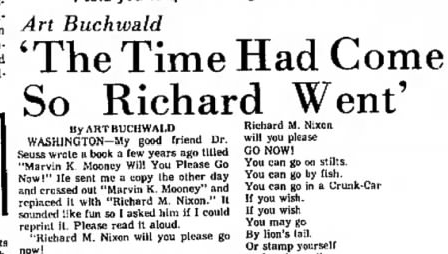
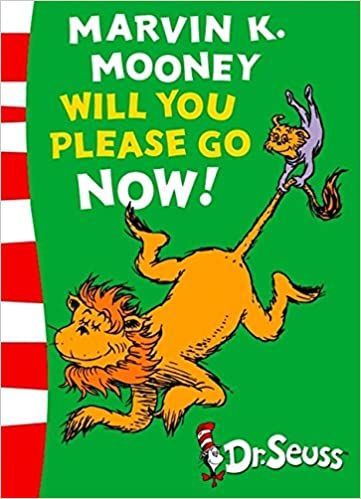
S. K. Orr recently posted a link to a particularly inspired Tucker Carlson monologue, under the heading "I, Too, Want To Encourage Brandon To Go." This rephrasing of the "Let's go, Brandon!" slogan made me think of the Dr. Seuss classic Marvin K. Mooney, Will You Please Go Now? -- and of the time-honored tradition of replacing the title character with the president of the United States.
"Marvin" put in an appearance in my recent Gene Hackman dream, in which Hackman plays a father interacting with his son in a series of short video clips. At first the son is called "Danny," and the Hackman character is angry (expressing that anger by means of minced oaths like "Gosh darn it!"); later, the son becomes "Marvin," and Hackman's tone changes to one of kind reassurance.
In my original post on the dream, I asked "Why Gene Hackman?" and offered some speculations, but I did not consider the two names of his "son."
When I hear the name Danny, the first association I make is with the song "Danny Boy," which begins thus:
O Danny boy, the pipes, the pipes are calling
From glen to glen and down the mountainside
The summer's gone and all the roses falling
'Tis you, 'tis you must go, and I must bide
So Danny and Marvin have this in common, that they must go. (After which "Danny Boy" stops just one consonant short of name-checking Slow Joe!)
In my 2009 post "The old savanna calling," I discuss "Danny Boy" (as modified by the Beatles) in connection with 9/11 prophecies. I link it both to the lion and to the 18th Tarot trump, the Moon. In the Seuss book, Marvin's last name is Mooney, and "by lion's tail" is suggested as one of the many ways in which he may "go." This even makes it onto the cover of some editions.
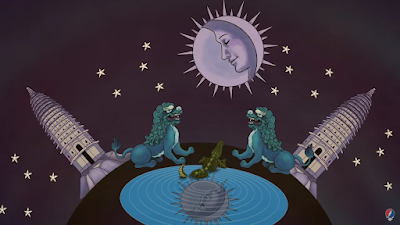
The "Let's go, Brandon!" phenomenon began on October 2, 2021. In the "Ripple" Tarot spread, October 2021 is represented by a modified version of the Moon card. Where the traditional Tarot card features two dogs, or a dog and a wolf, the "Ripple" version replaces them with (Chinese-style) lions.
As for the name Brandon itself, it apparently derives from a Celtic root meaning "crow, raven" (Slow Joe Crow). There is also the etymologically unrelated French word brandon, meaning a flaming torch, or a twist of straw or paper used to start a fire. This ties in with my "spontaneous human combustion" premonition, and with a dream in which Slow Joe is called "the Human Torch." There's also this interesting figurative meaning:
Personne, chose ou événement qui provoque des conflits, des querelles. Brandon de discorde, brandon de guerre, de guerre civile. Jeter le brandon de la discorde parmi les citoyens. Cet écrit est un brandon de guerre civile.
(In case your French is even worse than mine, a brandon can be a person or thing that provokes conflict, and the bolded phrase means "a brandon of civil war.")
Finally, I note that "Let's go, Brandon!" has become a way to curse without cursing, a way of implying a particular vulgar word without actually saying it. This ties in with the "Gosh darn it!" minced oaths of my Hackman dream.
"Just to be clear, this is not Jim Crow. This is more like Jim Crow's nicer, public health-defending cousin, John Crow. This is all about safety and science because we're the government and we care," said DeBlasio.
Jim Crow, John Crow, Joe Crow -- and then I remembered that Slow Joe himself had recently come out with his own new, more transmissible Jim Crow variant.
Biden’s bizarre quote has confused a lot of people who assumed that Jim Crow and Jim Eagle were two people. However, this isn’t the case.
Jim Eagle isn’t actually a real person. Joe Biden made up the name as a play on words, using different bird species to get his point across.
A crow is a small bird, whereas an eagle is far bigger and more dangerous.
What Biden was trying to say is that what the Republicans are trying to do with their voting legislation is huge, and far worse than that of the pre-Civil Rights Jim Crow era.
If you’re not familiar with what Jim Crow is, it’s a series of laws that enforced racial segregation in the United States.
Yeah, I'm pretty sure most people got that it was a play on words using different bird species -- and I'm also pretty sure that's not how "X makes Y look like Z" analogies work. If you want to express how big and dangerous something is, you might say it makes a lion look like a kitten -- not that it makes a kitten look like a lion!
I suspect that Slow Joe was thinking of eagles not as bigger and more dangerous than crows, but as more patriotic and all-American. He was trying to say that requiring ID to vote was so sinister and horrible that it made a sinister, horrible crow look like a majestic eagle by comparison.
He may also have been thinking of Sam Eagle, of Muppet Show fame, and misremembered the name.
Or maybe he was thinking of Larry Bird. I mean, with Biden who the hell knows?
I've just realized what the Jim Crow Jim Eagle thing reminds me of. This:
Reader Otto happened upon, and brought to my attention, this 2018 video by Peter Gregory Kelly.
It's very short. Here is a complete transcript:
In this dream, a crow had made its way into my house. And I thought, how did it get inside? It scraffled with the cat a bit, and in the scraffling, I got a few scratches on my arm. The crow seemed to want to stay inside. That was really very puzzling; why would the crow want to stay inside?
This is obviously very suggestive of the birdemic, referencing the name (the crow is Corvus corone, a member of the corvid family), the lockdowns ("want to stay inside," repeated twice), and the pecks ("a few scratches on my arm") -- plus, of course, the face mask that Mr. Kelly wears as he recounts all this!
The only element that doesn't immediately fit is the cat, so I tried to figure out what it could mean. Richard Arrowsmith had previously connected the birdemic with the 19th Tarot trump, called "The Sun." In light of the Chinese tradition of the Red Crows of the Sun, the card is basically called "Corvid 19." I therefore thought about cats and the Sun and came up with the 1965 Donovan song "The Summer Day Reflection Song," and its repeated line "Cat is . . . in the sun," with various participles (sleeping, walking, shifting, yawning, smiling) filling the ellipsis.
Looking up the lyrics online, I found that there were several slightly different versions posted and wondered which was official. This led me to search for donovan official website. This brought up the official Donovan Twitter account and its most recent tweet:
Donovan Sunshine Superman Album
Its stunning, Donovan was 19 when he recorded Sunshine Superman album!
How dare he be so cool 3 years from leaving school
Donovan was 19 when he recorded Sunshine Superman. (Oh, and I wrote a post on the 19th Tarot card called "Sunshine Superman.") Looks like I'm on the right track!
Looking up "The Summer Day Reflection Song," I found that it features corvids (rooks, Corvus frugilegus) as well as a cat.
Dragon kite in the sky Wheel and turn, spin and fly Attacked by rooks who never fail To cry the sound of fairy tales Cat is walking in the sun
The "dragon kite in the sky" also seems significant. In my post on Tintin and St. George, I mentioned that reader Mr. Andrew had drawn my attention to an Owen Benjamin podcast posted just before St. George's Day, with "George fights a dragon" in the title.
Mr. Andrew explained, "Owen's dog is named George (really) - and the dragon reference was just a kite. Has absolutely nothing to do w/ St. George (Catholic or Floyd variety) - just a little coincidence/synchronicity at the same time."
This verse of "The Summer Day Reflection Song" also seems apropos.
Marionette dangles dead Insensitivity is fed By the TV wizard's wand Whilst in the spell you're conned Cat is smiling in the sun
Marionette strongly suggests "Slow Joe Crow" Biden. I have linked Slow Joe with Robin Hood, in part because his middle name is Robinette -- and obviously Robinette Hood's better half would be Maid Marionette. A marionette is a puppet, and this one is controlled "by the TV wizard's wand." I have already linked Biden, in his Slow Joe Crow persona, with a mechanical puppet controlled by a magician with a wand.
I recently noted that the magician's name is Steve -- in Latin, Stephanus. The Latin Wikipedia entry for that name begins thus: "Stephanus est nomen et praenomen masculinum quod e verbo Graeco στέφανος, 'corona', vertitur." (That is, the name Stephen may be translated into Latin as Corona.)
There may be a cat link in Steve Martin's name as well. The marten (an animal of the weasel family) has historically been called the marten cat, and there has been some speculation that the "cats" domesticated by the Greeks and Romans were in fact martens.
Coming back to marionette, the most famous marionette in literature and popular culture is undoubtedly Pinocchio. In my original Slow Joe Crow post, I noted that Dr. Seuss character's resemblance to a plague doctor and to Slow Joe Biden, writing
Hats are passé now, as is the miasma theory of disease, but mutatis mutandis, the photo on the left below might as well be captioned "Joe Biden wearing a hat and telling a lie."
That "telling a lie" bit was a direct reference to Pinocchio: If Slow Joe's nose grew when he lied, like Pinocchio's, it would stretch out his Covid mask and make it look like a plague doctor's "corvid" mask.
Trying to think of more cat-sun connections, I thought of the 1971 Cat Stevens album Teaser and the Firecat. The name "Firecat" sounds solar, and the cat on the album cover is bright orange, like my own cat Q*Bert. And although I didn't notice it until just now, if a marten counts as a cat, then Cat Stevens is basically the same name as Steve Martin.
When Teaser and the Firecat was released, Cat Stevens wrote and illustrated a children's book of the same name as a promotional tie-in. In the story, the moon falls down from the sky and ends up "on a prickle-red-tree. Then out came five red owls and Teaser told them what had happened. The owls picked up the moon with their beaks, and they flung it into the starry sky." Problem solved.
Nothing Whitley Strieber about this picture!
This is so maddeningly close to being a hit! Instead of 10 red crows associated with the Sun, we have five red owls associated with the moon. Way to mess up the sync, Cat Stevens! Don't you know the sync fairies can't communicate clearly when you're on acid all the time? Anyway, they're still red birds from outer space.
And finally it's come to me, the answer to the riddle of Peter Gregory Kelly's dream. Where have I seen a cat and Slow Joe Crow together? Here:
In all fairness, that's not actually Slow Joe Crow hisself (it's Pogo; I have to say "hisself") but Deacon Mushrat. Still, with his hat, specs, and beak, he's certainly got the plague-doctor look. And who's that with him? Not just a cat, but an unelected "stick to facts" pretender-to-the-presidency cat named Simple J. Malarkey. Since Malarkey was intended as a caricature of Joe McCarthy (this was 1953), we can even assume the J stands for Joe.
Slow Joe is still being compared to a banjo player, one who is being secretly controlled by a hidden mechanism.
Asked an unchallenging question about 12-year-olds and vaccination, he drifted off in the middle of a sentence, and, as he so often does, looked down, got that Deliverance banjo player look on his face, and appeared to be listening to something in his earpiece, and then strung together a sequence of words that were not grammatically related to the rest of the sentence, but which, on their own, were coherent. As if repeating what he just heard.
This might be a good time to review my October 2020 post "Slow Joe Crow on the banjo," featuring His Joeness as a machine-operated banjo-pickin' corvid plague doctor under the control of a magician called either Steve ("crown," stephanos being the Greek equivalent of the Latin corona) or Maladie ("sickness").
Back in January, one of my readers contacted me to say that he had been encountering seemingly significant sequences of fives (55, 555, 5555, etc.) for years and asked if I had any idea as to what it might mean. Since then, we've been corresponding on and off, often but not exclusively about 5-related synchronicities.
Today my wife told me she had ordered five pairs of socks for me and that I needed to pick them up at the shop and pay for them. When I asked how much, she said, "I don't remember, 500-something." When I went to the shop, I found that the total was exactly $555.
Why is fox equal to 666? It comes from taking the system of Greek and Hebrew numerals, on which gematria is based, and applying it to English. The first nine letters have values from 1 to 9, the next nine are numbered from 10 to 90, and the remaining letters are assigned to the hundreds.
So I gave Fox in Socks a quick reread to see if anything new jumped out at me. Well, yes -- taking "new" and "jump out" quite literally.
This caught my attention because I had just got some new socks. Only later, after posting the gematria table above to show the reader how fox = 666, did I realize that by the same rules, new = 555.
⁂
Incidentally, the Greek-numeral equivalent of FOX is ϜΞΧ. Replacing O with Ξ (xi, three horizontal lines) was discussed in my old post, "Jay-Z in 2009 presages Biden and 2020." It also means Biden was adding the letter xi to his name in his logos, paralleling the nickname Xiden, used by his critics to suggest that he is a pawn of China.
⁂
Note: My title means (roughly) "Yes, that's just it!" in Spanish. It's pronounced S-O-C-K-S.
You've probably heard that some of Dr. Seuss's books have recently been "canceled" -- will no longer be published -- because of they supposedly "portray people in ways that are hurtful and wrong." This sort of thing is hardly news these days, and I'm certainly giving it several orders of magnitude more attention than it deserves -- but, well, I've certainly never let that stop me from posting anything!
One of these libri non grati (the only one I shall bother to discuss; life is, in the last analysis, short) is And to Think That I Saw It on Mulberry Street, originally published in 1937. Its crime is the inclusion of "a Chinaman who eats with sticks" among the other improbable things (a zebra, a brass band, the mayor, a man with a ten-foot beard, etc.) the main character imagines seeing on that street. This was apparently deemed offensive even back in 1978, when Seuss amended it to "a Chinese man" and altered the illustration slightly. Now even this bowdlerized version is deemed "problematic," so the whole book has been junked.
Why the changes in 1978? Okay, I guess Chinaman had somehow become offensive and was replaced with the more up-to-date Chinese man, even though the change messes up the rhythm a bit. (Did you know that technically "Chinese" is a racial epithet, which I'm pretty sure is bad, while "Chinaman" is a much less hurtful-sounding racial substantive? Not that anyone asked us grammarians. It's also still more common than the PC alternative, unlike other passé demonyms.)
But, setting the vocabulary to one side, why the changes to the illustration? The Chinese haven't worn queues (a style forced on them by their Manchu overlords) since the revolution of 1912, so that's just more updating -- but why is his skin now white instead of yellow?
Was it offensive to show him with yellow skin? Is it insulting to say or show that Chinese people aren't white -- you know, because white is the best skin color, and not having white skin is bad? Is that the logic here? Because I'm not sure what other explanation there can be.
Anyway, after those changes -- now that the gentleman from China is a proper post-revolutionary queueless one in whiteface -- what's the objection? Maybe the New York Times can explain it to us.
In “And to Think That I Saw It on Mulberry Street,” a character described as “a Chinaman” has lines for eyes, wears a pointed hat, and carries chopsticks and a bowl of rice. (Editions published in the 1970s changed the reference from “a Chinaman” to “a Chinese man.”)
Okay, lines for eyes. First of all, you might have noticed that the (non-Chinese) "big magician doing tricks" also has lines for eyes, as do most of the people on this page, because Seuss has drawn them as if they all have their eyes closed. But supposing he had drawn the person of Chinese ethnicity with less-round eyes than the other characters, why would that be offensive? Chinese people do in fact have epicanthic folds that make their eyes look narrower than those of Europeans -- is that bad? Is it ugly? Are European-looking eyes the best sort of eyes, so that to portray anyone with any other sort is an insult?
(Ironically, most of the Chinese women I know do think it's better to have round eyes and pale skin. Eyelid jobs are the most popular form of cosmetic surgery among the Chinese, and there's even a saying, 一白遮三醜, "one white covers three uglies.")
Pointed hat. Such hats really are worn by some Chinese (and other Asian) people, and I often see them even in modern-day Taiwan. Is there something shameful about wearing non-European headgear?
Chopsticks and a bowl of rice. I know it may come as a shock, but nearly every Chinese person I know eats rice from a bowl with chopsticks every single day. Is that a barbaric thing to eat? A barbaric way of eating it? Something to be ashamed of?
Look again at Seuss's Chinaman. Has he been made to look ugly? Sinister? Uncivilized? Animal-like? Does he have anything of the Yellow Menace about him? Is there anything at all negative in the way he has been portrayed? No, he simply looks different from the white characters -- a member of a different race and a different culture, wearing different clothes, eating different food in a different way. You know, diversity. That's what was found offensive.
If Mulberry Street were written today, the parade would feature people of a variety of skin colors, and perhaps sensitively subtle hints of other physical racial differences (nothing cartoonish, of course! Seuss's four-color palette would have to go), but these racial differences would not be allowed to correlate with any visible differences in culture, clothing, profession, or lifestyle. Perhaps the magician or one of the aldermen would happen to be Chinese, say, or black, but would be otherwise indistinguishable from a white magician or alderman. Oh, and at least one person would be in a wheelchair. This kind of superficial diversity is laudable. Failing that, the second best option -- as seen in Seuss's non-canceled books -- is for everyone to be white. Any diversity beyond the cosmetic, though? That's offensive, man.
⁂
By the way, these are the three jackasses responsible for starting the campaign to make sure all Dr. Seuss characters are white. I know they're functionally just interchangeable pseudopods of the Blob, but it's worth keeping in mind that they do in fact have names, faces, and moral agency.
Mike Curato, Lisa Yee, and Mo Willems hate the Chinese.
"foxes put the flowers on their feet to hide the sound of their footsteps" -- which makes them fox socks, not gloves
"it is very easy to get the amount wrong" -- proper dosage = temperance
Update: Less than an hour after posting this, I checked a young student's writing and found that he had misspelt "horses" as "hoses" -- "Do hoses run fast? Yes, they do."
This is another link to Fox in Socks: "Nose hose goes some, crow's rose grows some." In this post, I connect the nose in "nose hose" with rhino ("nose" in Greek) and mention that the rhino "belongs to the same order of mammals (Perissodactyla) as the donkey" -- and, though I did not mention it before, the horse.
Last night, two songs popped into my head. The first, the Pomplamoose rendition of "It's The End Of The World As We Know It," I posted; the second, I didn't, because I couldn't see its relevance: "Dear Prudence" as performed by Siouxsie and the Banshees.
This morning, I was reading a Taiwanese magazine for students of English and my attention was drawn to a full-page advertisement, all in Chinese except for a single English word that jumped out at me: Suzy.
At that exact moment, my phone informed me that I had just received an email, and I checked it:
Dear William,
Shortly after reading your post today, I was listening to CCR on youtube and the second song that came up was Suzie Q. I don't know how it fits in with the other synchronicities, but maybe it's relevant.
Is this an attempt by the synchronicity fairies to make me take Q seriously, something I have never done before? Or does the name Suzie/Suzy/Siouxsie have some specific relevance?
I thought of this.
Slow Joe is Biden, of course. When I first started thinking about Fox in Socks, I noticed that Sue and Crow suggest the Sioux and the Crow, two closely related American Indian tribes. This of course ties in with Siouxsie and the Banshees.
And then I thought of the Everly Brothers song that gives this post its title. I had been predicting before that Trump's victory would be finalized by January 10, but obviously that didn't happen.
Well, I told your mama that You'd be in by ten Well, Susie, baby Looks like we goofed again
But Susie still goes home, of course, just not on schedule.
I've already mentioned that the synchronicity fairies keep bringing the Jimmie Driftwood song "The Battle of New Orleans," as made famous by the Spectacular Johnny Horton in 1959, to my attention in connection with the ongoing electoral circus in America. (Remember "Shadilay"? This is this year's "Shadilay." I'm not sure yet how or why, but it is.)
Here, for a little variety, is the Nitty Gritty Dirt Band version:
I was taught this song in a public elementary school, which goes to show how much times have changed. Can you imagine kids today being taught a song that glorifies gun violence, cruelty to alligators, and so "problematic" a personage as Old Hickory?
Anyway, here's a first stab at an analysis.
First of all, we notice that singer who made the song famous was named Horton. Horton is also a Dr. Seuss character, an elephant, known for his repeated lines, "I meant what I said, and I said what I meant, and an elephant's faithful one hundred percent!" (Johnny Horton had not yet released his first album when Horton Hatches the Egg was published.)
. . . unlike the British at the Battle of New Orleans!
Johnny Horton used to perform the song in a period uniform, holding a musket with a flared mouth like a trumpet.
And now we come to the lyrics themselves.
We fired our guns and the British kept a-comin' There wasn't as many as there was a while ago We fired once more and they began to runnin' On down the Mississippi to the Gulf of Mexico
Fire has more than one meaning, but when Donald Trump says, "You're fired!" he's not talking about artillery. Couldn't "We fired our guns" mean "We terminated the employment of several top-level defense officials"?
"We fired once more and they began to runnin'" could mean, among other things, that the firing of some officials led others to resign of their own accord.
We looked down the river and we see'd the British come And there must have been a hundred of 'em beatin' on the drum They stepped so high and they made their bugles ring We stood behind our cotton bales and didn't say a thing
President Trump has stayed pretty quiet and played his cards close to his chest -- unlike his enemies, who have been beatin' on the drum and making their bugles ring.
Old Hickory said we could take 'em by surprise If we didn't fire our muskets till we looked 'em in the eye We held our fire till we see'd their faces well Then we opened up our squirrel guns and really gave 'em -- Well . . .
To look someone in the eye is to tell him the truth, or to challenge him to tell you the truth.
"We held our fire till we see'd their faces well" means we waited for all our enemies to identify themselves and show their hand before striking.
We fired our cannon till the barrel melted down So we grabbed an alligator and we fought another round We filled his head with cannonballs 'n' powdered his behind And when we touched the powder off, the gator lost his mind
Finding a way to fight another round even after your cannon has melted means continuing to fight even when everyone is saying you've already lost.
An allegator is one who makes allegations. (Alligator is etymologically el lagarto, "the lizard"; I'll let David Icke handle that one!)
An email correspondent of mine brought it to my attention some weeks ago that the first of the daily Mass readings for December 14, 2020 (the day the electoral college votes in the U.S.) is from Numbers 24, the story of Balaam being called upon to curse the Israelites but blessing them instead -- the implication being that, if the synchroncity fairies have anything to do with it, the electoral college might similarly "disappoint."
Following the link from the Mass readings website, I read the chapter in the Douay-Rheims version, a translation with which I am not at all familiar. (Mormons are King James readers.) The reading is only vv. 2-7, 15-17a, but I quote some of the context as well.
[1] And when Balaam saw that it pleased the Lord that he should bless Israel. he went not as he had gone before, to seek divination: but setting his face towards the desert,
[2] And lifting up his eyes, he saw Israel abiding in their tents by their tribes: and the spirit of God rushing upon him,
[3] He took up his parable and said: Balaam the son of Beor hath said: The man hath said, whose eye ire stopped up:
[4] The hearer of the words of God hath said, he that hath beheld the vision of the Almighty, he that falleth, and so his eyes are opened:
[5] How beautiful are thy tabernacles, O Jacob, and thy tents, O Israel!
[6] As woody valleys, as watered gardens near the rivers, as tabernacles which the Lord hath pitched, as cedars by the waterside.
[7] Water shall flow out of his bucket, and his seed shall be in many waters. For Agag his king shall be removed, and his kingdom shall be taken awry.
[8] God hath brought him out of Egypt, whose strength is like to the rhinoceros. They shall devour the nations that are his enemies, and break their bones, and pierce them with arrows.
[9] Lying down he hath slept as a lion, and as a lioness, whom none shall dare to rouse. He that blesseth thee, shall also himself be blessed: he that curseth thee shall be reckoned accursed.
[10] And Balac being angry against Balaam, clapped his hands together and said: I called thee to curse my enemies, and thou on the contrary hast blessed them three times.
[11] Return to thy place. I had determined indeed greatly to honour thee, but the Lord hath deprived thee of the honour designed for thee.
Why have I highlighted the bit about the rhinoceros? It caught my eye partly because of its unfamiliarity -- the King James has unicorn, and I believe the animal intended by the author was the aurochs -- but also because rhinoceroses had been on my mind recently for other reasons.
My recent Robin Hood post begins with a simplification of my actual train of thought. I said the story of Samson and the fiery foxes made me think of the brower Firefox, which in turn made me think of a fox firing an arrow. In fact, I got as far as Firefox and then got stuck. The sync fairies had to bring the Disney Robin Hood movie to my mind by other means.
I was thinking about songs that presage 2020 -- for example, the Beach Boys song "Time To Get Alone," from the 1968 album 20/20, featuring the refrain "Away from the people / And safe from the people." One of the songs I thought of was the 2005 They Might Be Giants song "I Never Go To Work" ("On Monday, I never go to work / On Tuesday, I stay at home . . ."). Besides the obvious 2020 theme of staying home and not going to work, it's also about practicing the trumpet every day and thus connects to Trump. The music video shows the main character staying home and practicing the trumpet in defiance of his boss, who is a rhinoceros.
This made me think of the "rhino guards" in the Disney Robin Hood film, and it was only then that I made the connection between Firefox and a fox firing an arrow.
I haven't seen that movie since I was tiny, but those rhino guards have stuck with me -- so much so that, the first time I saw a red turtle dove, its strange combination of gray and pink made me think of them.
⁂
RINO is a widely understood acronym for Republican in Name Only -- used by members of that party as a pejorative for fellow party members with whom they disagree. It predates the Trump era, and has even been applied by the GOP establishment to Trump himself, but it is currently used most often by Trump and his supporters with reference to the anti-Trump wing of the party.
The acronym is an apt one because the rhinoceros, though superficially resembling an elephant, in fact belongs to the same order of mammals (Perissodactyla) as the donkey.
Rhinoceros means "nose-horn" in Greek -- so the abbreviated form rhino is literally just "nose." (The omission of the holy letter H is also significant!) This suggests an additional meaning for the line "Fox sews hose on Slow Joe Crow's nose."
Remember what the Grinch did when he needed a reindeer? He used some thread to attach a big horn to the top of his dog's head.
Well, by the same logic, how would you "make" an elephant? By sewing a hose to some other animal's nose, of course. As discussed before, Fox is the news media and Slow Joe is Slow Joe. "Slow Joe Crow's nose" means nominal Republicans (RINO = rhino = nose) who are in fact on Slow Joe's side rather than Trump's. (A trump is a horn. Rhino is rhinoceros with the part meaning "horn" removed.) The media sews a hose to their nose (yes, the word nose is doing double duty here), presenting them as "real" Republicans.
Having just recently connected Fox in Socks with Men in Tights, I realize that the word hose can also mean "hosiery" -- tights, socks, and such.
⁂
Note: The TMBG video ends with the rhino boss agreeing to play the trumpet in spite of himself. Make of that what you will.
My last post ended with Samson tying firebrands to the tails of foxes, which made me think of the browser Firefox. And this made me think of the other meaning of the word fire.
And that's when I realized that tights are a kind of socks.
I had previously connected Fox in Socks with Joe Biden (see my posts Slow Joe Crow and Lots of new blue goo now), so you can well imagine that it came as something of a shock to suddenly realize that not only is Biden's middle name Robinette, but his two sons are called Beau and Hunter.
Well, shoot! What are the chances of a bull's-eye like that?
All three Biden men are alumni of Archmere Academy. The school's colors are deep ("lincoln"?) green and white, and the school newspaper is called The Green Arch.
Archmere is a Catholic school, and the Bidens are nominally Catholic -- "Mary men," you might say.
Biden's 2020 campaign logo was notable for omitting the letter E, replacing it with speed lines suggesting that the D had zoomed in from somewhere else.
And perhaps Biden thinks of himself as a Robin Hood figure: He knows he's stealing, but he also thinks he's a hero for doing so. I'm referring to the election, of course, but the "Robin Hood" project of stealing from the rich and giving to the poor is also something one associates with the Left.
I have connected Fox in Socks with the Red Sun and with Betelgeuse -- which, it occurred to me, is connected with archery because it is in the constellation Orion the Hunter. It turns out, though, that Orion isn't actually an archer; the part of the constellation that looks like a bow is "officially" either a shield or a lion.
Or both!
However, running a Google image search for betelgeuse archer did turn this up -- from, of all places, the white nationalist site Stormfront.
It's a comment on a thread called "Giant star Betelgeuse (or 'Beetlejuice') is dimming & changing shape." (I have no idea why this astronomical topic was being discussed on a political "hate" site; there is nothing about politics or race or anything in the entire thread.) The comment, posted on February 19 of this year, reads: "If Betelgeuse explodes tomorrow it only means it actually exploded on a day 650 years ago, during the age when England still fought with bows and arrows" -- with, in case the meaning were not clear, a very large picture of some Englishmen doing just that.
It seems a strange thing to zero in on. The point is simply that Betelgeuse is very far away (642.5 light years) and that anything we observe happening to Betelgeuse actually happened hundreds of years ago. Any historical figure or event or outdated technology would have served to make the point, but the poster chose to focus on archery, and specifically archery in England. The 14th century is, of course, around the time the Robin Hood legend began to become popular.
Bringing this all back to the Sun card, note that Robin Hood is classically depicted -- in the Disney film and Men in Tights, for example -- with a large, often red, feather in his cap. The rider on the white horse on the Rider-Waite card wears the same ornament.
Rider, wait!
I have connected this rider with the first horseman of the Apocalypse: "And I saw, and behold a white horse: and he that sat on him had a bow; and a crown was given unto him: and he went forth conquering, and to conquer" (Revelation 6:2).
⁂
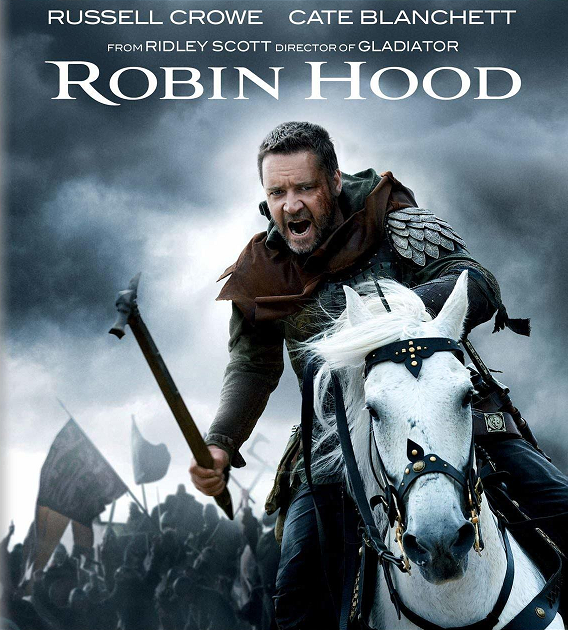
Note added: I'm not sure how I could possibly have missed this before! I've just connected the rider on the white horse with Robin Hood, in part because of the red feather he wears. In my post Red crows of the Sun, I connected that feather with what it says on the tin: legendary red crows associated with the Sun in Chinese folklore. How could it have escaped my notice that there is a Robin Hood movie in which Hood rides a white horse and is played by an actor whose name literally means Red Crow?
Russell means "red." Crowe means "crow." This isn't just a bull's-eye; this is splitting an arrow on the bull's-eye!
(Incidentally, it's really possible to do that. The famed "Robin Hood shot" has been duplicated three times by a kid from South Dakota with the ridiculously appropriate name Mike Merriman.)